Arbitration Agreements in Employment Contracts After the Epic - - PowerPoint PPT Presentation

arbitration agreements in employment contracts after the
SMART_READER_LITE
LIVE PREVIEW

Arbitration Agreements in Employment Contracts After the Epic - - PowerPoint PPT Presentation

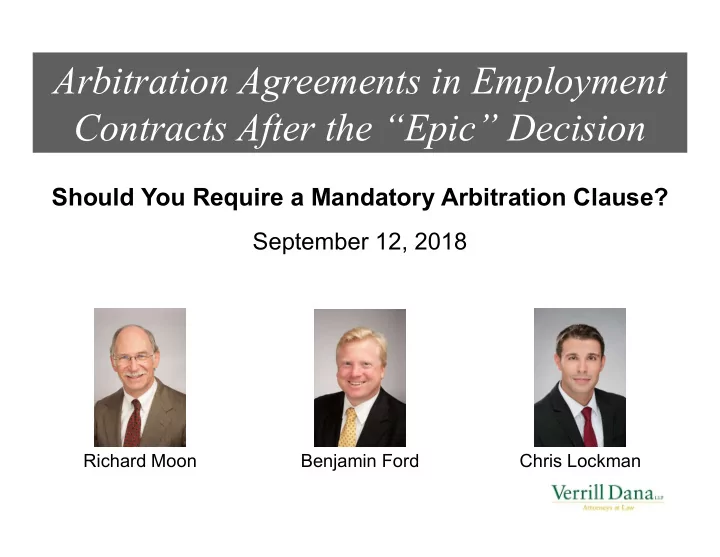
Arbitration Agreements in Employment Contracts After the Epic Decision Should You Require a Mandatory Arbitration Clause? September 12, 2018 Richard Moon Benjamin Ford Chris Lockman Background Federal Arbitration Act of 1925

slide-1
SLIDE 1

Arbitration Agreements in Employment Contracts After the “Epic” Decision

Should You Require a Mandatory Arbitration Clause?

September 12, 2018

Richard Moon Benjamin Ford Chris Lockman

slide-2
SLIDE 2

Background

  • Federal Arbitration Act of 1925 (“FAA”) passed

to address hostility to private arbitration

  • “A liberal federal policy favoring arbitration

agreement”

  • FAA “savings clause” invalidates arbitration

agreements when the contract itself is not valid

  • A contract can be invalid because

– It was obtained by fraud – It was obtained by coercion – It is illegal

slide-3
SLIDE 3

Question

If a contract seeks to waive a legally protected right, does that make it illegal?

slide-4
SLIDE 4

Question

If it is illegal, does that make the arbitration clause invalid?

slide-5
SLIDE 5

Answer

Yes (Ordinarily)

slide-6
SLIDE 6

Class Action

  • Make smaller claims more

economically justified by combining with other claims

  • Companies held

accountable for many small

  • ffenses
  • Form of private, non-

government regulation

  • Settlements can guarantee

total peace to defendants

  • Individual plaintiffs and

class members see little relief

  • Lawyers are the only ones

who benefit

  • Fear of litigation can stifle

innovation

  • Plaintiff’s lawyers can be

tempted to sell you non- participating class members

Pros Cons

slide-7
SLIDE 7

History

Class Action Waivers in Warranty and Service Contracts ATT v. Conception

  • NY State law prohibited as “unconscionable”

class action waivers in certain contracts

  • Plaintiffs argued that NY law made the waiver

illegal and therefore under the savings clause, the arbitration provisions were not enforceable

  • U.S. Supreme Court held that savings clause

did not apply to specific state laws affecting arbitration

slide-8
SLIDE 8

Epic Systems v. Lewis

  • Multiple cases consolidated into one
  • Junior accountant signs employment agreement

with a clause saying that he agrees to arbitrate claims “that could otherwise be decided by a court”

  • Plaintiff leaves his job and brings a class action

against his employer for misclassifying junior accountants as salaried employees

  • NLRA prohibits employers from barring

employees from engaging in “concerted activity.”

slide-9
SLIDE 9

Epic Systems v. Lewis

  • Employer sought to enforce the arbitration

agreement that prohibited class actions

  • Employee argued NLRA’s “concerted activity”

language made the arbitration agreement illegal and therefore unenforceable under the savings clause

slide-10
SLIDE 10

Class Action Waiver Held Enforceable in Employment Claims in Epic U.S. Supreme Court Decision July, 2018

Justice Gorsuch, writing for the majority, reasoned:

  • FAA was passed before the FLSA and the NLRA
  • FLSA and the NLRA say nothing about waivers of

collective action and certainly do not prohibit waivers on the part of employees

  • As in Conception, savings clause of the FAA does

not apply to specific statutes, but instead only applies to provisions that would make ANY contract illegal such as fraud or duress

slide-11
SLIDE 11

Dissent by Justice Ginsburg

  • All laws must be read in context of situation
  • NLRA protects certain rights – “collective rights”
  • Direct conflict – so savings clause applies
  • Intent of the law was not to preempt sensible

and fair claims through class actions

‒ Arbitration essentially prohibits relief for small injuries – even illegal failure to pay required wages

slide-12
SLIDE 12

Question

Are Mandatory Arbitration Waivers of Class Actions and Other Types of Claims Before a Court Right for You?

slide-13
SLIDE 13

Perceived Benefits of Arbitration

  • The parties can choose deadlines, pace, and

rules of the litigation, especially discovery

  • Pleadings, evidence, and results can be kept

confidential

  • The parties choose the identity and number of

arbitrators

  • Often reach resolution faster and cheaper (but not

always)

  • Employer may be able to limit forms of relief
  • Lessens the burdens on publically funded court

system

slide-14
SLIDE 14

Perceived Disadvantages of Arbitration

  • Depending upon arbitration decisions on process,

can end up costing just as much as litigating in court

  • “Precedent” is weak and the outcome

predictability is less certain

  • You have to pay the arbitrators
  • Arbitrators may be able to exercise fairly broad

discretion on process

  • Appeal rights significantly limited
  • Still expect a fight around a motion to compel

arbitration

slide-15
SLIDE 15

Issues in Arbitration Clauses

  • When to implement
  • What claims are covered

‒ Discrimination – any exemptions ‒ Retaliation ‒ Class actions

  • Mandatory mediation
  • Who pays for what
  • How are arbitrators chosen
  • Procedures in the arbitration

‒ Discovery ‒ Witnesses ‒ Decisions ‒ Relief

slide-16
SLIDE 16

How Do I Decide?

  • Conflict history
  • Types of conflicts
  • Cost history
  • Outcome history
  • Internal capabilities
  • Are you insured for the most common claims

‒ Size of deductible

  • What is the competition doing
  • What will be the reaction of the work force

‒ Do you cover everyone

slide-17
SLIDE 17

How Does Mandatory Arbitration Work for ERISA Claims?

ERISA Claims – Generally

  • Claim for benefits [§ 502(a)(1)(B)]
  • Claim for breach of fiduciary duty [§ 502(a)(2)]
  • Claim for equitable relief [§ 502(a)(3)]
slide-18
SLIDE 18

FAA and ERISA

  • Most courts agree that agreements to arbitrate

ERISA claims are enforceable BUT tension exists:

– DOL Regulations limit mandatory arbitration for group health plans and plans providing for disability benefits – Munro v. Univ. of S. California, 896 F.3d 1088 (9th

  • Cir. 2018)
  • A breach of fiduciary duty claim under Section

409(a) of ERISA is outside the scope of an arbitration clause in an employment contract requiring parties to arbitrate claims an employee may have against her employer

slide-19
SLIDE 19

Disadvantages and Limits of Arbitration of ERISA Claims

  • Advantages are largely the same as perceived

benefits of arbitration in general employment litigation

– E.g. parties control flow of the case, confidentiality, cost, etc.

  • Disadvantages somewhat unique to type of claim:

– Claim for benefits [§ 502(a)(1)(B)]

  • Benefits are similar to perceived benefits of arbitration in general

employment litigation

  • DOL Regulations limit cost sharing
  • Potential loss of Firestone deference
  • Potential for expanded discovery
  • Inadvertent class creation

– Claim for breach of fiduciary duty [§ 502(a)(2)]

  • Potential struggle to enforce provision
  • Limited chance for reversal of erroneous decision
slide-20
SLIDE 20

Q&A

Thank You

Richard Moon

rmoon@verrilldana.com

Chris Lockman

clockman@verrilldana.com

Benjamin Ford

bford@verrilldana.com