APPC Academic Program Prioritization Ad Hoc Committee Sy Adler - - PDF document

appc
SMART_READER_LITE
LIVE PREVIEW

APPC Academic Program Prioritization Ad Hoc Committee Sy Adler - - PDF document

APPC Academic Program Prioritization Ad Hoc Committee Sy Adler Talya Bauer Samuel Henry Sy


slide-1
SLIDE 1

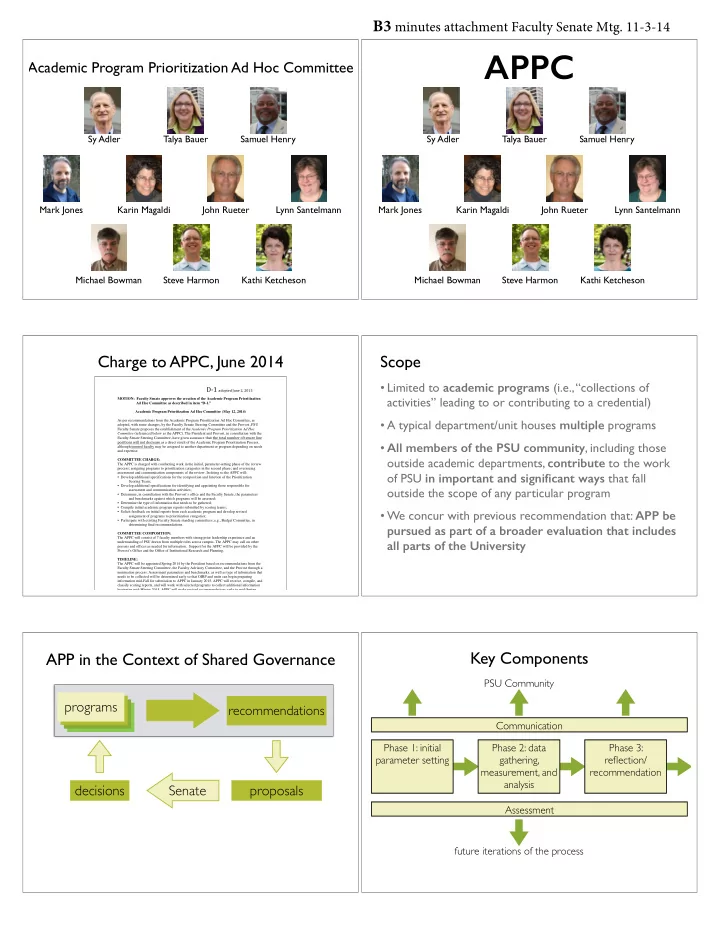
Sy Adler Talya Bauer Samuel Henry Mark Jones Lynn Santelmann John Rueter Karin Magaldi Michael Bowman Steve Harmon Kathi Ketcheson

Academic Program Prioritization Ad Hoc Committee

APPC

Sy Adler Talya Bauer Samuel Henry Mark Jones Lynn Santelmann John Rueter Karin Magaldi Michael Bowman Steve Harmon Kathi Ketcheson

Charge to APPC, June 2014

! !

D#1!adopted!June!2,!2015!

MOTION: Faculty Senate approves the creation of the Academic Program Prioritization Ad Hoc Committee as described in item “D-1.” Academic Program Prioritization Ad Hoc Committee (May 12, 2014) As per recommendations from the Academic Program Prioritization Ad Hoc Committee, as adopted, with some changes, by the Faculty Senate Steering Committee and the Provost, PSU Faculty Senate proposes the establishment of the Academic Program Prioritization Ad Hoc Committee (referenced below as the APPC). The President and Provost, in consultation with the Faculty Senate Steering Committee, have given assurance that!the!total!number!of!tenure!line! positions!will!not!decrease!as a direct result of the Academic Program Prioritization Process, although tenured faculty may be assigned to another department or program depending on needs and expertise. COMMITTEE CHARGE: The APPC is charged with conducting work in the initial, parameter-setting phase of the review process; assigning programs to prioritization categories in the second phase; and overseeing assessment and communication components of the review. In doing so the APPC will:

  • Develop additional specifications for the composition and function of the Prioritization

Scoring Team;

  • Develop additional specifications for identifying and appointing those responsible for

assessment and communication activities;

  • Determine, in consultation with the Provost’s office and the Faculty Senate, the parameters

and benchmarks against which programs will be assessed;

  • Determine the type of information that needs to be gathered;
  • Compile initial academic program reports submitted by scoring teams;
  • Solicit feedback on initial reports from each academic program and develop revised

assignment of programs to prioritization categories;

  • Participate with existing Faculty Senate standing committees, e.g., Budget Committee, in

determining final recommendations. COMMITTEE COMPOSITION: The APPC will consist of 7 faculty members with strong prior leadership experience and an understanding of PSU drawn from multiple roles across campus. The APPC may call on other persons and offices as needed for information. Support for the APPC will be provided by the Provost’s Office and the Office of Institutional Research and Planning. TIMELINE: The APPC will be appointed Spring 2014 by the President based on recommendations from the Faculty Senate Steering Committee, the Faculty Advisory Committee, and the Provost through a nomination process. Assessment parameters and benchmarks, as well as type of information that needs to be collected will be determined early so that OIRP and units can begin preparing information mid-Fall for submission to APPC in January 2015. APPC will receive, compile, and classify scoring reports, and will work with selected programs to collect additional information beginning mid-Winter 2015. APPC will make revised recommendations early to mid-Spring

Scope

  • Limited to academic programs (i.e., “collections of

activities” leading to or contributing to a credential)

  • A typical department/unit houses multiple programs
  • All members of the PSU community, including those
  • utside academic departments, contribute to the work
  • f PSU in important and significant ways that fall
  • utside the scope of any particular program
  • We concur with previous recommendation that: APP be

pursued as part of a broader evaluation that includes all parts of the University

APP in the Context of Shared Governance

recommendations

programs programs programs programs decisions proposals Senate

Key Components

Phase 1: initial parameter setting Phase 2: data gathering, measurement, and analysis Phase 3: reflection/ recommendation Assessment future iterations of the process Communication PSU Community

slide-2
SLIDE 2

DRAFT Criteria, Metrics, and Questions

DRAFT Criteria, Metrics, and Questions for the Academic Program Prioritization Process at PSU

Academic Program Prioritization Committee (APPC) Draft to Faculty Senate, November 3, 2014

Introduction

This document proposes a set of six high­level criteria, together with associated metrics (capturing quantitative data) and questions (capturing qualitative data), for use within the academic program prioritization (APP) process at PSU. These items are shared here in a draft, incomplete form that we hope will stimulate and focus a productive conversation as the APPC, the Senate, and the faculty as a whole work together to finalize the parameters of the APP

  • process. We welcome and strongly encourage any feedback that will help to improve the draft

set of parameters described here.

Scope

The scope of the APP process is limited, by the charge to the APPC, to consideration of academic programs, which are defined as collections of activities that consume resources and either contribute transcripted courses to a credential or else lead directly to a credential. As such, a single academic unit or department may house multiple programs, such as one or more bachelors, masters, doctoral, or certificate programs, for example. We recognize that members

  • f the PSU community are engaged in many activities that contribute in important and significant

ways to the work of the university but fall outside the immediate scope of any particular academic program, and hence outside the scope of APP. This includes some of the activities within academic units and departments as well as all other parts of the university, including centers, institutes, student services, facilities, and administrative units. We concur with and repeat the observation in the previous APPC committee’s final report that a review that extends to include all of these activities would require the development and use of evaluation procedures and criteria that may be different from those used in APP. For this reason, we also agree with the previous committee’s recommendation that academic program prioritization be pursued as part of a broader evaluation that includes all parts of the University.

Timeline

In keeping with the charge to APPC, it is our goal to finalize the selection of criteria and associated metrics and questions for this iteration of APP before the end of Fall 2014. As a result of interactions with other ongoing, university­wide projects, we expect that this timeline will allow us: (1) to consider and refine the selection of criteria in light of potential revisions to the University’s mission statement resulting from Strategic Planning; and (2) to use work that is

Draft, incomplete, proposed, …
 Feedback strongly encouraged!

Proposed Criteria

  • Demand, including both internal (within PSU) and

external

  • Quality, of program inputs and outcomes
  • Productivity, taking considerations of size and scope

into account

  • Financial Performance, including revenue and costs
  • Relation to Mission, including contributions to

knowledge, scholarship, and community engagement

  • Trajectory, including past history and future
  • pportunities

Metrics and Questions

  • Quantitative metrics and qualitative questions are

needed:

  • to identify specific data that will be needed/used in the

APP scoring process

  • to clarify and explain the meaning of each criterion in

more concrete terms

  • Numeric data alone will not capture important details of

context and nuance that are needed to document and understand the contributions of each program

Critical Challenges and Goals

  • Select metrics and questions (and develop associated

scoring instruments) such that a consistent, rigorous approach can be applied uniformly across all programs

  • Data collection will impose a burden on program

administrators; we need to minimize this!

  • Eliminate unnecessary metrics/questions
  • Leverage OIRP and other sources where possible
  • Provide clear, strong guidance on what is expected for

remaining items

Current Status

  • We recognize that the formulations in the current draft

DO NOT MEET these standards

  • Commitment: No data collection will begin until these

issues have been resolved, and until the rubrics or other scoring instruments have been developed and shared with the campus community

Other Considerations

  • Previous committee proposed that data for APP be

provided for a spread of three years

  • Some data can only be provided at the unit/department

level: it will provide a context but not a direct match for evaluating programs

  • We must be sensitive to discipline-specific standards,

expectations, and natural variations between programs

  • Data from SEM Planning will be available to programs in

timeframe for data collection

  • Strategic planning: revised mission in near term
slide-3
SLIDE 3

Examples from the Document From Proposals to Parameters

  • Add what is missing, remove what is unnecessary, clarify

what remains

  • This applies to criteria as well as metrics and questions:
  • Example: should there be a new criterion (i.e., column)

for “Research, Scholarly, and Creative Work”?

  • The table already includes some metrics and questions

that address this particular topic

  • Adding a new column provides a way to recognize this

component of the work of our academic programs

  • What do you think?

Next Steps

  • We are keen to receive your feedback on the criteria,

metrics and questions

  • Finalize the choices for this iteration of APP before the

end of this term

  • Public forum, tentative date: Monday, November 24

  • In the meantime, APPC is focussing on scoring:
  • Development of scoring instruments, rubrics, etc.
  • Appointment of program scoring team members

mpj@pdx.edu appc-discuss@lists.pdx.edu

Contact address for comments and feedback:


 (website coming soon)

still