Apixaban versus Heparin/Vitamin K Antagonist in Anticoagulation-nave - - PowerPoint PPT Presentation

apixaban versus heparin vitamin k antagonist in
SMART_READER_LITE
LIVE PREVIEW

Apixaban versus Heparin/Vitamin K Antagonist in Anticoagulation-nave - - PowerPoint PPT Presentation

Apixaban versus Heparin/Vitamin K Antagonist in Anticoagulation-nave Patients with Atrial Fibrillation Scheduled for Cardioversion: The EMANATE Trial Michael D. Ezekowitz, Professor, Sidney Kimmel Medical College at Thomas Jefferson


slide-1
SLIDE 1

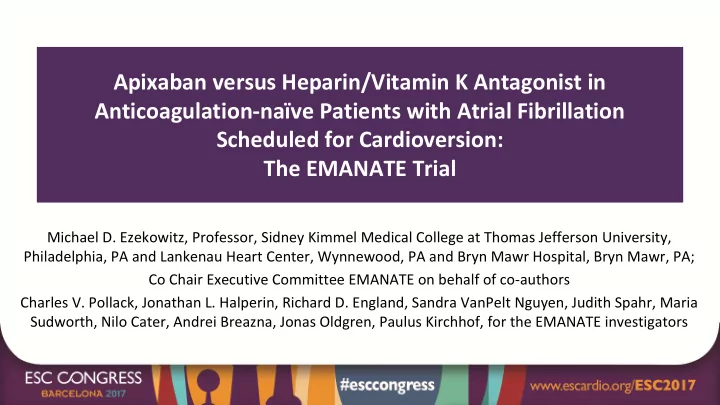
Apixaban versus Heparin/Vitamin K Antagonist in Anticoagulation-naïve Patients with Atrial Fibrillation Scheduled for Cardioversion: The EMANATE Trial

Michael D. Ezekowitz, Professor, Sidney Kimmel Medical College at Thomas Jefferson University, Philadelphia, PA and Lankenau Heart Center, Wynnewood, PA and Bryn Mawr Hospital, Bryn Mawr, PA; Co Chair Executive Committee EMANATE on behalf of co-authors Charles V. Pollack, Jonathan L. Halperin, Richard D. England, Sandra VanPelt Nguyen, Judith Spahr, Maria Sudworth, Nilo Cater, Andrei Breazna, Jonas Oldgren, Paulus Kirchhof, for the EMANATE investigators

slide-2
SLIDE 2

Disclosures

  • Michael D. Ezekowitz has received consulting fees from

Boehringer Ingelheim, Armetheon, Pfizer, Sanofi, Bristol- Myers Squibb, Portola, Daiichi-Sankyo, Medtronic, Johnson & Johnson, and Janssen Scientific Affairs; grant support from Boehringer Ingelheim, Pfizer, and Bristol-Myers Squibb

  • Co-PI PETRO, RE-LY, X-VeRT, EMANATE; Executive Committee

ENSURE-AF, ENGAGE-AF.

slide-3
SLIDE 3

Background

  • The goal of anticoagulation in the setting of cardioversion is to prevent

stroke and systemic embolism without causing bleeding.

  • Post hoc analyses of cardioversions in the RE-LY, ARISTOTLE, ROCKET-AF

and ENGAGE-AF trials found low event rates .1-4 A limitation was the prolonged period of pre-cardioversion anticoagulation.

  • To evaluate more immediate cardioversion , prospective trials

comparing rivaroxaban (X-VeRT)5 and edoxaban (ENSURE-AF)6 against heparin/VKA in patients undergoing cardioversion found comparable efficacy and safety with low event rates.

  • 1. Nagarakanti R, Ezekowitz M, et al. Circulation. 2011;123:131-136. 2. Flaker G, et al. J Am Coll Cardiol. 2014;63:1082-1087. 3.

Piccini JP, et al. J Am Coll Cardiol. 2013;61:1998-2006. 4. Plitt A, et al. Clin Cardiol. 2016;39:345-346. 5. Cappato R, Ezekowitz M, et al. Eur Heart J. 2014;35:3346-3355. 6. Goette A, et al. Lancet. 2016;388:1995-2003.

slide-4
SLIDE 4

Objectives of EMANATE

  • To prospectively compare the outcomes of stroke, systemic embolism,

major bleeding, and clinically relevant non-major (CRNM) bleeding in patients with < 48 hrs anticoagulation who were randomized to apixaban or heparin/VKA in an open-label trial with blinded endpoint adjudication.

  • To gain insight into the role of image guidance.
  • To assess the value of a loading dose of apixaban in patients rapidly

transitioned to cardioversion.

slide-5
SLIDE 5

Key Eligibility Criteria

Key Inclusion Criteria Key Exclusion Criteria §Anticoagulation-naïve patients with AF ( <48 hours of parenteral and/or

  • ral anticoagulation) indicated for

cardioversion. §Contraindications to apixaban or heparin/VKA §Mitral stenosis or previous valve surgery §Other conditions requiring anticoagulation §Dual antiplatelet therapy

slide-6
SLIDE 6

Study Design

Heparin/VKA (usual care)

Apixaban 5.0 mg twice daily (2.5 mg BID if down-titrated)

Cardioversion

If cardioverted follow up was 30+/- 7 days

Screening/ randomization

1:1 If not cardioverted follow up was 90 days

Treatment begins Imaging

slide-7
SLIDE 7

Apixaban Loading Dose Option

  • In patients randomized to apixaban, cardioversion could be performed

2 hours after a loading dose of 10 mg (reduced to 5 mg if 2 of the following present: age ≥ 80, weight ≤ 60 kg, serum creatinine ≥ 1.5 mg/dl [133 micromol/L).

slide-8
SLIDE 8

Patient Disposition (ITT Population)

Randomized (N=1500)

* No outcome events occurred. Apixaban (n=753) Heparin/VKA (n=747)

Died (n=2) Completed follow-up (n=736, 97.7%) Withdrew consent: refused follow-up* (n=15, 2.0%) Mean Follow-up from randomization to withdrawal was 29 days, range 1-83 days Died (n=1) Lost to follow-up (n=1) Completed follow-up (n=730, 97.7%) Withdrew consent, refused follow-up* (n=15, 2.0%) Mean Follow-up from randomization to withdrawal was 23 days, range 1-81 days Lost to follow-up (n=0)

slide-9
SLIDE 9

Key Baseline Patient Demographics

Apixaban Heparin/VKA All (n=753) 5-mg loading dose (n=11) 10-mg loading dose (n=331) (n=747) Age, years, mean (SD) 64.7 (12.2) 80.5 (7.4) 63.2 (12.2) 64.5 (12.8) Sex, female, n (%) 248 (32.9) 4 (36.4) 123 (37.2) 250 (33.5) Race, white, n (%) 654 (86.9) 10 (90.9) 322 (97.3) 648 (86.7) Weight, kg, mean (SD) 87.9 (20.6) 69.1 (15.5) 90.2 (21.0) 86.3 (19.8) Hypertension, n (%) 496 (65.9) 9 (81.8) 221 (66.8) 481 (64.4) LVEF <40, n (%) 45 (6.0) 21 (6.3) 54 (7.2) Diabetes, n (%) 154 (20.5) 1 (9.1) 75 (22.7) 140 (18.7) CHA2DS2-VASc score, mean (SD) 2.4 (1.7) 4.4 (1.8) 2.3 (1.7) 2.4 (1.7) Creatinine clearance, mL/min, mean (SD) 79.2 (50.6) 41.0 (13.4) 91.7 (52.1) 78.5 (49.0)

slide-10
SLIDE 10

Stroke/Systemic Embolic Outcomes

One patient’s adjudicated stroke date was one day prior to randomization; thus at Day 0, only 1499 were at risk for stroke. No patients had SE. ITT population. SE = systemic embolism

Number at risk Apixaban 199 55 Heparin/VKA 231 88

Time to stroke/SE (days) 30 60 90 0.020 0.010 0.015 0.005 0.000 Proportion of patients with stroke/SE Apixaban (events: 0/753) Heparin/VKA (events: 6/747)

  • 5 ischemic, 1 hemorrhagic stroke with 0 systemic embolic events

752 747 6145 65

P=0.0164

slide-11
SLIDE 11

Safety Outcomes (Safety Population*, N=1456)

Apixaban Total (n=735)

Apixaban Loading Dose Subset (n=342)

Heparin/VKA Total (n=721) Major bleeds 3

(1)

6 Clinically relevant non-major bleeds 11

(4)

13

*Randomized and received > 1 dose of study medication (by treatment received).

slide-12
SLIDE 12

Actual treatment

Heparin/VKA (n=31)

Thrombus-present (First Image) (n=61) complete follow up , no outcome events

Apixaban (n=30) Heparin/VKA (n=1) Apixaban (n=29) Heparin/VKA (n=31)

Image-Guided Strategy (n=840)

Thrombus (+) (n=8/18) Thrombus (–) (n=10 /18) No further imaging (n=13) No further imaging (n=1) Thrombus (+) (n=11/23) Thrombus (-) (n=12/23) No further imaging (n=6)

2nd View

Repeat Imaging was 37 + 9 days (mean +/-!SD) after first image Repeat Imaging was 37 + 14 days(mean +/-1SD ) after first Image

slide-13
SLIDE 13

Summary and Conclusion

  • EMANATE evaluated patients scheduled for cardioversion. All received < 48 hrs anticoagulation

and 61% were not anticoagulated prior to randomization.

  • There were 0 vs 6 strokes in the apixaban vs heparin/VKA group (p=0.0164*), 3 vs 6 major bleeds,

2 vs 1 deaths, and no systemic embolic events in either group.

  • Among 342 patients receiving the loading dose of apixaban, there were 0 strokes, 1 major bleed,

and 1 death.

  • Imaging identified left atrial appendage thrombi in 61 patients; all continued anticoagulation.

There were no outcome events. Among those with repeat imaging (37 ± 11 days after the initial imaging) thrombi resolved in 52% vs 56% in the apixaban and heparin/VKA groups.

  • Limitation: Like the other prospective cardioversion studies, EMANATE was underpowered.
  • We believe the findings observed in EMANATE support the use of apixaban in patients with AF

undergoing cardioversion.

*log-rank test

slide-14
SLIDE 14

The Executive Committee Acknowledge:

  • EMANATE patients and investigators from Belgium, Canada,

Denmark, Germany, Israel, Italy, Japan, Korea, Romania, Spain, Sweden, and the United States

  • Members of the Data and Safety Monitoring and Endpoint

Adjudication Committees

  • Sponsors: Bristol-Myers Squibb and Pfizer Pharmaceuticals
  • Editorial assistance from Caudex sponsored by Bristol Myers

Squibb and Pfizer Pharmaceuticals

slide-15
SLIDE 15

BACK UP

slide-16
SLIDE 16

Statistical Assumptions

  • Using the ARISTOTLE hypothesis of a non-inferiority margin of

1.38 and accounting for the short follow-up of between 30 and 90 days, and the event rate of 0.75 – 1.00% we estimated that approximately 40,000 patients would have to be recruited to achieve a statistically valid study.