SLIDE 1
Slide 1 / 42
AP Physics C
Rotational Motion
Multiple Choice www.njctl.org
Slide 2 / 42
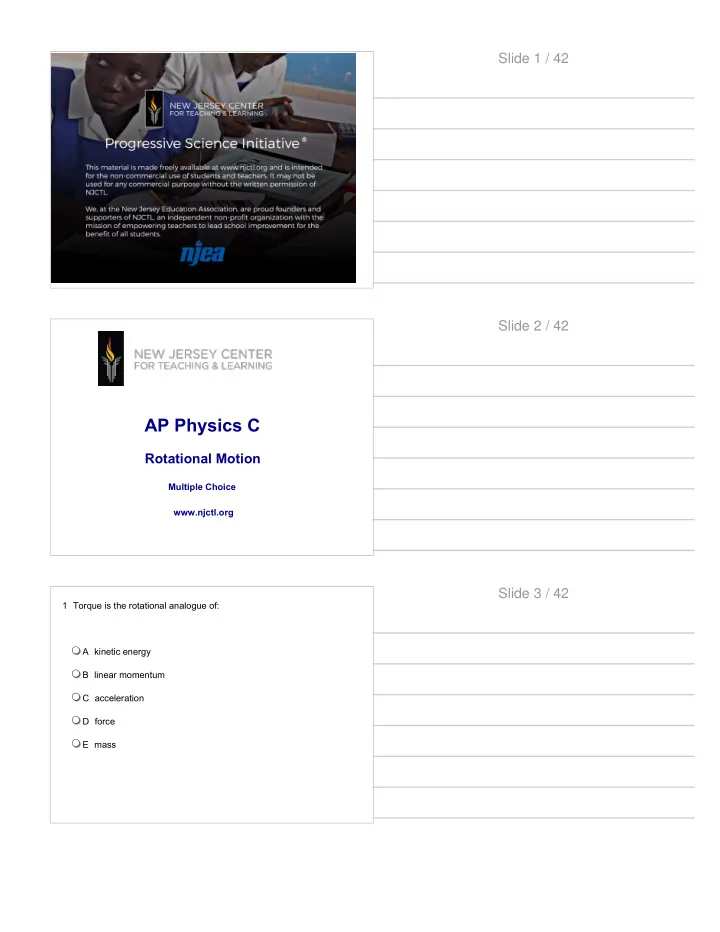
1 Torque is the rotational analogue of: A kinetic energy B linear momentum C acceleration D force E mass
Slide 3 / 42
SLIDE 2 2 A wooden square of side length 1 m is on a horizontal tabletop and is free to rotate about its center axis. The square is subject to two forces and rotates. Find the net torque of the system. A 2 Nm B 12 Nm C 4√2 Nm D 2√2 Nm E √2 Nm
Slide 4 / 42
3 A wooden square of side length 1 m is on a horizontal tabletop and is free to rotate about its center axis. The square is subject to two forces and rotates. Where should another 4N force be applied to maximize its rotational torque? A B C D E
Slide 5 / 42
4 A wooden square of side length 1 m is on a horizontal tabletop and is free to rotate about its center axis. The square is subject to two forces and rotates. Where should another 4N force be applied to set the wooden square to equilibrium? A B C D E
Slide 6 / 42
SLIDE 3 5 Two wheels are fixed to each other and are free to rotate about a frictionless axis through their concentric center. As shown above, four forces are exerted tangent to the wheels. The magnitude of the net torque is: A zero B FR C 2FR D 4FR E 8FR
Slide 7 / 42
6 A baseball player swings his bat with his arms fully extended. If his arms are pulled in closer to the body, and he swings again, which
- f the following is true about the angular momentum and kinetic
energy of the player? Angular Momentum Kinetic Energy A Increases Increases B Increases Remains Constant C Remains Constant Increases D Remains Constant Remains Constant E Decreases Remains Constant
Slide 8 / 42
7 A tire of mass M and radius R rolls on a flat track without slipping. If the angular velocity of the wheel is w, what is its linear momentum? A MωR B Mω2R C MωR2 D Mω2R2/2 E zero
Slide 9 / 42
SLIDE 4
8 A toy car drives around a circular track with a radius of 10 m. When the car’s velocity is instantaneously directed south, its acceleration is directed west at 10 m/s2. When viewed from above, the car moves: A clockwise at 1 rad/s B clockwise at 10 rad/s C counterclockwise at 1 rad/s D counterclockwise at 10 rad/s E with constant velocity
Slide 10 / 42
9 Two masses, one with mass m and the other with mass 2m, are attached to a light rigid rod as shown above. When the system is released from rest, the rod begins to rotate with an angular acceleration magnitude of: A g/7L B g/5L C g/4L D 5g/7L E g/9L
Slide 11 / 42
10 A rubber band ball of mass M and radius R (moment of inertia (2/5)MR2) rolls without slipping up an incline with an initial speed v. The ball reaches a maximum vertical height of: A v2/5g B 2v2/5g C v2/2g D 7v2/10g E v2/g
Slide 12 / 42
SLIDE 5 11 A dart of mass m moves with a constant speed vo along the dashed
- line. The dart strikes a uniform disk of radius R. What is the magni
tude of the angular momentum of the dart with respect to the center of the disk? A zero B mvoR C mvoRsinθ D mvoRcosθ E mvo
Slide 13 / 42 Slide 14 / 42 Slide 15 / 42
SLIDE 6 14 A satellite of mass m moves with a constant speed v in a circular
- rbit of radius r. Which of the following statements are true?
- I. Its angular speed is v/r.
- II. Its tangential acceleration is zero.
- III. The magnitude of its centripetal acceleration is constant.
A I only B II only C I and III only D II and III only E I, II and III
Slide 16 / 42
15 A planet moves in an elliptical orbit around the Sun. As it moves from point A to point B, which of the following is true about its speed and angular momentum? Speed Angular Momentum A Remains constant Remains constant B Increases Increases C Decreases Decreases D Increases Remains constant E Decreases Remains constant
Slide 17 / 42
16 In which of the following diagrams is the torque about point C equal in magnitude to the torque about point C in the diagram above? All forces lie in the plane of the paper. A B C D E
)
Slide 18 / 42
SLIDE 7
17 A clay blob of mass m is stuck to a wheel of radius R rotates clockwise with constant angular velocity ω. The clay mass passes through points 1, 2, 3, and 4 before making a full revolution. At which point will the net force on the mass be greatest? A Point 1 B Point 2 C Point 3 D Point 4 E At all points force is the same
Slide 19 / 42
18 A clay blob of mass m is stuck to a wheel of radius R rotates clockwise with constant angular velocity ω. The clay mass passes through points 1, 2, 3, and 4 before making a full revolution. What is the minimum adhesive force necessary for the clay to stay attached to the wheel at point 3? A mg B mω2R C mω2R2+mg D mω2Rmg E mω2R+mg
Slide 20 / 42
19 Two masses of mass 10.0 kg and 6.0 kg are hung from massless strings at the end of a light rod. The rod itself is virtually weightless. A pivot is placed off center and the system is free to rotate. If the rod is at equilibrium (not rotating) and the 6 kg mass is 4 m away from the pivot how far away is the 10 kg mass? A 0.42 m B 2.4 m C 4.8 m D 6.3 m E 9.8 m
Slide 21 / 42
SLIDE 8 20 Two masses of mass 10.0 kg and 6.0 kg are hung from massless strings at the end of a light rod. The rod itself is virtually weightless. A pivot is placed off center and the system is free to rotate. The string supporting 6 kg block is cut. Find the magnitude of the net torque on the system? A 60 Nm B 120 Nm C 240 Nm D 480 Nm E 0
Slide 22 / 42
21 Which of the following must be true for the above system to be at equilibrium? A B C D E
Slide 23 / 42
22 A ball of rotational inertia (2/5)MR2 is released from rest at the top
- f an incline of height H at an angle θ. There is no friction between
the ball and the surface of the incline.What is the acceleration of the ball as it slides down the incline? A g/2 B gsinθ C 2gcosθ D gsin2θ E 0
Slide 24 / 42
SLIDE 9 23 A ball of rotational inertia (2/5)MR2 is released from rest at the top
- f an incline of height H at an angle θ. There is no friction between
the ball and the surface of the incline. How fast does the ball travel at the bottom of the inclined? A B C D E
Slide 25 / 42
24 In another scenario there is friction between the ball and incline so that the ball rolls down without slipping.How fast does the ball travel at the bottom of the incline? A B C D E
Slide 26 / 42
25 In another scenario there is friction between the ball and incline so that the ball rolls down without slipping. What is the acceleration of the ball as it rolls down the inclined? A B C D E
Slide 27 / 42
SLIDE 10 26 In another scenario there is friction between the ball and incline so that the ball rolls down without slipping.Which of the following is true about the energy of the ball as it rolls down the inclined? A Initial potential energy is equally divided between translational and rotational kinetic energies B The rotational kinetic energy is always greater than translational kinetic energy C The translational kinetic energy is zero when the ball rolls down the inclined D The amount of the rotational kinetic energy gained by the ball depends on its mass E The amount of the rotational kinetic energy gained by the ball depends on its moment of inertia
Slide 28 / 42
27 Three objects of the same mass and radius are released at the top
- f an inclined plane: a disk with moment of inertia (1/2) MR2, a
hoop with moment of inertia MR2 and a sphere with moment of inertia 2/5 MR2.How will the speed at the bottom of the incline be different for all three objects as they roll down without slipping? A The disk will travel faster B The hoop will travel faster C The sphere will travel faster D They have the same speed at the bottom of the inclined E None of the above
Slide 29 / 42
28 A rod of length L is rotated about its center which has a moment of inertia (1/12)ML2. What is the moment of inertia at a point L/4 away from the center? A B C D E
Slide 30 / 42
SLIDE 11 29 A rod of length L is rotated about its center which has a moment of inertia (1/12)ML2. What is the moment of inertia with respect to the end of the rod? A B C D E
Slide 31 / 42
30 The system above rotates with an angular velocity ω. If the masses
- f the rod supports are negligible, what is the ratio of the angular
momentum of the two upper spheres to the angular momentum of the two lower spheres? A 2/1 B 4/3 C 3/4 D 1/4 E 1/1
Slide 32 / 42
31 The moment of inertia of a cylinder of mass M and radius R is ½ MR2 when the axis of rotation passes through its center. The moment of inertia of the cylinder about the axis of rotation tangent to the cylinder is A B C D E
Slide 33 / 42
SLIDE 12
32 A uniform beam of length L and mass m is mounted by a hinge on a wall. The beam is held in a horizontal position by a wire that makes an angle θ with the horizontal. Which of the following is equal to the tension force T in the wire? A B C D E
Slide 34 / 42
33 A disk is free to rotate about an axis perpendicular to the disk and passing through its center. If the disk starts from rest and accelerates uniformly at the rate of 5 rad/s2 for 4 s, what its angular displacement during this time? A 10 rad B 20 rad C 30 rad D 40 rad E 50 rad
Slide 35 / 42
34 A circular platform of mass M and radius R rotates about a fixed pivot at its center with an initial angular velocity ω. A boy of mass m initially standing at the edge of the platform jumps off the platform with a velocity v with respect to the ground. What is the new angular velocity of the platform? A B C D E
Slide 36 / 42
SLIDE 13
35 A uniform ladder of length L is supported by a person holding end A so the ladder makes an angle θ with the horizontal. There is no friction between the ladder and the floor. When the ladder is dropped it falls down because of gravity. Which of the following correctly describes the movement of end B as the ladder falls? A It stays at rest B It moves a distance Lsinθ to the right C It moves a distance Lcosθ to the right D It moves a distance Lsinθ to the left E It moves a distance Lcosθ to the left
Slide 37 / 42
36 A disk with mass M and radius R, and moment of inertia I = ½ MR2 rotates at a constant angular velocity ωo about its center. A piece of clay with mass m is dropped and lands on the surface of the disk at a point R/2 from the center of the disk. What is the new angular velocity of the diskclay system? A B C D E
Slide 38 / 42
37 Two disks with radii R and 3R are connected by a rubber belt which doesn’t slip on the surface of each disk. If the small disk rotates with an angular velocity ωo, what is the angular velocity of the larger disk? A ωo B 3ωo C 1/3ωo D 2/3ωo E 3/2ωo
Slide 39 / 42
SLIDE 14 38 Two blocks with masses m1 and m2 are connected by a light string that passes over a pulley with moment of inertia I. If m2 is greater than m1, what is the acceleration of the system after it was released from rest? A B C D E
Slide 40 / 42
39 A disk slides at a constant speed on the top of a horizontal frictionless table. The disk collides with a stationary rod that is pivoted on one end. Which of the following must be the same for the diskrod system before and after the collision?
- I. Linear momentum
- II. Angular momentum
- III. Kinetic energy
A I only B II Only C I and II only D I and III only E II and III only
Slide 41 / 42
40 A uniform ladder of mass m leans without slipping against a smooth wall. The coefficient of static friction between the ladder and the floor is µ. The minimum value of angle θ that can prevent the ladder from sliding on the floor is: A B C D E
Slide 42 / 42