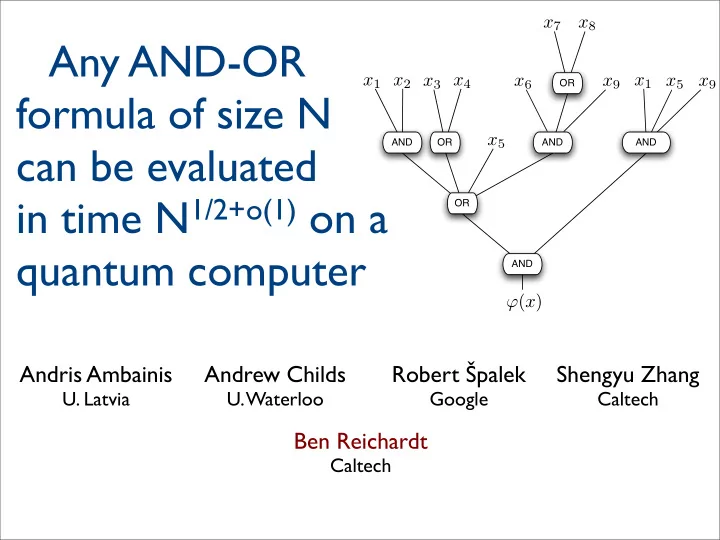
Any AND-OR x 1 x 2 x 3 x 4 x 1 x 6 x 9 x 5 x 9 OR x 1 x 1 formula - - PowerPoint PPT Presentation

any and or
SMART_READER_LITE
LIVE PREVIEW

Any AND-OR x 1 x 2 x 3 x 4 x 1 x 6 x 9 x 5 x 9 OR x 1 x 1 formula - - PowerPoint PPT Presentation

x 7 x 8 Any AND-OR x 1 x 2 x 3 x 4 x 1 x 6 x 9 x 5 x 9 OR x 1 x 1 formula of size N x 5 AND OR AND AND can be evaluated in time N 1/2+o(1) on a OR quantum computer AND ( x ) Andris Ambainis Andrew Childs Robert palek Shengyu


slide-1
SLIDE 1

x9 x5 x6

x1 x1

x9 x8 x7 x5 x4 x2 x3

AND OR AND AND AND OR OR

ϕ(x) x1 x1

Any AND-OR formula of size N can be evaluated in time N1/2+o(1) on a quantum computer

Ben Reichardt

Caltech

Andris Ambainis

  • U. Latvia

Andrew Childs

  • U. Waterloo

Robert Špalek

Google

Shengyu Zhang

Caltech

slide-2
SLIDE 2

x9 x5 x6

x1 x1

x9 x8 x7 x5 x4 x2 x3

AND OR AND AND AND OR OR

ϕ(x) x1 x1

Def: {AND, OR, NOT} Formula = Tree of nested gates

slide-3
SLIDE 3

x9 x5 x6

x1 x1

x9 x8 x7 x5 x4 x2 x3

AND OR AND AND AND OR OR

ϕ(x) x1 x1

Def: {AND, OR, NOT} Formula = Tree of nested gates

input variables may appear more than once… but gates cannot have fan-out! (only in a circuit can subexpressions be reused) (unless formula is read-once)

slide-4
SLIDE 4

x9 x5 x6

x1 x1

x9 x8 x7 x5 x4 x2 x3

AND OR AND AND AND OR OR

ϕ(x) x1 x1

Def: {AND, OR, NOT} Formula = Tree of nested gates

input variables may appear more than once… but gates cannot have fan-out! (only in a circuit can subexpressions be reused) (unless formula is read-once)

Problem: Evaluate φ(x). (Formula/Game tree evaluation problem)

slide-5
SLIDE 5
  • Problem: Evaluate the formula, with minimal queries to the inputs bits xi.
  • Classical history
  • Some formulas, e.g., OR(x1, x2, …, xN), require Ω(N) time
  • Randomized algorithm in E-time O(N0.754)

for balanced binary AND-OR formulas [Snir ‘85, Saks & Wigderson ‘86]

  • Flip coins to decide which subtree to evaluate next, short-circuit
  • Optimal [SW ‘86, Santha ‘95]
  • General formulas, ??

logd λmax( d 1

d−1 2

  • )

Problem history: Classical computation

slide-6
SLIDE 6
  • Classical history
  • Randomized algorithm in E-time Θ(N0.754) for balanced binary formulas
  • Other formulas may require Ω(N) time
  • Quantum history
  • Ω(√N) queries required for read-once [Barnum, Saks ‘04]
  • Grover search: Evaluates OR(x1, x2, …, xN)

using O(√N) queries (O(√N log log N)-time)

  • Can be applied recursively to evaluate shallow trees:
  • Evaluates regular depth-d AND-OR formula in √N O(log N)d-1

queries [Buhrman, Cleve, Wigderson ‘98]

  • Search on faulty oracles [Høyer, Mosca, de Wolf ‘03] ⇒ O(√N cd) queries

=

  • 1

if ∃ an i : xi = 1

  • therwise

Problem history: Quantum computation

slide-7
SLIDE 7
  • Classical history
  • Randomized algorithm in E-time Θ(N0.754) for balanced binary formulas
  • Other formulas may require Ω(N) time
  • Quantum history
  • Ω(√N) queries required for read-once [Barnum, Saks ‘04]
  • Grover search: Evaluates OR(x1, x2, …, xN)

using O(√N) queries (O(√N log log N)-time)

  • Can be applied recursively to evaluate shallow trees
  • Farhi, Goldstone, Gutmann 2007: Breakthrough quantum algorithm

for evaluating balanced binary AND-OR formula in N½+o(1) time

=

  • 1

if ∃ an i : xi = 1

  • therwise

Quantum Leap!

slide-8
SLIDE 8

Farhi, Goldstone, Gutmann ‘07 algorithm

NAND NAND NAND NAND NAND NAND NAND

x1 x2 x3 x4 x5 x7 x6 x8

  • Theorem ([FGG ‘07, CCJY ‘07]): A balanced binary NAND formula can be

evaluated in time N½+o(1).

  • Convert formula to a tree:
  • Attach an infinite line to the root

NAND

slide-9
SLIDE 9

x1 x2 x3 x4 x5 x7 x6 x8

Farhi, Goldstone, Gutmann ‘07 algorithm

  • Theorem ([FGG ‘07, CCJY ‘07]): A balanced binary NAND formula can be

evaluated in time N½+o(1).

  • Convert formula to a tree:
  • Attach an infinite line to the root

NAND

slide-10
SLIDE 10

Farhi, Goldstone, Gutmann ‘07 algorithm

  • Theorem ([FGG ‘07, CCJY ‘07]): A balanced binary NAND formula can be

evaluated in time N½+o(1).

  • Convert formula to a tree:
  • Attach an infinite line to the root
  • Add edges above leaf nodes evaluating to one…

=0 =1

NAND

slide-11
SLIDE 11

Continuous-time quantum walk [FGG ‘07]

x11 = 0 x11 = 1

slide-12
SLIDE 12

FGG quantum walk |ψt = eiAGt|ψ0

slide-13
SLIDE 13

FGG quantum walk |ψt = eiAGt|ψ0

slide-14
SLIDE 14

ϕ(x) = 0 ϕ(x) = 1

Wave transmits! Wave reflects!

FGG quantum walk |ψt = eiAGt|ψ0

slide-15
SLIDE 15

[FGG ‘07] algorithm

  • Theorem ([FGG ‘07, CCJY ‘07]): A balanced

binary AND-OR formula can be evaluated in time N½+o(1).

  • Theorem:
  • An “approximately balanced” AND-OR

formula can be evaluated with O(√N) queries (optimal for read-once!).

  • A general AND-OR formula can be

evaluated with N½+o(1) queries.

NAND NAND NAND NAND NAND NAND NAND

x1 x2 x3 x4 x5 x7 x6 x8 x9 x5 x6

x1 x1

x9 x8 x7 x5 x4 x2 x3

AND OR AND AND AND OR OR

ϕ(x) x1 x1

[ACRŠZ ‘07] algorithm

Running time is N½+o(1) in each case, after efficient preprocessing. Analysis by scattering theory.

slide-16
SLIDE 16
  • Quantumly, complexity is √N queries

always, all the way up to k=N (i.e., evaluating OR(x1,…,xN), Grover search)

  • General AND-OR formulas can be

evaluated with N½+o(1) queries

  • Expanding MAJ3 into AND-OR gates

gives O(√5d) quantumly.

  • Also, the algorithm generalizes to give
  • ptimal algorithm for evaluating

iterated f, where f is any 3-bit function

[Jayram, Kumar, Sivakumar ’03]

  • Classical complexity of evaluating

balanced k-ary alternating AND- OR tree is (k/2)depth = N~(1-1/log2k) — approaches N as k increases

  • Classical complexity of

evaluating general AND-OR formulas is not known?

  • Classical complexity of evaluating

iterative MAJ3 formula is unknown: between and

  • (the generalization of the optimal

AND-OR algorithm is not optimal when applied to MAJ3 trees)

Remarks on formula evaluation algorithms: Classical vs. Quantum

  • 7/3

d

  • 8/3

d

slide-17
SLIDE 17

Formula evaluation algorithm

Convert formula φ into a graph G(φ) Define classical random walk on G(φ) Quantize that walk

slide-18
SLIDE 18

x9 x5 x6

x1 x1

x9 x8 x7 x5 x4 x2 x3

AND OR AND AND AND OR OR

ϕ(x) x1 x1 . . .

AND

. . . . . .

OR

. . .

NOT

Substitution rules:

Convert formula φ into a graph G(φ) Define classical random walk on G(φ) Quantize that walk

slide-19
SLIDE 19

x9 x5 x6

x1 x1

x9 x8 x7 x5 x4 x2 x3 ϕ(x) x1 x1 . . .

AND

. . . . . .

OR

. . .

NOT

Substitution rules:

Convert formula φ into a graph G(φ) Define classical random walk on G(φ) Quantize that walk

slide-20
SLIDE 20 x1 x1

. . .

AND

. . . . . .

OR

. . .

NOT

Substitution rules:

Convert formula φ into a graph G(φ) Define classical random walk on G(φ) Quantize that walk

slide-21
SLIDE 21

. . .

AND

. . . . . .

OR

. . .

x1 x1

Convert formula φ into a graph G(φ) Define classical random walk on G(φ) Quantize that walk

  • P(stepping to subtree) ∝ √(size of that subtree)
  • (For a balanced tree, walk is uniform)
slide-22
SLIDE 22

x9 x5 x6

x1 x1

x9 x8 x7 x5 x4 x2 x3 x1 x1 If x9=0, STOP!

. . .

AND

. . . . . .

OR

. . .

Convert formula φ into a graph G(φ) Define classical random walk on G(φ) Quantize that walk

  • P(stepping to subtree) ∝ √(size of that subtree)
  • (For a balanced tree, walk is uniform)
  • Make leaves (inputs) evaluating to 0 probability sinks
slide-23
SLIDE 23

If xi=0, STOP!

. . .

AND

. . . . . .

OR

. . .

Convert formula φ into a graph G(φ) Define classical random walk on G(φ) Quantize that walk

  • Classically, roll a dice to determine next step
  • Quantumly, the dice is part of the quantum state. Instead of

randomizing the dice between steps, apply a unitary operator to it.

{p1, p2, . . . , p6}

| | | |

√p1

+√p2 +

√p5 √p6 √p3 √p4

| |

+ + +

Transition probabilities U = reflection about the state

slide-24
SLIDE 24
  • Classically, roll a dice to determine next step
  • Quantumly, the dice is part of the quantum state. Instead of

randomizing the dice between steps, apply a unitary operator to it.

  • Probability sinks in the classical r.w. (inputs xi=0) become

phase flips in the qu. walk ⇒ standard phase flip oracle If xi=0, STOP!

. . .

AND

. . . . . .

OR

. . .

Convert formula φ into a graph G(φ) Define classical random walk on G(φ) Quantize that walk

{p1, p2, . . . , p6}

| | | |

√p1

+√p2 +

√p5 √p6 √p3 √p4

| |

+ + +

Transition probabilities U = reflection about the state

slide-25
SLIDE 25

| | +

  • Start at the root
  • Apply phase estimation to the quantum walk with precision 1/√N

(i.e., run the walk for time √N)

  • If phase is 0, output “φ(x)=1”
  • Otherwise output “φ(x)=0”

If xi=0, STOP!

. . .

AND

. . . . . .

OR

. . .

Convert formula φ into a graph G(φ) Define classical random walk on G(φ) Quantize that walk

The Algorithm:

slide-26
SLIDE 26

Formula evaluation algorithm

Convert formula φ into a graph G(φ) Define classical random walk on G(φ) Quantize that walk

. . .

AND

. . . . . .

OR

. . .

If xi=0, STOP!

| | | |

√p1

+√p2 +

√p5 √p6 √p3 √p4

| |

+ + +

{p1, p2, . . . , p6}

P(stepping to subtree) ∝ √(size of that subtree)

slide-27
SLIDE 27
  • 2. Why It Works
slide-28
SLIDE 28
  • Start at the root
  • Apply phase estimation to the quantum walk with precision 1/√N

(i.e., run the walk for time √N)

  • If eigenvalue is 0, output “φ(x)=1”
  • Otherwise output “φ(x)=0”

The Algorithm:

Precision-δ phase estimation

  • n a unitary U, starting at an

e-state, returns the e-value to precision δ, except w/ prob. 1/4. It uses O(1/δ) calls to c-U. Note:

∴ We need to carry out spectral

analysis of the quantum walk U(x) |eigenvector corr. eigenvalue ±δ

slide-29
SLIDE 29

=1 =0

Szegedy eigenvalue and eigenvector correspondence

Quantum coined walk U(x): W’ted adj. matrix AG(x) of G(x):

eigenvalues & eigenvectors 2|E| dimensions |V| dimensions

√ P ◦ P T

Note: Much like the [FGG]

algorithm, edges to input vertices evaluating to 1 are deleted in G(x).

[FOCS ‘04]

slide-30
SLIDE 30
  • Start at the root
  • Apply phase estimation to the walk

with precision 1/√N

  • If e-value is 0, output “φ(x)=1”
  • Otherwise output “φ(x)=0”

The Algorithm:

  • Main Theorem:
  • φ(x)=1 ⇒ AG(x) has eigenvalue-0 e.v. with Ω

(1) support on the root.

  • φ(x)=0 ⇒ AG(x) has no eigenvectors
  • verlapping the root with |eigenvalue|<2/√N.

∴ Algorithm is correct, except w/ error rate <1/4 (say)

slide-31
SLIDE 31
  • Theorem: φ(x)=1 ∃ a λ=0 eigenstate of AG(x) supported on root r.

x9 x5 x6

x1 x1

x9 x8 x7 x5 x4 x2 x3

AND OR AND AND AND OR OR

ϕ(x) x1 x1 x9 x5 x6

x1 x1

x9 x8 x7 x5 x4 x2 x3 ϕ(x) x1 x1

. . .

AND

. . . . . .

OR

. . .

Proof: By induction, we argue that for every v, a vector α satisfying constraints for vertices above v must satisfy:

Induction hypothesis:

  • φv(x)=0 ⇒ αv=0
  • φv(x)=1 ⇒ αv can be ≠0
slide-32
SLIDE 32
  • φv(x)=0 ⇒ αv=0
  • φv(x)=1 ⇒ αv can be ≠0
  • Induction hypothesis:

λ=0 eigenvector constraint at c is αv=0. ✓ Base case: v an input xi=0: xi=1:

v v c c

v and c are not connected in G(x), so αv is not constrained.✓

slide-33
SLIDE 33

r v1

  • Induction hypothesis:

T1 T3 T2 |αT1 |αT2 |αT3

AND

v2 v3 αv1 + αr = 0 αv2 + αr = 0 αv3 + αr = 0

  • If any φ(vi)=0, αvi=0 ⇒ αr=0
  • If all φ(vi)=1, can scale each

so αv1=αv2=αv3≠0, then set αr=-αvi≠0 AND gate gadget constraints: |αTi

✓AND

  • φv(x)=0 ⇒ αv=0
  • φv(x)=1 ⇒ αv can be ≠0
slide-34
SLIDE 34

r v1

  • Induction hypothesis:

T1 T3 T2 |αT1 |αT2 |αT3

OR

v2 v3

  • αr can be ≠0 ⇔ at least one

αvi≠0 ⇔ at least one φ(vi)=1 OR gate gadget constraint:

✓OR

αv1 + αv2 + αv3 + αr = 0

  • φv(x)=0 ⇒ αv=0
  • φv(x)=1 ⇒ αv can be ≠0
slide-35
SLIDE 35

Just in case…

a a αr=-a αr=0 αr=0 AND(0,0)=0 AND(0,1)=0 AND(1,1)=1

slide-36
SLIDE 36
  • Theorem: φ(x)=1 ∃ a λ=0 eigenstate of AG(x) supported on root r.
  • Main Theorem:
  • φ(x)=1 AG(x) has eigenvalue-0 e.v. with Ω(1) support on the root.
  • φ(x)=0 AG(x) has no eigenvectors overlapping the root with

|eigenvalue|<1/√N.

  • Remains to show support αr is large (Ω(1)) when φ(r)=0, and that there is a

large spectral gap (1/√N) away from E=0 when φ(r)=1.

  • Proofs by same induction but quantitative.
  • In the balanced case, √N is from losing a factor of two every other level

⇒ ⇒

OR

p v αp αv ∈ (0, svλ) −αv αp ∈ (0, svλ) sv =

  • s2

v1 + · · · + s2 v3 =

  • size(ϕv)

if true if false with

slide-37
SLIDE 37

[FGG ‘07] algorithm

  • Theorem ([FGG ‘07, CCJY ‘07]): A balanced

binary AND-OR formula can be evaluated in time N½+o(1).

  • Theorem:
  • An “approximately balanced” AND-OR

formula can be evaluated with O(√N) queries (optimal for read-once!).

  • A general AND-OR formula can be

evaluated with N½+o(1) queries.

[ACRŠZ ‘07] algorithm

Running time is N½+o(1) in each case, after efficient preprocessing. Analysis by scattering theory.

slide-38
SLIDE 38

[FGG ‘07] algorithm

  • Theorem ([FGG ‘07, CCJY ‘07]): A balanced

binary AND-OR formula can be evaluated in time N½+o(1).

  • Theorem:
  • An “approximately balanced” AND-OR

formula can be evaluated with O(√N) queries (optimal for read-once!).

  • A general AND-OR formula can be

evaluated with N½+o(1) queries.

[ACRŠZ ‘07] algorithm

Running time is N½+o(1) in each case, after efficient preprocessing. Analysis by scattering theory.

Where do o(1) terms come from?

slide-39
SLIDE 39

[FGG ‘07] algorithm

  • Theorem ([FGG ‘07, CCJY ‘07]): A balanced

binary AND-OR formula can be evaluated in time N½+o(1).

  • Theorem:
  • An “approximately balanced” AND-OR

formula can be evaluated with O(√N) queries (optimal for read-once!).

  • A general AND-OR formula can be

evaluated with N½+o(1) queries.

[ACRŠZ ‘07] algorithm

Running time is N½+o(1) in each case, after efficient preprocessing. Analysis by scattering theory.

Fixed, by working with coined quantum walks (via Szegedy corr.) instead of continuous- time qu. walks

Where do o(1) terms come from?

slide-40
SLIDE 40

Algorithm for very unbalanced trees

  • Problem: We lose control of recursion fudge factors in a very deep formula.
  • Intuition: Walk from root will not even reach the farthest leaves in time √N.

… E.g., if depth is N, then gap could be only 1/N

                                        

root

slide-41
SLIDE 41
  • Problem: Walk might not even reach the bottom of a deep formula in time √N
  • Solution: Rebalance the formula tree (in preprocessing)

Theorem: ([Bshouty, Cleve, Eberly ‘91, Bonet & Buss ‘94]) For any NAND

formula φ and k ≥ 2, can efficiently construct an equivalent NAND formula φ’ with

  • depth(φ’) = O(k log N)
  • size(φ’) ≤ N1+1/log k
  • Open Classical ?: Is [BCE‘91] formula rebalancing optimal?
  • Does there exist formula φ, k such that every equivalent φ’ of depth at most k

log N has size(φ’) ≥ N1+1/log k?

  • Open: What is the effect of general formula rebalancing on the ADV bound?

Algorithm for very unbalanced trees

size-depth tradeoff (set k=2√(log N) to balance size*depth)

slide-42
SLIDE 42
  • Classical complexity of evaluating

balanced k-ary alternating AND- OR tree is (k/2)depth = N~(1-1/log2k) — approaches N as k increases

  • Classical complexity of

evaluating general AND-OR formulas is not known?

  • Classical complexity of evaluating

iterative MAJ3 formula is unknown: between and

  • (the generalization of the optimal

AND-OR algorithm is not optimal when applied to MAJ3 trees)

Remarks on formula evaluation algorithms: Classical vs. Quantum

  • 7/3

d

  • 8/3

d

  • Quantumly, complexity is √N queries

always, all the way up to k=N (i.e., evaluating OR(x1,…,xN), Grover search)

  • General AND-OR formulas can be

evaluated with N½+o(1) queries

  • Expanding MAJ3 into AND-OR gates

gives O(√5d) quantumly.

  • Also, the algorithm generalizes to give
  • ptimal algorithm for evaluating

iterated f, where f is any 3-bit function

[Jayram, Kumar, Sivakumar ‘03]

slide-43
SLIDE 43

Span-program-based quantum algorithm for formula evaluation

Robert Špalek

Google

Ben Reichardt

Caltech [quant-ph/0710.2630]

. . .

OR

. . .

G(ρ1) G(ρk) ρ1 ρk

NOT

G(ρ) ρ

MAJ

ρ1 ρ2 ρ3 G(ρ3) G(ρ2) G(ρ1)

EQUAL

G(ρ1) ρ1 G(¬ρ1)

. . .

ρk

. . . . . .

G(ρk) G(¬ρk)

PARITY

G(ρ1) ρ1 ρ2 G(ρ2) G(¬ρ2) G(¬ρ1)

We present a time-efficient and query-optimal quantum algorithm for evaluating adversary-bound- balanced formulas on an extended gate set. The allowed gates include arbitrary two- and three-bit gates, as well as bounded fan-in AND, OR, PARITY and EQUAL gates. The technique behind the formula evaluation algorithm is a new framework for quantum algorithms based on span programs. For example, the classical complexity of evaluating the balanced ternary majority formula is unknown, and the natural generalization of the standard balanced AND-OR formula evaluation algorithm is known to be suboptimal. In contrast, a generalization of the optimal quantum {AND, OR, NOT} formula evaluation algorithm is optimal for evaluating the balanced ternary majority formula.

span programs [Karchmer, Wigderson ‘93],…

slide-44
SLIDE 44
  • Is the phase estimation needed, or can the walk be run directly?
  • Is the eigenstate useful as a witness?
  • Open Classical ?: Is [BCE‘91] formula rebalancing optimal?
  • Does there exist formula φ, k such that every equivalent φ’ of depth at

most k log N has size(φ’) ≥ N1+1/log k?

  • Effect of rebalancing on the adversary lower bound
  • Optimal algorithm for more formula types, more span-program-based quantum

algorithms; see [quant-ph/0710.2630]

Open problems Classical learning theory:

Corollary: AND-OR formulas of size N are (classically) PAC-learnable

in time 2^{N½+o(1)}.

(and many more…)

[O’Donnell & Servedio ‘03]

link