Antimicrobial Stewardship: VUH Program started in 2009 Program - - PDF document

antimicrobial stewardship
SMART_READER_LITE
LIVE PREVIEW

Antimicrobial Stewardship: VUH Program started in 2009 Program - - PDF document

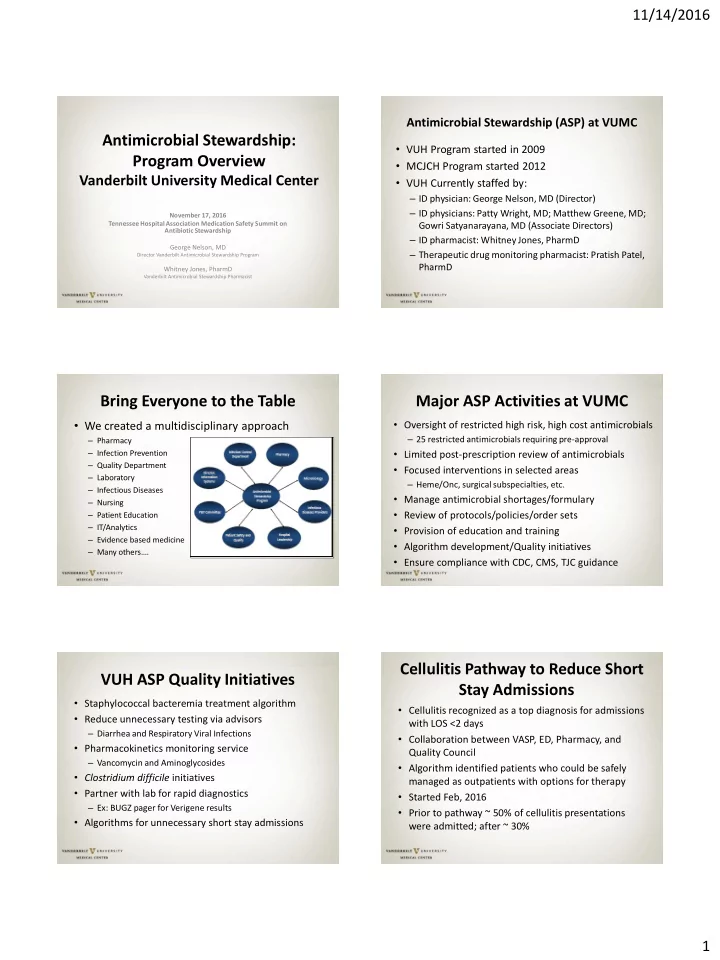
11/14/2016 Antimicrobial Stewardship (ASP) at VUMC Antimicrobial Stewardship: VUH Program started in 2009 Program Overview MCJCH Program started 2012 Vanderbilt University Medical Center VUH Currently staffed by: ID physician:


slide-1
SLIDE 1

11/14/2016 1

Antimicrobial Stewardship: Program Overview

Vanderbilt University Medical Center

November 17, 2016 Tennessee Hospital Association Medication Safety Summit on Antibiotic Stewardship George Nelson, MD

Director Vanderbilt Antimicrobial Stewardship Program

Whitney Jones, PharmD

Vanderbilt Antimicrobial Stewardship Pharmacist

Antimicrobial Stewardship (ASP) at VUMC

  • VUH Program started in 2009
  • MCJCH Program started 2012
  • VUH Currently staffed by:

– ID physician: George Nelson, MD (Director) – ID physicians: Patty Wright, MD; Matthew Greene, MD; Gowri Satyanarayana, MD (Associate Directors) – ID pharmacist: Whitney Jones, PharmD – Therapeutic drug monitoring pharmacist: Pratish Patel, PharmD

Bring Everyone to the Table

  • We created a multidisciplinary approach

– Pharmacy – Infection Prevention – Quality Department – Laboratory – Infectious Diseases – Nursing – Patient Education – IT/Analytics – Evidence based medicine – Many others….

Major ASP Activities at VUMC

  • Oversight of restricted high risk, high cost antimicrobials

– 25 restricted antimicrobials requiring pre-approval

  • Limited post-prescription review of antimicrobials
  • Focused interventions in selected areas

– Heme/Onc, surgical subspecialties, etc.

  • Manage antimicrobial shortages/formulary
  • Review of protocols/policies/order sets
  • Provision of education and training
  • Algorithm development/Quality initiatives
  • Ensure compliance with CDC, CMS, TJC guidance

VUH ASP Quality Initiatives

  • Staphylococcal bacteremia treatment algorithm
  • Reduce unnecessary testing via advisors

– Diarrhea and Respiratory Viral Infections

  • Pharmacokinetics monitoring service

– Vancomycin and Aminoglycosides

  • Clostridium difficile initiatives
  • Partner with lab for rapid diagnostics

– Ex: BUGZ pager for Verigene results

  • Algorithms for unnecessary short stay admissions

Cellulitis Pathway to Reduce Short Stay Admissions

  • Cellulitis recognized as a top diagnosis for admissions

with LOS <2 days

  • Collaboration between VASP, ED, Pharmacy, and

Quality Council

  • Algorithm identified patients who could be safely

managed as outpatients with options for therapy

  • Started Feb, 2016
  • Prior to pathway ~ 50% of cellulitis presentations

were admitted; after ~ 30%

slide-2
SLIDE 2

11/14/2016 2 Staphylococcus Bacteremia Safety Algorithm

  • Ensures appropriate management

– TTE/repeat BCx/etc, treatment (duration/agent)

  • Implemented at VUH August 2015

– After several patient-specific opportunities for improvement noted – Elevated need for quality improvement

  • 82 interventions on 68 distinct patients

– Only 2 elevations to supervising MD – No elevations to Chief of Staff

  • 15 patients had adverse events averted (not mutually exclusive):

– No treatment (or suboptimal) treatment n= 9 – Escalate from PO to IV therapy n= 5 – Increase duration of therapy n=1 – Obtain TTE n= 9 – Repeat BCx n=7

Improving Antibiotic Appropriateness Reduces C. diff

  • Increase in C. difficile infections on select

inpatient units, FY2015

  • Task Force convened

– Antibiotic misuse identified

  • Rounding tool created on target unit (MICU)

– Based on validated CDC assessment tool

  • 650 patients enrolled in quality improvement

project

  • C. diff Rates Improved

Task Force convened Rounding Tool Started

Quality vs Cost

  • We have found that it is important to partner with

Quality department

– Resonates with providers – Longer lasting – Quality/safe care is goal – Patient level concerns drive point home

  • Cost effectiveness remains important goal

– Easier to quantify – Leverage in administration

  • Collect data on interventions to demonstrate value

Unrestricted Antibiotics

  • Lack of restriction

demonstrates stable use Restricted Antibiotics

  • Restrictions can

drive improvement

Antibiotic Utilization Reporting

  • Mandatory external reporting anticipated
  • Internal reporting to leverage change within units,

divisions, departments and beyond

  • Build upon success of hand hygiene feedback

program

  • Use data as agent of change
  • Have developed dashboard to capture the above
slide-3
SLIDE 3

11/14/2016 3

AU Dashboard Gap Analysis

  • Start with a program review
  • CDC Core Elements of ASP

– Good starting place

  • Write down what you have

– Resources, interests, programs, champions who could represent other areas

  • We performed Gap Analysis recently

– Really helpful to define next steps and

  • pportunities we had

Conclusion

  • ASP is hard, but worth it
  • Impossible to do everything all at once
  • Have to bring everyone to table
  • When possible link to quality outcomes

– Use patient specific examples for need

  • Leverage data to inform your next steps (and

results of your projects)

  • THANKS!!!

Questions?