
SLIDE 1
Anti-Human Trafficking
Joanne Maguire
B00451830 Blog : www.jmfinalproject.wordpress.com
Thursday 17 February 2011
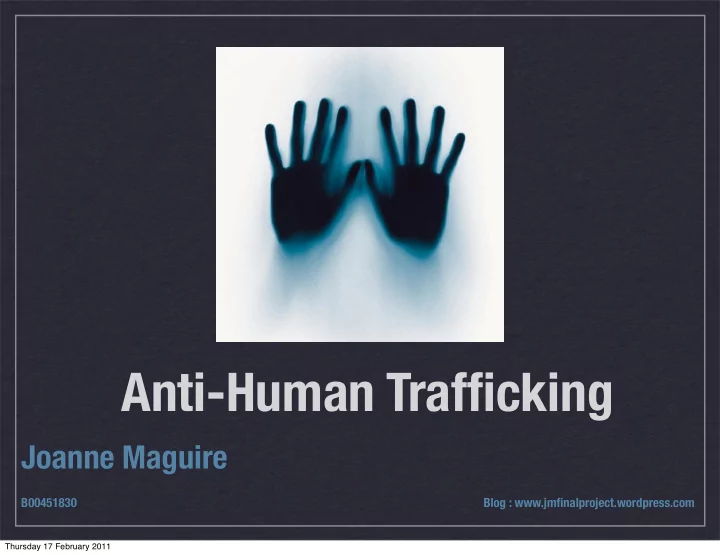
Anti-Human Trafficking Joanne Maguire B00451830 Blog : - - PowerPoint PPT Presentation
Anti-Human Trafficking Joanne Maguire B00451830 Blog : www.jmfinalproject.wordpress.com Thursday 17 February 2011 Project Analysis WILLIE DOHERTY STEFAN HENRI CARTIER SAGMEISTER GAMBATTISTA BRENSSEN BODONI PAUL RAND GRIPPING IMAGES
B00451830 Blog : www.jmfinalproject.wordpress.com
Thursday 17 February 2011
MAJOR ANTI-POSTER CAMPAIGN
PHOTOGRAPHY GRAPHIC DESIGN WARNING ADVERTISING PROPAGANDA POSTER CAMPAIGNS WEB SITE INTERACTIVE COMMUNICATION PORTAL DESIGNERS NEVILLE BRODY DAVID CARSON GAMBATTISTA BODONI TYPOGRAPHY GRIPPING IMAGES POSSIBLY BLACK AND WHITE WILLIE DOHERTY HENRI CARTIER BRENSSEN WORLD PROBLEMS ILLEGAL IMMIGRATION HUMAN TRAFFICKING CLIMATE CHANGE ECONOMY CONSUMERISM HEALTHCARE PAULA SCHER STEFAN SAGMEISTER WWII 30’S +40’S STYLE BLUNT MESSAGE USING STRONG PHOTOS BLUEBLINDFOLD.ORG TARGET AUDIENCE UNITED NATIONS STUDENTS IMMIGRANTS TRAVELERS PAUL RAND Thursday 17 February 2011
Thursday 17 February 2011
My original idea was a lot more complicated as i planned to use 15 countries world wide and 15 separate problems linked to each country and campaign each problem, my first amendment was the amount of problems i wanted to use, so that has been cut from 15 to
Now that I have started to get into depth with my research in the 5 main subject it has proven harder than I expected to find research on certain subjects like Drug Smuggling, though in the other hand I am finding a lot of useful information on the subject of Human Traffjcking, so I think I am going to focus my project even more to just the major matter of Human traffjcking through out the world. Realizing that Traffjcking is more serious in some parts but has little or no warning information about Traffjcking, in comparison to other areas that is not as intense and has a lot more information and organizations to help prevent it, has very difgerent ways of getting the message across. I am going to use the 6 main continents Asia, Africa, Australia, Europe, North America and South America, and the level of traffjcking to help design the style and how blunt I am going to be with my message. So I should hopefully end up with 6 or more difgerent designs/styles that would work best in each continent and each with their own strong but blunt message. As it is a campaign I am doing, 6 posters is not enough, so now that I have focused on what I want to do I can expand on each continent, so I plan to end up with 24 final posters, (6 sets and 4 versions for each continent) each having their own strength of the message. I also want to show what each
Thursday 17 February 2011
Decide what you want to change and create clear and achievable aims, plans and objectives. Study your aims, study the environment and decide who needs to change their mind for your campaign to succeed.
Make sure you know what information is already out there. Read up and record data from other voluntary
the media that will support (and counter) your aims and arguments. Once you have got hold of all the readily available research and opinion, collect what is known as ‘primary evidence’ – things like statistics and personal experience – that will point out the problems your campaign seeks to address. Both are powerful tools in putting together a compelling case.
Promoting your campaign to local media is usually a great way of gathering more support, raising awareness and reaching out to people. Good media coverage can help a campaign really take off. t’s not just about getting in the national newspapers or television and radio. Local newspapers sometimes support local campaigns and if you can get them on your side, your chance of success immediately
Emails, letters, phone calls and texts – keep in touch with the right people The internet – check out marketing opportunities Social networking sites – people power is a good way to whip up a storm
Evaluating your campaign is a good idea for a number of reasons: i) If your campaign was successful…you have a strong base on which to build further change and you can share your ideas with others about how to make a difference. ii) If your campaign initially failed to achieve its aims…you are likely to have put together research, statistics, personal experience that can be used in other campaigns and you can learn what to do differently next time – we are all always learning. Thursday 17 February 2011
Human Trafficking Illegal Immigration Drug Smuggling Health Consumerism
Thursday 17 February 2011
Sex Trafficking Forced Labor Child Labor Bonded Labor
Thursday 17 February 2011
Sex Trafficking, victims are generally found in dire circumstances and
easily targeted by traffickers. Individuals, circumstances, and situations vulnerable to traffickers include homeless individuals, runaway teens, displaced homemakers, refugees, and drug addicts. While it may seem like trafficked people are the most vulnerable and powerless minorities in a region, victims are consistently exploited from any ethnic and social background.
Child Labor, is a form of work that is likely to b hazardous e to the physical,
mental, spiritual, moral, or social development of children and can interfere with their education. The International Labor Organization estimates worldwide that there are 246 million exploited children aged between 5 and 17 involved in debt bondage, forced recruitment for armed conflict, prostitution, pornography, the illegal drug trade, the illegal arms trade, and other illicit activities around the world.
Forced Labor, is a situation in which victims are forced to work against their
degree of ownership is exerted. Men are at risk of being trafficked for unskilled work, which globally generates $31billion according to the International Labor Organization. Forms of forced labor can include domestic servitude; agricultural labor; sweatshop factory labor; janitorial, food service and other service industry labor; and begging.
Bonded Labor, or debt bondage, is probably the least known form of
labor trafficking today, and yet it is the most widely used method of enslaving people. Victims become bonded laborers when their labor is demanded as a means of repayment for a loan or service in which its terms and conditions have not been defined or in which the value of the victims’ services as reasonably assessed is not applied toward the liquidation of the debt. The value of their work is greater than the original sum of money “borrowed. Thursday 17 February 2011
UNITED NATIONS TRAVELERS IMMIGRANTS STUDENTS 16 - 25 YEAR OLDS
Thursday 17 February 2011
1 2
Thursday 17 February 2011
3 4
Thursday 17 February 2011
5 6
1: I LIKE THIS ONE BECAUSE OF THE STRONG FACT, AND THE IMPRESSION OF SO MUCH HAPPENING WITH IN 8 HOURS OF OUR BUSY DAYS. 2: I LIKE THIS ONE BECAUSE OF AGAIN THE STRONG FACT OF SEX TRAFFICKING BUT ALSO BECAUSE IT IS REPRESENTED BY A YOUNG CHILD. 3: I LIKE THE GRITTY LOOK OF THIS POSTER, ITS NOT ALL NICE, CRISP AND CLEAN, IT SEEMS EXTREMELY TRUTHFUL. 4: THIS ONE I LIKE FOR THE STRONG IMAGERY, IT STANDS OUT AND MAKES AN IMPACT. 5: I LIKE THIS ONE BECAUSE OF THE WAY THE IMAGERY AND THE TEXT WORK TOGETHER. ITS A STRONG STATEMENT. 6: THE TYPOGRAPHY IS THE MAIN OBJECT THAT I LIKE ON THIS
BUT IT MAKES YOU LOOK A LITTLE LONGER AND REALLY UNDERSTAND THE MEANING. 7: THIS CAMPAIGN IS SIMILAR TO WHAT I WOULD LIKE MY FINAL POSTERS TO BE LIKE. THEY ARE BOLD AND THE CONTRAST IS
THE BOLD IMAGES TO HELP HOLD THAT MESSAGE.
Thursday 17 February 2011
7
Thursday 17 February 2011
Neville Brody (born 23 April 1957 in London) is an English graphic designer, typographer and art director. Neville Brody is an alumnus of the London College of Printing and Hornsey College of Art, and is known for his work on The Face magazine (1981–1986) and Arena magazine (1987–1990), as well as for designing record covers for artists such as Cabaret Voltaire and Depeche
and is a founding member of Fontworks. He has been announced to be the new Head of the Communication Art & Design department at the Royal College of Art commencing in January 2011. David Carson is an American graphic designer. He is best known for his innovative magazine design, and use of experimental typography. He was the art director for the magazine Ray Gun. Carson was perhaps the most influential graphic designer of the nineties. In particular, his widely-imitated aesthetic defined the so-called "grunge typography" era.
Banksy is the pseudonym[2][3] of a British graffiti artist, political activist and painter, whose identity is unconfirmed.[4] His satirical street art and subversive epigrams combine irreverent dark humour with graffiti done in a distinctive stenciling technique. Such artistic works of political and social commentary have been featured on streets, walls, and bridges of cities throughout the world.[5] Thursday 17 February 2011
NEVILLE BRODY DAVID CARSON BANKSY
Thursday 17 February 2011
Stefan Sagmeister (born 1962 in Bregenz, Austria) is a New York-based graphic designer and typographer currently living in Bali, Indonesia. He has his own design firm—Sagmeister Inc.—in New York City. He has designed album covers for Lou Reed, OK Go, The Rolling Stones, David Byrne, Aerosmith and Pat Metheny. Paula Scher (born 1948 in Washington, D.C.) is an American graphic designer and artist. Scher studied at the Tyler School of Art in Philadelphia, Pennsylvania, earning a Bachelor of Fine Arts in 1970, and was awarded a Doctor of Fine Arts Honoris Causa by the Corcoran College of Art and Design in Washington D.C. in 2001 and the Maryland Institute College of Art in Baltimore in 2008. In the 1970s she designed album covers for CBS Records and Atlantic Records, before moving into art direction for magazines. She worked at Time Inc. before forming her own design firm, Koppel & Scher. Since 1991, she has been a principal at the New York office of the Pentagram design consultancy. Thursday 17 February 2011
STEFAN SAGMEISTER PAULA SCHER Thursday 17 February 2011
Henri Cartier-Bresson (August 22, 1908 – August 3, 2004) was a French photographer considered to be the father of modern photojournalism. He was an early adopter of 35 mm format, and the master of candid
reportage" style that has influenced generations of photographers who followed.
Willie Doherty was born in Derry in Northern Ireland, and from 1978 to 1981 studied at Ulster Polytechnic in Belfast. As a child he witnessed Bloody Sunday in Derry, and many of his works deal with The Troubles. Some of his pieces take images from the media and adapt them to his
These and other works by Doherty explore the multiple meanings that a single image can have. Doherty has again suggested that this interest may stem from his witnessing of Bloody Sunday and subsequent knowledge that many photos of the incident did not tell the whole truth. Some of Doherty's earliest works are of maps and similar images accompanied by texts in a manner similar to the land art of Richard Long, except that here the text sometimes seems to contradict the image. Thursday 17 February 2011
Henri Cartier-Bresson
Willie Doherty Thursday 17 February 2011
Thursday 17 February 2011
Thursday 17 February 2011