
SLIDE 1
Jagdish T Punjabi April 14, 2018
Anti-abuse sections – 68, 69 & Benami Law
2
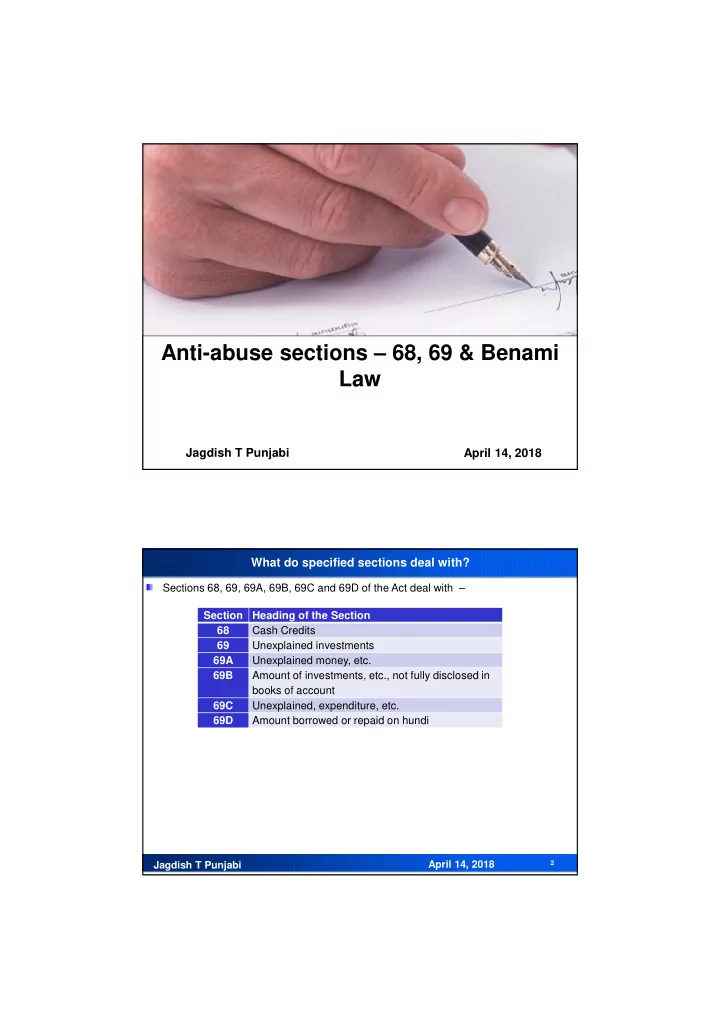
Anti-abuse sections 68, 69 & Benami Law Jagdish T Punjabi - - PDF document
Anti-abuse sections 68, 69 & Benami Law Jagdish T Punjabi April 14, 2018 What do specified sections deal with? Sections 68, 69, 69A, 69B, 69C and 69D of the Act deal with Section Heading of the Section 68 Cash Credits 69
2
3
4
5
6
7
64a[Assessing]
8
9
10
11
12
13
14
Jagdish T Punjabi April 14, 2018
15
16
17
18
19
MAINT AINING OF 'BOOKS' OR 'BOOKS OF ACCOUNT ' As per section 2(12A) of the Income-tax Act, 1961 books include ledgers, day books, cash books, account books and other books, whether kept in the written form or as print outs of data stored in floppy, disc, tape or any other form of electro-magnetic data storage device. In Central Bureau of Investigation v. V.C. Shukla [1998] 3 SCC 410 , the Supreme Court held that 'Book' ordinarily means a collection of sheets of paper or other material, blank, written
Loose sheets or scraps of paper cannot be termed as book, for they can be easily detached and replaced. Thus, spiral notebooks and spiral pads can be regarded as 'books' within the meaning of section 34 of the Indian Evidence Act, 1872, but not the loose sheets of papers contained in the files. Further, to ascertain whether a book of account has been regularly kept, the nature of
shopkeeper who has daily transactions cannot be the same as that of a broker in real estate. Not only their systems of maintaining books of account will differ, but also the yardstick of contemporiness in making entries therein. Jagdish T Punjabi April 14, 2018
20
BOOKS WHICH CAN'T BE CONSIDE RE D AS BOOKS OF ACCOUNT OF T HE ASSE SSE E F OR T HE PURPOSE OF SE CT ION 68 It was held in the case of CIT v. Bhaichand N. Gandni [1982] 11 Taxman 59 (Bom.) that the pass book supplied by the bank to the assessee could not be regarded as the book of the assessee, that is, a book maintained by the assessee or under his instructions. Therefore, a cash credit for the previous year shown in the assessee's bank pass book but not shown in the cash book maintained by the assessee for that year, would not fall within the ambit of section 68 of the Income-tax Act, 1961, and, as such, the sum so credited was not chargeable to tax as the income of the assessee of that previous year. In Smt. Shanta Devi v. CIT [1988] 37 Taxman 104 (Punj. & Har.), it was held that a perusal of section 68 would show that the expression "books" has been used with reference to the word "assessee". In other words, such books have to be books of the assessee himself, and not
be the books of account of the partner. Any cash credit shown therein cannot be brought to tax as income under section 68 in the hands of the partners. Jagdish T Punjabi April 14, 2018
21
IF BOOKS OF ACCOUNT HAVE BE E N RE JE CT E D AND T AX IS L E VIE D ON E ST IMAT E D INCOME , CAN A.O. MAKE AN ADDIT ION F OR CASH CRE DIT UNDE R SE CT ION 68?
22
IF BOOKS OF ACCOUNT HAVE BE E N RE JE CT E D AND T AX IS L E VIE D ON E ST IMAT E D INCOME , CAN A.O. MAKE AN ADDIT ION F OR CASH CRE DIT UNDE R SE CT ION 68?
23
IF BOOKS OF ACCOUNT HAVE BE E N RE JE CT E D AND T AX IS L E VIE D ON E ST IMAT E D INCOME , CAN A.O. MAKE AN ADDIT ION F OR CASH CRE DIT UNDE R SE CT ION 68?
24
IF BOOKS OF ACCOUNT HAVE BE E N RE JE CT E D AND T AX IS L E VIE D ON E ST IMAT E D INCOME , CAN A.O. MAKE AN ADDIT ION F OR CASH CRE DIT UNDE R SE CT ION 68? In Ramcharitar Ram Harihar Prasad v. CIT [1953] 23 ITR 301 (Pat.) it was held that adding up extra estimated profits as well as the amounts of cash credits was open to authorities only when there was material to show that assessee carried on an independent business apart from the business for which assessment was being made. In Maddi Sudarsanam Oil Mills Co. v. CIT [1959] 37 ITR 369 (AP) it was held that where the authorities reject the books of account and estimate the gross profits at a flat rate, they cannot rely on the books for the purpose of adding cash credit which is part of the scheme of balancing accounts to the profits so ascertained. Similar view has been expressed in Reliable Surface Coatings v. Asstt. CIT [2012] 20 taxmann.com 268 (Ahd.). In CIT v. Babban Pandey [1970] 77 ITR 601 (All.) the High Court followed Maddi Sudarsanam Oil Mills Co. case (supra), observing that the decision of the Supreme Court in Kale Khan Mohammad Hanif's case (supra) was not an authority for the contention that where the income
appearing in the business books had to be separately added. In CIT v. Daluram Pannalal Modi [1981] 7 Taxman 92 (MP) it was held that unless the assessee showed by adducing satisfactory evidence that the cash credits were referable to the undisclosed income of the known or disclosed source, namely, the business income from which had already been estimated, the Tribunal could not assume that once the business income was estimated, the unexplained cash credit would be covered by the income so estimated. Jagdish T Punjabi April 14, 2018
25
WHE T HE R AN ADDIT ION CAN BE MADE ON ACCOUNT OF CASH CRE DIT UNDE R SE CT ION 68 E VE N IF NO BOOKS OF ACCOUNT ARE MAINT AINE D? In the case of Anand Ram Raitani v. CIT [1997] 223 ITR 544 (Gau.) it was held that the Assessing Officer before invoking the power under section 68 of the Act must be satisfied that there are books of account maintained by the assessee and the cash credit is recorded in the said books of account. If the assessee fails to satisfy the Assessing Officer, the sum so credited has to be charged to income-tax as the income of the assessee of that previous year. The existence of books of account is a condition precedent for invoking the power and discharging the burden is a subsequent condition.
Jagdish T Punjabi April 14, 2018
26
27
28
29
Addition is not ma nda tor y e ve n whe n e xpla na tion ma y not be sa tisfa c tor y
30
31
32
33
34
35
36
37
38
39
40
41
42
43
44
45
46
47
48
49
50
AT WHAT RAT E DE E ME D INCOME UNDE R SE CT IONS 68, 69, 69A, 69B, 69C AND 69D IS T O BE T AXE D?
51
RE L E VANCE OF E NT RIE S IN T HE BOOKS OF ACCOUNT WIT H RE F E RE NCE T O T HE INDIAN E VIDE NCE ACT , 1872 It has been observed in V.C. Shukla (supra) that according to section 34 of the Indian Evidence Act, 1872, entries in books of account regularly kept in the course of business are relevant whenever they refer to a matter into which the Court has to inquire into. From a plain reading of section 34 it is manifest that to make an entry relevant thereunder it must be shown that it has been made in a book; that book is a book of account and that book of account has been regularly kept in the course of business. From the said section 34 it is also manifest that even if the above requirements are fulfilled and the entry becomes admissible as relevant evidence, still the statement made therein shall alone not be sufficient evidence to charge any person with
entry as evidence, the second part speaks, in a negative way, of its evidentiary value for charging a person with a liability. Where the genuineness and regularity of the accounts have not been challenged, the accounts are relevant, prima facie proof of the entries and the correctness thereof under section 34 of the Evidence Act - Tolaram Daga v. CIT [1966] 59 ITR 632 (Assam); Dhansiram Agarwalla v. CIT [1995] 81 Taxman 1 (Gau.). Jagdish T Punjabi April 14, 2018
52
PROPE R E NQUIRY BE F ORE MAKING ADDIT ION UNDE R SE CT ION 68 Section 68 of the Income-tax Act, 1961 empowers the Assessing Officer to make an enquiry regarding cash credit. If he is satisfied that these entries are not genuine he has every right to add these as income from other sources. But before rejecting the assessee's explanation, A.O. must make proper enquiries. In the absence of proper enquiries, addition cannot be sustained as was held in Khandelwal Constructions v. CIT [1997] 227 ITR 900 (Gau.). The assessee may seek assistance of section 131 of the Act for the purpose of proving its own
for compelling attendance of witnesses. Jagdish T Punjabi April 14, 2018
53
ASSE SSE E 'S RIGHT T O CROSS- E XAMINE The assessee is entitled to cross examine any person whose statement has been recorded by the A.O., if such statement is proposed to be used by the A.O. - CIT v. Eastern Commercial Enterprises [1994] 210 ITR 103 (Cal.) The assessee had on its part produced the discharged hundis and also vouchers showing payment of interest. That was sufficient for the assessee to discharge its initial burden. It was for the ITO to have examined the bankers when he wanted to rely on the statements obtained from them. The A.O. ought to have given an opportunity to the assessee to cross examine the bankers before taking into account the contents of those statements - CIT v. Gani Silk Palace [1988] 37 Taxman 295 (Mad.).
Jagdish T Punjabi April 14, 2018
54
SHARE APPL ICAT ION MONE Y CRE DIT E D IN T HE BOOKS OF T HE COMPANY The position, with effect from assessment year 2013-14 - With effect from assessment year 2013-14, section 68 has been amended to provide that if a closely held company fails to explain the source of share capital, share premium or share application money received by it to the satisfaction of the A.O., the same shall be deemed to be the income of the company under section 68. However, the amendment shall not apply where the share capital, share premium or share application money is received from Venture Capital Fund or Venture Capital Company registered with the SEBI. The position prior to the amendment - Some of the Courts had taken a view that amounts received towards share capital are totally outside the scope of assessment, even if they are unproved, on the ground that they cannot be treated as cash credits falling within the purview of section 68.
Jagdish T Punjabi April 14, 2018
55
SHARE APPL ICAT ION MONE Y CRE DIT E D IN T HE BOOKS OF T HE COMPANY Relevant case laws - The Delhi High Court after a review of the precedents on the subject in CIT v. Divine Leasing & Finance Ltd./Lovely Exports (P.) Ltd. [2007] 158 Taxman 440 in a group
creditworthiness to be proved. Where a company furnishes the address and permanent account number (PAN) of depositor, such identity is established. As regards creditworthiness in a matter
proof that is expected as regards creditworthiness has to be decided in the light of the facts of each case. Where the subscriptions were received through banking channels as prescribed under the SEBI regulations, the inference that the subscribers lacked creditworthiness could not have been lightly drawn without some investigation on the part of the Assessing Officer. The addition without such investigation should be treated as based upon mere surmises. The principle that identity is more important in such cases has been reiterated and that where creditworthiness is not established to the satisfaction of the Assessing Officer, it need not be unexplained income of the company, since the legitimate inference is that the income is that of the subscriber as long as the advance of the amount to the company is established and there is nothing to suggest that the amount belonged to the company. Jagdish T Punjabi April 14, 2018
56
SHARE APPL ICAT ION MONE Y CRE DIT E D IN T HE BOOKS OF T HE COMPANY The SLP of the department in the case of Divine Leasing & Finance Ltd./Lovely Exports(P.) Ltd.(supra) had been dismissed by the Supreme Court 319 ITR (St.) 5 observing as follows: "Can the amount of share money be regarded as undisclosed income under section 68 of the Income-tax Act, 1961? We find no merit in this special leave petition for the simple reason that if the share application money is received by the assessee-company from alleged bogus shareholders, whose names are given to the Assessing Officer, then the Department is free to proceed to reopen their individual assessments in accordance with
The Allahabad High Court in the case of Jaya Securities Ltd. v. CIT [2008] 166 Taxman 7 held that no addition under section 68 can be made in respect of investment made by different persons in the share capital of a company limited by shares, whether public or private. However, in Hindusthan Tea Trading Co. Ltd. v. CIT [2003] 129 Taxman 601 (Cal.) it was held that the amounts received as share capital by way of cheques on nationalised banks after advertisement in newspapers inviting share capital, cannot be subject to addition. Also refer to CIT v. Victor Electrodes Ltd. [2012] 20 taxmann.com 680 (Delhi). Jagdish T Punjabi April 14, 2018
57
SHARE APPL ICAT ION MONE Y CRE DIT E D IN T HE BOOKS OF T HE COMPANY In CIT v. Down Town Hospital (P.) Ltd. [2004] 139 Taxman 247 (Gau.), the High Court reviewed the case law on the subject and concluded, where the identity of the shareholders is established, the further requirement as to the source may not be expected, since the burden shifts to the Revenue once the identity is established. The Delhi High Court in the case of CIT v. Value Capital Services (P.) Ltd. [2008] 307 ITR 334 held that department must show that investment made by subscribers actually emanated from coffers of assessee to be treated as undisclosed income of assessee. A review of the case laws would indicate that the degree of responsibility in respect of share capital on the company may well be less, but it cannot disown the responsibility, especially if it is a private company where the shareholders may ordinarily be expected to be known to the company.
Jagdish T Punjabi April 14, 2018
58
SHARE APPL ICAT ION MONE Y CRE DIT E D IN T HE BOOKS OF T HE COMPANY The same issue came up before the Madras High Court before a different Bench in CIT v. Gobi Textiles Ltd. [2008] 170 Taxman 142 where the assessee had on the request of the Assessing Officer produced evidence regarding share capital contributions of more than Rs. 1 lakh each. Salary certificates were produced to show their identity as well as capacity to subscribe to the
genuineness of one of the shareholders and added the share capital of nine others. The Commissioner (Appeals) not only confirmed the addition but also sustained the penalty. The Tribunal deleted the addition since the assessee had discharged the onus by the identification and proof as to source, so that the addition could only be taken as made on mere surmises. The finding of the Tribunal being one of fact, the High Court declined to interfere. The Chhattisgarh High Court in the case of Asstt. CIT v. Venkateshwar Ispat (P.) Ltd. [2009] 319 ITR 393 held that merely because notice issued to some shareholders was not responded to, their share application money could not be treated as unexplained amount under section 68. Where the assessee furnishes the return of income of the share applicants and their loan confirmations, the burden of the assessee stands discharged - CIT v. Jay Dee Securities & Finance Ltd. [2013] 214 Taxman 62/32 taxmann.com 91 (All.). Jagdish T Punjabi April 14, 2018
59
SHARE APPL ICAT ION MONE Y CRE DIT E D IN T HE BOOKS OF T HE COMPANY The Delhi High Court in the case of CIT v. Orbital Communication (P.) Ltd. [2010] 327 ITR 560 held that where assessee has established the genuineness of the share transaction and the creditworthiness of the applicant, then mere failure to produce the creditor cannot be a ground for making addition under section 68. Also refer to CIT v. Samir Bio-Tech (P.) Ltd. [2010] 325 ITR 294 (Delhi).
However, where information was obtained from investigation wing about accommodation entry providers and their modus operandi, and the list contained the name of the assessee to whom entry providers had provided entries, and further summons to such persons were not responded to, in such a case the affidavits filed by assessee after 2 years from entry providers to the effect that transactions were genuine, were of no evidentiary value. There was no duty on Assessing Officer to prove that monies emanated from coffers of assessee - CIT v. Nova Promoters & Finlease (P.) Ltd. [2012] 206 Taxman 207/18 taxmann.com 217 (Delhi). Jagdish T Punjabi April 14, 2018
60
BURDE N OF PROOF
T E R INVOL VING CASH CRE DIT Prima facie onus is upon the assessee.The Supreme Court in the cases of Roshan Di Hatti v. CIT [1977] 107 ITR 938; Kale Khan Mohammad Hanif(supra) held that the law is well-settled that the onus of proving the source of a sum of money found to have been received by an assessee is on him. Where the nature and source of a receipt, whether of money or other property cannot be satisfactorily explained by the assessee, it is open to the revenue to hold that it is the income of the assessee and no further burden lies on the revenue to show that the income is from any particular source. In the case of Shankar Industries v. CIT [1978] 114 ITR 689, the Calcutta High Court held that it is necessary for the assessee to prove prima facie the transaction which results in a cash credit in his books of account. Such proof includes proof of the identity of his creditor, the capacity of such creditor to advance the money and lastly, the genuineness of the transaction. Only after the assessee has adduced evidence to establish prima facie the aforesaid, the onus shifts to the department. The Supreme Court in the cases of A. Govindarajulu Mudaliar v. CIT [1958] 34 ITR 807; CIT v.
satisfactorily the source and nature of a credit entry in his books and it is held that the relevant amount is the income of the assessee, it is not necessary for the department to locate its exact source. Jagdish T Punjabi April 14, 2018
61
BURDE N OF PROOF
T E R INVOL VING CASH CRE DIT The Kerala High Court in the case of ITO v. Diza Holdings (P.) Ltd. [2002] 120 Taxman 539 held that it was clear in the terms of section 68 that the burden was on the assessee to offer a satisfactory explanation about the nature and source of the amount found credited in the books
mere fact that payment was made by way of account-payee cheque was also not conclusive. Therefore, the A.O. would be entitled to consider whether notwithstanding the fact that the payments were made by cheques, whether the assessee had satisfactorily explained the nature and source of the amounts found credited in the books of the assessee? The Madras High Court in the case of V. Datohinamurthy S. Natarajan v. Asstt. Director of Inspection [1983] 12 Taxman 185 held that it had been a long accepted principle of income-tax law that an assessee was obliged to explain the nature and source of cash credits in his accounts and in the absence of satisfactory explanation on his part, the assessing authorities could very well proceed to treat the amount of cash credits in question as representing the taxpayer's income. Jagdish T Punjabi April 14, 2018
62
BURDE N OF PROOF
T E R INVOL VING CASH CRE DIT The Calcutta High Court in C. Kant & Co. v. CIT [1981] 5 Taxman 64 held that in the case of cash credit entry it was necessary for the assessee to prove not only the identity of the creditors but also to prove the capacity of the creditors to advance the money and the genuineness of the
whether the onus had been discharged in a particular case was a question of fact. In the case of Northern Bengal Jute Trading Co. Ltd. v. CIT [1968] 70 ITR 407 (Cal.) it was held that there could not be one general or universal proposition of law which could be the guiding yardstick in the matter of cash credit. Each case had got to be decided on the facts and circumstances of that case. The surrounding circumstances to be considered must, however, be
facts, evidence adduced before the taxing authorities, presumption of facts based on common human experience in life and reasonable
assessee cannot be decided by the revenue on the basis of surmises, suspicions or probabilities. In S. Hastimal v. CIT [1963] 49 ITR 273 the Madras High Court held that inability of the Department to verify the explanation offered by the assessee was not a sufficient cause for rejection of the explanation. The assessee cannot be presumed to have special knowledge about the source of source or the origin of origin. Jagdish T Punjabi April 14, 2018
63
BURDE N OF PROOF
T E R INVOL VING CASH CRE DIT In Sriram Jhabarmull (Kalimpong) Ltd. v. CIT [1967] 64 ITR 314 the Calcutta High Court held that it was not correct to say that as soon as the initial burden of proof on the part of the assessee was discharged, the ITO was not entitled to reject the assessee's explanation without some other positive evidence falsifying the assessee's case. It cannot be true that any possible explanation which an assessee puts forth for clarifying the source and nature of a cash receipt must have to be accepted by the income-tax department nor can it be lawfully urged that the ITO can arbitrarily reject the assessee's explanation. Delhi High Court in the case of Sona Electric Co. v. CIT [1984] 19 Taxman 160 held that the explanation offered by the assessee can be rejected by the ITO on cogent grounds. When such grounds are themselves based on no evidence, the question of presumption does not arise. In Tolaram Daga(supra), the High Court held that even if the credit is in the name of a close relation, e.g., the wife, the assessee cannot be presumed to have knowledge of the source from which the depositor obtained the money. The fact that an assessee was unable to satisfy the authorities as to the source from which the depositor derived the money could not be used against the assessee. The Allahabad High Court in the case of Sheo Narain Duli Chand v. CIT [1969] 72 ITR 766 held that there is no presumption that witnesses appearing for an assessee come forward to give false evidence to oblige the assessee.
Jagdish T Punjabi April 14, 2018
64
DISCHARGING T HE ONUS T O PROVE 'IDE NT IT Y' Relevant judicial views: Orient Trading Co. Ltd. v. CIT[1963] 49 ITR 723 (Bom.) - When the entry stands in the name
evidence showing that the entry is not fictitious, initial burden lying on the assessee stands discharged; the burden shifts on to the Revenue to show that the entry represents assessee's suppressed income. ITO v. Suresh Kalmadi [1988] 32 TTJ (Pune) (TM) 300 - Where identity of creditor is established and entry is shown not to be fictitious, the burden shifts on to the Department to show as to why the entry still represented the suppressed income of the assessee? The assessee cannot be called upon to prove the worth of the creditor's creditor. The fact that in the books of the creditors exactly the same amounts had been credited in the name of other parties and that immediately after repayment, the creditors withdrew the money could not lead to any adverse inference when this was their modus operandi and assessee's case was not the solitary transaction. In this case the creditors appeared before the ITO; produced their books and admitted categorically having advanced money to the assessee. Furthermore, a diary was seized in a search of assessee's premises in 1980 alleged to contain certain entries showing payments, whereas the assessee was called upon in 1983 to explain the entries in diary and assessee produced proof of confirmation of the creditors and their addresses, etc.. Therefore, the period of three years could not be said to be bought by assessee to manufacture evidence. The assessee could, therefore, be taken as having established that he had borrowed money from the creditors and no addition was, therefore, called for. Jagdish T Punjabi April 14, 2018
65
DISCHARGING T HE ONUS T O PROVE 'IDE NT IT Y' ITO v. B. Wariyam Singh Bhagat Singh [1987] 27 TTJ (All.) 501 - The assessee produced confirmatory letters from the creditors which neither contained their addresses nor their permanent account numbers. The AAC, without considering the same, deleted the addition. The Tribunal held that deletion in first appeal was not justified. In Gumani Ram Siri Ram v. CIT [1975] 98 ITR 337 (Punj. & Har.) it was held that in a case, where the entry stands in the name of an independent third party, the burden will still lie upon the assessee to establish the identity of the said third party, and to satisfy the A.O. that the entry is real and not fictitious. [distinguishing Tolaram Daga (supra)].
Jagdish T Punjabi April 14, 2018
66
DISCHARGING T HE ONUS T O PROVE 'CAPACIT Y T O ADVANCE MONE Y' OR 'CRE DIT WORT HINE SS' In case ofShankar Ghosh v. ITO [1985] 13 ITD 440 (Cal.) the assessee failed to prove the capacity of the person from whom he had allegedly taken loan. Further, assessee could not explain the need for loan and the manner in which the loan amount was spent. The creditor had issued two letters demanding repayment but did nothing on non-compliance therewith. Such letters did not, therefore, carry any conviction about the explanation of the assessee. The burden not having been discharged by assessee, loan amount was rightly held as assessee's
In case of Jagadamba Construction Co. v. ITO [2004] 3 SOT 670 (Jodh.) some of the creditors were produced before the A.O. while affidavits of some of them had been produced. Balance sheets of some of the creditors were also produced wherein the transactions were entered into. Some of the creditors had filed confirmations. Cash creditors were income-tax assessees who also had bank accounts. The finding of the A.O. that the creditors were not creditworthy was not
adverse to the claim of the assessee. Thus, when the cash credit stand was explained, no addition, including addition on account of interest thereon, was justified. Jagdish T Punjabi April 14, 2018
67
DISCHARGING T HE ONUS T O PROVE 'GE NUINE NE SS' Case of Sikri & Co. (P.) Ltd. v. CIT [1977] 106 ITR 682 (Cal.)- In case of cash credit the assessee has to prove the genuineness of cash credits. In this case summons issued by ITO to creditors were not served as creditors were not traceable and the assessee gave no further information regarding whereabouts of creditors. No other evidence was produced by the assessee to show creditworthiness of creditors. The creditors were also shown to have denied advancing any loan to assessee before their respective ITOs. Held that cash credit was rightly assessed as income from undisclosed sources. Case of CIT v. Sahibganj Electric Cables (P.) Ltd. [1978] 115 ITR 408 (Cal.) - Amounts of loan were received by cheques and repayments were also made by cheques through assessee's bankers. The creditors gave confirmation letters mentioning their Income-tax file
made addition. ITAT held the addition was not justified as the assessee had discharged the
Case of CIT v. Korlay Trading Co. Ltd. [1998] 232 ITR 820 (Cal.)- Mere filing of the income- tax file number of the creditors was not enough to prove the genuineness of the cash credit. The creditor had to be identified. There should be creditworthiness. There should be a genuine transaction. Jagdish T Punjabi April 14, 2018
68
DISCHARGING T HE ONUS T O PROVE 'GE NUINE NE SS' Bhagawandas Sharda v. Asstt. CIT [2004] 4 SOT 469 (Hyd.)- Lender, an income-tax assessee, confirmed the loan but could not be produced as he was not available. The loan was cleared by assessee before assessment proceedings started. Onus on assessee stood
enquired from the bank. The only ground for addition being that cash was deposited and cheque issued to assessee on the same day could create a suspicion but not proof. The addition was deleted – Rulings in cases of CIT v. Daulat Ram Rawatmull [1973] 87 ITR 349 (SC), Sreelekha Banerjee v. CIT [1963] 49 ITR 112 (SC), CIT v. Luxmi Trading Co. [1979] 117 ITR 439 (Cal.) and Dhakeswari Cotton Mills Ltd. v. CIT [1954] 26 ITR 775 (SC) were relied on. In Nemi Chand Kothari v. CIT [2004] 136 Taxman 213 (Gau.) the assessee who carried on the business of supply of bamboo had taken loans amounting to Rs. 4,35,000 and Rs. 5 lakhs during the previous year, relevant to the assessment year 1992-93. The amounts were paid by cheques by the creditors to the assessee. The creditors received the said amount by way of loans from their sub-creditors by means of cheques. The A.O. declined to treat the loan amount
extent of Rs. 4,25,000 as genuine. The A.O. added the two amounts to the total income of assessee as income from undisclosed sources. The Tribunal set aside the order passed by the Commissioner (Appeals) and upheld the order of the A.O. on the ground that neither the sub- creditors nor the creditors in question had creditworthiness to advance the said loans. Jagdish T Punjabi April 14, 2018
69
DISCHARGING T HE ONUS T O PROVE 'GE NUINE NE SS' On appeal the Gauhati High Court held as follows- (i) that the assessee had established the identity of the creditors. The assessee had also shown in accordance with the burden which rested on him under section 106 of the Evidence Act, that the said amounts had been received by him by way of cheques from the creditors which was not in dispute. Once the assessee had established these, the assessee must be taken to have proved that the creditor had the creditworthiness to advance the loans. Thereafter, the burden had shifted to the A.O. to prove the contrary. (ii) that the failure on the part of the creditors to show that their sub-creditors had creditworthiness to advance the said loan amounts to the assessee, could not, under the law be treated as the income from undisclosed sources of the assessee himself, when there was neither direct nor circumstantial evidence on record that the said loan amounts actually belonged to, or were owned by, the assessee. The A.O. failed to show that the amounts, which had come to the hands of the creditors from the hands of the sub-creditors, had actually been received by the sub-creditors from the assessee. Therefore, the A.O. could not have treated the said amounts as income derived by the assessee from undisclosed sources.
Jagdish T Punjabi April 14, 2018
70
DISCHARGING T HE ONUS T O PROVE 'GE NUINE NE SS' (iii) that no assessment could be made contrary to the provisions of law. In the instant case, the very basis for making the assessment was under challenge. If the assessment was based
fact, but must be treated as substantial questions of law. Therefore, the question raised in the appeal was a substantial question of law because it went to the very root of the assessment made. (iv) that a person may have funds from any source and an assessee, on such information received, may take a loan from such a person. It is not the business of the assessee to find out whether the source or sources from which the creditor had agreed to advance the amounts were genuine or not. If a creditor has, by any undisclosed source, a particular amount of money in the bank, there is no limitation under the law on the part of the assessee to obtain such amount of money or part thereof from the creditor, by way of cheque in the form of loan and in such a case, if the creditor fails to satisfy as to how he had actually received the said amount and happened to keep it in the bank, the said amount cannot be treated as income of the assessee from undisclosed sources. . Jagdish T Punjabi April 14, 2018
71
DISCHARGING T HE ONUS T O PROVE 'GE NUINE NE SS' The above decision is likely to have far reaching effect with regard to provisions of section 68. It is praiseworthy that the Gauhati High Court has added a new dimension by reading section 68 together with section 106 of the Indian Evidence Act. Now, in view of the above decision, a creditor's creditworthiness has to be judged vis-a-vis transactions, which have taken place between the assessee and the creditor and, it is not business of assessee to find out source of money of his creditor or genuineness of his transactions, which took place between creditor and sub-creditor and/or creditworthiness of sub-creditors for these aspects may not be within special knowledge of the assessee.
Jagdish T Punjabi April 14, 2018
72
T RE AT ME NT OF CRE DIT S IN ROUGH CASH BOOK AND E VIDE NT IARY VAL UE OF AF F IDAVIT S ' TREATMENT OF CREDITS IN ROUGH CASH BOOK Where cash credits are recorded in the rough cash book of the assessee and there is no proper explanation, section 68 will apply and the credit amount will be assessable as income of the assessee - Haji Nazir Hussain v. ITO [2004] 91 ITD 42 (Delhi). EVIDENTIARY VALUE OF THE AFFIDAVITS Where the subscribers of the shares had availed of accommodation entries from professional name-lenders and there had been no response to the summons issued to the subscribers It was held in CIT v. Nova Promoters & Finlease (P.) Ltd. [2012] 18 taxmann.com 217/206 Taxman 207 (Delhi)that there was no evidentiary value of the affidavits filed after two years, specifically in view of the fact that subscribers did not appear or respond to the summons and issued statement before investigation wing that share application was accommodation entry. Affidavit unless rebutted has evidentiary value – Meha Parikh 30 ITR (Ashok Sharma)
Jagdish T Punjabi April 14, 2018
73
Unde r whic h he a d c a n inc ome a sse ssa ble unde r
g e d ? Income assessable under section 68 cannot be assessed under any particular head of income including income from other sources under section 56 [AY 2006-07] – ITO v. Dulari Digital Photo Services (P.) Ltd. [2012] 24 taxmann.com 31 / 53 SOT 210 (URO)(Chd.). Income can be taxed under a specific head of income as enumerated in section 14 only when it is possible to peg the same to a known source / head of income. If the nature and source of a particular receipt is not known, it cannot then be pegged to a known source / head of income. Chapter IV contemplates computation of income arising from known sources / heads of income whereas Chapter VI, on the other hand, contemplates aggregation of the netire sum the nature and sources of which are not known. The aforesaid two Chapters are completely different in their nature, scope and effect. Though the incomes assessable under them are part of total income as defined in section 2(45) or section 4 or section 5 yet that does not mean that thte income assessable under section 68 has to be assessed under section 56. Income from unexplained or unknown sources cannot therefore be considered or taxed as Income from other sources.
Jagdish T Punjabi April 14, 2018
74
Cash receipts found during search - Where register seized during search conducted at assessee's premises revealed cash receipts in name of 15 persons, though assessee stated that said cash receipts were realization of sales effected in earlier years by erstwhile firm in which he was partner and filed confirmations of seven parties but when letters were sent to said parties, same were returned by post office marked 'not known' and other parties also either did not respond or denied any relationship with firm, Assessing Officer was justified in treating said receipts as unexplained and making addition under section 68 - Vijay Kumar Talwar v. CIT [2011] 196 Taxman 136 / [2010] 8 taxmann.com 264 (SC). SHARE APPLICATION MONEY- Creditworthiness or genuineness of transaction depends on whether two parties are related or known to each other, manner or mode by which parties approached each other, whether transaction was entered into through written documentation to protect investment, whether investor professes and was an angel investor, quantum of money, creditworthiness of recipient, object and purpose for which payment /investment was made, etc. Certificate of incorporation of company, payment by banking channel, etc. cannot in all cases tantamount to satisfactory discharge of onus- C!T v.N R. Portfolio (P.) Ltd [2014] 42 taxmann.com 339/222 Taxman 157 (Mag.) (Delhi). Jagdish T Punjabi April 14, 2018
75
Where the matter concerns money receipts by way of share application from investors through banking channel, the assessee has to prove the existence of the person in whose name the share application is received. Once the existence of the investor is proved, it is not further the burden of the assessee to prove whether that person itself has invested the said money or some other person has made investment in the name of that person. The burden then shifts on to the revenue to establish that such investment has come from the assessee- company itself. Once the receipt of the confirmation letter from the creditor is proved and the identity and the existence of the investor has not been disputed, no addition on account of share application money in the name of such investor can be made in the assessee's hands - Shree Barkha Synthetics Ltd v. Asstt. CIT[2006] 155 Taxman 289 (Raj.). Jagdish T Punjabi April 14, 2018
76
In the case of a public issue, the company concerned cannot be expected to know every detail pertaining to the identity as well as financial worth of each of its subscribers. The company must, however, maintain and make available to the Assessing Officer for his perusal all the information contained in the statutory share application documents. In the case of private placement the legal regime would not be the same. A delicate balance must be maintained while walking the tightrope of sections 68 and 69. The burden of proof can seldom be discharged to the hilt by the assessee; if the Assessing Officer harbours doubts of the legitimacy of any subscription, he is empowered, nay duty bound, to carry out thorough
cannot obdurately adhere to his suspicions and treat the subscribed capital as the undisclosed income of the company. A distillation of the precedents yields the following propositions of law in the context of section 68: The assessee has to prima facie prove (1) the identity of the creditor / subscriber; (2) the genuineness of the transaction, namely, whether it has been transmitted through banking or other indisputable channels; (3) the creditworthiness or financial strength
subscriber are furnished to the Department along with copies of the shareholders' register, share application forms, share transfer register, etc., it would constitute acceptable proof or acceptable explanation by the assessee; (5) the Department would not be justified in drawing an adverse inference only because the creditor / subscriber fails or neglects to respond to its Jagdish T Punjabi April 14, 2018
77
notices; (6) the onus would not stand discharged if the creditor/ subscriber denies or repudiates the transaction set up by the assessee nor should the Assessing Officer take such repudiation at face value and construe it, without more, against the assessee; (7) the Assessing Officer is duty bound to investigate the creditworthiness of the creditor / subscriber, the genuineness
[2007] 158 Taxman 440 (Delhi). If the share application money is received by the assessee-company from alleged bogus shareholders, whose names are given to the Assessing Officer, then the department is free to proceed to reopen their individual assessments in accordance with law but this amount of share money cannot be regarded as undisclosed income under section 68 of the assessee company- CIT v. Lovely Exports (P.) Ltd. [2008] 216 CTR (SC) 195. If department wants to make addition on account of share application money, burden is on the Department to show that even if applicant did not have means to make investment, investment made by assessee actually emanated from coffers of assessee so as to enable it to be treated as undisclosed income of assessee- CIT v. Value Capital Services (P.) Ltd. [2008] 307 ITR 334 (Delhi). Jagdish T Punjabi April 14, 2018
78
Where in respect of share application money received by assessee, all applicants had given confirmation of advancing money, and assessee had proved identity and creditworthiness of applicants and in respect
found that said person was a man of means and his creditworthiness could not be doubted, Tribunal was justified in deleting additions made on account of said share application money and loan- CIT v. VLS Foods (P.) Ltd. [2011] 203 Taxman 213/ 15 taxmann.com 225 (Delhi). Certificate of incorporation, PAN etc., are not sufficient for purpose of identification of subscriber company when there was material to show that subscriber was a paper company and not a genuine investor- CIT v. Navodaya Castles (P.) Ltd. [2014] 226 Taxman 190 (Mag.)/ 50 taxmann.com 110 (Delhi) [SLP dismissed in Navodaya Castle (P.) Ltd. v. CIT [2015] 56 taxmann.com 18/230 Taxman 268 (SC)] Assessee has to establish identity
subscribers to share capital and prove their creditworthiness and genuineness of transaction; furnishing of income-tax file numbers may not be sufficient to discharge the burden- CITv. Nivedan Vanijya Niyojan Ltd. [2003] 130 Taxman 153 (Cal.). Jagdish T Punjabi April 14, 2018
79
In CIT v. N Tarika Properties Investment (P.) Ltd. [2013] 40 taxmann.com 525/[2014] 221 Taxman 14 (Delhi) [SLP dismissed in N Tarika Property Invest. (P.) Ltd. v. CIT [2014] 51 taxmann.com 387/227 Taxman 373 (SC)] the assessee-company was required to give information about respective persons who had subscribed to its share capital. On enquiry, the Assessing Officer found that the subscribers' bank account statements were forged and fabricated as there were corresponding cash deposits in the bank accounts before issue of share application cheques and that the deposits were through cash or transfer entries from same bank of entry operators. It was held that since false evidence had been adduced by the assessee to give colour of genuineness to bogus entries through the bank accounts and deposits, which were mostly by cash, the Assessing Officer was justified in making addition. Where Commissioner, in section 263 proceedings, set aside ITO's order holding that there was a device used by assessee for converting black money by issuing shares and ITO failed to conduct detailed investigation into genuineness of shareholders and Tribunal reversed Commissioner's order and rejected reference application, Tribunal came to a conclusion on facts and as such no interference was called for- CITv. S teller Investment Ltd [2001] 115 Taxman 99 (SC). Note: See amendments to section 68 by the Finance Act, 2012. Jagdish T Punjabi April 14, 2018
80
No deductions are allowable against deemed income The Gujarat High Court in the case of Fakir Mohmed Haji Hasan v. CIT [2001] 247 ITR 290/[2002] 120 Taxman 11 held that the opening words of section 14 ‘save as otherwise provided by this Act’? clearly leave scope for ‘deemed income’ of the nature covered under the scheme of sections 69, 69A, 69B and 69C being treated separately because such deemed income is not income from salary, house property, profits and gains of business or profession,
69A, 69B and 69C treat unexplained investments, unexplained money, bullion, etc., and unexplained expenditure as deemed income where the nature and scope of acquisition, investment or expenditure have not been explained or satisfactorily explained. Therefore, in these cases, the sources not being known such deemed income will not fall even under the head ‘Income from other sources’. Therefore, the deductions which are applicable to the incomes under any of these various heads, will not be attracted in case of deemed income which are covered under the provisions
Jagdish T Punjabi April 14, 2018
81
Jagdish T Punjabi February 19, 2016
82
83
84
85
86
87
88
89
90
91
92
93
94
95
96
97
Jagdish T Punjabi April 14, 2018
98
99
100
101
102
Jagdish T Punjabi April 14, 2018
103
104
105
106
107
108
Jagdish T Punjabi April 14, 2018
109
Jagdish T Punjabi April 14, 2018
110
111
112
113
114
115
Share application money cannot be treated as unexplained credit if the AO does not make any investigation on the documentary evidences filed by the assessee or ask for the production of the investors for examination u/s 131 or if adverse material is found during search to prove that share application money is bogus or an arranged affair of the assessee. The A.O. however, did not make any further enquiry on the documents filed by the assessee-company. The A.O. thus, failed to conduct any enquiry and scrutiny of the documents at assessment stage and merely suspected the transaction between the Investor Company and assessee-company because the Investor Company was from
addition against the assessee-company. No cash was found deposited in the account of the Investor. Therefore, the totality of the facts and circumstances clearly prove that assessee-company discharged initial onus to prove identity of the Investor Company, its creditworthiness and genuineness of the transaction in the matter. Jagdish T Punjabi April 14, 2018
116
117
118
119
120
121
122
123
124
125
126
127
128
129
130
131
132
134
135
In the 57th Report of the Law Commission of India on benami transactions, regarding benami transactions in general, it was stated, with reference to judicial decisions, thus: "Principle that transaction is presumed to be for benefit of person providing money. The principle is that where property is acquired in the name of one person but the purchase price is paid by another, a presumption arises that the transaction was one for the benefit of the person providing the money. Such cases are common in India where benami transactions are recognised. Benamidar representing the true owner. — In general, the benamidar fully represents the
able to challenge his title so long as the real owner does not come in the picture. Position as between real owner and third parties. — As to the position between the real
any assertions about title. If however, such a situation does arise, then the law will have regard to the reality, and (disregarding the ostensible title of the benamidar), the law will allow the real
Jagdish T Punjabi April 14, 2018
136
Originally, the President, following the recommendations of the 57th Law Commission Report promulgated the Benami Transactions (Prohibition of Right to Recover Property) Ordinance, 1988, on 19th May, 1988. Thereafter, the Benami Transactions (Prohibition) Bill, 1988 was passed by both the houses of Parliament and on 5th September, 1988, it became the Benami Transactions (Prohibition) Act, 1988 (hereinafter referred to as “the Original Act”). The Original Act was a small Act with 9 sections. The Benami Transactions (Prohibition) Amendment Act, 2016 (hereinafter referred to as “the Amending Act”) has amended the Original Act and has enlarged it from an Act having 9 sections to an Act having 72 sections. The Amending Act has even renamed the Original Act as “The Prohibition of Benami Property Transactions Act, 1988”. The Amending Act has come into force on 1.11.2016. Jagdish T Punjabi April 14, 2018
137
Date The Benami Transactions (Prohibition) Act, 1988 (hereinafter referred to as “the Original Act”) was a small Act with 9 sections when originally enacted. The Benami Transactions (Prohibition) Amendment Act, 2016 (hereinafter referred to as “the Amending Act”) has amended the Original Act and has enlarged it from an Act having 9 sections to an Act having 72 sections. The Amending Act has even renamed the Original Act as “The Prohibition of Benami Property Transactions Act Jagdish T Punjabi April 14, 2018
Ma y 13, 2015 T he Be na mi T ra nsa c tio ns (Pro hib tio n) Ame nd me nt Bill, 2015 intro duc e d in L
pro visio ns to the Orig ina l Ac t April 28, 2016 Sta nding c o mmitte e sub mitte d its re po rt upo n e xa mina tio n o f the Bill July 22, 2016 Go ve rnme nt pro po se d a me ndme nts to the Ame nd me nt Bill, 2015 July 27, 2016 Ame nd me nt Bill wa s pa sse d b y L
Aug 2, 2016 Ra jya Sa b ha a ppro ve d the Ame nd me nt Bill Aug 10, 2016 Pre side nt g a ve his a sse nt to the Ame nding Ac t No v 1, 2016 Da te o n whic h the Ame nding Ac t c a me into fo rc e No v 1, 2016 T he Pro hib itio n o f Be na mi Pro pe rty T ra nsa c tio ns Rule s, 2016 c a me into fo rc e
138
Benami transactions, a practice common to all communities and prevalent in this country for a very long time, have received judicial recognition from very early times, as would be seen from the classic decisions of the Privy Council in Gopeekrist Gosain v. Gungapersaud Gosain [1854] 6 MIA 53, in Mt. Bilas Kunwar v. Desraj Ranjit Singh AIR [1915] PC 96 and in GurNarayan v. Sheo Lal Singh AIR [1918] PC 140. What then were benami transactions, as understood prior to the Act? As early as 1908, the Privy Council, in Petherpermal Chetty v. Muniandy Servai [1908] ILR 35 Cal. 551 at 558, approved the statement in Mayne's Hindu Law (7th edition) as correct. The Privy Council
Jagdish T Punjabi April 14, 2018
139
"In Mayne's Hindu Law (7th edn., p. 595, para 446), the result of the authorities, on the subject
'446 . .. Where a transaction is once made out to be a mere benami, it is evident that the benamidar absolutely disappears from the title. His name is simply an alias for that of the person beneficially interested. The fact that A has assumed the name of B in order to cheat X can be no reason whatever why a Court should assist or permit B to cheat A. But, if A requires the help of the Court to get the estate back into his own possession, or to get the title into his own name, it may be very material to consider whether A has actually cheated X or not. If he has done so by means of his alias, then it has ceased to be a mere mask, and has become reality. It may be very proper for a Court to say that it will not allow him to resume the individuality which he has once cast off in order to defraud others. If, however, he has not defrauded anyone, there can be no reason why the Court should punish his intention by giving his estate away to B, whose roguery is even more complicated than his
been allowed to recover property which they had assigned away ... where they had intended to defraud creditors, who, in fact, were never injured... But, where the fraudulent
maxim applies: In pari delicto potior est conditio possidentis. The court will help neither
Jagdish T Punjabi April 14, 2018
140
Is there any difference between benami and sham transactions? In a very early decision of the Madras High Court in Rangappa Nayakar v. Rangasami Nayakar AIR 1925 Mad. 1005 it was held thus: ".. .The essence therefore of a sham transaction is that though a registered deed is brought into existence no title of any kind, either legal or beneficial is intended to be passed thereby to any person whatsoever, that is to say, the deed of transfer is not intended to effect any transfer of property. The difference therefore between sham transactions and benami transactions is one of intention. If the deed of transfer is made with the intention of placing the property in the name of third person, the intention clearly amounts to a transfer of the legal title and such a transaction can scarcely be called a sham transaction, but comes directly within the meaning of benami transactions properly so called." (p. 1008) Jagdish T Punjabi April 14, 2018
141
We have the direct authority of the Supreme Court in at least two decisions. In Sree Meenakshi Mills Ltd. v. CIT [1957] 31 ITR 28, Justice Venkatarama Ayyar, speaking for the Court, held thus: ". . . In this connection, it is necessary to note that the word 'benami' is used to denote two classes of transactions which differ from each other in their legal character and incidents. In one sense, it signifies a transaction which is real, as for example, when A sells properties to B but the sale deed mentions X as the purchaser. Here the sale itself is genuine, but the real purchaser is B, X being his benamidar. This is the class of transactions which is usually termed as benami. But the word 'benami' is also occasionally used, perhaps not quite accurately, to refer to a sham transaction, as for example, when A purports to sell his property to B without intending that his title should cease or pass to B. The fundamental difference between these two classes of transactions is that whereas in the former there is an operative transfer resulting in the vesting of title in the transferee, in the latter there is none such, the transferor continuing to retain the title notwithstanding the execution of the transfer deed. It is only in the former class of cases that it would be necessary, when a dispute arises as to whether the person named in the deed is the real transferee or B, to enquire into the question as to who paid the consideration for the transfer, X or B. But in the latter class of cases, when the question is whether the transfer is genuine or sham, the point for decision would be, not who paid the consideration but whether any consideration was paid. . . ." (p. 52) Jagdish T Punjabi April 14, 2018
142
143
144
145
146
147
Jagdish T Punjabi April 14, 2018 Orig ina l Ac t Ame nde d Ac t
148
Jagdish T Punjabi April 14, 2018
149
150
Ac quisition of be na mi prope rty a nd Ac t not to a pply in c e rta in c a se s – Ss 5 a nd 6 of the orig ina l Ac t 5 Property held benami liable to acquisition - (1) All properties held benami shall be subject to acquisition by such authority, in such manner and after following such procedure, as may be prescribed. (2) For the removal of doubts, it is hereby declared that no amount shall be payable for the acquisition of any property under sub-section (1). 6 Act not to apply in certain cases – Nothing in this Act shall affect the provisions of section 53 of Transfer of Property Act, 1882, or any law relating to transfers for an illegal purpose.” Jagdish T Punjabi April 14, 2018
151
152
` sha m tra nsa c tion’ – is it a ` be na mi tra nsa c tion’ a s pe r the orig ina l Ac t
The Act has provided a definition for 'benami transaction'. It means any transaction in which property is transferred to one person for a consideration paid or provided by another. It contemplates cases where (a ) there is a transfer of property, and (b) the consideration is paid
a sham document, there is no consideration for the transaction which does not satisfy the definition of 'benami transaction' under the Act. The definition of 'benami transaction' in the Act, thus, excludes from its purview a sham transaction. Further, section 81 of the Indian Trusts Act, 1882, applies to a transaction under which no transfer was intended and no consideration passed, i.e., to a sham transaction. But section 82 provides for another class of transactions which are also statutorily treated as obligations in the nature of a trust and they relate to transfer to one for consideration paid by another. It is significant that section 82 has practically been bodily lifted and incorporated in the definition of 'benami transaction' in the present Act. This definition has nothing to do with the concept contained in section 81. If the Act intended to embrace transactions covered by section 81 also, there was no reason for restricting the definition of 'benami transaction' to the phraseology employed in section 82. This also gives an indication that sham transactions, loosely called benami transactions, which are in fact not benami transactions in the real sense of the term, are not subject to the rigour of the
word 'benami'. But that makes no qualitative difference in the application of the Act. Jagdish T Punjabi April 14, 2018
153
As regards applicability of s. 4 it held that – “Ss. 3 and 4 have to be read and understood together. They are not disjunctive provisions in a comprehensive legislation intended to prohibit benami transactions. Sections 3 and 4 are complementary to each other and intended to achieve the same object. While section 3 prohibits the creation of any 'benami transaction', section 4 prevents any suit, claim or action to enforce any right in respect of any property 'held benami'. It is only when any right in respect of a property 'held benami' is sought to be enforced in any suit or claim that section 4 is attracted. 'Hold' according to Black's Dictionary means 'to possess by virtue of a lawful title as in the expression, common in grants, to have and to hold, to possess, to occupy, to be in possession and administration of. In the context and setting
possession or occupation is not benami, section 4 can have no application. An intended benami does not confer even pretended rights. A benami transaction where the property is so held as benami is the subject of the statutory prohibition under sections 3 and 4. The definition of 'benami transaction' is inextricably connected with all the provisions of the Act, as the Act is intended 'to prohibit benami transactions and the right to recover property held benami and for matters connected therewith or incidental thereto'. S. 4 cannot be invoked in case of transactions which were sham or only nominal.” Jagdish T Punjabi April 14, 2018
154
1[Prohibition of Benami Property
Jagdish T Punjabi April 14, 2018
155
156
157
158
159
160
Jagdish T Punjabi April 14, 2018
161
162
163
‘3. Prohibition of benami transactions (1) No person shall enter into any benami transaction. (2) Whoever enters into any benami transaction shall be punishable with imprisonment for a term which may extend to three years or with fine or with both. (3) Whoever enters into any benami transaction on and after the date of commencement of the Benami Transactions (Prohibition) Amendment Act, 2016, shall, notwithstanding anything contained in sub-section (2), be punishable in accordance with the provisions contained in Chapter VII."; _________________________________________________________________________ Present sub-section (2) was earlier sub-section (3) and sub-section (2) under the Old Act was – “(2) Nothing in sub-section (1) shall apply to – (a) the purchase of property by any person in the name of his wife or unmarried daughter and it shall be presumed, unless the contrary is proved, that the said property had been purchased for the benefit of the wife or the unmarried daughter; (b) the securities held by a – (i) depository as registered owner under sub-section (1) of section 10 of the Depositories Act, 1996 (22 of 1996); (ii) Participant as an agent of a depository. Explanation: The expressions “depository” and “participants” shall have the meanings respectively assigned to them in clauses (e) and (g) of sub-section (1) of section 2 of the Depositories Act, 1996. Jagdish T Punjabi April 14, 2018
164
The following are the legal consequences of benami transactions: 1 Benami transaction is a punishable offence – Whoever enters into any benami transaction shall be punishable with imprisonment for a term which may be extend to three years or with fine or with both – Section 3(2) of the Act [Formerly section 3(3) of the Act]. 2 Prohibition of the right to recover property held benami – No suit, claim or action to enforce any right in respect of any property held benami against the person in whose name this property is held or against any other person shall lie by or on behalf of a person claiming to be the real owner of such property – Section 4(1) 3 No defence based on any right in respect of any property held benami, whether against the person in whose name the property is held or against any other person, shall be allowed in any suit, claim or action or by or on behalf of a person claiming to be the real owner
4 Property held benami liable to confiscation
matter of benami transaction, shall be liable to be confiscated by the Central Government – New section 5 as substituted by the 2016 Amendment Act. Jagdish T Punjabi April 14, 2018
165
5 Prohibition on re-transfer of property by benamidar – No person, being a benamidar shall re-transfer the benami property held by him to the beneficial owner or any other person acting on his behalf – New section 6(1). Any such re-transfer shall be null and void – New section 6(2). However, this prohibition shall not apply where the re-transfer is made in accordance with the Income Declaration Scheme, 2016 – i.e. in accordance with section 190 of the Finance Act, 2016 – New section 6(3). Jagdish T Punjabi April 14, 2018
166
“4. Prohibition of the right to recover property held benami (1) No suit, claim or action to enforce any right in respect of any property held benami against the person in whose name the property is held or against any other person shall lie by or on behalf of a person claiming to be the real owner of such property. (2) No defense based on any right in respect of any property held benami, whether against the person in whose name the property is held or against any other person, shall be allowed in any suit, claim or action by or on behalf of a person claiming to be the real
__________________________________________________________________________ Omitted by the Benami Transactions (Prohibition) Amendment Act, 2016, w.e.f. 1-11-
(3) Nothing in this section shall apply,—(a) where the person in whose name the property is held is a coparcener in a Hindu undivided family and the property is held for the benefit of the coparceners in the family; or(b) where the person in whose name the property is held is a trustee or other person standing in a fiduciary capacity, and the property is held for the benefit of another person for whom he is a trustee or towards whom he stands in such capacity." Jagdish T Punjabi April 14, 2018
167
Confisc a tion of be na mi prope rty a nd prohibition on re -tra nsfe r of prope rty by be na mida r – Ss 5 a nd 6
April 14, 2018
168
B.Com., B.G.L., FCA. February 19, 2016