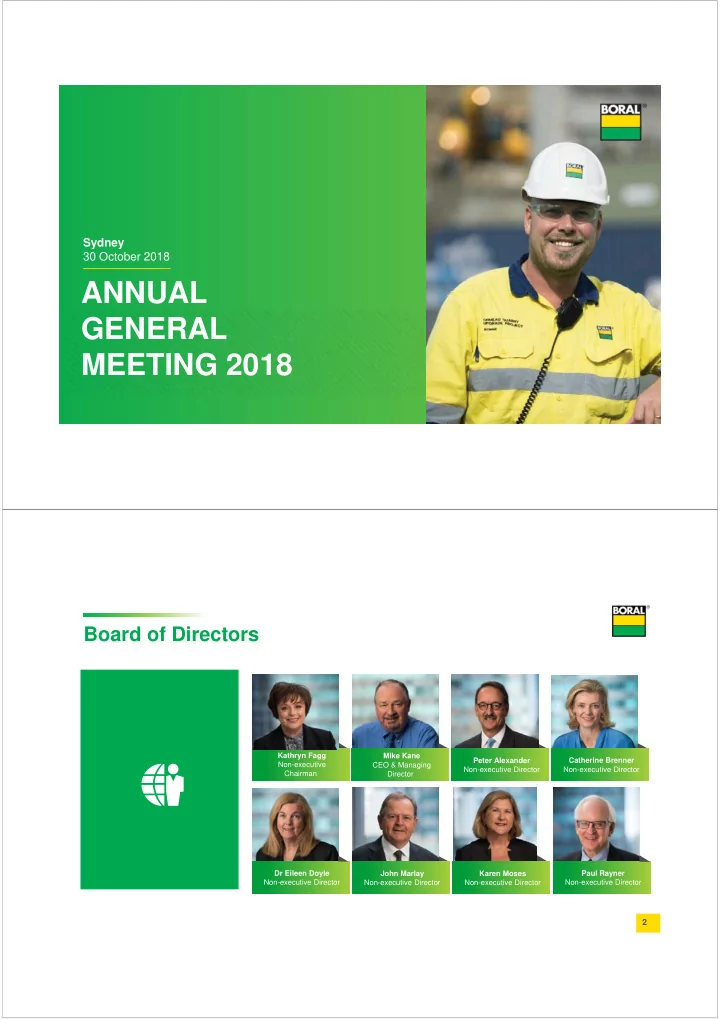
ANNUAL GENERAL MEETING 2018 Board of Directors Kathryn Fagg Mike - - PDF document

annual general meeting 2018
SMART_READER_LITE
LIVE PREVIEW

ANNUAL GENERAL MEETING 2018 Board of Directors Kathryn Fagg Mike - - PDF document

Sydney 30 October 2018 ANNUAL GENERAL MEETING 2018 Board of Directors Kathryn Fagg Mike Kane Catherine Brenner Peter Alexander Non-executive CEO & Managing Non-executive Director Non-executive Director


slide-1
SLIDE 1

ANNUAL GENERAL MEETING 2018

Sydney 30 October 2018

2

Board of Directors

  • Karen Moses
  • Non-executive Director
  • Mike Kane
  • CEO & Managing

Director

  • John Marlay
  • Non-executive Director
  • Dr Eileen Doyle
  • Non-executive Director
  • Kathryn Fagg
  • Non-executive

Chairman

  • Peter Alexander
  • Non-executive Director
  • Catherine Brenner
  • Non-executive Director
  • Paul Rayner
  • Non-executive Director
slide-2
SLIDE 2

3

Executive Committee

Frederic de Rougemont CEO, USG Boral Mike Kane CEO & Managing Director Rosaline Ng Chief Financial Officer Joe Goss Divisional Chief Executive, Boral Australia David Mariner President and CEO, Boral North America Ross Harper Executive General Manager, Cement (reporting to Joe Goss) Linda Coates Group Human Resources Director Kylie FitzGerald Group Communications & Investor Relations Director Dominic Millgate Company Secretary Damien Sullivan Group General Counsel Michael Wilson Group Health, Safety & Environment Director Tim Ryan Group Strategy and M&A Director (reporting to Ros Ng)

4

  • Greg Price

Executive General Manager – NSW/ACT Wayne Manners Executive General Manager WA/NT, Building Products Lloyd Wallace Executive General Manager – Southern Region

Other key executives attending AGM

Steve Dadd Executive General Manager - Timber Dr Richard Strauch Group Environmental Advisor

slide-3
SLIDE 3

Chairman’s address

Kathryn Fagg

6

FY2018 achievements

Delivering transformation and improved earnings

1. Excluding significant items. 2. Excluding amortisation of acquired intangibles. 3. FY2017 Return on funds employed (ROFE) is based on average monthly funds employed to better reflect the impact of the Headwaters acquisition. Based on 30 June 2017 funds employed, ROFE for FY2017 would be reported as 5.9%.

FY2018 vs FY2017

EBITDA1,2

47% 47%

Full year dividend

10%

ROFE1,3

9.2%

from

NPAT before amortisation Acquisition synergies

US$30-35m

Four-year synergy target

versus year 1 target of

15%

slide-4
SLIDE 4

7

Safety performance

Employee and contractor recordable injury frequency rate1 (per million hours worked)

1.9 1.9 1.8 1.3 1.5 1.9 1.6 15.5 11.7 10.3 7.5 6.6 7.3 7.1 FY13 FY14 FY15 FY16 FY17 FY17 PF FY18

Comparable data

Employee and contractor RIFR1

(per million hours worked)

1. Recordable Injury Frequency Rate (RIFR) per million hours worked is made up of Lost Time Injury Frequency Rate (LTIFR) and Medical Treatment Injury Rate (MTIFR). FY18 and FY17PF include 100%-owned businesses including Headwaters and all joint ventures regardless of equity interest. Prior years include 100%-owned businesses and 50%-owned joint venture operations

  • nly.

LTIFR MTIFR 8

ROFE as an LTI metric

5 10 15 20

FY2002 FY2003 FY2004 FY2005 FY2006 FY2007 FY2008 FY2009 FY2010 FY2011 FY2012 FY2013 FY2014 FY2015 FY2016 FY2017 FY2018

Over the 17-year period, Boral’s ROFE performance would have exceeded WACC seven times (41% of the time), and would have exceeded the stretch target five times (29% of the time) Target Stretch = WACC + 2.0% Target = WACC Group ROFE

1. For remuneration calculations ROFE is EBIT return on average funds employed excluding significant items, with funds employed calculated as the average of funds employed at the start and end of the year, except for FY2017, which was calculated on a monthly average funds employed basis, recognising the impact of the timing of the Headwaters acquisition. The graph is based

  • n reported ROFE – no retrospective adjustments have been made to adjust for joint venture accounting.

2. WACC calculated on a pre-tax basis, enabling direct comparison with pre-tax ROFE measures.

Group ROFE1 versus WACC2, %

Comparison of WACC to historical ROFE between FY2002 and FY2018

slide-5
SLIDE 5

9

Property earnings

Property is managed as an integrated and ongoing feature of Boral Australia’s business

24 28 25 29 37 47 56 54 47 32 28 12 28 8 46 28 24 63

FY2001 FY2002 FY2003 FY2004 FY2005 FY2006 FY2007 FY2008 FY2009 FY2010 FY2011 FY2012 FY2013 FY2014 FY2015 FY2016 FY2017 FY2018

Property EBIT contribution ($m) since FY2001

Boral has recorded an average EBIT contribution from property of $34 million per annum

10

Responding to external changes by managing risks and embracing opportunities Managing transition and physical risks, and adopting recommendations of the Financial Stability Board’s Task Force on Climate-related Disclosures (TCFD) Investment in innovation across our three divisions continues to benefit customers

Building a sustainable business

Across each of our three divisions we are focused on maximising performance and delivering results

slide-6
SLIDE 6

CEO’s Address

Mike Kane

12

Safety performance

1.9 1.9 1.8 1.3 1.5 1.9 1.6 15.5 11.7 10.3 7.5 6.6 7.3 7.1 FY13 FY14 FY15 FY16 FY17 FY17 PF FY18

Comparable data

Employee and contractor RIFR1

(per million hours worked)

1. Recordable Injury Frequency Rate (RIFR) per million hours worked is made up of Lost Time Injury Frequency Rate (LTIFR) and Medical Treatment Injury Rate (MTIFR). FY18 and FY17PF include 100%-owned businesses including Headwaters and all joint ventures regardless of equity interest. Prior years include 100%-owned businesses and 50%-owned joint venture operations only.

LTIFR MTIFR

  • On a comparable basis (proforma FY2017)

RIFR1 of 8.7 down from 9.2 with LTIFR of 1.6 versus 1.9 last year

  • RIFR1 for Headwaters businesses improved

27% year on year to 10.7

slide-7
SLIDE 7

Boral Australia Boral North America USG Boral

13

Divisional performance

With three strong divisions, Boral is well positioned for growth and continued improved performance

A$634 million EBITDA business

EBITDA margins 17.6% and ROFE of 17.5%

Continued to optimise networks, reinvest in quarries and grow volumes

Working to fully recover cost increases through price and strengthen margins

A$368 million EBITDA, compares to A$111 million in FY2017

EBITDA margins 17.2% and ROFE 4.4%

Synergies of US$39 million exceeded initial target of US$30-$35 million

Four-year synergy target increased 15% to US$115 million

A$1.5 billion revenue business (100% of JV)

50% share of post-tax earnings down 9% to $63 million

EBITDA margins 17.0% and ROFE of 9.9%

Since formation of the JV in FY2014, EBITDA has grown by more than 80%

14

1Q FY2019 trading update and outlook

Fly ash reclaim, Montour, Pennsylvania

slide-8
SLIDE 8

15

Boral Australia

1Q FY2019 trading update

› Infrastructure and commercial activity strong and growing; residential moderating in some parts › Dry September quarter but some project delays and Berrima outage › Record October rain days in New South Wales and up through Queensland › Improvement programs progressing well and prices positive in most markets

FY2019 outlook

› High single digit EBITDA growth in FY2019 excluding Property in both years › Including Property in both years, expect EBITDA to be broadly in line with prior year › FY2019 Property earnings expected to be around $20m › Strong skew to second half with plans to claw back current shortfall › Assumes favourable weather for remainder of the year, including drier March quarter relative

to last year

16

Boral North America

1Q FY2019 trading update

› Adverse weather causing significant delays in construction, including extremely high September

rainfalls across Texas, Midwest and the Northeast

› Fly ash volumes lower year-on-year with expected impact from Texas closures; volume growth to be

delivered from second half 2019 with commissioning of reclaim project and imports progressing well

› Synergy delivery on track with target of US$25m in FY2019 › Operational improvements progressing well and price growth continuing

FY2019 outlook

› EBITDA growth1 of around 20% or more in FY2019 (for continuing operations after divestment of

Block business)

› Strong skew to second half with plans to make up weather-related early shortfall › Assumes drier weather patterns than seen so far this year, with spring recovery from March 2019

1. In US dollars.

slide-9
SLIDE 9

17

September 2018 rainfalls

Significantly above average September rainfalls in Texas, the Midwest and the Northeast

17

Divisional Precipitation Ranks

September 2018

Period: 1895-2018

September 2017

Period: 1895-2017 Record wettest Much above average Above average Near average Below average Much below average Record driest

18

USG Boral

1Q FY2019 trading update

› Australia continuing to deliver strong results, with residential activity holding up well › South Korea impacted by adverse weather and changing competitive dynamics › Competitive pressures continue in Thailand and Indonesia but demand growth expected in 2HFY19

FY2019 outlook

› Profit growth of around 10% in FY2019 › Outlook reflects forecast moderation in residential construction in Australia and South Korea, and

improvements in other countries including China, Indonesia, Thailand and India

› Year-on-year increase in earnings expected to come through in the second half of FY2019 › Strategic opportunities as we consider options triggered by Knauf’s announced takeover of USG

slide-10
SLIDE 10

19

Outlook for FY2019 – largely unchanged

Boral Australia

  • High single digit EBITDA growth in FY2019 excluding property in both years
  • Including Property in both years, expect EBITDA to be broadly in line with prior year
  • FY2019 Property earnings expected to be around $20m compared with $63m in FY2018
  • Volumes and margins expected to strengthen in FY2019 relative to FY2018
  • Expected growth in RHS&B and non-residential demand, more than offsetting moderating residential construction market
  • Strong skew to second half with plans to claw back current shortfall and assumes favourable weather for remainder of

year, including a drier March quarter relative to last year

USG Boral

  • Profit growth of around 10% in FY2019
  • Outlook reflects forecast moderation in residential construction in Australia and South Korea, and improvements in other

countries including China, Indonesia, Thailand and India

  • Year-on-year increase in earnings expected to come through in the second half of FY2019
  • Strategic opportunities as we consider options triggered by Knauf’s announced takeover of USG

Boral North America

  • EBITDA growth of around 20% or more in FY2019 (for continuing operations after adjusting for sale of Block)
  • Further synergies of ~US$25m and operational improvements
  • Underlying market growth expected: growth of ~5% in housing starts to ~1.31m, ~3% in repair & remodel,

~2% in non-residential and ~6% in infrastructure (based on external market forecasts)

  • Fly ash volumes should increase at least in line with cement demand, reflecting efforts to increase available supply
  • Price growth for most products with margins improving or at least holding across all businesses
  • Meridian Brick JV delivering positive and improved earnings
  • Strong skew to second half with plans to make up weather-related early shortfall; assumes a return to drier weather

patterns than seen so far this year, with spring recovery from March 2019

USG Boral

20

USG Boral strategic opportunities

  • In June, JV partner USG

Corporation and Knauf entered into definitive merger agreement

  • Triggers right for Boral to acquire

USG’s interest in USG Boral

  • Process to establish fair value

underway – expect to finalise in early 2019

  • Discussions with industry players

continue to assess full range of alternatives, including formation of an expanded JV 50%-owned joint venture in Australasia, Asia & Middle East

1. As at June 2018. Certain manufacturing facilities and gypsum mines are held in joint venture with third parties. 2. Excludes capacity under construction in India and Vietnam. 3. Production of plasterboard and other products may be at the same physical location. 4. Other plants include mineral fibre ceiling tile, metal ceiling grid, metal products, joint compounds, mineral wool and cornice production.

Middle East

1 3 1

India

1 3

China

4 8

Australia

3 1 4

South Korea

3 2

Vietnam

1 1

Malaysia

1 3

Thailand

2 2 1 Plasterboard plants 617m m1 capacity2 23 board lines / 6 ceiling lines Gypsum mines Other plants3,4 18 3 29 Operating Footprint (number of operating sites1)

Indonesia

2 2

NZ

1

slide-11
SLIDE 11

21

Long-term performance and sustainability of Boral

671 644 582 523 491 489 375 FY12 FY13 FY14 FY15 FY16 FY17 FY18 Emissions intensity million tonnes CO2-e per A$m revenue Absolute emissions (million tonnes CO2-e)

Boral’s GHG emissions from operations1

Australia North America Asia 2.60 3.54 3.41 3.14 2.64 2.46 2.46

  • Absolute GHG emissions of 2.60m tonnes CO2-e pa

(scope 1 & 2)

5% in FY2018 27% since FY2012

(largely due to Headwaters)

  • Emissions intensity 375 tonnes CO2-e /A$m revenue

23% in FY2018 44% since FY2012

(due to Headwaters)

Target: a further 10-20% reduction in intensity by 2023

  • Boral’s fly ash in supply chain avoids ~5.2m T CO2-e pa

Target: reduce supply chain emissions by a further 1.1-1.5m T CO2-e pa through increased fly ash supply2

1. For 100% owned operations and Boral’s share of 50%-owned joint ventures. Excludes some JV’s which in aggregate are deemed not to be material. 2. Based on target to increase net supply of fly ash by 1.5-2.0m tons pa over three years.

Annual General Meeting 2018

Formal Business