
SLIDE 1
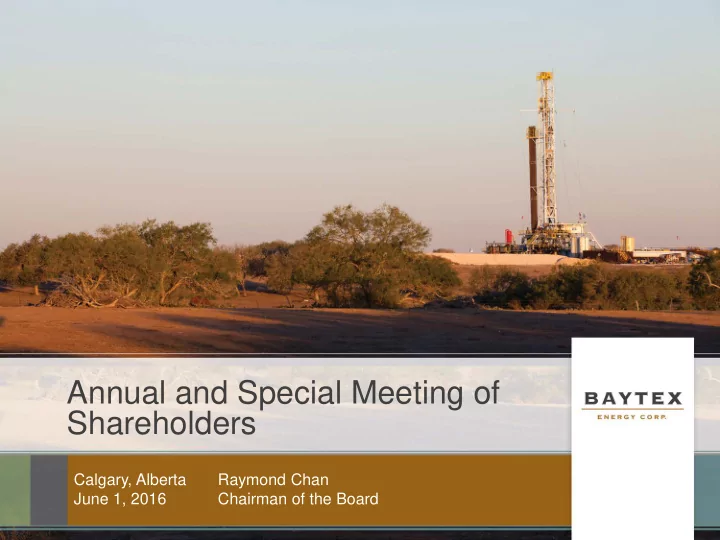
Annual and Special Meeting of Shareholders
Calgary, Alberta Raymond Chan June 1, 2016 Chairman of the Board
Annual and Special Meeting of Shareholders Calgary, Alberta - - PowerPoint PPT Presentation
Annual and Special Meeting of Shareholders Calgary, Alberta Raymond Chan June 1, 2016 Chairman of the Board Board of Directors Director Role/Committee(s) Raymond T. Chan Chairman of the Board James L. Bowzer President and Chief Executive
Calgary, Alberta Raymond Chan June 1, 2016 Chairman of the Board
2
3
James L. Bowzer President and Chief Executive Officer Rodney D. Gray Chief Financial Officer Richard P. Ramsay Chief Operating Officer Geoffrey J. Darcy Senior Vice President, Marketing Brian G. Ector Senior Vice President, Capital Markets and Public Affairs Kendall D. Arthur Vice President, Lloydminster Business Unit Murray J. Desrosiers Vice President, General Counsel and Corporate Secretary Cameron A. Hercus Vice President, Corporate Development Ryan M. Johnson Vice President, Central Business Unit Chad L. Kalmakoff Vice President, Finance Gregory A. Sawchenko Vice President, Land Gregory M. Zimmerman Vice President, U.S. Business Unit
4
i) Unallocated Awards ii) Plan Amendments
Calgary, Alberta James Bowzer June 1, 2016 President and Chief Executive Officer
6
Forward-Looking Statements In the interest of providing Baytex's shareholders and potential investors with information regarding Baytex, including management's assessment of Baytex's future plans and operations, certain statements made by the presenter and contained in these presentation materials (collectively, this "presentation") are "forward-looking statements" within the meaning of the United States Private Securities Litigation Reform Act of 1995 and "forward-looking information" within the meaning of applicable Canadian securities legislation (collectively, "forward-looking statements"). The forward-looking statements contained in this presentation speak only as of the date of this presentation and are expressly qualified by this cautionary statement. The information contained in this presentation does not purport to be all-inclusive or to contain all information that potential investors may require. Specifically, this presentation contains forward-looking statements relating, but not limited, to: our business strategies, plans and objectives; our focus on per share growth in production, cash flow and reserves; our target to fund our capital program from internally generated funds from operations; our ability to mitigate the volatility in Western Canadian Select price differentials by transporting our crude oil to market using railways; our annual average production rate and capital budget for 2016; our plans to develop our three key resource plays (Eagle Ford, Peace River and Lloydminster), including the number of wells to be brought on production in the Eagle Ford in 2016; the proportion of our expenditures to be made in the Eagle Ford; our drilling plans in the Eagle Ford, Peace River and Lloydminster; the number of drilling rigs and frac crews working on our Eagle Ford lands in 2016; our plan to bring shut-in production back on line; our expectation that we will realize further improvements in capital efficiencies through cost reductions; our target for all-in capital efficiencies; the rate of return for an individual well in the Eagle Ford, Peace River and Lloydminster under various pricing assumptions for West Texas Intermediate light oil (“WTI”) and the oil price at which the wells break-even; our expectation that our development opportunities will provide attractive returns; for individual wells in the Eagle Ford, Peace River and Lloydminster, the cost to drill, complete and equip a well, initial production rates, liquids weighting, estimated ultimate recoveries (EUR) and single well economics (including internal rate of return, net present value, payout and capital efficiency); our Eagle Ford shale play, including the growth potential of the assets, initial production rates from new wells, our plans to use “stack and frac” pilots to target three zones in the Eagle Ford formation in addition to the overlying Austin Chalk formation, our assessment of the results of the “stack and frac” pilots, individual well economics, cumulative recoveries, drilling efficiency and the pricing benchmarks used for our liquids production; our Peace River heavy oil resource play, including years of drilling inventory remaining, reservoir characteristics, individual well economics for multi-lateral horizontal wells (including well design, drilling and completion costs, initial production rates, capital efficiency ratio, internal rate of return and estimated ultimate recoveries (EUR)); our Lloydminster heavy oil property, including years of drilling inventory remaining, the impact of drilling horizontal wells and individual well economics for horizontal wells (including drilling and completion costs, initial production rates, capital efficiency ratio internal rate of return and estimated ultimate recoveries (EUR) and our expectation that multi-lateral drilling will result in improvements in capital efficiencies); that we retain significant leverage to increases in crude oil prices, have a significant inventory of development projects and have strong levels of financial liquidity; and the sensitivity of our 2016 funds from operations to changes in WTI prices, heavy oil differentials, natural gas prices and Canada-United States foreign exchange rates. In addition, information and statements relating to reserves are deemed to be forward-looking statements, as they involve implied assessment, based on certain estimates and assumptions, that the reserves described exist in quantities predicted or estimated, and that the reserves can be profitably produced in the future. Although Baytex believes that the expectations and assumptions upon which the forward-looking statements are based are reasonable, undue reliance should not be placed on the forward-looking statements because Baytex can give no assurance that they will prove to be correct. These forward-looking statements are based on certain key assumptions regarding, among other things: petroleum and natural gas prices and pricing differentials between light, medium and heavy gravity crude oil; well production rates and reserve volumes; our ability to add production and reserves through our exploration and development activities; capital expenditure levels; our ability to borrow under our credit agreements; the receipt, in a timely manner, of regulatory and other required approvals for our operating activities; the availability and cost of labour and other industry services; interest and foreign exchange rates; the continuance of existing and, in certain circumstances, proposed tax and royalty regimes; our ability to develop our crude oil and natural gas properties in the manner currently contemplated; and current industry conditions, laws and regulations continuing in effect (or, where changes are proposed, such changes being adopted as anticipated). Readers are cautioned that such assumptions, although considered reasonable by Baytex at the time of preparation, may prove to be incorrect.
7
Actual results achieved will vary from the information provided herein as a result of numerous known and unknown risks and uncertainties and other factors. Such factors include, but are not limited to: the volatility of natural gas prices; further declines or an extended period of the currently low oil and natural gas prices; failure to comply with the covenants in our debt agreements; that our credit facilities may not provide sufficient liquidity or may not be renewed; uncertainties in the capital markets that may restrict or increase our cost of capital or borrowing; risks associated with a third-party operating our Eagle Ford properties; changes in government regulations that affect the oil and gas industry; changes in environmental, health and safety regulations; restrictions or costs imposed by climate change initiatives; variations in interest rates and foreign exchange rates; risks associated with our hedging activities; the cost of developing and operating our assets; risks related to the accessibility, availability, proximity and capacity of gathering, processing and pipeline systems; depletion of our reserves; risks associated with the exploitation of our properties and our ability to acquire reserves; changes in income tax or other laws or government incentive programs; uncertainties associated with estimating petroleum and natural gas reserves; our inability to fully insure against all risks; risks of counterparty default; risks associated with acquiring, developing and exploring for oil and natural gas and other aspects of our operations; risks associated with large projects; risks related to our thermal heavy oil projects; risks associated with the
enforce civil remedies, differing practices for reporting reserves and production, additional taxation applicable to non-residents and foreign exchange risk; and other factors, many of which are beyond our
filed with Canadian securities regulatory authorities and the U.S. Securities and Exchange Commission. Readers are cautioned that the foregoing list of risk factors is not exhaustive. New risk factors emerge from time to time, and it is not possible for management to predict all of such factors and to assess in advance the impact of each such factor on our business or the extent to which any factor, or combination of factors, may cause actual results to differ materially from those contained in any forward-looking statements. The above summary of assumptions and risks related to forward-looking statements in this presentation has been provided in order to provide potential investors with a more complete perspective of our current and future operations and as such information may be not appropriate for other purposes. There is no representation by Baytex that actual results achieved will be the same in whole or in part as those referenced in the forward-looking statements and Baytex does not undertake any obligation to update publicly or to revise any of the included forward-looking statements, whether as a result of new information, future events or otherwise, except as may be required by applicable securities law. Oil and Gas Information This presentation contains estimates, as at December 31, 2015, of the volume of our petroleum and natural gas reserves as prepared by our independent qualified reserves evaluators, Sproule Unconventional Limited ("Sproule") for our Canadian properties and Ryder Scott Company, L.P. for our United States properties. These estimates have been prepared in accordance with Canadian reserves disclosure standards and definitions as set forth in National Instrument 51-101 “Standards of Disclosure for Oil and Natural Gas Activities” of the Canadian Securities Administrators (“NI 51-101”). The determination of oil and gas reserves involves the preparation of estimates that have an inherent degree of associated uncertainty. Categories of proved and probable reserves have been established to reflect the level of these uncertainties and to provide an indication of the probability of recovery. The estimation and classification of reserves requires the application of professional judgment combined with geological and engineering knowledge to assess whether or not specific reserves classification criteria have been satisfied. Knowledge of concepts, including uncertainty and risk, probability and statistics, and deterministic and probabilistic estimation methods, is required to properly use and apply reserves definitions. The recovery and reserves estimates described herein are estimates only and there is no guarantee that the estimated reserves will be recovered. Actual reserves and future production from such reserves may be greater or less than the estimates provided herein. The estimates of reserves for individual properties may not reflect the same confidence level as estimates of reserves for all properties, due to the effects of aggregation. For complete NI 51-101 reserves disclosure, please see our Annual Information Form for the year end December 31, 2015. References herein to initial test production rates, 30-day IP rates and other short-term production rates are useful in confirming the presence of hydrocarbons; however, such rates are not determinative of the rates at which such wells will commence production and decline thereafter and are not indicative of long term performance or of ultimate recovery. While encouraging, readers are cautioned not to place reliance on such rates in calculating aggregate production for us or the acquired assets. A pressure transient analysis or well-test interpretation has not been carried out in respect of all wells. Accordingly, we caution that the test results should be considered to be preliminary. When converting volumes of natural gas to oil equivalent amounts, Baytex has adopted a conversion factor of six million cubic feet of natural gas being equivalent to one barrel of oil, which is based on an energy equivalency conversion method primarily applicable at the burner tip and does not represent a value equivalency at the wellhead. Oil equivalent amounts may be misleading, particularly if used in isolation.
8
Non-GAAP Financial Measures This presentation refers to funds from operations, net debt, operating netback and Bank EBITDA, which do not have any standardized meaning prescribed by generally accepted accounting principles in Canada ("GAAP"). We define funds from operations ("FFO") as cash flow from operating activities adjusted for financing costs, changes in non-cash operating working capital and other operating items. We believe that this measure assists in providing a more complete understanding of certain aspects of our results of operations and financial performance, including our ability to generate the cash flow necessary to fund potential future dividends to shareholders and capital investments. However, funds from operations should not be construed as an alternative to traditional performance measures determined in accordance with GAAP, such as cash flow from operating activities and net income. Please refer to our most recent management's discussion and analysis of financial condition and results of operations for a reconciliation of funds from
We define net debt as the sum of monetary working capital (which is current assets less current liabilities (excluding current losses on financial derivatives)), and the principal amount of both long-term notes and the bank loan. We believe that this measure assists in providing a more complete understanding of our cash liabilities. We define operating netback as product sales price less royalties, production and operating expenses and transportation expenses divided by barrels of oil equivalent sales volume for the applicable period. Our determination of operating netback may not be comparable with the calculation of similar measures by other entities. We believe that this measure assists in characterizing our ability to generate cash margin on a unit of production basis. Bank EBITDA is calculated based on terms and definitions set out in the agreement governing our revolving credit facilities. It is calculated by adjusting net income for financing costs, income tax, certain specific unrealized and non-cash transactions (including depletion, depreciation, amortization, impairment, exploration expenses, unrealized gains and losses on financial derivatives and foreign exchange, and share- based compensation) and acquisition and disposition activity and is calculated based on a trailing twelve month basis. Bank EBITDA is used by our lenders to monitor compliance with financial covenants.
9
WTI (US$/bbl)
Source: Reuters
10
Source: U.S. Energy Information Administration, RBC Capital Markets
11
Source: IEA, RBC Capital Markets
OPEC Production
2.5 mmbbl/d increase
12
Source: IEA, Bloomberg, Raymond James
13
Global Oil Demand (million barrels/day)
Source: IEA, Raymond James
14
Source: PIRA Energy Group
15
17
Capital expenditures directed to the Eagle Ford, which generates the highest netback and highest rate of return in
Strong capital efficiencies across three core resource plays; retain a significant inventory of development prospects Cost reduction focus across all facets of our
maintaining efficiency in
safety of our employees Pro-actively worked with
syndicate to provide increased financial flexibility; targeting capital expenditures to approximate FFO Maintained Financial Liquidity Reduced Cost Structure Deployed Capital Effectively Retained Leverage to Rising Crude Environment
18 18
19
development with four to five drilling rigs (six drilling rigs in Q4/2015) and one to two frac crews (two frac crews in Q4/2015) working on our lands. We anticipate bringing approximately 30 net wells on production.
this year. We will forgo drilling 12 net wells at Peace River and 24 net wells at Lloydminster.
predominantly low or negative margin heavy oil production during the first quarter in order to optimize the value of our resource base and maximize our funds from operations.
Summary of 2016 Expectations Exploration and Development Capital $225-$265 million Production 68,000 – 72,000 boe/d
Production by Region 2016 Guidance
United States 55% Canada 45%
minimize additional bank borrowings.
20
Credit Capacity $2.3 Billion Long-Term Notes Maturity Schedule ($ Millions)
Debt composition as at March 31, 2016. We have secured revolving credit facilities totaling US$575 million that mature June 2019. The revolving credit facilities do not require any mandatory principal payments prior to maturity and can be further extended beyond June 2019 with the consent of the lenders.
21 $0 $5,000 $10,000 $15,000 $20,000 2014 Current 2014 Current 2014 Current $/boe/day
Individual Well Capital Efficiencies(1)
(1) Individual well capital efficiencies represent the cost to drill, complete and equip divided by the
average first year production rate.
Eagle Ford Peace River Lloydminster
22
Break-Even WTI (4)
(1) Individual well economics are based on constant pricing and costs. Pricing assumptions: NYMEX gas = US$2.75/mcf, WCS differential = US$13.50/bbl, FX Rate (US$/C$) = 1.3. (2) Type curve assumptions: Eagle Ford: 30-day IP rate ~ 1,000 boe/d, EUR ~ 800 mboe. Peace River multi-lateral well: 30-day IP rate ~ 400 boe/d, EUR ~ 300 mboe. Lloydminster: for a single
lined horizontal well: 30-day IP rate ~ 70 boe/d, EUR ~ 70 mboe. Baytex internal estimates.
(3) Internal rate of return (“IRR”) is a rate of return measure used to compare the profitability of an investment and represents the discount rate at which the net present value of costs equals the
net present value of the benefits. The higher a project’s IRR, the more desirable the project.
(4) Break even price represents the constant oil price (WTI) at which the net present value of the average type well is zero using a 10% discount rate.
0% 25% 50% 75% 100% 125% 150% 175% $45 $50 $55 $60 $65 $70 Eagle Ford - US$5.6M/well Peace River - C$2.8M/well Lloydminster - C$750K/well WTI (US$/bbl) Rate of Return (1) (2) (3)
23
Sensitivities Estimated Effect on Annual Funds from Operations ($ Millions) Excluding Hedges Including Hedges Change of US$1.00/bbl WTI crude oil $17.8 $15.1 Change of US$1.00/bbl WCS heavy oil differential $9.7 $7.4 Change of US$0.25/mcf NYMEX natural gas $7.5 $2.7 Change of $0.01 in the C$/US$ exchange rate $4.6 $4.9
FFO sensitivities represent the remainder of 2016 (Q2 thru Q4) annualized. Price Assumptions: WTI crude oil - US$50/bbl, WCS heavy oil differential - US$14/bbl, NYMEX natural gas - US$2.10/mcf, Exchange Rate (C$/US$) – 1.31.
24 24
25 25
James L. Bowzer President & Chief Executive Officer (587) 952-3000 Rodney D. Gray Chief Financial Officer (587) 952-3160 Brian G. Ector Senior Vice President, Capital Markets and Public Affairs (587) 952-3237 Suite 2800, Centennial Place 520 – 3rd Avenue S.W. Calgary, Alberta T2P 0R3 T: (587) 952-3000 1-800-524-5521 www.baytexenergy.com
26
Q2/2016 Q3/2016 Q4/2016
Balance of 2016
Full-Year 2017
WTI Fixed Hedges Volumes (bbl/d) 8,000 5,000 5,000 6,000
$59.84 $63.79 $63.79 $62.03
Volumes (bbl/d) 9,500 10,000 10,000 9,833 10,000 Average Ceiling/Floor/Sold Floor (US$/bbl) (2) $60/$50/$40 $60/$50/$40 $60/$50/$40 $60/$50/$40 $59/$46/$36 Total WTI Hedge Volumes (bbl/d) 17,500 15,000 15,000 15,833 10,000 Hedge (%) (1) 49% 42% 42% 44% 28%
(1) Percentage of hedged volumes are based on the mid-point of 2016 production guidance (excluding NGL), net of royalties. (2) WTI 3-way option consists of a sold call, a bought put and a sold put. In a $60/$50/$40 example, Baytex receives WTI + US$10/bbl when WTI is at or below US$40/bbl; Baytex receives
US$50/bbl when WTI is between US$40/bbl and US$50/bbl; Baytex receives WTI when WTI is between $50/bbl and $60/bbl; and Baytex receives $60/bbl when WTI is above US$60/bbl.
WCS Differential Hedges Volumes (bbl/d) 8,000 7,000 7,000 7,333 1,500 WCS Price Relative to WTI (US$/bbl) ($13.26) ($13.32) ($13.40) ($13.32) ($13.42) Hedge (%) (1) 42% 37% 37% 38% 8%