Announcements Software Engineering for HW 2, Due Thursday, Jan 19 - - PDF document

announcements software engineering for
SMART_READER_LITE
LIVE PREVIEW

Announcements Software Engineering for HW 2, Due Thursday, Jan 19 - - PDF document

Announcements Software Engineering for HW 2, Due Thursday, Jan 19 Capstone Courses Presentations, Tuesday Jan 23 15 minute presentation + 3 minutes discussion Richard Anderson PowerPoint slides CSE 481b Group order: A, B, C,


slide-1
SLIDE 1

1

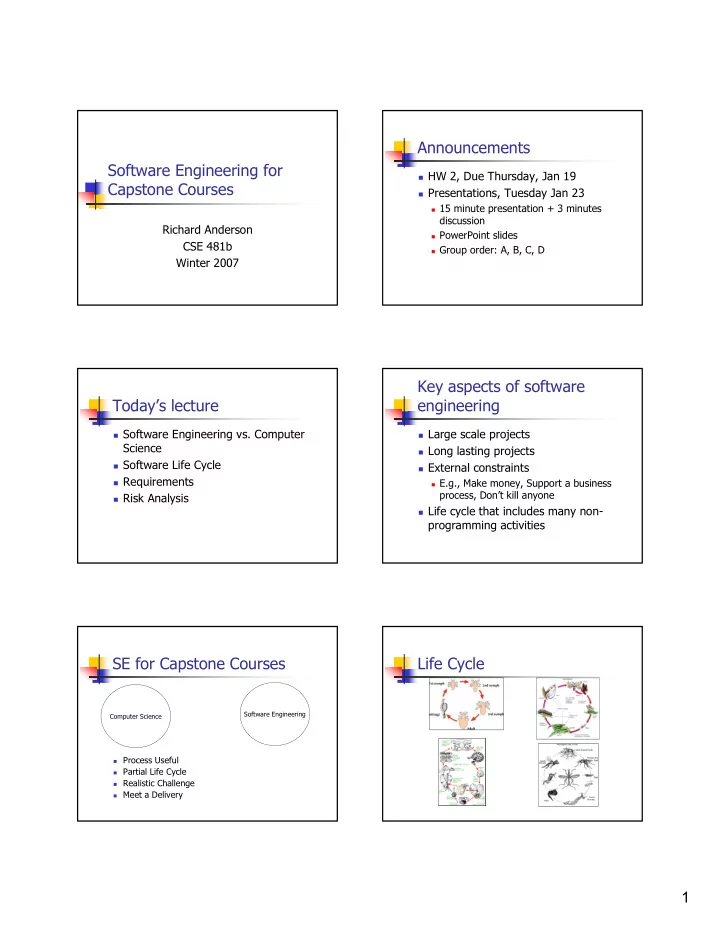
Software Engineering for Capstone Courses

Richard Anderson CSE 481b Winter 2007

Announcements

HW 2, Due Thursday, Jan 19 Presentations, Tuesday Jan 23

15 minute presentation + 3 minutes

discussion

PowerPoint slides Group order: A, B, C, D

Today’s lecture

Software Engineering vs. Computer

Science

Software Life Cycle Requirements Risk Analysis

Key aspects of software engineering

Large scale projects Long lasting projects External constraints

E.g., Make money, Support a business

process, Don’t kill anyone

Life cycle that includes many non-

programming activities

SE for Capstone Courses

Process Useful Partial Life Cycle Realistic Challenge Meet a Delivery

Software Engineering Computer Science

Life Cycle

slide-2
SLIDE 2

2

Life Cycle (McConnell)

System specification Requirements Analysis Architectural Design Detailed Design Coding and Debugging Unit testing System testing Maintenance

Life Cycle (CSE 403 course slides) Requirements on requirements

Who are they for? What are they for?

Pitch to management Fodder for market study Basis for legal contract

Easy to understand, concise, complete,

unambiguous, . . .

Requirements

"Gather and document the functions

that the application should perform for the users in the users' language and from the users' perspective"

Requirements should neither constrain

nor define methods of implementation

Customers

(Almost) every large software project

has a customer who is paying the bills

Project requirements driven by this

customer

Approaches to requirements

Personas Scenarios Use cases

slide-3
SLIDE 3

3

Project Pitch

What you are going to do What value it delivers to the customer What is the novelty What are the risks

Is dog food good for you?

Dog food (verb), to

use your own software

Risk

Exposure to the chance of injury or loss For a software project:

Failure to deliver on time Exceeding resource limits Not meeting quality threshold

Risk analysis

Types of Risk

Code Development External Dependency Technology Personnel Requirements Change

Sources of Risk I

Development risks

Code harder to develop than thought Learning curve on new facilities Expected facilities not available Need to iterate on requirements / design Performance Issues Trigger other bugs

Sources of Risk II

Integration risks

Parts don't fit together Integration reveals bugs Integration reveals design errors Need to rewrite code after integration Code left out

slide-4
SLIDE 4

4

Sources of Risk III

Testing risks

Bugs will be found Bugs won't be found Complexity of testing matrix Deployment beyond development

machines

Difficulties in test automation and test tools UI and Workflow feedback

Sources of Risk IV

Requirements Risks

New requirements introduced Change in Specification Inconsistencies in requirements User feedback Market conditions Platform and technology changes

Sources of Risk V

Deployment Risks

Packaging distributable Rights and licensing of components Legal signoff Marketing signoff Systems configuration

Sources of Risk VI

People risks

Unexpected Loss of Personnel Illness Vacation Other demands on time Group friction Inaccurate evaluation of skills Drop in performance

What to do with risk analysis

Avoid the risk Transfer risk off the critical path Buy information

Bring in outside help Prototype

Publicize risk

The sky is falling

Schedule to accommodate some risk Monitor risks as project progresses