Announcements Final Exam Friday, May 16 th 8am Review Session here, - - PDF document

announcements
SMART_READER_LITE
LIVE PREVIEW

Announcements Final Exam Friday, May 16 th 8am Review Session here, - - PDF document

Announcements Final Exam Friday, May 16 th 8am Review Session here, Thursday 11am. Lighting affects appearance Photometric Stereo: using this variability to reconstruct Recognition: Accounting for this variability in matching Shape ( normals


slide-1
SLIDE 1

1

Announcements

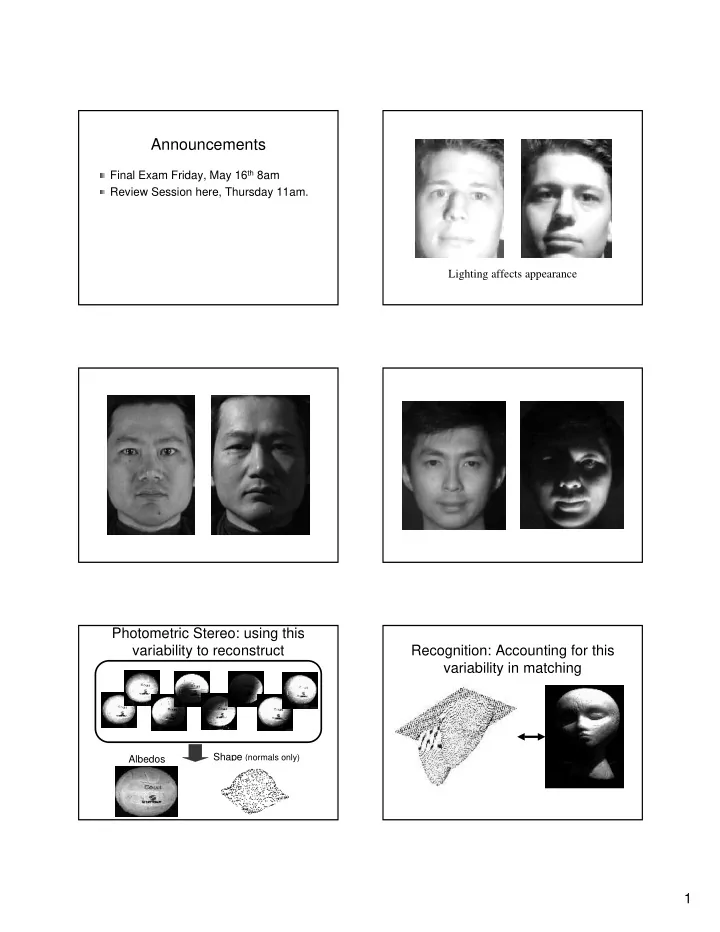
Final Exam Friday, May 16th 8am Review Session here, Thursday 11am. Lighting affects appearance

Photometric Stereo: using this variability to reconstruct

Shape (normals only) Albedos

Recognition: Accounting for this variability in matching

slide-2
SLIDE 2

2 Basics: How do we represent light? (1)

Ideal distant point source:

  • No cast shadows
  • Light distant
  • Three parameters
  • Example: lab with controlled

light

Basics: How do we represent light? (2)

Environment map: l(θ,φ)

  • Light from all directions
  • Diffuse or point sources
  • Still distant
  • Still no cast shadows.
  • Example: outdoors (sky and sun)

Sky

` Basics

How do objects reflect light? Lambertian reflectance n l θ

lλmax (cosθ, 0)

Reflectance map

Reflected light is function of surface normal: i = f(θ,φ) Suitable for environment map. Can be measured with calibration

  • bject.

Photometric stereo

Given reflectance map: i = f(θ,φ) each image constrains normal to

  • ne degree of freedom.

Given multiple images, solve at each point.

slide-3
SLIDE 3

3

Lambertian + Point Source

Surface normal Light

l ˆ

normal surface is ˆ is radiance is ) ˆ ( , max( light

  • f

intensity is light

  • f

direction is n albedo i n l i l l l l l λ λ

  • =

  

  • =

Lambertian, point sources, no

  • shadows. (Shashua, Moses)

Whiteboard Solution linear Linear ambiguity in recovering scaled normals Lighting, reflectance map not known. Recognition by linear combinations.

Linear basis for lighting

λZ λY λX

Integrability

Means we can write height: z=f(x,y). Whiteboard Reduces ambiguity to bas-relief ambiguity. Also useful in shape-from-shading and other photometric stereo.

Bas-relief Ambiguity Shadows

Attached Shadow Cast Shadow
slide-4
SLIDE 4

4

90.7 97.2 96.3 99.5 #9 88.5 96.3 95.3 99.1 #7 84.7 94.1 93.5 97.9 #5 76.3 88.2 90.2 94.4 #3 42.8 67.9 53.7 48.2 #1 Parrot Phone Face Ball

(Epstein, Hallinan and Yuille; see also Hallinan; Belhumeur and Kriegman)

5 2D ±

Dimension:

With Shadows: Empirical Study

Attached Shadows

Lambertian Environment map n l θ

lλmax (cosθ, 0)

Images

...

Lighting Reflectance

1 2 3 0.5 1 1 2 3 0.5 1 1.5 2

r

Lighting to Reflectance: Intuition

(See D’Zmura, ‘91; Ramamoorthi and Hanrahan ‘00)

slide-5
SLIDE 5

5

Forming Harmonic Images

nm nm

b (p)=?r (X,Y,Z)

λ λZ λY λX

2 2 2

2?(Z -X -Y ) λXZ λYZ

2 2

?(X -Y ) λXY

Models Query

Find Pose Compare

Vector: I Matrix: B

Harmonic Images

Experiments

3-D Models of 42 faces acquired with scanner. 30 query images for each

  • f 10 faces (300 images).

Pose automatically computed using manually selected features (Blicher and Roy). Best lighting found for each model; best fitting model wins.

Results

9D Linear Method: 90% correct. 9D Non-negative light: 88% correct. Ongoing work: Most errors seem due to pose problems. With better poses, results seem near 97%.

slide-6
SLIDE 6

6

Summary

Linear solutions are good. For pose variation with points, each image is linear combination of 2 others. For Lambertian lighting no shadows, each image is linear combination of 3. With attached shadows, linear combination of 9. Only diffuse lighting affects images, unless there are shadows or specularities.

slide-7
SLIDE 7

This document was created with Win2PDF available at http://www.daneprairie.com. The unregistered version of Win2PDF is for evaluation or non-commercial use only.