
SLIDE 1
Janet Iwasa, Ph.D. Department of Biochemistry, University of Utah
ANIMATING MOLECULES
Monday, November 9, 15
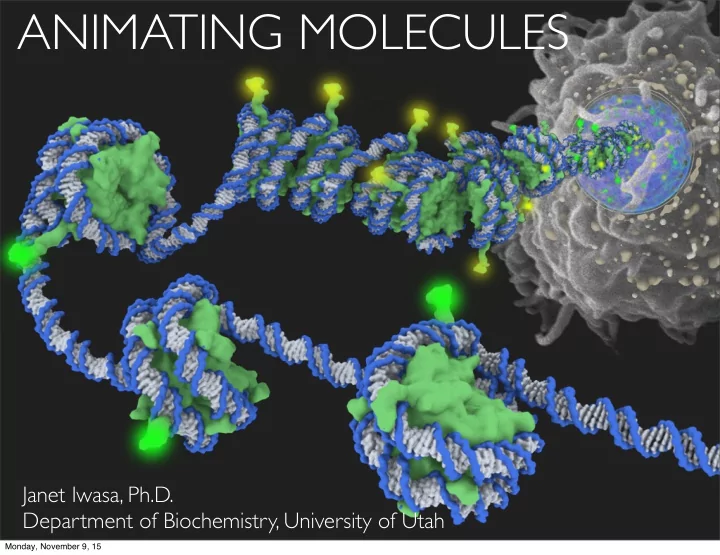
ANIMATING MOLECULES Janet Iwasa, Ph.D. Department of Biochemistry, - - PowerPoint PPT Presentation
ANIMATING MOLECULES Janet Iwasa, Ph.D. Department of Biochemistry, University of Utah Monday, November 9, 15 3D MODELS IN SCIENCE Early chemical models: August Kekul from Models: The Third Dimension of Science, edited by Soraya de
Janet Iwasa, Ph.D. Department of Biochemistry, University of Utah
Monday, November 9, 15
Early chemical models: August Kekulé
from Models: The Third Dimension of Science, edited by Soraya de Chadarevian and Nick Hopwood
Monday, November 9, 15
James Watson with paper base pair models
from HHMI’s “Biointeractive” (http://hhmi.org/biointeractive)
Monday, November 9, 15
from “String and Sealing Wax” Nat Struct Biol 1997 from Cold Spring Harbor Labs
Monday, November 9, 15
1958 - Myoglobin in a “forest of rods”
Image from: Dickerson RE. Chapter 2: myoglobin: a whale of a structure! J Mol Biol. 2009 Sep 11;392(1):10-23.
Monday, November 9, 15
Virtual models
Covers Made with Pymol - from the Pymol Wiki
Monday, November 9, 15
Monday, November 9, 15
Monday, November 9, 15
illustration by Pearse & Crowther, 1987
Monday, November 9, 15
an animation in collaboration with Tom Kirchhausen (2012)
Monday, November 9, 15
Monday, November 9, 15
Ehrlich et al., Cell 2004 Fotin et al., Nature 2004
Heuser & Keen, 1998 clathrin structures on cell plasma membrane by “deep etch” electron microscopy
Monday, November 9, 15
Atom: ~0.1 nanometer Protein: ~10 nanometers Virus: ~100 nanometers Bacterial Cell: ~1 micrometer Mammalian Cell : ~10 micrometers
Monday, November 9, 15
Insect coated in gold
Peter Halasz
Monday, November 9, 15
Thomas Splettstoesser / wikipedia Eric Martz / U. Massachusetts
Monday, November 9, 15
2007a 2007b 2008/9 2011/12
Monday, November 9, 15
Monday, November 9, 15
Monday, November 9, 15
Monday, November 9, 15
Monday, November 9, 15
NSF Discovery Corps Postdoctoral Fellowship
Monday, November 9, 15
getting the public excited about your science
Monday, November 9, 15
Monday, November 9, 15
Entry of Small Molecules into Vesicles with Jack Szostak | Harvard Medical School
Monday, November 9, 15
A simplified depiction of RNA folding with Jack Szostak | Harvard Medical School
Monday, November 9, 15
Exploring Origins: Exhibit Museum of Science, Boston 2008-2013
Monday, November 9, 15
Exploring Origins: A Virtual Exhibit with Jack Szostak | Harvard Medical School
Monday, November 9, 15
getting the public excited about your science
Monday, November 9, 15
Monday, November 9, 15
Monday, November 9, 15
Monday, November 9, 15
Monday, November 9, 15
with Wendell Lim and Brian Yeh, Nature Chemical Biology 3 (2007)
Monday, November 9, 15
an articulated model of dynein
with Sam Reck-Peterson, Harvard Medical School
Monday, November 9, 15
Monday, November 9, 15
in collaboration with Sam Reck-Peterson, Harvard Medical School
Monday, November 9, 15
Monday, November 9, 15
with NIGMS (P50) Centers for HIV/AIDS Related Structural Biology
Monday, November 9, 15
Monday, November 9, 15
Monday, November 9, 15
with Wes Sundquist & the CHEETAH consortium
Monday, November 9, 15
Monday, November 9, 15
Monday, November 9, 15
with TED Ed & Javier Saldeña
Monday, November 9, 15
Monday, November 9, 15
Benefits for the audience
existing models
Monday, November 9, 15
Benefits for the author
Monday, November 9, 15
motofolio.com
Monday, November 9, 15
a community resource for creating & sharing molecular animations
Monday, November 9, 15
a community resource for creating & sharing molecular animations
built in Blender’s game engine which will include import, modeling, animation and rendering modules.
after watching a short video tutorial. Primary challenge: How do we make 3D animation intuitive for users new to animation (and to those returning after a long break)?
Monday, November 9, 15
Monday, November 9, 15
a community resource for creating & sharing molecular animations
Monday, November 9, 15
Monday, November 9, 15
a community resource for creating & sharing molecular animations
Monday, November 9, 15
a community resource for creating & sharing molecular animations
database that also hosts community/social interactions/ collaborations
Blender-based animation, but also Illustrator, Photoshop files, etc.
the evolution of a hypothesis over time Primary challenge: How do we get users to share their visualizations with others?
Monday, November 9, 15
Monday, November 9, 15
TOOLS intuitive animation/visualization tools that could allow integration
sources TRANSPARENCY standardized means of providing references and sources used in visualizations ARCHIVES centralized repository for cellular data, images and animations
Monday, November 9, 15
Tom Kirchhausen Harvard Medical School Wes Sundquist, Michael Kay and the CHEETAH Consortium University of Utah Molecular Flipbook Team: Mike Pan, Rise Riyo, Gaël McGill (HMS), Piotr Sliz (HMS) Sam Reck-Peterson Harvard Medical School Jack Szostak Massachusetts General Hospital/Harvard Medical School National Science Foundation National Institutes of Health (NIGMS) The TED Fellows Program
University of Utah website: http://biochem.web.utah.edu/iwasa The Science of HIV Project: http://ScienceofHIV.org The Molecular ViewBook Project: http://MolecularFlipbook.org The Exploring Origins Project: http://ExporingOrigins.org Tutorials, Movies and Molecular Maya: http://molecularmovies.org
Monday, November 9, 15