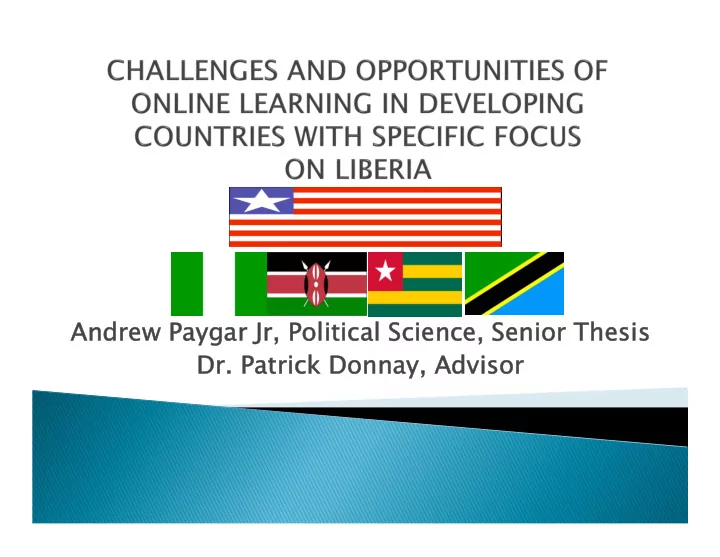
SLIDE 1 Andrew Paygar Andrew Paygar Jr, Political Science, Jr, Political Science, Senior Thesis Senior Thesis
- Dr. Patrick Donnay, Advisor
- Dr. Patrick Donnay, Advisor
SLIDE 2
It was originated1976 in South-Saharan Africa by the
National Teachers Institute, Kadauna in Nigeria.
The intention was to remove barriers and constraints
that may prevent learners from accessing and succeeding in quality, lifelong education.
It courses were predominantly through the print
media.
It helps encourage studies at home and help combat
educational problems in the Nation.
It geared towards educating growth competitiveness
and reaching social and economic impact.
SLIDE 3 Developing nations will
respond to increase demands
It reduces costs of education
and increases participation of many students regardless of their locations.
It provides students the
- pportunity to learn at their
- wn pace.
It creates an environment for
students to collaborate on an assigned project without being at one locations.
SLIDE 4
Majority of the students
attend public or government schools due to high tuition fees.
Students and instructors
will need to take fundamental computer courses.
Institutions lack relevant
infrastructures.
The country lacks of high
bandwidth connections.
Partial view of class room in Liberia.
SLIDE 5
Learning can be difficult for
students who are not familiar with the technology involved.
Students do not have direct
interaction with instructors and classmates.
It can be difficult for
students who are undisciplined or unmotivated.
It involves spending on
training of staffs and new technologies.
Staff being trained in the lab.
SLIDE 6 United Nations Educational, Scientific and
United Nations Educational, Scientific and Cultu Cultural Organization (UNESCO al Organization (UNESCO) 1945-Present 1945-Present
- Is working to improve the development of African
countries educational sectors.
- It has been encouraging African governments and
development partners to maintain education as one of its priorities.
African Virtual University (AVU) 2003-Present
African Virtual University (AVU) 2003-Present
- Makes efforts to increase access to quality higher
education and training through information communication technologies ICT.
- To build sustain and enhance the capacity of African
tertiary educational institutions.
- To implement research and evaluation activities on the
African Continent.
SLIDE 7
Liberia was founded July 26, 1847 by
free African slaves from the United States.
It’s a country in West Africa bordered
by Sierra Leone to its West, Guinea to its North and Ivory Coast to its east.
Monrovia, is Liberia capital city Tropical, humid and raining season is
the climate in Liberia.
St John river, St Paul river are the
largest river in Liberia
Nimba Mountain is Liberia biggest
mountain.
Iron ore, Timber, Diamonds, Rubber,
are Liberia natural resources.
SLIDE 8
Americo-Liberian rule (1847-
1980)
The Country covers an area of
43,000 square miles.
Suffered 14 years of civil crisis
from 1989-2003
President is the head of state. Ellen Johnson Sirleaf a Harvard-
educated banker and administrator is the current and 24th president of Liberia. 2006- Present.
He Her Ex r Excellen cellency, P y, Presiden ident t Ellen Johnson Sirle Ellen Johnson Sirleaf
SLIDE 9 Poverty Rate: 80% Unemployment rate: 85% and
201st compared to rest of the world.
GDP: 8.3% and 11th compared
to rest of the world.
Communication: Telephone:
2.394 million (2012) 138th compared to rest of the world.
Electricity: 335 million kWh
(2010 est.) 168th compared to rest of the world.
Workers at a Workers at a Construct Construction site
SLIDE 10
Potential is huge for Liberia educational
system for online learning and technologies in the emerging years.
Challenges: Are also huge and more so in
Liberia due to destroyed infrastructure, including the educational sector, which was badly affected due to fourteen years of civil war.
Questions?
SLIDE 11 Agency, Agency, C. I. (2014,
April 8). 8). The World The World FactBook
. Retrieved from The World d from The World FactBook: FactBook: https://w ttps://www.c ww.cia.gov/library/pu a.gov/library/publications/the-w lications/the-world-
fac factbook/geos/li.h book/geos/li.html ml
Education S
ucation System i stem in L Liberia
- ria. (2012). Retrieved from Education
. (2012). Retrieved from Education System in Liber System in Liberia: a: http://www.clas ttp://www.classbas sbase.com/Countries e.com/Countries/Liberia/Education- /Liberia/Education- System System
Gajaraj, D.
Gajaraj, D. (2001). Distance Educ (2001). Distance Education: Promise, Performance and ation: Promise, Performance and Potential.
- Potential. Commonwealth o
Commonwealth of L Learning, Ca arning, Canada, 16 nada, 16, 61. , 61.
O, o. D., &
O, o. D., & K, O. F. K, O. F. (2006, June (2006, June). The International Review of ). The International Review of Resear Research in Open in Open and Distan and Distance Learn
Attitudes and Pe Perceptions o rceptions of S Students t udents to Op Open a en and Di d Distance L ance Learning i arning in Nigeria, 7 Nigeria, 7, 1-6. , 1-6.