AND CHILD CARE PRESENTED BY: CHRISTOPHER EMOND, CEO BOYS & - - PowerPoint PPT Presentation

and child care
SMART_READER_LITE
LIVE PREVIEW

AND CHILD CARE PRESENTED BY: CHRISTOPHER EMOND, CEO BOYS & - - PowerPoint PPT Presentation

PROPOSAL FOR REOPENING SUMMER CAMPS AND CHILD CARE PRESENTED BY: CHRISTOPHER EMOND, CEO BOYS & GIRLS CLUBS OF CENTRAL NH TUESDAY, APRIL 28, 2020 CONTACT: Emond@Centralnhclubs.org Thank you to everyone for all you are doing to help our


slide-1
SLIDE 1

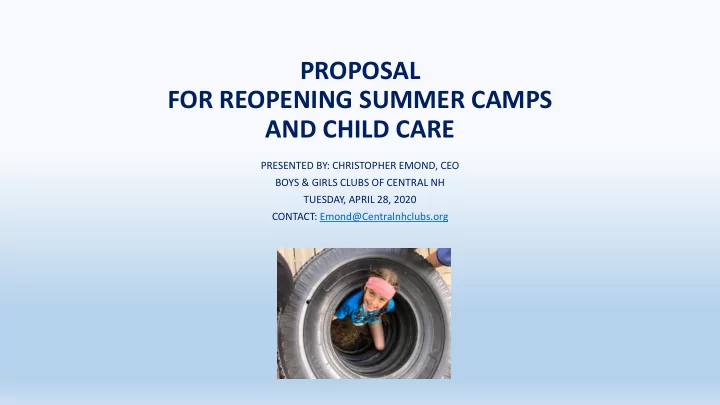
PROPOSAL FOR REOPENING SUMMER CAMPS AND CHILD CARE

PRESENTED BY: CHRISTOPHER EMOND, CEO BOYS & GIRLS CLUBS OF CENTRAL NH TUESDAY, APRIL 28, 2020 CONTACT: Emond@Centralnhclubs.org
slide-2
SLIDE 2

Thank you to everyone for all you are doing to help our state recover from this pandemic. We have heard from business owners that their employees are not reporting to work because they lack access to child care. We have surveyed parents and many say they want to send their children to camp and back to child care centers this summer. They want to get back to work. Like all industries, our sector has been hit hard by the pandemic; however, we recognize the critical role that child care and summer and day camps programs will play in restarting New Hampshire’s economy. Right now, 243 Child Care Centers are operating under an emergency designation established by DHHS. We have learned a lot about how to operate in the safest manner possible. We are going to further communicate with our local school districts to discuss the role of the 32 21st Century Programs in the state.

slide-3
SLIDE 3

General Overview

  • Child Care, Day Camp, and Overnight Camps are all part of the critical network of care.
  • Each program requires a different set of considerations to ensure a safe, meaningful, and

effective experience. We encourage a thoughtful, aligned, but unique approach to reopening and managing each.

  • Each serves tens of thousands of children and teens, providing life skills while parents

work – in person and virtually.

  • Due to COVID-19, all child care, day camps, and overnight camps will have to operate at a

much lower capacity in order to keep our children safe.

  • The industry as a whole will require a significant investment from the State of NH just to
  • ffer these reduced services. Our needs going forward to get our capacity back to pre-

COVID-19 levels is as yet undetermined.

  • New Futures and DHHS are co-leading the Rebuild and Recovery for Child Care Plan. The

New Hampshire Charitable Foundation and DHHS are co-leading the Emergency Child Care Collaborative. Both groups are aligned and are public-private partnerships.

slide-4
SLIDE 4

Child Care

(Includes after school care)

February 2020: Over 788 licensed child care businesses operating in NH with 7895 employees Today: Approximately 243 child care businesses are currently open as Emergency Child Care Programs (ECCPs).

  • Only 54 are serving school-aged

children: less than 1/4.

  • 2400 employees are currently on

unemployment.

slide-5
SLIDE 5

5000 10000 15000 20000 25000 30000 35000 40000 45000 50000 Licensed Child Care Capacity February 2020 Today, # children attending the open child cares

Today February 2020 46,032 4875

slide-6
SLIDE 6
  • All ECCP designees as of April 13th were eligible to apply for a $5.00

per staff hour pay differential.

  • Currently all programs that serve NH Child Care Scholarship Program

children are able to bill whether children are present or not; there are no cost-shares for parents.

  • All ECCPs are eligible to receive supplies, including thermometers,

toilet paper, bleach, masks, gloves, wipes, hand sanitizer.

  • DHHS and NH Employment Security have been working together to

analyze, industry by industry, the number of spaces and location of child care needed per industry. They’re matching the need to available child care resources.

Current DHHS Funding for Emergency Child Care Programs

slide-7
SLIDE 7

In accordance with recommendations from the CDC; ECCPs have implemented additional health and safety measures.

Health & Safety Guidance for ECCPs

slide-8
SLIDE 8
  • Group size is limited to 8 children/youth, with no

more than 2 staff;

  • Health screenings, including temperature checks, are

performed on every staff member and student upon entry and kept in a log;

  • Cloth masks and latex gloves have been provided to

each staff member and student;

  • Parents/caregivers drop off at the front door and do

not enter the facility;…

Health & Safety Guidance for ECCPs

slide-9
SLIDE 9
  • Movement is reduced within each facility and each

group avoids contact with others for the entire day;

  • Staff are assigned to one group that will stay together

for the duration of the State of Emergency;

  • Backup crews have been established in the event of an

illness, COVID-19 or not;

  • Staff have been designated as cleaners and are

responsible for cleaning up after each group.

Health & Safety Guidance for ECCPS

slide-10
SLIDE 10

CDC Guidelines - In In the Event of Ill Illness

  • An isolation room or area will be used to isolate a sick

child;

  • Staff will follow CDC guidance on how to disinfect the

building or facility if someone is sick;

  • If a sick child has been isolated, surfaces in the isolation

room will be cleaned and disinfected after the sick child has gone home.

slide-11
SLIDE 11

CDC Guidelines - In the Event of Illness

If COVID-19 is confirmed in a child or staff member…

  • Areas used by the person who is sick will be closed off;
  • Outside doors and windows will be opened;
  • Staff will wait up to 24 hours or as long as possible

before cleaning to allow respiratory droplets to settle;

  • Staff will clean and disinfect all areas used by the

person who is sick.

  • If more than 7 days have passed since the person who is sick visited
  • r used the facility, additional cleaning and disinfection is not

necessary.

slide-12
SLIDE 12

Summer Day Camp

There are hundreds of summer day camps in New Hampshire, meeting the child care needs of tens of thousands of children and families.

slide-13
SLIDE 13

Health & Safety Guidance for Day Camps

The additional health and safety recommendations for Emergency Child Care Programs may be used as a template for day camp programs.

slide-14
SLIDE 14

Day Camp

Opportunities unique to day camp:

  • Day camp is mostly outdoors or well-ventilated (pavilions etc.);
  • Staff are generally young and have a low risk factor for infection;
  • Campers are almost always 5+ and can care for their own bodies (potty-trained),

reducing required staff-to-camper physical contact;

  • Typically no food service or could easily be suspended for summer;
  • Camps with large properties can spread children apart and manage small groups
  • f children safely;
  • Larger properties that normally hold 100 to 600 campers/week may be able to

handle more kids than child care centers;

Day Camp Capabilities & Challenges

slide-15
SLIDE 15

Day Camp

Challenges unique to day camp:

  • Running a shorter or smaller camp will pose an economic challenge;
  • Daily screening is possible but could be challenging due to size of camp and

congestion it could create: will need systems for temp checks, interviews at drop-

  • ff, etc…;
  • Some of the larger camps have buses to alleviate parents’ need to drive long

distances, so safety guidance around transportation will be important so more children can access day camp;

  • Camps need adequate inclement weather shelters. Without these, capacity is
  • limited. Large event tents would be a temporary solution.

Day Camp Capabilities & Challenges

slide-16
SLIDE 16

Overnight Camp

Number of NH overnight camps: 85 Number of Campers: 40,000 Number of Staff: 8,000 Y’s in NH operate 14 facilities hosting about 7,000 campers in the summer

  • n approximately 2,500 acres;
slide-17
SLIDE 17

Health & Safety Guidance for Overnight Camps

A work group including YMCA of the USA, US CDC, and the American Camp Association (ACA) aim to release guidance by May 4th. The Resources are being developed by an independent panel coordinated by Environmental Health and Engineering, Inc. a Boston based consulting firm specializing in environmental health. Guidance most likely will include the following:

slide-18
SLIDE 18

Health & Safety Guidance for Overnight Camps

  • Staff Arrivals (testing, health screening);
  • Camper Arrivals (testing, health screening);
  • Food service (space needed for prep, dining, etc…);
  • Cleaning and Disinfection Recommendations

(Equipment, Facilities, etc…);

  • Disease Prevention Strategies and Control Measures

(Hand washing, etc.);

slide-19
SLIDE 19

Health & Safety Guidance for Overnight Camps

  • PPE use expectations;
  • Guidelines on space requirements for assembly

and living areas;

  • Communicable Disease Response Plan – Action for

COVID case(s) on camp;

  • Protocol for camper departure and return home;
  • Day off management of staff (keeping staff on

site).

slide-20
SLIDE 20

Overnight Camp Capabilities & & Challenges

Capabilities

  • Young and committed work force ready to mobilize and committed

to the health and safety of campers;

  • Overnight Camps will have medical staff on site and will need to be

very sensitive to avoid burdening smaller remote hospitals;

  • Serving low-risk populations;
  • Overnight camps are spread throughout the state and can provide a

geographically supportive environment;

  • With support of testing and contact tracing an opportunity to

demonstrate, with data, to the state that children can be back together and that schools can reopen.

slide-21
SLIDE 21

Overnight Camp Challenges & Capabilities

Challenges:

We will most likely have to operate with a lower percentage of campers; current estimates are 30% to 50%. This is based upon expected social distancing and group size requirements.

  • For most camps, operating at reduced capacity is cost-prohibitive;
  • Overnight Camp Recommendations are based on NH getting to Level

2;

  • Some camps may need to shorten their seasons in order to operate

as effective public health partners in accordance with guidelines.

This will create economic hardship for these small nonprofit and for-profit businesses.

slide-22
SLIDE 22

Support Needed to Open Child Care, Summer Day and Overnight Camps

slide-23
SLIDE 23

Support Needed

State relief around the risk and liability of operating this summer.

Non-profits and small businesses providing childcare, daycare or youth services have serious concerns about re-opening this summer due to risks and potential liabilities related to the pandemic. They will not re-open if the risk of exposure to lawsuits is too high. These organizations request state relief in the form of immunity and protection from legal liability arising from their willingness to operate during the pandemic. The state legislature on numerous occasions has provided such immunity as a matter of good public policy, to encourage conduct that otherwise might not happen because of fear of liability --for example, the Good Samaritan law (protecting bystanders who provide assistance in emergencies) and the law mandating reporting of child abuse or neglect (protecting reporters of suspected abuse or neglect). Similar liability protection should be enacted under these circumstances.

slide-24
SLIDE 24

Funding to ensure that we can safely operate our programs and meet the needs of our communities during this challenging time.

  • Funding would support running at reduced levels, PPE, increased

deep cleaning, staff training and retention. The industry is working to provide details around funding requirements.

  • Guidance on the acceptance of geographic distribution of

campers.

  • State support for testing and contact tracing; Assistance with

fixed costs like rent/mortgage, heat and utilities that aren’t covered when the number of children and youth served is down due to new safety protocols;

Support Needed

slide-25
SLIDE 25

Council for Thriving Children

Governor and state agency/court leadership, co-led by DHHS and DOE Lead/s from B-8 Advisory and Early Childhood Expert Groups Parents, Legislators, and other stakeholders

“Guiding the System”

B-8 ECCE Advisors

Led by selected entity

Early Childhood Care & Education Experts

Led by Center for Excellence at UNH

DOE Early Childhood Integration Team (ECIT) DHHS Early Childhood Integration Team (ECIT)

Decision-Making and Operationalizatio n Role Advising and Strengthening Role

Data driven policy and program coordination, integration, and development, while increasing performance and resource accountability Sharing emerging trends for children, families, communities, workforce and business, while generating learning and capacity

Interagency Coordination Formal Infrastructure to Support Interagency Coordination

DRAFT 3.12.2020

Communication Role

Core Support Team

Ensure effective communication across the Governance structure with and through designated members from the Council, ECITs, Advisors and Experts, and PDG

slide-26
SLIDE 26
slide-27
SLIDE 27

THANK YOU

Christopher Emond CEO, Boys & Girls Clubs of Central NH (603) 568-0923 Emond@Centralnhclubs.org Seth M Kassels Executive Director, YMCA Camp Belknap (603) 569-3475 seth@campbelknap.org Jackie Cowell Executive Director, Early Learning NH (603) 226-7900 jcowell@earlylearningnh.com Ken Robbins President, NH Camp Directors Association Director, Camp Kabeyun (603) 717- 1037 info@nhcamps.org Bette Bussel Executive Director, American Camp Association, New England (781) 541-6080 x100 bette@acanewengland.org