
SLIDE 1
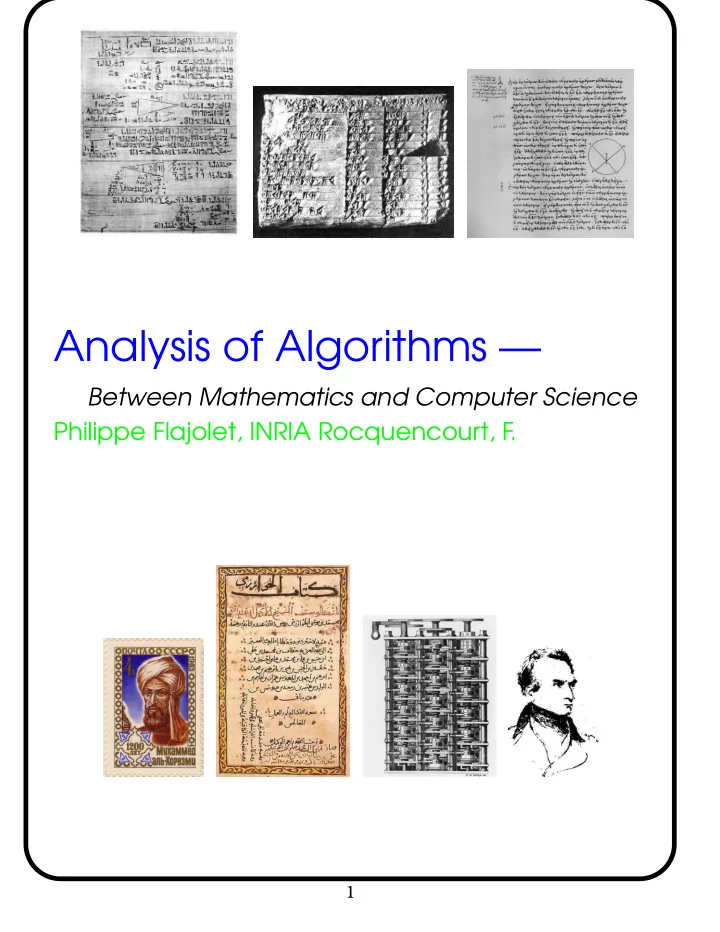
Analysis of Algorithms —
Between Mathematics and Computer Science Philippe Flajolet, INRIA Rocquencourt, F .
1
Analysis of Algorithms Between Mathematics and Computer Science - - PDF document
Analysis of Algorithms Between Mathematics and Computer Science Philippe Flajolet, INRIA Rocquencourt, F . 1 FIRST, A glimpse of history . . . Mathematics and Computing, i.e., algorithms , = a joint enterprise since the dawn of history.
Between Mathematics and Computer Science Philippe Flajolet, INRIA Rocquencourt, F .
1
A glimpse of history . . . Mathematics and Computing, i.e., algorithms, = a joint enterprise since the dawn of history. Thesis:
✂✁☎✄ Conceptual advances lead to morecomplex and efficient algorithms.
✆✁✝✁✞✄ Computer age obeys similar principle?2
Rhind papyrus (ca 1650BC
✟1900BC)
Egyptians knew binary representations and technique of “binary powering”!
✠☛✡ ☞ ✌ ✍ ✎✑✏ ✒✓✏ ✔✖✕ ✗ ✘✚✙ ✛ ✜ ✡✣✢ ✤ ✔ ✢ ✤✦✥ ✧★☞ ✌ ✍ ✡ ✌ ✢ ✤ ✔ ✌ ✢ ✤✦✥ ✌ ✩41
☞59 1 59
✪2 118 4 236 8 472
✪16 944 32 1888
✪= 2419
3
The Rhind papyrus contains eighty-seven problems. The papyrus, a scroll about 6 metres long and 1/3 of a metre wide, was written around 1650 BC by the scribe Ahmes who states that he is copying a document which is 200 years older. c
✶History of Mathematics archive @ St Andrews, UK.
3-1
Geometry
✷ Euclid [325BC–265BC] discovers Euclid’s algorithm andformalizes geometry. Archimedes [287BC–212BC] discovers that
✸is computable; cf Vi` ete [1540–1603]:
✸ ✹ ✺ ✹ ✻ ✹ ✹ ✹✽✼ ✻ ✹ ✹ ✹✽✼ ✹✽✼ ✻ ✹ ✾✿✾✿✾Arithmetics & Algorithms
✷ Al Kwarizmi [780–850] gives complete set of rules, an“algorithm” for the four operations on “hindi” numerals. Calculus
✷ Newton [1643–1727] “De Methodis Serierum etFluxionum” = Newton’s algorithm; “computer algebra”
4
Let
❀✴❁❃❂❅❄✂❆❈❇❊❉●❋ ; determine ❍ ❍ ❂ ❆✖❁❃❂■❇ ? Cf: Newton 1671; here, Buffon’s translation. ❏ Euler, Gauß and others apeal to computation alot! — Mathematics and computing largely progress together till the XIX–th century.
5
1 Rhind papyrus 2000 BC 3.16045 (= 4(8/9)2) 2 Archimedes 250 BC 3.1418 (average of the bounds) 3 Vitruvius 20 BC 3.125 (= 25/8) 4 Chang Hong 130 3.1622 (= sqrt10) 5 Ptolemy 150 3.14166 6 Wang Fan 250 3.155555 (=142/45) 7 Liu Hui 263 3.14159 8 Tsu Ch’ung Chi 480 3.141592920 (= 355/113) 9 Aryabhata 499 3.1416 (=62832/2000) 10 Brahmagupta 640 3.1622 (= sqrt10) 11 Al-Khwarizmi 800 3.1416 12 Fibonacci 1220 3.141818 13 Madhava 1400 3.14159265359 14 Al-Kashi 1430 3.14159265358979 15 Otho 1573 3.1415929 16 Vi` ete 1593 3.1415926536 17 Romanus 1593 3.141592653589793 19 Van Ceulen 1596 35 D 20 Newton 1665 16 D 21 Sharp 1699 71 D 22 Seki Kowa 1700 10 D 24 Machin 1706 100 D 25 De Lagny 1719 127 D, 112 correct 26 Takebe 1723 41 D 27 Matsunaga 1739 50 D 28 von Vega 1794 140 D, 136 correct 29 Rutherford 1824 208 D, 152 correct 30 Strassnitzky, Dase 1844 200 D 31 Clausen 1847 248 D 32 Lehmann 1853 261 D 33 Rutherford 1853 440 D 34 Shanks 1874 707 D, 527 correct
Source: http://www-gap.dcs.st-and.ac.uk/˜history/HistTopics/Pi_chronology.html
6
100 200 300 400 500 600 –2000 –1000 1000 2000
2 4 6 8 10 12 14 –2000 –1500 –1000 –500 500 1000100 200 300 400 500 600 1600 1650 1700 1750 1800 1850 1900 1950
1–14 D, till 1500 15–620 D, after 1500
PROGRESS = Geometry + Arithmetics + Analysis.
7
PROGRESS = Geometry + Arithmetics + Analysis.
8
ENIAC, 1949: 1120D; 1000 IPS; Supercomputer 2002:
▲✰▼❖◆✆❋ ◆✂▲ D; ◆✆❋ ◆✂▲IPS [Instruction Per Second]
.1e4 .1e5 1e+05 1e+06 1e+07 1e+08 1e+09 1e+10 1e+11 1e+12 1950 1960 1970 1980 1990 2000
Moore’s law ENIAC 1949
P ◗❘◗■❙❘❚❱❯ ◗❲❚❱❚❘❚❱❳✚❨❬❩ ❭ ◗❘❪❫◗❲❙❵❴Kanada 2002
P❛❙✑❜❘◗❲❚✳❝❡❞❘❯ ◗❲❚ ❝❢❞ ❳✚❨❣❩ ❭ ❙❤❪✐❚❱❚✳❪ ❜❥❜❥❜ is only half of the story.Computation cost is superlinear
❭❧❦better algorithms are needed!! Initially:
♠ ♥ ♦q♣ ❞❱r , s t ❭ t✈✉✿✇❡①✞②③✉✿④ ◗ ⑤ ⑥ ✉✿✇❡①✞②③✉✿④ ◗ ❙⑧⑦❱⑨ ❪ ⑩ Subquadratic multiplication (Karatsuba) ⑩ Fast Fourier transform ⑩ Arithmetic-geometric mean; elliptic functions ❪❥❪❥❪ ⑩ Superquadratically convergent algorithmsFinally:
♠ ♥ ❶❷♣✈♦q❸❺❹❱❻❼♣ r ❞❾❽9
10
An aside: ‘ miraculous’ Bailey-Borwein-Plouffe alg.
❿ ✍ ➀ ➁➃➂➅➄ ✠ ✱➇➆ ✢ ✡ ➈ ✤ ✱➉➆ ✢ ✠ ➈ ✡ ✱➇➆ ✢ ➊ ➈ ✡ ✱➇➆ ✢ ✲ ✡ ✡✳✲ ➁ ✩The forty–trillionth bit of Pi is ’0’
101 0 0000 1111 1001 1111 1111 0011 0111 0001 = A0F9FF371D17593E
❿ ✍ ✎❥➋❱➌ ✕ ➄ ✠ ✪ ✤ ➈ ✱ ✌ ✔ ➈ ✠ ✪ ✤➇✌➎➍ ➈ ✱ ✌ ✥ ✡ ➈ ✌ ✒ ➏ ✌➐✩Experimental maths in the computer age: Found
dencies between high precision evaluations applied to an inspired guess.
Cf. CECM site on Experimental Mathematics at Vancouver & Borwein’s pages. A curiosity
➑ ➒ ✺ ➓→➔☎➣☎➣↔➣✞➣☎➣ ↕❾➙ ❝ ➛➝➜➟➞✚➠ ↕❅➡ ❝ ✹➤➢ ➜ ➞ ➥ ➑ ✺ ➦✦➧ ➞ ➓ ➞❅➨✳➩✳➫➤➭➤➨ ➦ ➨✳➯➲➩❊➳❵➩ ➦ ✹ ➓ ➫ ➓ ➭ ✹ ➭ ➓➇➦➲➦ ➯ ➦ ✹ ➭➲➩➤➨❤➫ ✹ ➯➲➯ ➓ ➞❱➩❊➳ ✹ ➩➃➞ ➦ ➩✳➩ ➦ ➳ ✸ ✺ ➦✦➧ ➞ ➓ ➞❅➨✳➩ ✹ ➭➤➨ ➦ ➨✳➯➲➩❊➳❵➩ ➦ ✹ ➦ ➯ ➓ ➭ ✹ ➭ ➓➇➦➲➦ ➯ ➦ ✹ ➳❵➩➤➨❤➫ ✹ ➯➲➯ ➓ ➞❱➩❊➳➉➞❱➭➲➩ ➦ ➩✳➩ ➦ ➳10-1
Yet another case
Integer factorization challenge The problem of decomposing
✡✳➊ ✍ ✵ ☞ ➊ is notknown to be in class
➵ olynomial time.Triggered by Public Key Cryptosystems based on arithmetic strctures, a la RSA. ( c
➸Richard Brent.) Probabilistic algorithms start largely with Rabin in 1976: here (almost) all the algorithms are randomized —they make bets. . .
11
Analysis of Algorithms = an indispensable companion! Some algorithms are more efficient than others. — By how much ? Why?
➺Optimizations “Subliminal” in classical math.
— Trial division for factoring and Erastothenes’ sieve are costly. — Newton’s algorithm for root finding doubles the number of digits at each stage
➻ ✺fixed-point iteration
— Charles Babbage (1837)
➼ ➽➚➾✞➪ ➶☎➹⑧➘☎➴➷➹⑧➬❾➾➮➾✞➱ ➾❖➪➃➹✃➾❖➽❒❐ ➹✃➹⑧❐ ➴❰❮Ï➱✚Ð➤➹❘Ñ ✾✿✾✖✾ ➽❒Ò ➾✞ÓÔ➶☎Ò❰➘✽➱➲ÕÖ➾✞➪Ô➹ ➪❧×❵ÒÔÑ❰❮Ï➹ ➒ ❞ ➣■Ø ❝❢❞❖ÙÛÚ➤ÜÝÙ❼❝ ➔❲ØßÞ Ù✴à❲Ü á✞â ❞ Õã➱➲➶✽ä ÓÔ❮➚➾➮åæ➽➚➾❖➪➃➱➤Ó➃➾æ➘③➾✞➹✿➴❰➴❰➽❒ÒÔç ×❵Ò❰Ñ ❞ ➣■Ø ❝❢❞❖ÙÛÚ➤ÜÝÙ❼❝ ➔❲ØßÞ Ùéè❈ÙêàëÜ á✞â ❞ Õã➱➲➶✽ä ÓÔ❮➚➾➮åæ➽➚➾❖➪ ➘③➾✞➹✿➴❰➴❰➽❒ÒÔç12
Burks, Goldstine, von Neumann, 1946 (US Army) “The logical design of an electronic computing instrument”
✾✿✾✿✾➟ì ➼ ➹★➘✞➪í×❵❮❒❮☛➘✞➪Ô➱✚å ➾❖➪í×î➾ Õã➱➲➶ï× ➘☎Ó❰❐ ➱➲ÕÖðí➽❒Ò❧×❤➶③Ð åñ➱➲➶☎Ñ❰➘✿ò❰➹❱×❵➬ë➪ ➱➲Õ ❮Ï➹⑧ÒÔç✳➾✞➪ óôò➃➾✞➪Ô➹ ❮Ï➹⑧ÒÔç✳➾✞➪ ➱➲Õ❼➾✞➪Ô➹★❮õ×❤➶☎ç➲➹⑧➘ö➾➮➬❱×❤➶ö➶③Ð ➘ö➹❘÷➇ÓÔ➹⑧Ò❰➬✖➹➟➽❒➘ ➱➤Ò ➾❖➪➃➹ ×❘ø➤➹⑧➶❖×❤ç➲➹ ÒÔ➱✳➾æ➽❒Ò ➹❾ù➃➬✖➹❘➘☎➘❣➱➲Õ ❞ ❮Ï➱➲çúóüûþý ÿFeller, Knuth: Runs of good luck in coin tossings
➧✖➧✿➧13
14
1950’s: Scientific computing meets information processing
➺non-numerical data, esp. Sorting & Searching. First algorithms deal with sorting and searching. Radix-exchange sort (H&I)
a b a ?? b
Compare-exchange based on successive bits of data.
place 0’s on left, 1’s on right; recurse. The trie splitting process (Fredkin)
1
Separate recursively based on successive bits of data.
15
Journal of the ACM Vol. 6 (April 1959)
This note describes a new technique—Radix Exchange. The technique is faster than Inserting by the ratio
♦❷❸❺❹❘❻ ❞ ♣ r✁ ♣Its speed compares favorably with internal merging and it has the significant advantage of requiring essentially no working
Communications of the ACM Vol. 3 (August 1960)
16
Don Knuth (b. 1938)
What is the number of turns of the handle?
At CalTech around 1965, cooperation of Knuth & de Bruijn In The Art of Computer Programming 1973
17
Page 131 of Knuth’s TAOCP, Vol. 3 (1973) — The original derivation
✂Decompose
✍☎✄Divide & Conquer recurrence :
✆ ➁ ✍ ➆ ✢ ➁ ✝ ➂➅➄ ✡ ✤ ➁ ➆ ✞Solve binomial recurrence & reorganize.
☛Asymptotics : cleverly use Gamma function
☞ ✟✍✌ ✍ ✡ ✤ ✁ ❿ ✎❖✏✏✎ ➀ ✎ ✟ ✎ ➀ ✑ ✓✒❊✄ ✌ ✟✏✔ ➏ ✒ ✕Miraculous factorizations occur, residues fly all around, and
✩î✩❤✩18
The Big Theorem of P . 131
✖cost [path length, bit comparisons]
✗ ➆ ✘✚✙✜✛ ✕ ➆ ✢ ➆ ✢ ➈ ✡ ✘✣✙✤✛ ✤ ➈ ✡ ✤ ✢ ✥“where
✦ ➛ ó ➠ is the rather strange function ✾⑧✾✿✾Furthermore
✦ ➛ ó ➠ ✧ ➫ ➧ ➫➲➫➲➫➲➫➲➫Ô➞✚➳ ✹ ➨thus we may safely ignore
✦ ➛ ó ➠ for practical purposes.”————————————
⑩ Size has expectation (with fluctuations!) ★ ♣ ❸❺❹❘❻ ❙ ✩ ♣ ❜ ✪ ✫ ♦õ♣ r ✫ ♦q♣ r ❭ ◗ ❸❺❹❱❻ ❙ ↕✭✬ ➙ ➣ ✮ ✯ ⑥ ◗ ⑥ ❙✱✰✳✲îs ❸❺❹❱❻ ❙✵✴ ✶✸✷✺✹ ♦ ❙✱✰✳✲îs ❸❺❹❘❻ ❞ ♣ r19
Fluctuations
✻ ✡✽✼ ✟✿✾ :–1.5e–06 –1e–06 –5e–07 5e–07 1e–06 1.5e–06 200 400 600 800 1000 1200 1400 1600 1800 2000 n
✕A complicated math exercise. An isolated problem.
✕An expected outcome (
✖ ): ❀probabilistic argument.
✕A useless answer with
✡✺✼ ✟✍✾ fluctuations! ✕With Moore’s law, anyhow, etc.
20
Some “modern” views: Trabb Pardo 1978, Greene 1980, F .–R´ egnier–Sedgewick–Sotteau 1985, F .–Gourdon-Dumas 1995.
21
Symbolic methods: Combinatorics is reflected by algebra of generating functions Mainstream methods of enumerative combinatorics (
❁ ✡✽❂ ✱ ✼ ) replace recurrences. ✥ ➁ ➈✿❃ ✥ ✁❄❧✄❆❅ ✍ ➁ ✥ ➁ ❄ ➁ ✩ ➺Difference equations for expected trie costs:
❇toll
✁❄❧✄ ✩Semiclassical: Iteration, coefficient extraction, . . .
22
Mellin transforms
✥ ➈❋❃ ✥❍● ❅ ✍ ➀ ➄ ✥Real asymptotics from complex singularities. Factorizes linear superposition of models
■ ↕ ✦ ➛❑❏ ↕▼▲ ➠ ◆❖ P ■ ↕ ❏ ➡❘◗ ↕ ❙ ✾ ✦✠❚ ➛❱❯✚➠ ➧ ❲ ➛❳❯✚➠ ➞❣➜ ✹ ➡❘◗–10 –5 5 10 x –10 –5 5 10 y 0.5 1 1.5 2 2.5 3
23
Work from 1965++ yields a systematic approach Algorithms
❨Algebra of Costs Gen. Functions
❨Asymptotic estimates from singularities applicable to a major combinatorial process of computer science.
24
Knuth’s and others’ results inform us on shape of certain trees: Binary trie (uniform bits) Continued fraction trie Weyl tree by Devroye, versus ‘beta tree’
24-1
25
Adaptive hashing schemes
Tries are very versatile. — They can be paginated (bucketted): stop splitting at
❩ .— They can be combined with hashing to cope with non-uniformity of data. Near 1977-78, several groups discover the virtues
chaining them. [Larson;
Fagin-Nievergelt-Pippenger-Strong; Litwin]
Expected size of
❩ –tree is ➆ ❩ ✘✣✙✤✛ ✤ ✢ ❬❪❭❴❫❛❵❜❭ ,corresponding to 69% filling ratio. Compare with similar ratio for B–trees (Yao)
26
2 accesses suffice for very large DB. Extendible Hashing transforms the index into a perfect tree
❝array that can be paginated.
❞=height Index size
❝ ✤✤❡[Yao, R´ egnier, F ., ca 1980]
❢(
q ❭ ⑤ ❚ )5 10 15 20 25 30 200 400 600 800 1000
Fluctuations do exist!
27
Height: One of the very first intrusions of saddle point method in Analysis of Algorithms.
rs❄ ➁✉t ✥ ♦❄í✄ ✍ ✡ ✤ ✁ ❿ ✥ ✁❄❧✄ ➏ ❄ ❄ ➁ ✏✑✎ ✩ ➺Jacquet & Szpankowski’s “analytic de-Poissonization”: analyse under probabilistic model with “imaginary probabilities”!
28
From VSAM’s to skip lists Idea 1 (old): build indexes of indexes of indexes . . . Idea 2: balance
➺B–trees Idea 2’: randomize!
❝Pugh’s skip lists Much easier to maintain than balanced structures!
Analysis by Papadakis + Munro, Poblete Kirschenhofer, Mart´ ınez, Prodinger entirely based on
trie technology.
29
Can you estimate to 5% the number of different words in Shakespeare given a pencil and one sheet of paper?
.+Martin (1985) for data base query
Ideas: hash to get uniformity; observe bit patterns. 0... = 50% of times; 10... = 25%; 110... = 12.5% Try
✹✭✈where
✈ ✇ ①③② ④ ➞➲➞ ✾✖✾⑧✾ ➞❛➫ ➧✿➧⑧➧ is longest initial run of 1’s.The best observable known is trie-like and has accuracy 0.78
✻ ⑤for
⑤words of memory (+“stochastic averaging”); 0.78 is a Mellin constant.
Works in distributed environment: Yellow pages of New York
⑥San Francisco by phone line! Data mining applications. Quick running counts in routers [Durand 2003] based on other trie
30
31
1970: the shared communication channel
A B − A B C C − B ................
2+ 1 2+
B C
2+ 1 1 1
E D
Ethernet: Try; wait
☞★✡ , ☞ï✤ , ☞❣✠ , etc ➺Aldous 1987: Ethernet is unstable!
☛1977: The Tree/Stack protocol CTM = Capetanakis, Tsybakov, Mikhailov
G
Heads Tails 0, 1 (no collision) 2+ (collision) 0, 1 (no collision); probab. = p 2+ (collision), probab. = q
= A digital trie but with a flow of arrivals!
✕ ✕Erroneous analyses missed the wobbles. Variance by Kirschenhofer, Prodinger et al.= Mellin + modular forms.
32
Tree protocol
✍☎✄Poisson GenFun solves
⑧⑦ ✢ ⑨ ✍ ✡ ) ⑩ ✁❄❧✄ ➈ ⑩toll
✁❄❧✄ ✩A non-commutative iteration semigroup with a globally invariant measure.
Analyses by Fayolle, F ., Hofri, Jacquet, Mathys
✺❍➊— Ternary tree algorithms gives 10% better throughput — Protocol is hyperstable at all arrival rates. The IEEE 802.14 norm. . . a failed success story! Also analyses by Greenberg+F+Ladner: tree protocol modified to attain 93% of optimal:
■✠➋➍➌➏➎ ✺ ➫ ➧✐➓ ➭❊➳ ✹.
33
Leader Election:
✆✁✞✄ The leftmost branch of a trie ✆✁✝✁✞✄ The leftmost border of a trieAnalyses by Fill, Mahmoud, Szpankowski, Prodinger, F+Sedgewick; includes distributions.
rounds
✩34
35
Szpankowski’s Analysis of Algorithms on Sequences.
➺Random text: kwnbpr hwnqqcpq yt nxgfhsd agghos fhskla zmmxnz kasiweyzkcn ejhjsal ehrdjn...
➐ ✍“Natural” language text: Cale Pismo przez Boga
jest natchnione i pozyteczne do nauki, do wykrywania
Can be compressed!
❏ Lempel & Ziv invent LZ compression (1977+)based on building adaptive dictionaries.
a
➑ b ➑ r ➑ ac ➑ ad ➑ ab ➑ ra ➑ abr ➑ aca ➑ d ➑ abra ➑ abrac ➑ ada ➑ br ➑ aa ➑ br ➑ acad ➑ abraa ➑ ...Turns out to be related to digital search trees.
36
egnier-Jacquet (1987) do distributional analysis
analysis of tries under Markovian dependencies.
❏ Jacquet–Szpankowski–Louchard (1995+) extenddistributional analysis to DST’s:
➒ ➒ ❄➔➓ ♦❄➣→↕↔ ✄ ✍ ➓ ♦❄➣→✓⑦❴↔ ✄ ➓ ♦❄➣→ ⑨ ↔ ✄ ✢fudge
➺Combines everything: algebra of trie costs, Mellin, analytic
Complete characterizations of Lempel-Ziv algorithms, notably: redundancy.
37
38
(1977.)
❏ Related to information theory & tries by Vall´ee (1995+)
➙is a transformation. Iterates? Transfer operator:
➛ ✔ r ✥ tVall´ ee: Spectra & functional analysis serve to generate probabilities of prefixes
➺tries. Tries under dynamic source models;
➺Bentley-Sedgewick’s Ternary Search Tries Entropy for size, depth path-length; Eigenvalue
❶➐ ✤ ✄ for height, etc.39
Applies to continued fraction representations & algs:
ÿHAKMEM Algorithm (Gosper, 1972); 2D orientation = Avnaim, Boissonnat, Devillers, Preparata, Yvinec 1997.
➦ ➭ ➞➲➞ ➦ ✺ ➞ ➦ ✼ ➞ ➳ ✼ ➞ ➧ ➥ ➞➲➞ ➦ ➦ ➨➲➨ ✺ ➞ ➦ ✼ ➞ ➳ ✼ ➞ ➨➫➩ ➧ ÿSorting with continued fractions, cost:
➭ ➣ ó✃❮Ï➱➲çúó ✼ ➭ ❝ ó ✼ ➯ ➛ ó ➠ ✼ ➭ ❞ ✼ ➲ ➛③➞✚➠ ➥ ➭ ➣ ✺ ➭ ❮Ï➱➲ç ✹ ✸ ❞ ➥ ➭ ❝ ✺ ➞❱➯❴➳ ❮Ï➱➲ç ✹ ✸ ❞ ✼ ➩ ➛ ❮Ï➱➲ç ✹ ➠ ❞ ✸ ❞ ➜ ➳ ✹ ❮Ï➱➲ç ✹✺➵❼➸ ➛ ✹ ➠ ✸ à ➜ ➞ ✹ü➧ ➺➻➺➻➺ ➯depends on Riemann hypothesis!!!
40
41
Polynomial factorization (Cantor-Z refinement)
> factor(xˆ13-xˆ10+xˆ5-xˆ2+xˆ3-1); 2 6 4 2 2 (x - 1) (x
+ 1) (x + x + 1)
Vol 2., F+Gourdon+Panario
☛Quadtries and geometry, multiD search Rivest–Bentley–Samet
☛Other probabilistic counting algorithms Morris–Freivalds, Wegner’s, etc
☛Binary Decision Diagrams (BDD’s) by Bryant (!?) = Fully developed tries + common subtree
Hierarchical data compression by J. Kieffer
☛Level compressed tries
✍☎✄fast lookup in routers! Nilsson et al.
42
43
Analysis of algorithms as of now: Complex Models . . . become more and more tractable.
☛A large number of basic algorithms have been
Symbolic Methods help translate complex probabilistic models into gen. functions.
☛Analytic Combinatorics = an extensive calculus
A unified theory of basic random combinatorial structures and algorithms.
☛Fruitful connections with computer algebra.
➺Automatic counting, automatic asymptotics, automatic random generation.
44
Two basic principles
➼❃“dictionaries” SYMBOLIC METHODS Generating functions
➼❃ ➽ ✎❾✎ ➽ ✢ ➽ ✕ ✢ ➽ ✔ ✢ ✤ ➽ ➍ ✢ ✤ ➽ ✥✓✢ ✠ ➽ ✾ ✢ ➊ ➽ ➾ ✢ ❂ ➽ ✒ ✢ ➚➪➚➶➚ ✦ ➛✳➹➇➠ ✺ ➹ ✼ ✦ ➛✳➹ ❞ ✼ ➹ á ✼ ➹ à ➠ANALYTIC FUNCTIONS AND SINGULARITIES
45
The example of TRAINS
❏ Cope with complex structural “specifications”(- n) 0.1008557594 (0.5180547070) + ...
46
Analytic Combinatorics = organize random discrete structures (cf. stochastic proc.) = tightly coupled with Analysis of algs.
❏ Permutations: order stat., search & sort. ❏ Words: patterns, comput. biology, coding ❏ DIGITAL TREES ❏ Allocations: hashing, comb. opt., . . . ❏ Graphs: combinat opt., networks (?) ❏ Trees: symbolic manipulation, etc.47
THERE IS A story about two friends, who were classmates in high school, talking about their jobs. One of them became a statistician
➧✿➧✖➧ ”And what is this symbolhere?” ”Oh,” said the statistician, ”this is pi.” ”What is that?” ”The ratio of the circumference of the circle to its diameter.” ”Well, now you are pushing your joke too far,” said the classmate, ”surely the population has nothing to do with the circumference of the circle.” The miracle of the appropriateness of the language of mathematics for the formulation of the laws of physics is a wonderful gift which we neither understand nor
will remain valid in future research and that it will extend, for better or for worse, to our pleasure, even though perhaps also to our bafflement, to wide branches of learning. — Eugene Wigner ————————
”The Unreasonable Effectiveness of Mathematics in the Natural Sciences,” in Communications in Pure and Applied Mathematics, vol. 13, No. I (February 1960).
48