An update on the low mass cable. D. Calvo, P. De Remigis, M. - - PowerPoint PPT Presentation

an update on the low mass cable
SMART_READER_LITE
LIVE PREVIEW

An update on the low mass cable. D. Calvo, P. De Remigis, M. - - PowerPoint PPT Presentation

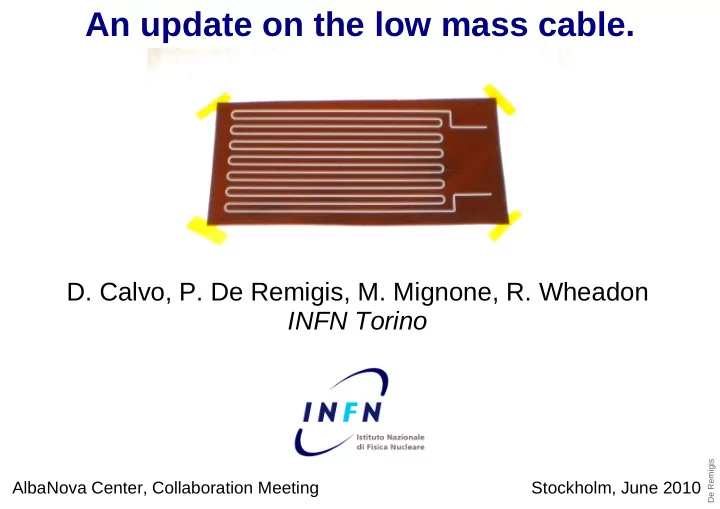
An update on the low mass cable. D. Calvo, P. De Remigis, M. Mignone, R. Wheadon INFN Torino De Remigis AlbaNova Center, Collaboration Meeting Stockholm, June 2010 Cable prototype and testing board.

slide-1
SLIDE 1

De Remigis

An update on the low mass cable.

  • D. Calvo, P. De Remigis, M. Mignone, R. Wheadon

INFN Torino

AlbaNova Center, Collaboration Meeting Stockholm, June 2010

slide-2
SLIDE 2

De Remigis

Cable prototype and testing board.

Two prototype made by:

  • Techfab (Torino)

Technology with aluminum deposition on kapton, at present not completely reliable for bonding.

  • CERN (Geneve)

Technology with laminated aluminum on kapton, reliable for bonding.

Transmitter 65lvds100, 2Gb/s Differential input Differential

  • utput

Receiver 65lvds100, 2Gb/s 1m folded cable

slide-3
SLIDE 3

De Remigis

Layout specification.

Both cable samples have a differential pair in a folded layout, for a total length of 1m.

  • Techfab

Aluminum thickness: ~7µm; kapton thickness: 50µm.

  • CERN

Aluminum thickness: 15µm; kapton thickness: ~70µm.

kapton aluminum aluminum

slide-4
SLIDE 4

De Remigis

Test setup for cable prototype.

The test has been performed using some standard protocols, as listed in the table.

2.130 Fiber Channel 2x 1.250 Giga Bit Ethernet 1.060 Fiber Channel 1x 0.622 Optical carrier 12x 0.156 Optical Carrier 3x Data rate [Gb/s] Standard protocol Tektronix dpo70604, 6GHz Agilent n5980a, 3.13Gb/s

slide-5
SLIDE 5

De Remigis

Results from prototypes (1).

The samples are measured with, and without, the receiver circuit.

.0 .5 1.0 1.5 2.0 2.5 50 100 150 200 250 300

Total jitter vs data rate.

INFN, Cu, 0.570mm, no receiver Techfab, Al, 0.15mm, receiver Techfab, Al, 0.15mm, no receiver Cern, Al, 0.10mm, receiver Cern, Al, 0.15mm, no receiver

data rate [Gb/s] mean(jitter) [ps]

No errors in communication Total Jitter

slide-6
SLIDE 6

De Remigis

Results from prototypes (2).

In the first case the swing is st=442mV, while in the last case it is sc=540mV.

TECHFAB CERN

slide-7
SLIDE 7

De Remigis

Results from prototypes (3).

Mean total jitter, relative to a board connected in loopback mode, to study the influence of the wirebond number on the transmission quality of the data link. All measurements was performed with the receiver circuit.

.0 .5 1.0 1.5 2.0 2.5 60 80 100 120 140 160 180

Total jitter vs data rate.

1wire 2wire 3wire 4wire 5wire data rate [Gb/s] mean jitter [ps]

slide-8
SLIDE 8

De Remigis

Results from prototypes (4).

Concerning the Techfab cables, due to some problems on connection, a new cable was made with an Al/Si alloy, but it presents a very large linear resistance that reduces the voltage swing and the common mode. The eye diagram becomes closed generating errors, starting from 622Mb/s.

slide-9
SLIDE 9

De Remigis

Bus prototype.

SMD capacitors soldering: partial success with a low yield, due to the disconnection of many aluminum pads and components. Copper via: the large measured value r=200Ω looks related to a rough mask alignment, and has to be repeated.

slide-10
SLIDE 10

De Remigis

Short summary.

  • Both providers, Techfab and Cern, can produce cables

that are working up to 2Gb/s.

  • Techfab samples show some difficulties for the bonding

process, and present a large linear resistance.

  • The first bus prototype, for connection of the readout chip,

needs improvements on the mask alignment and soldering capability for the SMD components.

  • Next steps will be the production of cables with a linear

layout, and some test without transceiver to verify the intrinsic feature of the differential pair.