An Overview of Context Modeling Approaches Abstract Context - - PDF document

an overview of context modeling approaches
SMART_READER_LITE
LIVE PREVIEW

An Overview of Context Modeling Approaches Abstract Context - - PDF document

Table of Contents Introduction ............................................................................................................................................. 2 Motivation


slide-1
SLIDE 1

Table of Contents

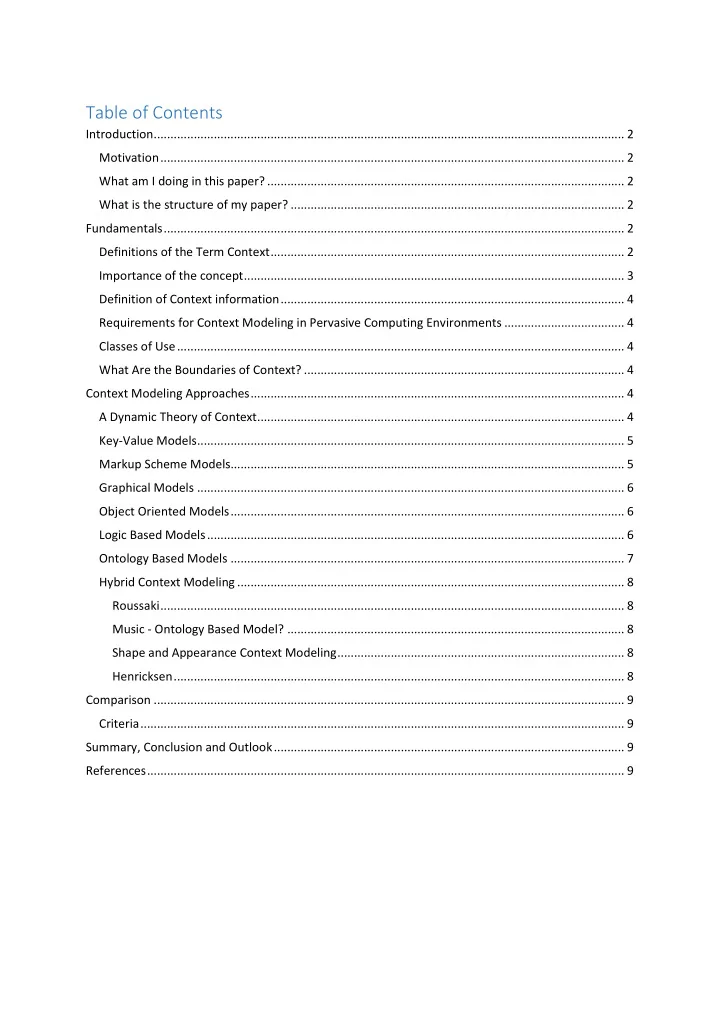
Introduction ............................................................................................................................................. 2 Motivation ........................................................................................................................................... 2 What am I doing in this paper? ........................................................................................................... 2 What is the structure of my paper? .................................................................................................... 2 Fundamentals .......................................................................................................................................... 2 Definitions of the Term Context .......................................................................................................... 2 Importance of the concept .................................................................................................................. 3 Definition of Context information ....................................................................................................... 4 Requirements for Context Modeling in Pervasive Computing Environments .................................... 4 Classes of Use ...................................................................................................................................... 4 What Are the Boundaries of Context? ................................................................................................ 4 Context Modeling Approaches ................................................................................................................ 4 A Dynamic Theory of Context .............................................................................................................. 4 Key-Value Models ................................................................................................................................ 5 Markup Scheme Models...................................................................................................................... 5 Graphical Models ................................................................................................................................ 6 Object Oriented Models ...................................................................................................................... 6 Logic Based Models ............................................................................................................................. 6 Ontology Based Models ...................................................................................................................... 7 Hybrid Context Modeling .................................................................................................................... 8 Roussaki ........................................................................................................................................... 8 Music - Ontology Based Model? ..................................................................................................... 8 Shape and Appearance Context Modeling ...................................................................................... 8 Henricksen ....................................................................................................................................... 8 Comparison ............................................................................................................................................. 9 Criteria ................................................................................................................................................. 9 Summary, Conclusion and Outlook ......................................................................................................... 9 References ............................................................................................................................................... 9

slide-2
SLIDE 2

An Overview of Context Modeling Approaches

Abstract Context information is the basis for realizing adequate context-aware applications. There are several definitions of context and there are several approaches to model context information. The work should provide an overview of existing modeling approaches and evaluate them with respect to different criteria. TO DO

Introduction

Motivation

Henricksen, K., Indulska, J., & Rakotonirainy, A. (2002). Modeling context information in pervasive computing systems. In Pervasive Computing (pp. 167-180). Springer Berlin Heidelberg. In the past a variety of context models were subject of research, because a well-designed model is a key accessor to the context in any context-aware system. While early models mainly addressed the modeling of context with respect to one application or an application class, generic context models are of interest since many applications can benefit from these. While some models take the users current situation, e.g. “in a meeting” into account, others model the physical environment, i.e.

  • locations. First steps towards a common understanding of context have been published, mostly with

respect to location, identity, and time. The objective of most current research is to develop uniform context models, representation and query languages as well as reasoning algorithms that facilitate context sharing and interoperability of applications.1

What am I doing in this paper?

  • > Overview of the most relevant current approaches to modeling context

What is the structure of my paper?

Fundamentals

Definitions of the Term Context

Many interpretations of the notion of context have emerged in various fields of research like psychology, philosophy, or computer science. Context has often a significant impact on the way humans (or machines) act and on how they interpret things; furthermore, a change in context causes a transformation in the experience that is going to be lived. The word itself, derived from the Latin con (with or together) and texere (to weave), describes a context not just as a profile, but as an

1 Strang/Linhoff-Popien, 2004, S. 1

slide-3
SLIDE 3

active process dealing with the way humans weave their experience within their whole environment, to give it meaning.2  Kokinov, B. (1999). Dynamics and automaticity of context: A cognitive modeling approach. In Modeling and Using Context (pp. 200-213). Springer Berlin Heidelberg. AI and psychological approaches to context are contrasted and the dynamic and automatic nature of the continuous context change in human cognition is emphasized. A dynamic theory of context is presented which defines context as the dynamic state of human mind. It describes the interaction between memory, perception, and reasoning in forming context as well as how they are influenced by context. A general cognitive architecture, DUAL, is presented that implements the mechanisms of context formation and accounts for the context-sensitivity of human cognition. A model of human problem solving, AMBR, has been built upon the DUAL architecture and the simulation experiments performed with it produce data that are coherent with experimental data on human problem solving.  SCHILIT, B. N., ADAMS, N. L., AND WANT, R. Context-aware computing applications. In IEEE Workshop on Mobile Computing Systems and Applications (Santa Cruz, CA, US, 1994)  SCHILIT, W. N. A System Architecture for Context-Aware Mobile Computing. PhD thesis, Columbia University, 1995.  SCHMIDT, A., BEIGL, M., AND GELLERSEN, H.-W. There is more to context than location. Computers and Graphics 23, 6 (1999), 893–901.  PASCOE, J. Adding Generic Contextual Capabilities to Wearable Computers. In 2nd International Symposium on Wearable Computers (ISWC 1998) (1998), pp. 92–99.  CHEN, G., AND KOTZ, D. A survey of context-aware mobile computing research. Tech. Rep. TR2000-381, Dartmouth, November 2000.  BROWN, P. J., BOVEY, J. D., AND CHEN, X. Context-aware Applications: from the Laboratory to the Marketplace. IEEE Personal Communications 4, 5 (October 1997), 58–64.

Importance of the concept

Ubiquitous computing systems make high demands on any context modeling approach.1 DETAIL Definition of Ubiquitous computing systems. The concept of context-awareness increasingly gained importance in the area of distributed systems since the 90’s, since it seemed to be a promising solution for a lot of problems which have been implied by the usage of mobile terminals in ever-changing environments. Context dependency is thus a major issue in recent research work in the area of ubiquitous computing systems which are specialisations of mobile, distributed systems. 1 A context model provides an unambiguous definition of the context artifacts, their representations, semantics and usage. It takes into account the general characteristics of context information, such as its temporal nature, ambiguity, impreciseness, incompleteness and privacy. Furthermore, a context model must also address special requirements of pervasive computing environments like distribution, mobility, heterogeneity of context sources and resource-constrained devices. Often, pervasive applications require high-level context information that is derived from low-level context

  • values. Therefore, support for automatic context reasoning has to be provided as well.3

2 Bolchini, et al., 2007, S.1 3 Reichle, R., Wagner, M., Khan, M. U., Geihs, K., Lorenzo, J., Valla, M., ... & Papadopoulos, G. A. (2008, January).

A comprehensive context modeling framework for pervasive computing systems. In Distributed applications and interoperable systems (pp. 281-295). Springer Berlin Heidelberg.

slide-4
SLIDE 4

Definition of Context information

 Henricksen, K., Indulska, J., & Rakotonirainy, A. (2002). Modeling context information in pervasive computing systems. In Pervasive Computing (pp. 167-180). Springer Berlin Heidelberg.

Requirements for Context Modeling in Pervasive Computing Environments

This section identifies requirements for a context model that aims to ease the development of context-aware applications in mobile and pervasive computing environments. A comprehensive list

  • f requirements has been derived through a process where a set of case studies featuring both real

(commercial) and fictional scenarios were studied and evaluated in the scope of mobile and pervasive computing.3  Ease of development  Considering the characteristics of mobile and pervasive computing environments  Need for machine-interpretable representation of context information  Dealing with special context properties  Dealing with context information partitioning  Evolution and extensibility

Classes of Use

This characterization covers the focus of the model, its representation and the way context data are used; the result is a rich set of features, emphasizing that context modeling is a varied and complex

  • problem. Depending on the specific purpose it is designed for, each model may “include” several of

the listed features. Bolchini et al. developed five classes of use, which share general sets of features, and more important, the same target field of application. These classes can be considered as a coarse-grained categorization of the context models, or as a decomposition of the context problem itself (in boldface the key features of each class).  Bolchini, C., Curino, C. A., Quintarelli, E., Schreiber, F. A., & Tanca, L. (2007). A data-oriented survey of context models. ACM Sigmod Record, 36(4), 19-26.

What Are the Boundaries of Context?

Kokinov, B. (1995). A dynamic approach to context modeling. In Proceedings of the IJCAI-95 workshop on modeling context in knowledge representation and reasoning. LAFORIA (Vol. 95, No. 11, pp. 199-209).

Context Modeling Approaches

In order to provide application dependent context information through a context framework, a uniform way of representing and sharing context is required. Strang and Linnhoff-Popien evaluate the most relevant context approaches based on the data structures used for representing and exchanging context information: key-value pair, markup scheme, graphical, object oriented, logic based and ontology based models. According to their evaluation, the most promising assets for context modeling for ubiquitous computing environments are found in ontology based models. In these models, the semantic context information is represented using one of the ontology markup languages, for example OWL (Web Ontology Language).3

A Dynamic Theory of Context

A dynamic theory of context is proposed which considers context as the set of all entities that influence human cognitive behavior on a particular occasion. As a consequence context is thought of as the dynamic fuzzy set of all associatively relevant memory elements at a particular instant of time.

slide-5
SLIDE 5

These memory elements might be both mental representations and operations. Some experimental facts about the influence of the perceptible environment as well as of the previous memory state on human problem solving are briefly presented. The dynamic nature of context influence on behavior is

  • emphasized. A general cognitive architecture, DUAL, is presented which consists of many small

agents running autonomously in parallel with variable speeds depending on their current associative

  • relevance. A model of problem solving, AMBR, based on DUAL is discussed where problem solving

emerges from the collective behavior of the agents. The possibilities of AMBR for modeling context and priming effects are considered and some simulation results are presented.  Kokinov, B. (1995). A dynamic approach to context modeling. In Proceedings of the IJCAI-95 workshop on modeling context in knowledge representation and reasoning. LAFORIA (Vol. 95, No. 11, pp. 199-209).

Key-Value Models

 Chang, S. G., Yu, B., & Vetterli, M. (2000). Spatially adaptive wavelet thresholding with context modeling for image denoising. Image Processing, IEEE Transactions on, 9(9), 1522- 1531. This work proposes a spatially adaptive wavelet thresholding method based on context modeling, a common technique used in image compression to adapt the coder to changing image characteristics. Each wavelet coefficient is modeled as a random variable of a generalized Gaussian distribution with an unknown parameter. Context modeling is used to estimate the parameter for each coefficient, which is then used to adapt the thresholding strategy.  Hsiang, S. T. (2001). Embedded image coding using zeroblocks of subband/wavelet coefficients and context modeling. In Data Compression Conference, 2001. Proceedings. DCC

  • 2001. (pp. 83-92). IEEE.

In this paper, we present a new embedded wavelet image coding system using quadtree splitting and context modeling. It features low computational complexity and high compression efficiency, thanks to joint utilization of two powerful embedded coding techniques-set partitioning and context modeling.  SAMULOWITZ, M., MICHAHELLES, F., AND LINNHOFF-POPIEN, C. Capeus: An architecture for context-aware selection and execution of services. In New developments in distributed applications and interoperable systems (Krakow, Poland, September 17-19 2001), Kluwer Academic Publishers, pp. 23–39.  SCHILIT, B. N., ADAMS, N. L., AND WANT, R. Context-aware computing applications. In IEEE Workshop on Mobile Computing Systems and Applications (Santa Cruz, CA, US, 1994).  STRANG, T. Service Interoperability in Ubiquitous Computing Environments. PhD thesis, Ludwig-Maximilians-University Munich, Oct. 2003.

Markup Scheme Models

 HELD, A., BUCHHOLZ, S., AND SCHILL, A. Modeling of context information for pervasive computing applications. In Proceedings of SCI 2002/ISAS 2002 (2002).  HENRICKSEN, K., AND INDULSKA, J. Modelling and Using Imperfect Context Information. In Workshop Proceedings of the 2nd IEEE Conference on Pervasive Computing and Communications (PerCom2004) (Orlando, FL, USA, March 2004), pp. 33–37.  CHTCHERBINA, E., AND FRANZ, M. Peer-to-peer coordination framework (p2pc): Enabler of mobile ad-hoc networking for medicine, business, and entertainment. In Proceedings of International Conference on Advances in Infrastructure for Electronic Business, Education,

slide-6
SLIDE 6

Science, Medicine, and Mobile Technologies on the Internet (SSGRR2003w) (L’Aquila/Italy, January 2003).  BROWN, P. J., BOVEY, J. D., AND CHEN, X. Context-aware Applications: from the Laboratory to the Marketplace. IEEE Personal Communications 4, 5 (October 1997), 58–64.  CAPRA, L., EMMERICH, W., AND MASCOLO, C. Reflective middleware solutions for context- aware applications, 2001.  KAGAL, L., KOROLEV, V., CHEN, H., JOSHI, A., AND FININ, T. Project centaurus: A framework for indoor mobile services.  RYAN, N. ConteXtML: Exchanging Contextual Information between a Mobile Client and the FieldNote Server, August 1999.

Graphical Models

 Simons, C. (2007, January). CMP: a UML context modeling profile for mobile distributed

  • systems. In System Sciences, 2007. HICSS 2007. 40th Annual Hawaii International Conference
  • n (pp. 289b-289b). IEEE.

 Wang, Y., Zhou, X. G., Zhou, B., Liang, L., & Peng, C. L. (2006, September). A MDA based SoC modeling approach using UML and SystemC. In Computer and Information Technology, 2006. CIT'06. The Sixth IEEE International Conference on (pp. 245-245). IEEE.  Henricksen, Karen, Jadwiga Indulska, and Andry Rakotonirainy. "Modeling context information in pervasive computing systems." Pervasive Computing. Springer Berlin Heidelberg, 2002. 167-180.  HALPIN, T. A. Information Modeling and Relational Databases: From Conceptual Analysis to Logical Design. Morgan Kaufman Publishers, San Francisco, 2001.  HENRICKSEN, K., INDULSKA, J., AND RAKOTONIRAINY, A. Modeling context information in pervasive computing systems. In LNCS 2414: Proceedings of 1st International Conference on Pervasive Computing (Zurich, Switzerland, 2002), F. Mattern and M. Naghshineh, Eds., Lecture Notes in Computer Science (LNCS), Springer, pp. 167–180.  HENRICKSEN, K., INDULSKA, J., AND RAKOTONIRAINY, A. Generating Context Management Infrastructure from High-Level Context Models. In Industrial Track Proceedings of the 4th International Conference on Mobile Data Management (MDM2003) (Melbourne/Australia, January 2003), pp. 1–6.

Object Oriented Models

 BOUZY, B., AND CAZENAVE, T. Using the Object Oriented Paradigm to Model Context in Computer Go. In Proceedings of Context’97 (Rio, Brazil, 1997).  CHEVERST, K., MITCHELL, K., AND DAVIES, N. Design of an object model for a context sensitive tourist GUIDE. Computers and Graphics 23, 6 (1999), 883–891.  SCHMIDT, A., BEIGL, M., AND GELLERSEN, H.-W. There is more to context than location. Computers and Graphics 23, 6 (1999), 893–901.

Logic Based Models

 MCCARTHY, J. Notes on formalizing contexts. In Proceedings of the Thirteenth International Joint Conference on Artificial Intelligence (San Mateo, California, 1993), R. Bajcsy, Ed., Morgan Kaufmann, pp. 555–560.  MCCARTHY, J., AND BUVACˇ. Formalizing context (expanded notes). In Working Papers of the AAAI Fall Symposium on Context in Knowledge Representation and Natural Language (Menlo Park, California, 1997), S. Buvacˇ and Ł. Iwanska, ´ Eds., American Association for Artificial Intelligence, American Association for Artificial Intelligence, pp. 99–135.

slide-7
SLIDE 7

 GHIDINI, C., AND GIUNCHIGLIA, F. Local models semantics, or contextual reasoning ✄ locality compatibility. Artificial Intelligence 127, 2 (2001), 221–259.  GIUNCHIGLIA, F. Contextual reasoning. Epistemologica - Special Issue on I Linguaggi e le Macchine 16 (1993), 345–364. Also IRST-Technical Report 9211-20, IRST, Trento, Italy.  AKMAN, V., AND SURAV, M. The use of situation theory in context modeling. Computational Intelligence 13, 3 (1997), 427–438.  BARWISE, J., AND PERRY, J. Situations and Attitudes. MIT Press, 1983.

Ontology Based Models

The behavior of pervasive applications should depend not only on their internal state and user interactions but also on the context sensed during their execution. The GCoM model facilitates context reasoning by providing structure for contexts, rules and their semantics. Context and context semantics in GCoM model are represented using the upper and the lower level ontology. Rules are represented using ontology compatible rule languages. Even though ontology data has static nature, GCoM model is designed to be dynamic and reusable in multiple domains of pervasive applications where resource limitation is a key issue. Initial prototype of the use of the model is created and the result obtained is promising.4  Krummenacher, R., & Strang, T. (2007, June). Ontology-based context modeling. In Proceedings Third Workshop on Context-Aware Proactive Systems (CAPS 2007)(June 2007) (p. 22).  O¨ TZTU¨ RK, P., AND AAMODT, A. Towards a model of context for case-based diagnostic problem solving. In Context-97; Proceedings of the interdisciplinary conference on modeling and using context (Rio de Janeiro, February 1997), pp. 198–208.  STRANG, T. Service Interoperability in Ubiquitous Computing Environments. PhD thesis, Ludwig-Maximilians-University Munich, Oct. 2003.  GU, T., WANG, X. H., PUNG, H. K., AND ZHANG, D. Q. Ontology Based Context Modeling and Reasoning using OWL. In Proceedings of the 2004 Communication Networks and Distributed Systems Modeling and Simulation Conference (CNDS2004) (San Diego, CA, USA, January 2004).  WANG, X. H., ZHANG, D. Q., GU, T., AND PUNG, H. K. Ontology Based Context Modeling and Reasoning using OWL. In Workshop Proceedings of the 2nd IEEE Conference on Pervasive Computing and Communications (PerCom2004) (Orlando, FL, USA, March 2004), pp. 18–22. Here we propose an OWL encoded context ontology (CONON) for modeling context in pervasive computing environments, and for supporting logic-based context reasoning. CONON provides an upper context ontology that captures general concepts about basic context, and also provides extensibility for adding domain-specific ontology in a hierarchical

  • manner. Based on this context ontology, we have studied the use of logic reasoning to check

the consistency of context information, and to reason over low-level, explicit context to derive high-level, implicit context. By giving a performance study for our prototype, we quantitatively evaluate the feasibility of logic based context reasoning for nontime-critical applications in pervasive computing environments, where we always have to deal carefully with the limitation of computational resources.

4 Ejigu, D., Scuturici, M., & Brunie, L. (2007, March). An ontology-based approach to context modeling and

reasoning in pervasive computing. In Pervasive Computing and Communications Workshops, 2007. PerCom Workshops' 07. Fifth Annual IEEE International Conference on (pp. 14-19). IEEE.

slide-8
SLIDE 8

 CHEN, H., FININ, T., AND JOSHI, A. Using OWL in a Pervasive Computing Broker. In Proceedings of Workshop on Ontologies in Open Agent Systems (AAMAS 2003) (2003).

Hybrid Context Modeling

Roussaki

This paper is concerned with the development of a hybrid context representation scheme that aims to combine the maintenance, distribution and administrative facilities of a location-based context model and the semantic advantages of context ontologies  Roussaki, I., Strimpakou, M., Kalatzis, N., Anagnostou, M., & Pils, C. (2006, March). Hybrid context modeling: A location-based scheme using ontologies. In Pervasive Computing and Communications Workshops, 2006. PerCom Workshops 2006. Fourth Annual IEEE International Conference on (pp. 6-pp). IEEE.

Music - Ontology Based Model?

 Reichle, R., Wagner, M., Khan, M. U., Geihs, K., Lorenzo, J., Valla, M., ... & Papadopoulos, G.

  • A. (2008, January). A comprehensive context modeling framework for pervasive computing
  • systems. In Distributed applications and interoperable systems (pp. 281-295). Springer Berlin

Heidelberg.

Shape and Appearance Context Modeling

In this work we develop appearance models for computing the similarity between image regions containing deformable objects of a given class in realtime. We introduce the concept of shape and appearance context. The main idea is to model the spatial distribution of the appearance relative to each of the object parts. Estimating the model entails computing occurrence matrices. We introduce a generalization of the integral image and integral histogram frameworks, and prove that it can be used to dramatically speed up occurrence computation. We demonstrate the ability of this framework to recognize an individual walking across a network of cameras. Finally, we show that the proposed approach outperforms several other methods.

Henricksen

 Henricksen, K., & Indulska, J. (2006). Developing context-aware pervasive computing applications: Models and approach. Pervasive and mobile computing, 2(1), 37-64. There is growing interest in the use of context-awareness as a technique for developing pervasive computing applications that are flexible, adaptable, and capable of acting autonomously on behalf of

  • users. However, context-awareness introduces a variety of software engineering challenges. In this

paper, we address these challenges by proposing a set of conceptual models designed to support the software engineering process, including context modelling techniques, a preference model for representing context-dependent requirements, and two programming models. We also present a software infrastructure and software engineering process that can be used in conjunction with our

  • models. Finally, we discuss a case study that demonstrates the strengths of our models and software

engineering approach with respect to a set of software quality metrics.

Unstructured

 Bolchini, C., Curino, C. A., Quintarelli, E., Schreiber, F. A., & Tanca, L. (2007). A data-oriented survey of context models. ACM Sigmod Record, 36(4), 19-26.  Shotton, J., Winn, J., Rother, C., & Criminisi, A. (2006). Textonboost: Joint appearance, shape and context modeling for multi-class object recognition and segmentation. In Computer Vision–ECCV 2006 (pp. 1-15). Springer Berlin Heidelberg.

slide-9
SLIDE 9

This paper proposes a new approach to learning a discriminative model of object classes, incorporating appearance, shape and context information efficiently. The learned model is used for automatic visual recognition and semantic segmentation of photographs.  Yao, B., & Fei-Fei, L. (2010, June). Modeling mutual context of object and human pose in human-object interaction activities. In Computer Vision and Pattern Recognition (CVPR), 2010 IEEE Conference on (pp. 17-24). IEEE.  Yao, X., & Thill, J. C. (2005). How Far Is Too Far?–A Statistical Approach to Context‐contingent Proximity Modeling. Transactions in GIS, 9(2), 157-178.

Comparison

Criteria

 Modeled aspects  Representation features  Context management and usage

Summary, Conclusion and Outlook

context modeling approach S.4 ab 2005 S.2

References