SLIDE 1 1
An Environmentally Sustainable Present and Future
Our children’s right, our responsibility
Marina Bachmann, Kate Harris Collectively Kids
May 2018
Marina: I own and teach at Collectively Kids in Mt Albert, Auckland. Kate Harris and I are part of a team of 7 qualified
- teachers. CK is a small centre with 30 children aged 0-5. This July this year we turn 25…
I will start by outlining the reasons why environmental education has been our vision and the foundation of
- ur work for over a decade. Just bear in mind that our approach has evolved over time – we haven’t, and
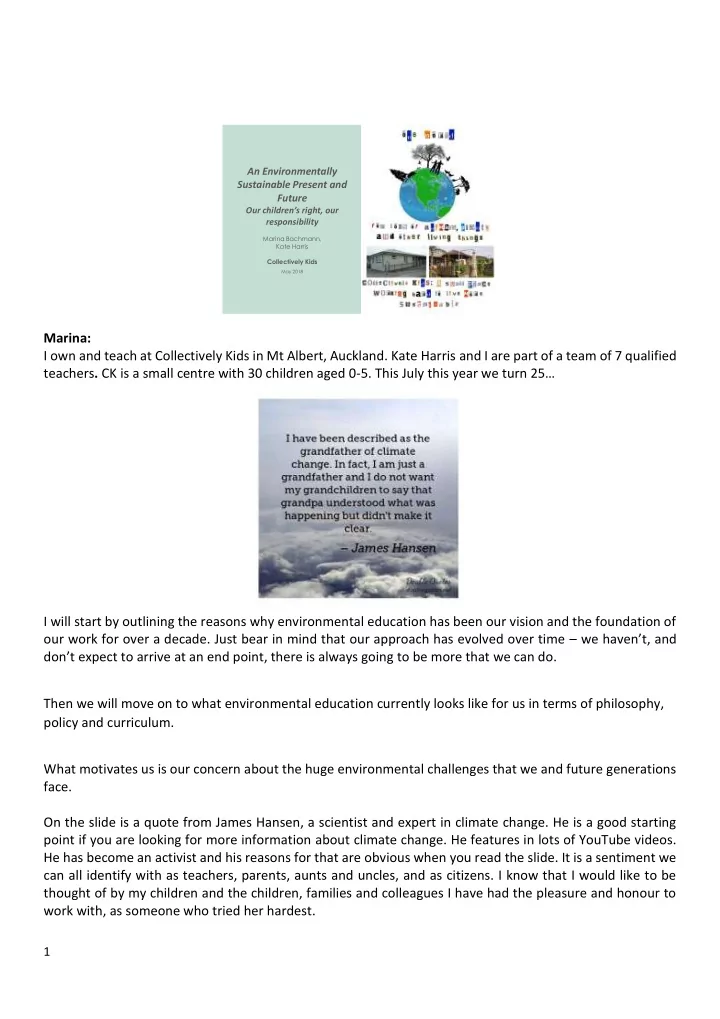
don’t expect to arrive at an end point, there is always going to be more that we can do. Then we will move on to what environmental education currently looks like for us in terms of philosophy, policy and curriculum. What motivates us is our concern about the huge environmental challenges that we and future generations face. On the slide is a quote from James Hansen, a scientist and expert in climate change. He is a good starting point if you are looking for more information about climate change. He features in lots of YouTube videos. He has become an activist and his reasons for that are obvious when you read the slide. It is a sentiment we can all identify with as teachers, parents, aunts and uncles, and as citizens. I know that I would like to be thought of by my children and the children, families and colleagues I have had the pleasure and honour to work with, as someone who tried her hardest.
SLIDE 2 2
The issues we face are incredibly complex but also really simple. We need a healthy planet to live healthy lives but the way we have been, and are, living is not sustainable. Climate change is already affecting us and is a big issue for our neighbours – other Pacific islands and Australia as well as many developing countries. The scientific consensus is that environmental sustainability is no longer possible. But there are things we can and need to do to reduce the impact of climate change. Most important is that we urgently reduce greenhouse gas emissions (mainly using less/reducing our focus on consumerism). We also need to treasure what we have and repair what we have damaged through mitigation work – which is about making things better (planting trees, improving our waterways…) Basically we need to more careful, caring and considerate. To achieve that there has to be a huge shift of attitude in the way we think about our planet. Currently we act as if the earth is a resource that we can exhaust when it is in fact our home. We totally depend on it and we ignore its rights at our peril. This shift in attitude includes thinking more globally and collectively. We need to convince our communities,
- rganisations and governments to prioritise environmental issues and social justice.
Social justice is a key component of environmental sustainability models – we all know that when things get tough, the most vulnerable members our communities tend to be left behind (often children). That is not OK
We need to reconsider our economic framework and shift from a growth focus to one that prioritises the health of the earth and sees emission reduction and mitigation as overarching economic goals rather than focussing on increasing the wealth of a few. We are going to share a video with you made by a young woman who used to come to CK. Ella made this for us for a presentation in 2011 but it is still very relevant. We have to act now - we can’t let our children down and young people down. Link to Ella’s video, password collectivelykids https://vimeo.com/270811244 So how can we address these complex and often overwhelming issues in ECE? What is our role as teachers and citizens at this time?
SLIDE 3 3
In ECE we are very lucky that we have a lot of freedom in terms of curriculum and we come from a profession that has made advocacy for children and their rights its mission. Another bonus is that exploring environmental education in depth is really rewarding, empowering and satisfying for our community as we look at finding different and better ways of living and being in this world. It’s creative – you can approach the topic in a number of different ways. It’s full of opportunities to provide a really meaningful holistic curriculum for our children. I believe that we need to really think about what we can deliver in ECE that will be helpful and useful for children in the present and what we can do to prepare them for an uncertain future. One of the key aspects we focus on is active and engaged citizenship which includes agency and advocacy within and beyond our
- community. It sees children as competent and powerful members of our community. We are trying to ensure
that our children have the skills, knowledge, and wide range of ways of being and acting that will help them navigate challenges in ways that prioritise the environment and social justice. Identifying and speaking up about their rights is a part of that. When we were preparing for this presentation we asked the older children what they would like the teachers at this Seminar to do to make sure that the world is a good place for them to live in when they grow up. Like Ella our children have concerns, hopes and dreams. Here are the unedited comments: Look after animals Care about the planet Don’t put rubbish on the ground Pick up rubbish on the ground and footpath Don’t put rubbish on the footpath and road Don’t put things in the bin - recycle and use them again otherwise they go in the ground (Rubbish is an issue the children are very engaged with and really our wasteful habits are a key driver of climate change and environmental degradation) Here are some more puzzling comments: Persons and buses can be a rainbow if they want to (this I think links to the key message of current project
- n gender neutral curriculum – you can be whoever and whatever you want – don’t let stereotypes limit
you) Someone just said “home” Tidy up your room Tidy up
SLIDE 4 4
Tidy up the rubbish in your house Homes are important to children and everyone has the right to a safe, secure and comfortable home And finally: Eat candy (maybe that refers to the importance of an occasional treat) Essentially our aim at Collectively Kids, is to engage with the complex environmental challenges that face us, in ways that are meaningful for us and that happens mainly through small place-based actions, processes and projects. The children’s comments are an example of this. It’s a mix of very practical everyday things like waste minimisation and looking after our resources as well about thinking differently, particularly about our ways of being with each other and the environment. And we hope that our small actions create ripples and encourage other people to get involved. Trying to make those ripples bigger is hard work but essential. The environmental challenges we face are not something we can solve as individuals. But as communities and organisations we can start to make a difference particularly if our voices are heard by government. This is one of the reasons why we are sharing
The obvious place to start with is our families. We make a point of sharing our vision from the first contact we have with parents and generally families are very supportive. A few years ago a parent whose children used to come to CK used us a case study for a sustainable business
- assignment. A part of that was a questionnaire which over ½ the families answered. For most of the families
CKs environmental focus was important or very important when they chose us as an ECE setting. It impacted positively on parent satisfaction and it was something they shared when talking to people about CK. A month ago we had a whānau hui to discuss our Te Tiriti based practice policy and our gender neutral project (both part of environmental education) and it was wonderful to see the deep engagement and genuine support of families for our work. Here is a comment from a year or so ago – it demonstrates that ripple effect too: ‘Just wanted to acknowledge the tremendous work and effort that you do at CK, as highlighted in the presentation you gave to the University of Auckland. It was inspiring to read and I particularly liked how you took massive global issues that often paralyse people and overwhelm them, and broke them down into manageable component parts and how as a community you are working to change the way things are seen and done. It highlighted to me that the work you do can be an example not just to the immediate community but also the way we typically think of early childhood education in NZ. If all children could be part of a community like yours/ours, what a different world we would live in, and how much more respect for each
- ther and the environment we would have and the interconnected nature of all things.’
This demonstrates that a political, deep approach to environmental education is a positive thing for our
- community. It also strengthens the work we are able to do because we have the support of our families. We
shouldn’t be scared of sharing what we believe is in the best interests of our children.
SLIDE 5 5
Our work started well over a decade ago when we were planning to move to new premises and decided develop an environment policy that as a framework when for that process. At that time I was also becoming increasingly interested in addressing environmental issues more effectively within my work. We developed the policy as part of a whole centre professional development programme focused on bicultural practice. We were looking at care of the self, others and the environment within Aotearoa’s bicultural context. We were particularly exploring practical things that might be possible in our new premises. It was a good way to come up with an agreement as a team which accommodated different understanding and perspectives of individual teachers. It meant we had a concrete vision and plan that we could share with
- ur community including the architect.
Once you have a document that is meaningful for your centre, and you actively engage with it, environmental education becomes embedded – it will be part of strategic and annual planning and internal evaluation. Our Environment policy is reviewed every year and has an action plan. It links to the opening statement of
- ur philosophy which you can see on the slide.
That still includes the term sustainability, because a sustainable future is the right of children, but it’s becoming more unlikely that we will be able to achieve that because some of the impacts of climate change, (for instance rising sea levels) are already locked in. Even if we were to go to zero emissions right now sea levels would still continue to rise. So we are looking at life on this planet that will be very different from what we are experiencing at this time which is why we now use the term environmental education rather than focusing on sustainability.
SLIDE 6 6
Here is a slide of the first part of the policy. It has changed quite a bit and will continue to change. It has the standard components of environmental sustainability models – adaption, emissions reduction, mitigation and social justice The second slide is more specific to our approach. Hopefully the rest of the presentation will make it clear how aspects of our policy are addressed. Consumerism Kate: I’m now going to speak briefly about consumerism, and some of the strategies and practices we use in our centre to combat, cope with, and create other options to it. At Collectively Kids we are trying to provide our tamariki with an alternative to the current focus on
- consumerism. We want them to begin to understand the impact mass production has on the environment,
and find other ways of doing and being that satisfy them. The reason we are in this current climate and environmental ‘mess’ is that we, particularly in the developed world, consume too much of everything.
SLIDE 7 7
This has multiple negative effects. For example - in terms of the non-renewable resources we use, the pollution created in the manufacture and transportation of the goods, and in the waste generated from the goods themselves. As you can appreciate, consumerism and its consequences are complex issues. So rather than get too tied up in knots, I suggest the key is keeping things simple. Framing the wider issues in ways we can all relate to - in our everyday lives and within our own terms of reference - makes them more manageable. For us, in our place, respecting and looking after the resources we have is an integral part of our centre
- culture. Children are encouraged to tidy up after themselves and help others too. Leaving a place as good
as you found it - or better - is a small reflection of how we should all live in the wider world. In addition, looking after our resources means they last longer and we do not need to replace them so
- frequently. Toys and equipment are fixed rather than chucked out. Consideration is given to the raw
materials and labour that go into manufactured items. As part of our avoidance of consumer culture we don’t show toys at mat time. Toys are made at a cost - which is not just the retail price. There are also issues like social justice and the rights of the child that relate to mass production. Resources, pollution, child labour and poorly paid workers (which is something we discuss with the older children) are all factors worth considering. Sadly, children and childhood in developed countries are framed within a context of having to have stuff. Advertising is aimed relentlessly at children and families. It feels like there are often promotions based on giving away mass produced toys or things requiring further consumerism to complete. Encouraging critical thinking and creativity, relishing opportunities to problem solve, and viewing and describing our tamariki as ‘problem solvers who don’t give up’ are small ways I believe we can begin to develop ways of combating consumerism. Reminding them of times they showed perseverance, imagination, or creative solutions can be powerful and effective in supporting them to develop a sense of agency and self belief. At Collectively Kids we want to offer children and whānau a place where they experience different and “better” pleasures, not just ones focussed on buying and consuming goods. By offering such alternatives we hope they begin to internalise this to become “refusers” and more able to resist (or to at least think about) the current pressure to be consumers. Just being able to begin distinguishing the difference between ‘want’ and ‘need’ is an important step in thinking more critically about the pressure to buy and consume. This can be challenging (even for adults) so it can be a really useful place to start conversations about consumerism, and consider carefully where
Before we buy goods or use resources even just asking ourselves: Do we need this? Do we want this? Or is it just easier? can be a good habit to get into.
SLIDE 8 8
If we do need it and can justify getting or using it then what are the best ways of doing that? It can be better in the long run to spend a little more on quality products that last a long time than buying cheaper, poorer quality items which end up needing replacing sooner. When buying resources, we also consider environmentally friendly options (including packaging), ethical issues, and we try to source second hand when possible (including asking parents before buying as sometimes families have just what we need). When asking “do I need it, do I want it, or is it just easier?” sometimes, making life easier is important too. The main thing is that over all we aim to consume less and be more thoughtful about what we do consume. This extends to our food choices which are mainly unbranded, fairtrade, and organic. We try to cook from scratch and in bulk – for example things like crackers, baked beans, hummus, low sugar loaves, bread, and seed spreads. Many of the recipes we have are very forgiving and are used as part
- f the curriculum cooking we do with the children (for the morning and afternoon teas we supply).
As well as looking after our things we also recycle, reuse, or better still refuse when we can. These are part of what are known as the 7 Rs: reduce, reuse, recycle, respect, repair, reflect and refuse. It includes questioning current ways of living - which can be challenging at times. We are currently developing an acquisitions, purchasing, and disposals policy which will include criteria for accepting donations of second hand goods, as well as new goods we may have to purchase. We will share this with families and children and hopefully that will lead to some shifts in the practices within our community and homes. We also support families to pass on clothes or household items which no longer fit or are needed. Families and the centre also share surplus fruit and veges from their gardens with the wider community. We believe these things help in some small way to reducing our consumption of new or packaged goods, and reduce waste. In the past we have done a rubbish audit and Marina will talk more about rubbish later. Pleasure is taken in celebrating the old things we have – the worn pages of books once loved by teachers’ children - or sometimes even the teachers themselves. Furniture, clothes, toys, and household items which all hold memories and have stories to tell. Old traditions are given new angles. For example: the advent calendar with fun activities to do together instead of chocolates to eat; the Easter hunts where the children make their own treats for each other or plan and map the concealing of objects; Christmas presents made by hand or in the form of books or videos rather than items which require various resources to be bought and assembled. And also, just as important are the celebrations which focus on things other than buying stuff like being together, sharing kai and celebrating the seasons or festivals, which we value and enjoy. Here I’m thinking about celebrations like Matariki and Diwali for example – and you may have other celebrations and traditions that are meaningful to your community or centre.
SLIDE 9 9
Some other things we have done in relation to countering consumerism include: Exploring what things are made of. Ron Sperber, who was working for Auckland council at the time, came to talk to us about this. He had some great resources which included small jars containing the raw products
- f common household items. For example: sand used as part of the manufacture of glass, crude oil for
plastic, bauxite for aluminium. It was an effective way of starting the conversation about the resources used for making things, and how many of these are non-renewable. Researching and making your own books with the children – for example the book complied by Marina’s daughter Maya about the manufacturing of toys... Making games for the children to play eg bingo type games, matching games, board games Gardening and producing ingredients for centre use – and it goes without saying how good it is for exploring science and science process skills as well, not to mention kaitiakitanga... Books – eg Patricia Grace ‘the Trolley’ about a mum who makes a Christmas present from old items for her kids (partly because she doesn’t have enough money but is a good way of introducing the idea of alternatives to buying new and the value in making things yourself) ‘George saves the world by lunchtime’ – esp loved by the children when we use their names instead of “George”. Marina: I am going to move on to some examples of our work in mitigation, advocacy and agency, which are all ways expressing citizenship. Mitigation is a way of countering consumerism by making things better/making up for our emissions. What we do as individuals or small communities makes a minimal difference to reducing global emissions but it demonstrates a willingness to act and sharing our work is advocacy for the environment – so again it’s about that ripple effect. An ongoing project in this area has been our involvement with friends of Te Auaunga, Oakley Creek. The slide is from our “Special places book”. Through volunteer help and environmental mitigation required as part the Waterview tunnel project the area has improved hugely and has become a lovely adventurous walk, with a generally clearer and cleaner Creek. Over the years the children have planted trees, collected rubbish, weeded, tested water and have generally enjoyed the place - for instance running along the path, telling stories and playing games.
SLIDE 10 10
There are lots of environmental projects happening around the county and it’s worth exploring what is in your area. The idea here is that we do something tangible and real to improve an area we are privileged to be able to access. Our focus as humans is often on taking something from our natural spaces (even if it’s just taking them for granted.) We rarely take natural resources from the places we visit unless we have a very good reason. Rubbish The most successful mitigation project over many years has been waste minimisation within the centre (for instance by introducing cloth nappies) and picking up rubbish in our community. We have been collecting rubbish in our neighbourhood for many years and the children love it. It's so visible, they can make a big difference, feel proud of themselves and express their annoyance about the behaviour
- f other people. They often receive compliments from people who are passing by. This interest has also
spread to home – with some parents mentioning that walks almost always have a rubbish collection component. The focus of our recent rubbish project was on writing a letter to Margi Watson who is a councillor on the Albert-Eden Board and has previously come to talk the older children about what the council does. The idea was to share the good work the children are doing picking up rubbish on Sutherland Road, our street, once a month and at Whatua Kaimarie, a Maori mental health unit across the road from us where we regularly enjoy active games and tree climbing. You can see Manawanui the Wharenui on the slide and the children picking up rubbish by the Pohutukawa trees. They have, unfortunately been damaged by recent storms. I also wanted to use this opportunity to ask the children to share their thoughts about rubbish with the
- council. This meets the advocacy section of our policy as well as giving children agency. Environmental
degradation is a problem that impacts on their present and future. The project included - science (particularly environmental science), literacy/language, maths, technology and the visual arts. This has been a long process - we started our exploration in March 2017. It involved discussions, research, making a rubbish sign. You can see that on the slide. One of the children came up with the words – no rubbish in the whole world – which received unanimous approval from the older children. It was powerful experience
- the older children took part in the design and in writing the letters. On the photo they are wearing the eco
superhero capes made with the children out of old t shirts by one of our parents which we usually put on when we go on rubbish walks. We finally sent the big letter made up of several A3 pages of drawings, photos, comments and signatures early this year and now Margi has replied with a book for the children which has some suggestions for us to
SLIDE 11
11
follow up. So we will keep going with that and hopefully this will help to build our relationship with the council. We also have a rubbish audit planned for this month which the children will be involved in. The idea is that you gather all rubbish for a week and then examine what you have thrown out (particularly rubbish that goes to landfill) You can then come up with strategies for reducing waste. Last time we did this we decided to send home cloth nappies which meant children wouldn’t come in disposables in the morning. And we discovered a lot of yoghurt containers so we now offer CK easiyo for a small donation. Small changes made a big difference in terms of our waste. Election project We try to be creative and use opportunities to give children an understanding of civics and to make their voices heard. An example is that we always engage children in elections – they learn about voting in playful ways, they come to polling booth when teachers vote, they help with posters for our fence. During the last election our children also went on mini marches with our climate change banner and we had a CK ballot about what kind of cakes we should have at the centre – where everyone had a chance to vote. Parents loved this mini project and the fact that they and their children can have a say on something that will have an impact on the centre. It was astonishing how actively children engaged in this quite sophisticated project with some children developing a good understanding of parties, government. We have book that explains government which we need to update with our new prime minister.
SLIDE 12 12
Social justice Social justice is an important topic within environmental education. The solutions to climate change have to be socially just (for instance acknowledging the challenges faced by the developing world whose contribution to emissions is far less that of the developed world). And a socially just environment allows more voices to be heard which would hopefully lead to new perspectives and better solutions. More of the same isn’t likely to solve our problems. It’s a big topic for New Zealand with our complex history and current inequalities. If we don’t address social justice now inequity will grow as climate change complicates
- life. As you can see on the slide social justice is embedded in our philosophy.
For us at CK social justice is about interacting in peaceful, equitable and fair ways in our community and beyond – which is complex, with difficult decisions to be made including the way the centre is run as a
- business. There are always competing interests. Essentially this is about how we think about and exercise
- ur rights and responsibilities and the tensions between individual rights (which are currently given a lot of
focus even in ECE), and the rights of communities. I will share a few examples of that work and Kate will finish with our most recent project on gender neutral practice. Understanding diversity and equity is important for social justice. The key areas for us are exploring te Tiriti based practice in a number of ways and seizing the opportunities for highlighting and celebrating diversity that exists within our community as well as trying to minimise bias. In terms of te Tiriti based practice I am going to share what we are working on at the moment as that has a clear link to environmental education as well as really helping all of us to understand Māori world views. We are taking part in PLD which has been developed by Tamsin Hanly for teachers and consists of 6 books that critically examine the history of Aotearoa/New Zealand from creation stories to the present. The resources are designed to give teachers a better understanding of the very complex, difficult histories and injustices that have shaped Māori/Pākehā relationships. It involves a commitment to read the books over a 1 or 2-year period and to engage in the content to plan curriculum. We are the first early childhood centre to take part in this. We will include Tamsin’s contact details in the list of websites and other bits and pieces we have compiled. We developed a project focussed on the creation myths. This was really enriching for environmental
- education. The story of Papatūānuku and Ranginui is a great way for the children to understand the
interconnectedness of everything, and to see our world as a complex system. As humans, we often see
- urselves as above nature which is proving to be a risky and dangerous way of being.
I happened to open a Forest and Bird magazine and found an article about Anne Salmond who describes what I wanted to say very eloquently. She talks about approaches to environmental issues in New Zealand and the Māori view of humans being “interlocked with other living systems”.
SLIDE 13 13
Here are a couple of quotes: “In NZ we don’t need to invent a brand-new philosophy to replace neo-liberalism, we have a powerful set of indigenous philosophies already available to us.” “We are looking at relationships which are less about rights and control but more about what is right, tika – appropriate, fair and productive. Relationships that are mutually beneficial and creative – where a river and people can be kaitiaki of each other and both thrive. The essence of a healthy relationship is one of manaaki – giving mana to others as well as receiving it from them.” She also talks about “alternative imaginings” and that these can coexist with science. The Māori creation myths and the stories that follow on from them are not only dramatic and engaging, they lend themselves to exploration in the way Anne describes. We have looked at a variety of versions of the Māori creation myths and discussed the differences and similarities in the text and illustrations. The personification of the earth and sky is really useful for children because it is a great symbol of interconnectedness, deepens engagement and invites an emotional, compassionate response to our environment which is really important – we need to care deeply to bring about change. It has been a very exciting and rich project. It has included exploring Kaitiakitanga in relation to Rangi and Papa, science, working theories (an interesting one is how do Tawhirimatea and Ranginui share the sky), representing ideas in different ways, extending te Reo Māori (some of the books are in Māori or bilingual) English language, literacy, the arts… We are also compared world creation stories and have engaged in scientific theories such as the big bang. Around Waitangi Day we looked at what a treaty is and at the history and implications of Te Tiriti o
- Waitangi. One of our teachers (as part of her inquiry focussed on supporting tuakana teina relationships)
began developing a CK treaty. Tuakana/teina relationships are great way for children to explore what citizenship means and to discover their nurturing and caring selves in relation to younger, sometimes more vulnerable children and to develop their sense of responsibility in meaningful ways such as helping. We are now working on an early explorers project with a focus on Kupe as the first explorer to discover
- Aotearoa. We are also trying to develop an understanding in the children of what Aotearoa would have
been like before humans arrived and at the time of European explorers. We are starting to look at human impact on our world. It will be interesting to see how the other books influence our approach. Diversity We are not a hugely culturally diverse centre but we do acknowledge all the cultures within our community and try to support home languages. We are lucky that teachers speak a range of languages and we are all
SLIDE 14 14
trying to improve our te reo Māori. So the children are familiar with languages and cultures but one of the main ways we explore diversity and live social justice is through providing an inclusive setting, which has been a feature of the centre since we opened. Inclusive practice - this is an example social justice in action We see inclusion as a right. That’s not just the right to attend but to participate and to achieve. It doesn’t matter what the disability or additional need we will give it a try and that’s always worked for us. This approach is empowering for families with children with additional needs who are often not welcomed in early childhood settings. We make sure that we are welcoming from our first communication. We don’t focus on the diagnosis but see the child. When you take that approach potential obstacles or barriers become problems to solve. The trust parents of children with additional needs place in us is a gift for our community and we all learn so
- much. Children learn not to be scared of difference but to engage with it, they can be (but of course aren’t
always) compassionate, patient. They are creative when they communicate, helpful, welcoming and they can consider life from different perspectives. I have to briefly mention our friend Dugald who always appears in our presentations and you can see him on this slide. Dugald has cerebral palsy and uses a wheelchair. He has been a CK friend since we moved to Pt Chev almost 10 years ago. Dugald does the shopping for us to get a bit of extra income. When children first start, they are often frightened of him but he is a patient man and it usually doesn’t take long to make friends with him. We have learnt a lot from Dugald! The children understand that we are all different and that everyone has contributions to make. These are very important things for young children to learn in terms of social justice. Families have mentioned how much they value inclusion and how this expresses itself outside the centre, for example how positively children react when they see someone who has a disability. Specialist advisors have also noted how inclusive the children are. Another example around social justice is a peaceful play project which we developed for our younger children. We have a strong focus on relationships and this project was aimed at helping children to develop the skills to be assertive, express their opinions but also to play peacefully with others which involves taking account
- f and accommodating other people’s perspectives in ways that are fair which is the foundation of social
SLIDE 15
15
justice and very tricky thing for younger children, older children, sometimes adults…and even our world leaders… Gender neutral practice – an area of social justice that we are beginning to explore in more depth Kate: This project has since won an OMEP award and parts of our submission are included here. We are very grateful to Nola Harvey from the Auckland Chapter of OMEP for encouraging us to enter and supporting us through the process. At Collectively Kids we had always tried to challenge gender stereotypes but this was in a fairly informal way, and according to each teachers’ beliefs and pedagogies. Sure, we had had discussions as a team. For example - if our approaches didn’t align with an individual family’s over particular issues. But this was the extent (more or less) to which we had really explored the topic in any great depth as a team. (One example I remember was a boy whose father was very against him wearing nail polish). A more formal exploration of gender and a gender neutral curriculum began with a number of events and developments:Firstly, the arrival into our community of a whānau who identified as ‘gender queer’ and who were actively parenting in a gender neutral way; Combined with: a more focussed interest in social justice as part of us developing our Education for Sustainability Curriculum; and individual kaiako interests and the desire to improve outcomes for our tamariki. Thus marked the ‘genesis’ of our gender neutral enquiry and curriculum. As a team we began reading, discussing, listening, and watching. Naturally, there were a range of knowledge and beliefs amongst the team. Simple definitions were discussed to further people’s understandings, and we made a real effort tfor people to feel safe asking questions and having conversations.
SLIDE 16 16
We were also invited to particpate in a national professional development programme – facilitated by CORE Education. This project aimed to support centres to implement the revised version of Te Whāriki within an enquiry model of internal evaluation. So, what did we do? Kaiako watched a TED talk about a Swedish gender neutral Kindergarten, read articles on gender neutral education, and listened to an interview about gendered toys (the link to that TED Talk will be included in the presentation notes we will share with you). We reflected on these, as well as our own personal understandings and experiences around gender. These reflections were then shared at a meeting in a very
- pen and honest discussion.
Some teachers felt uncertain about gender neutral education. Understanding, particularly around gender as a social construct, varied. And teachers felt uncomfortable responding to gendered comments from parents. Quantitative evidence in the form of photo time samples of the centre environment showed girls and boys playing together but resources were generally organised in a way that did not complicate gendered play. For example – babies with clothes and cots, and the cars with garages. Teachers discussed the evidence and concerns and came up with strategies to promote children’s deeper
- exploration. These included: developing ideas for setting up environments to complicate gendered play;
and project leaders modelling and providing examples of ways to complicate language during book reading and conversations to challenge and explore working theories of gender. We also provided further reading by sharing an article on gender versus biological sex. Changes to the environment resulted in kaiako providing provocations by mixing resources more. For example – adorning the dinosaurs with necklaces and jewellery, baby dolls spending time in the sandpit on construction toys, dolls and soft toys with the cars and garages, dinosaurs in the dolls’ house and so on... What did we observe as a result? A video was taken of tamariki at play - playing at building with tools, hard hats, blocks, and baby dolls.This showed girls and boys of mixed ages playing peacefully and creatively in a small space with resources they generally wouldn’t use in combination.I should point out here that tamariki did show some resistance to these different set ups. (for example – by trying to move resources back to ‘traditional’ set ups) It was the first time some of the girls had used the tools and some of the boys had engaged in nurturing ways with the baby dolls. Spaces were set up intentionally to support group play and to encourage boys and girls to experience active and quiet play in small and open areas. So, What else are we doing? We are also:Using clothing and colour to challenge stereotypes. For example – by giving boys pink nappies, dressing girl dolls in ‘boy’ clothes, and considering colour when we make name tags;Looking more carefully at the visual environment and how displays portray gender;Researching and using books that complicate gender stereotypes; as well as changing the sex of characters in books or using the children's names;Changing traditional rhymes, finger plays and songs so language is gender neutral or inclusive rather than gender specific.Modelling self awareness of gendered language use - and correcting this. We are also making sure we describe tamariki and their actions (with the adjectives and pronouns we use) so they can view themselves in more and different ways. (For example – after describing one girl’s actions
SLIDE 17 17
when helping as very “strong” rather than “helpful” teachers noted the girl would tell her friends she was strong (“ I am a strong boy”). Parents also reported their children using similar language at home). What else have we seen? Tamariki were initially resistant to changing the sex of core characters in stories. For example - Red Riding Hood being a boy, the wood chopper being the Mum, or where children’s names were used to replace the names of characters. Now they are doing this happily (and even remind us when we forget). If they do ask (for example why we are changing names), kaiako are engaging in discussion about this with them (and modelling critical thinking in the process). Tamariki are now engaging more critically and initiaiting change in stories. ‘Dan Dan the flying man’ has become Dan Dan the flying person, Dan Dan the flying woman, and even Dan Dan the flying dog. During a story about Captain Cook recently the children asked me why the ship was referred to as “she” and why I hadn’t changed Captain Cook to a girl. Kaiako are also talking with whānau about offering tamariki a wider range of experiences, offering them access to articles of interest, and are generally feeling more comfortable to approach whānau about gender stereotypes. (One example of encouraging a boy into more nurturing play lead to a discussion with a parent about boys typically not having exposure to that way of being and including it in his individual plan. A teacher also responded to a parent who said that “all boys are into gun play” talked about individuals and their interests not being determined by gender)
- So. Why is this so important?
Gender stereotypes limit possibilities and are a barrier to social justice. All children have the right to experience different ways of being and doing – not just those limited to current stereotypes dictated by dominant norms and assumptions in society. Our tamariki should be able to freely develop their own interests and positive self image, and not be guided by what others think they should. Environmental education has been a foundation of our work for more than ten years. Over time our focus has broadened from practical approaches to looking more closely at children’s rights, advocacy, and agency. It is our goal to support children to develop a wide range of skills and ways of being, thinking and acting. That way they will be more able to engage actively and postiviely with the environmental and social challenges in their present and future.
SLIDE 18
18
Websites, contact people and links that might be useful:
These are Sweden’s gender-neutral kindergartens, administered by Lotta Rajalin, https://www.youtube.com/watch?v=fJH0_P42C5c An interview about gendered toys 02/06 Radio NZ interview about gendered toys http://www.radionz.co.nz/audio/player?audio_id=201847095 https://www.amightygirl.com/books?cat=55 MG social issues book list https://www.amightygirl.com/books?cat=59 MG environmental issues book list https://www.ry.org.nz/friends-whanau/useful-words/ Rainbow Youth resource page of words and meanings around gender and gender identification http://temp.aucklandcouncil.govt.nz/EN/environmentwaste/educationvolunteering/Pages/wasteminimisa tionlearningcentre.aspx ‘Wake up freak out’ - short animated film. I find this useful to revisit from time to time – gives a clear explanation re climate change, feedback loops etc. https://www.youtube.com/watch?v=VnyLIRCPajM http://wakeupfreakout.org/script.pdf is the transcript for the video (This is from council email/Amber from Council re Resources): Emails Any environmental/sustainability queries -sustainableschools@aucklandcouncil.govt.nz General Composting or to host/attend a workshop – hello@compostcollective.org.nz Websites Sustainable Schools online resources - https://www.pond.co.nz/community/593146/sustainable- schools-auckland-council/1 Compost Collective - https://compostcollective.org.nz/
SLIDE 19 19
Create your own Eden, composting information kid friendly - http://www.createyourowneden.org.nz/ Food reduction information/activities - https://lovefoodhatewaste.co.nz/ Auckland Council recycling and rubbish information - http://www.makethemostofwaste.co.nz/ The Nappy Lady, reducing waste at centres and homes - http://www.thenappylady.co.nz/ Ron Sperber (used to work for the council) - ron@earthwhile.co.nz Fieldtrips Zero Waste Zone, Waitakere Transfer Station - http://www.aucklandcouncil.govt.nz/EN/environmentwaste/educationvolunteering/Pages/wasteminimisa tionlearningcentre.aspx Visy Recycling Education Centre Visy Recycling 29 Victoria Street, Onehunga Located at the Onehunga Material Recovery Facility (MRF), Visy Recycling offers educational group sessions to members of the Auckland community and schools. There is a minimum age of 5 years to visit this site. Excursions can include interactive presentations and the opportunity to see where materials get dropped
- ff. Bookings: recyclingvisits@visy.co.nz or 09 975 2000.
Tamsin Hanly – bicultural PD Critical Histories of Aotearoa: Homepage cmph.cybersoul.co.nz Gender neutral inquiry - some teaching strategies When reading stories A lot of stories are very gendered in the way they describe boys and girls, men and women. To challenge children’s thinking and complicate their experience of a story you can:
- Change the sex of characters (e.g. make the wolf female, Red Riding Hood male)
- Use children’s names (changing the name for each page so every child listening to the story has a
chance to be the protagonist (and themain character becomes gender fluid)
- Use non-gendered terms – they (instead of she or he), person, people, child,children, parents…
- Look at illustrations – reflect or 'notice out loud' when you see pictures that provide positive images
- r challenges to gender stereotypes
- Rephrase any sexist language in books
- Consider and/or ask who, what, why and how questions. Who is the protagonist/antagonist? Are
they male or female? Why are they male or female? What is the impact of them being male or female?How could you change the story by changing the gender? What is the impact on the children if you do change the gender?
SLIDE 20 20
Using these strategies can be very enlightening as children respond and engage in the narrative in unexpected ways… Seize opportunities to complicate children’s working theories of gender as they arise:
- Don’t be afraid to correct yourself – this can be a learning experience for the children as well as
you!
- Change the sex of characters in fingerplays and rhymes or keep them gender neutral (the crocodile,
hungry wolf rather than “Mr”)
- Refer to teddies and soft toys (usually “he” unless they are dolls) as” it” or discuss what sex they
might be in the game, situation…
- Use gender neutral terms for occupations: ‘fire fighter, flight attendant, police officer, principal,
postie…’ including when children use gender specific terms for these jobs ie” if a child says ooh look there’s a policeman” correct them and say “police officer”, point out it’s because police officers are women and men…
- Use adjectives that aren’t used so much for specific genders e.g. noticing and describing when boys
are being kind, gentle, nurturing, using words like ‘beautiful, pretty etc’ to describe them
- Notice and comment on things (clothes, hair, appearance) that challenge gender stereotypes
- When acting out stories making sure girls get to be Maui, boys the Birdwoman
- Begin to complicate thinking about the binary approach to gender for ourselves and children
- Actively encourage children to engage with a wide variety of children and resources through careful
setting up of the environment, supporting children to try new things and play with people they don’t usually play with.
- Invite children to experience different activities. Invite girls to active play, maths experiences,
- puzzles. Invite boys to dance, play with dolls, do cooking or help others.
- Ensure that boys take a tuakana role in the infant toddler room