
SLIDE 1
An Assessment of Community Tourism Action Planning:
Lessons From Washtenaw County, Michigan
An Assessment of Community Tourism Action Planning: Lessons From - - PowerPoint PPT Presentation
An Assessment of Community Tourism Action Planning: Lessons From Washtenaw County, Michigan As tourism relies on visiting places and people, it cannot exist outside a community. So, both tourism and the communities it is in must be viewed
Lessons From Washtenaw County, Michigan
As tourism relies on visiting places and people, it cannot exist
in must be viewed simultaneously – any change to one will affect the other. Consequently, tourism is one of the most significant community development tools, particularly in marginal or peripheral communities such as indigenous, remote and rural communities.
Source: (2006-09-14). Community Development through Tourism (p. 16). Landlinks Press. Kindle Edition.
Community tourism shifts the focus away from the tourist and their experience to the host community and THEIR experience (Kelly 2002).
Source: (2006-09-14). Community Development through Tourism (p. 16). Landlinks Press. Kindle Edition.
tourism development.
affected by tourism through consensus-based decision-making and local control of development. Source: Pearce, P.L. (1992). Alternative tourism:
concepts, classifications and questions. In Tourism alternatives: potentials and problems in the development of
PLANNING GEOTOURISM
COMMUNITY TOURISM ACTION PLAN (CTAP)
Community Action Tourism Program (CTAP) identifies, expands, and develops tourism assets.
Visitors Bureau, the CTAP program is a yearly, on-going community-oriented tourism marketing investment program in which a $10,000 funding level may be allocated to each Washtenaw County community to support new and/or enhanced visitor-based programming.
development planning process, what types of projects and activities are funded by CTAP, what organizations and stakeholder groups choose to act as partners in the planning process, and how CTAP spending contributes to a larger community benefit.
development, provides a broader understanding of the role of local tourism assets in placemaking efforts.
networks in local economic development planning.
could be made that might lead to more effective tourism planning and local economic development policy.
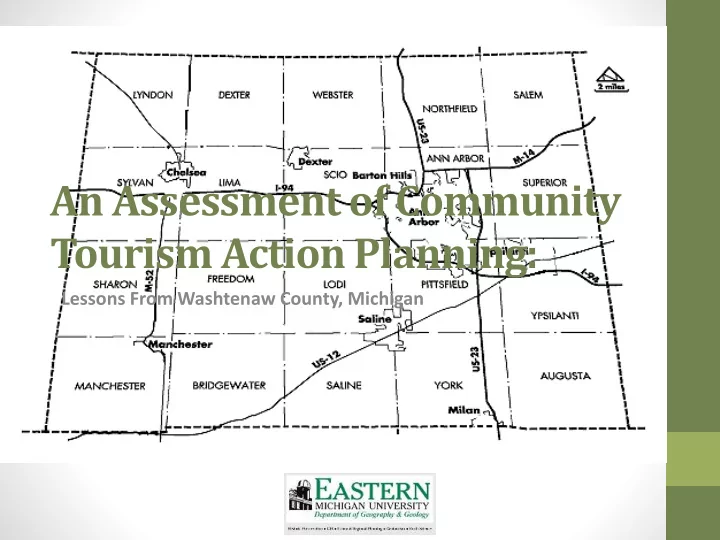
economic development planning efforts utilizing a mixed methods case study of eight communities in Washtenaw County, Michigan.
community tourism action plans and 2) interviews with key stakeholders, 3) a GIS-based accounting of tourism assets suitable to assist local and regional planning as well as supporting the addressing of practical and theoretical research questions, especially relating to sustainable systems (economic, social, ecological).
Professor Khan’s research and teaching focuses on state and local economic development efforts. She has taught courses in economic and community development, urban development in comparative perspective, and local development policy. She has contributed professional expertise to the broader community through participation in tourism planning at the state-level as a member on the 2012-2017 Michigan Tourism Strategic Plan, which is intended to lay the foundation for tourism in Michigan and contribute to the overall economic development of the
member of the Research and Technical Assistance
teach and conduct research in geographic information science (GIS), remote sensing, and environmental planning. In addition, he has worked in marketing research for Focus Suites of Philadelphia and was a National Geographic Society geography intern, which led to his participation in the formation of the Geotourism program at EMU. Wwelsh@emich.edu
Professor Victor-Burke teaches courses in the geography geotourism concentration including tourism and socioeconomic development and the geotourism field course in the Grand Traverse region. She currently serves on the Board of Directors
(WCCVB). Victor-Burke sat on the Board of Directors of the Ypsilanti Area Convention and Visitors Bureau (YACVB) 2012-
Plan (CTAP) grant committee since its launch in 2014. She is a member of the Tourism Industry Coalition of Michigan (TICOM). Kvictor@emich.edu