SLIDE 1
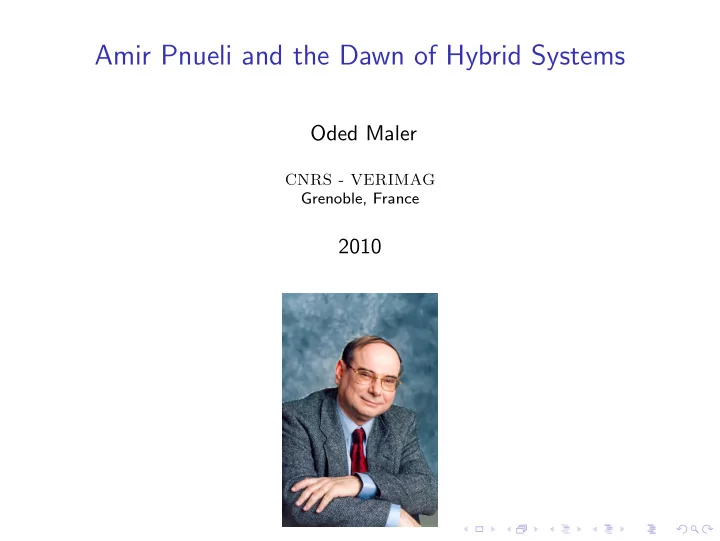
Amir Pnueli and the Dawn of Hybrid Systems
Oded Maler
CNRS - VERIMAG Grenoble, France
2010
SLIDE 2
Preface
◮ Amir Pnueli (1941-2009) was one of the key figures in the
verification of discrete reactive systems
◮ He received the Turing Award in 1996 for proposing
Temporal Logic as a language for specifying acceptable behaviors of concurrent systems
◮ He participated in pioneering efforts to extend verification
methodology to timed and hybrid systems
◮ He wrote one of the first CS papers on hybrid automata
(phase-transition systems)
◮ He was among the founders of HSCC and a member of the
steering committee (1998-2003)
◮ He was my PhD advisor (1986-1989) and a close collaborator
and friend afterwards
◮ The talk is intended to tell about himself, his work and his
contribution to hybrid systems research
SLIDE 3 Very Short Personal Notes
◮ Amir was a very nice person, universally appreciated,
admired and loved by members of the communities he interacted with
◮ He earned his fame and status by the quality of his work and
his receptiveness to others not because of being an unbounded operator (he was not)
◮ Unlike many of us he was not an ego-maniac (or managed to
mask it perfectly by timidity, modesty and politeness)
◮ He knew maths of many sorts and did not shy away from
applications and software development
◮ He had a broad culture, sense of humor and good appetite ◮ Much more on that will be said by many in the Amir Pnueli
Memorial Conference NYU, May 7-9, 2010 and other
- ccasions related to his core community
SLIDE 4 Talk Overview
◮ Part I: Verification for Dummies ◮ A comprehensible introduction to the context of Amir’s work,
- riented toward outsiders (control persons, CS persons of
- ther genres):
◮ What is computer science? ◮ What is verification? ◮ What is temporal logic?
◮ Part II: Historical Revisionism 101: ◮ Sketch of (a personal projection of) the evolution of hybrid
systems research in the CS side, roughly around (1988-1998):
◮ Pre-history ◮ Motivation ◮ First models ◮ Verification and controller synthesis ◮ Temporal logic for continuous signals
SLIDE 5
What Is Computer Science ?
◮ Among other things computer science is: the (pure and
applied) study of discrete-event dynamical systems (automata, transition systems)
◮ A natural point of view for the reactive systems parts of CS
(hardware, protocols, real-time, stream processing)
◮ At least for people working on modeling and verification of
such systems
◮ Sometimes obscured (intentionally or not) by fancy
formalisms: Petri nets, process algebras, temporal logics..
◮ All honorable topics with intrinsic importance, beauty, etc. ◮ But sometimes should be distilled to their essence in order to
make sense for potential users from other disciplines, rather than intimidate them
SLIDE 6 Digression: Greek vs. Egyptian/Babylonian Math
◮ Many computer scientists in the audience may not feel my
definition faithfully describes their domain
◮ In many engineering disciplines there is a division between the
amateurs of the concrete and the fans of the abstract
◮ In CS:
◮ Concrete: systems, C or VHDL code, Makefiles,... ◮ Abstract: automata, logic, semantics,...
◮ In control, EE, signal processing:
◮ Concrete: Simulink blocks, filters, transistors, motors,... ◮ Abstract: manifolds, differential equations, linear operators,...
◮ Abstract models are not necessary nor sufficient for building
systems: software can be written in a programming language without thinking of the underlying abstract dynamical system
◮ But radically-new insights are easier to obtain in the abstract
world
SLIDE 7
Dynamical System Models in General
◮ The following abstract features of dynamical systems are
common to both continuous and discrete systems:
◮ State variables whose set of valuations determine the state
space
◮ A time domain along which these values evolve ◮ A dynamic law which says how state variables evolve over
time, possibly under the influence of external factors
◮ System behaviors are progressions of states in time ◮ Having such a model, knowing an initial state x(0) one can
predict, to some extent, the value of x(t)
SLIDE 8 Classical Dynamical Systems
◮ State variables: real numbers (location, velocity, energy,
voltage, concentration)
◮ Time domain: the real time axis R or a discretization of it ◮ Dynamic law: differential equations
˙ x = f (x, u)
- r their discrete-time approximations
x(t + 1) = f (x(t), u(t))
◮ Behaviors: trajectories in the continuous state space ◮ Achievements: Apples, Stars, Missiles, Electricity, Heat,
Chemical processes
◮ Theorems, Papers, Simulation tools
SLIDE 9
Automata as Dynamical Systems
◮ An abstract discrete state space, state variables need not
have a numerical meaning
◮ A logical time domain defined by the events (order but not
metric)
◮ Dynamics defined by transition rules: input event a takes the
system from state s to state s′
◮ Behaviors are sequences of states and/or events ◮ Composition of large systems from small ones, hierarchical
structuring
◮ Different modes of interaction: synchronous/asynchronous,
state-based/event-based
◮ Sometimes additional syntax may be required
SLIDE 10
Automata can Model many Phenomena and Devices
◮ Software, hardware, ◮ ATMs, user interfaces ◮ Administrative procedures ◮ Communication protocols ◮ Cooking recipes, Manufacturing instructions ◮ Any process that can be viewed as a sequence of steps ◮ But what can we do with these models? ◮ There are no easy-to-use analytical tools as in continuous
systems
◮ We can simulate and sometimes do formal verification
SLIDE 11 What is Verification ?
◮ The generic question: ◮ Given a complex discrete dynamical system with some
uncontrolled inputs or unknown parameters
◮ Check whether all its behaviors satisfy some properties ◮ Properties:
◮ Never reach some part of the state space ◮ Always come eventually to some (equilibrium) state ◮ Never exhibit some pattern of behavior ◮ Quantitative versions of such properties..
◮ Existing verification tools can do this type of analysis for huge
systems by sophisticated graph algorithms
SLIDE 12 Illustration: The Coffee Machine
◮ Based on a first chapter of an unwritten book ◮ Consider a machine that takes money and distributes drinks ◮ The system is built from two subsystems, one that takes care
- f financial matters, and one which handles choice and
preparation of drinks
◮ They communicate by sending messages
M1 5 4 6 M2 drink-ready st-tea st-coffee 3 2 1 coin-in cancel coin-out 7 8 9 req-coffee req-tea reset
done
SLIDE 13 Automaton Models
◮ The two systems are modeled as automata ◮ transitions are triggered by external events and events coming
from the other subsystem
drink-ready/done drink-ready/done A C B D
reset/ M2 req-coffee/st-coffee req-tea/st-tea done/ 1 coin-in/ ok cancel/coin-out, reset M1
SLIDE 14 The Global Model
◮ The behavior of the whole system is captured by a
composition (product) M1 M2 of the components
◮ States are elements of the Cartesian product of the
respective sets of states, indicating the state of each component
◮ Some transitions are independent and some are
synchronized, taken by the two components simultaneously
◮ Behaviors of the systems are paths in this transition graph
done/ 1 coin-in/ ok cancel/coin-out, reset 0A 1B drink-ready/ drink-ready/ 1C 1D 0C 0D cancel/coin-out cancel/coin-out req-tea/st-tea req-coffee/st-coffee cancel/coin-out coin-in/ drink-ready/done drink-ready/done A C B D
reset/ M2 req-coffee/st-coffee req-tea/st-tea M1
SLIDE 15 Normal Behaviors
0A 1B drink-ready/ drink-ready/ 1C 1D 0C 0D cancel/coin-out cancel/coin-out req-tea/st-tea req-coffee/st-coffee cancel/coin-out coin-in/
◮ Customer puts coin, then sees the bus arriving, cancels and
gets the coin back
0A coin-in 1B cancel coin-out 0A
◮ Customer inserts coin, requests coffee, gets it and the systems
returns to initial state
0A coin-in 1B req-coffee st-coffee 1C drink-ready 0A
SLIDE 16 An Abnormal Behavior
0A 1B drink-ready/ drink-ready/ 1C 1D 0C 0D cancel/coin-out cancel/coin-out req-tea/st-tea req-coffee/st-coffee cancel/coin-out coin-in/
◮ Suppose the customer presses the cancel button after the
coffee starts being prepared..
0A coin-in 1B req-coffee st-coffee 1C cancel coin-out 0C drink-ready 0A
◮ Not an attractive feature for the owner of the machine
SLIDE 17 Fixing the Bug
◮ When M2 starts preparing coffee it emits a lock signal ◮ When M1 received this message it enters a new state where
cancel is refused
M1 1 coin-in/ ok 2 lock/ cancel/coin-out, reset done/ drink-ready/done drink-ready/done A C B D reset/ req-coffee/st-coffee,lock req-tea/st-tea,lock M2
0A 1B drink-ready/ 2C 2D coin-in/ cancel/coin-out req-tea/st-tea req-coffee/st-coffee drink-ready/
SLIDE 18
The Moral of the Story
◮ Many complex systems can be modeled as a composition of
interacting automata
◮ Behaviors of the system correspond to paths in the global
transition graph of the system
◮ The size of this graph is exponential in the number of
components (state explosion, curse of dimensionality)
◮ These paths are labeled by input events representing
influences of the outside environment
◮ Each input sequence may generate a different behavior ◮ We want to make sure that a system responds correctly to all
conceivable inputs, that it behaves properly in any environment (robustness)
SLIDE 19
So What is Verification, Then?
◮ The question: how to ensure that a system behaves properly
in the presence of all conceivable external inputs and parameters?
◮ For every individual input sequence or parameter value we
can simulate the reaction of the system. But we cannot do it exhaustively
◮ Verification is a collection of automatic and semi-automatic
methods that allow us to say something about all the behaviors (paths in the graph, trajectories, runs)
◮ Verification complements other, more traditional, validation
techniques based on testing/simulation
SLIDE 20 The Ingredients of a Verification Methodology
◮ A specification language: a formalism for describing the
desired properties of the system. In other words a criterion for classifying event sequences as good or bad
◮ A computational model: a formalism for describing the
designed system (automata, transition systems, programs)
◮ A verification technique: a method to show that the system
satisfies the desired properties: all the behaviors generated by the system are those accepted by the specification
◮ Verification techniques come in two major flavors:
◮ Deductive/Analytic ◮ Algorithmic (Model Checking) ◮ Plug and Pray
SLIDE 21
Deductive, Analytic Verification
◮ An intelligent user (an engineer) proves that all behaviors
never reach a bad state (safety) or eventually reach a good state (progress) without actually computing all these behaviors
◮ The proof is based on specific features of the dynamics (the
program, in the discrete case, the vector field in the continuous case)
◮ For safety, you find an invariant, a subset of the state space,
closed under the dynamics (preserved by the transitions). In the continuous domain it is called a barrier certificate
◮ For liveness you find some progress measure (ranking
function) which always decreases along the execution. In the continuous domain it is called a Liapunov function
◮ The need for an intelligent user is a major drawback
SLIDE 22
Algorithmic Verification
◮ Also known as Model Checking (Turing Award 2007,
Clarke, Emerson, Sifakis)
◮ Best understood (at least by me) as a model-aware
exhaustive simulation
◮ Rather than stimulating a black box with all input
sequences, use graph algorithms to explore all the paths in the system
◮ Symbolic version (to cope with state explosion): compute
sets of reachable states, represented by logical formulae, in a breadth first manner
◮ Compute all states reachable by all inputs of length k + 1
from states reachable by all inputs of length k
◮ In other words, a qualitative version of dynamic programming ◮ Although algorithmic, it is not a push-button (nor
click-mouse) activity
SLIDE 23
Temporal Properties in a General Context
◮ Any system is evaluated according to the observable
behaviors (trajectories, signals, runs) it produces
◮ This is done according to performance measures defined on
these behaviors
◮ In Control such measures are typically quantitative: the
average cost/energy, the distance from a reference signal, quadratic norms,...
◮ Properties are qualitative yes/no measures. They classify
behaviors as good or bad according to property satisfaction
◮ Temporal logic is good at specifying properties of sequences
based on the occurrence of certain events in certain orders
◮ Regular expressions constitute an alternative formalism of a
different flavor for specifying sets of sequences
SLIDE 24
Why Temporal Logic
◮ Consider the statement: one day the sun will shine again ◮ In first-order predicate logic: there is some t such that
t > now and the sun will shine at t
◮ Temporal logic, like human language, has special concise
constructs to talk about time
◮ Sooner and later, before and after, until and since, next and
previous
◮ A typical property: every customer will be (eventually) served ◮ Always (request → eventually grant)
(r → ♦g)
◮ Compare to first-order: ∀t(r[t] → (∃t′ > t g[t′])) ◮ “Manna and Pnueli try to do everything with one hand tied
behind their back” (J. McCarthy)
SLIDE 25
How to use Properties in Verification
◮ From a temporal logic formula one can build a property
tester (observer), an automaton or a program that accepts exactly the sequences satisfying the property
◮ The property tester can be used to check behaviors produced
by simulators (monitoring, runtime verification)
◮ It can be composed with the system model and integrated
in the model-checking process to see whether states representing property violations are reachable
◮ Verification aside, the very process of writing down and
debugging the specifications helps enormously in understanding the system requirements in a non-ambiguous manner
SLIDE 26
Part Two: Hybrid Systems, a Personal Perspective
SLIDE 27
Information and Control
◮ In 1957 the journal Information and Control has been
founded
◮ I am not that old to remember this event ◮ The editorial board included figures such as Noam Chomsky,
Peter Elias, Benoit Mandelbrot, Claude Shannon, and Norbert Wiener and many others
◮ These were the days of Cybernetics where information,
communication, control, computation, linguistics and psychology were all mixed
◮ Computer Science as a distinct discipline did not exist
SLIDE 28 A Sample of Articles from the First Volumes
- L. Brillouin: Mathematics, Physics, and Information (An Editorial)
C.E. Shannon: Certain Results in Coding Theory for Noisy Channels
- N. Chomsky, G.A. Miller: Finite State Languages
M.-P. Schutzenberger: On the Quantization of Finite Dimensional Messages
- R. Bellman: Dynamic Programming and Stochastic Control Processes
- M. Eden: A Note on Error Detection in Noisy Logical Computers
- J. Hartmanis: Symbolic Analysis of a Decomposition of Information
Processing Machines R.M. Karp: A Note on the Application of Graph Theory to Digital Computer Programming I.J. Good, K.C. Doog: A Paradox Concerning Rate of Information W.H. Burge: Sorting, Trees, and Measures of Order L-H. Zetterberg: Detection of Moving Radar Targets in Clutter C.A. Desoer: The Bang Bang Servo Problem Treated by Variational Techniques C.W. Merriam: An Optimization Theory for Feedback Control System Design
- H. Jacobson: The Informational Content of Mechanisms and Circuits
SLIDE 29
One Generation Later
◮ From the journal web site: ◮ “The journal was one of the earliest to publish extensively on
formal language and automata theory, computability, inductive inference, and complexity theory, as well as on its titular subjects
◮ The present editor-in-chief took over in 1982 and recruited to
the editorial board a distinguished international group of scholars focusing primarily on theoretical Computer Science
◮ The journal was renamed Information and Computation in
1987, reflecting its new focus.”
◮ The divorce between computation and control was
formalized during the period of my thesis under Pnueli
◮ A similar episode happened with another journal from the
same period, Mathematical Systems Theory
SLIDE 30 A Sample of CS Articles from 1987
- D. Peleg, B. Simons: On Fault Tolerant Routings in General Networks
- A. Marron, K-I. Ko: Identification of Pattern Languages from Examples
and Queries
- J. Sakarovitch: Easy Multiplications. I. The Realm of Kleene’s Theorem
R.B. Boppana, J.C. Lagarias: One-Way Functions and Circuit Complexity A.Z. Broder, D. Dolev, M.J. Fischer, B. Simons: Efficient Fault-Tolerant Routings in Networks
- G. Bracha: Asynchronous Byzantine Agreement Protocols
- Y. Mansour, S. Zaks: On the Bit Complexity of Distributed
Computations in a Ring with a Leader
- A. Amir, D.M. Gabbay: Preservation of Expressive Completeness in
Temporal Models
- G. Winskel: Petri Nets, Algebras, Morphisms, and Compositionality
- D. Angluin: Learning Regular Sets from Queries and Counterexamples
SLIDE 31 Personal Motivation
◮ Although my thesis was purely mathematical (automata
theory) I felt from time to time as an captive poet
◮ Consequently I kept looking from time to time at softer
sciences such as AI
◮ One day I found technical reports from MIT AI lab by
- R. Brooks, advocating a behavior-based approach to
robotics and AI
◮ His proposed architecture was a sort of a block diagram ◮ Some blocks represented sensors, some were realized by
finite-state machines or programs, some were timers
◮ I asked Amir: how can one specify and verify the correct
behavior of these creatures?
◮ Amir was very responsive and called me immediately to his
- ffice. He has been thinking about the physical environment
- f the reactive system for a long time
SLIDE 32 A Research Proposal
◮ After discussing the issue we decided to write a research
proposal on the topic, intended to support my post-doc
◮ The title was Systematic Development of Robots ◮ In other words: we propose to export the practical failure
- f program verification toward new domains ¨
⌣
◮ The proposal did not pass and I moved to France
SLIDE 33
From Timed to Hybrid Systems I
◮ Amir was already involved in extending discrete system model
with timing information
◮ In this an extremely-important level of abstraction ◮ Can be used to specify (and verify) not only that every
customer is (eventually) served, but also that he is served at most 5 minutes after the request
◮ Semantically speaking, in such systems the behaviors are
Boolean signals rather than just sequences
◮ He already worked on real-time extensions of temporal logic
and on timed transition systems, similar to timed automata
◮ In 1990 he proposed the model of phase-transition systems,
a kind of hybrid automaton
SLIDE 34
From Timed to Hybrid Systems II
SLIDE 35
From Timed to Hybrid Systems III
SLIDE 36
From Timed to Hybrid Systems IV
SLIDE 37 CS Research on Hybrid Systems
◮ The paper was accepted with enthusiasm and various groups
started looking at the verification of hybrid systems
◮ At that time the algorithmic (model-checking) approach
became more popular than the deductive
◮ Encouraged by the verification of timed automata, people
started looking for similar algorithmic result on a class of piecewise-trivial hybrid automata
◮ Automata where in each state the derivative is constant and
complexity comes from switching
x1 x2 c1 c2 c3 V1 V2 Open 1 Close 2 Close 2 Open 1 A B C D ˙ x2 = −c3 ˙ x1 = 0 ˙ x1 = c1 ˙ x2 = −c3 ˙ x1 = c1 − c2 ˙ x2 = c2 − c3 ˙ x1 = −c2 ˙ x2 = c2 − c3 Close 1 Close 1 Open 2 Open 2
SLIDE 38
Some of Amir’s Contributionsd to Hybrid Systems
◮ Extending StateCharts to hybrid StateCharts [Kesten] ◮ Contribution to deductive verification [Manna, Henzinger] ◮ Decidability and undecidability results on classes of
stopwatch automata, timed automata with preemptible clocks, [Kesten, Sifakis, Yovine]
◮ Decidability (in 2 dimensions) and undecidabilty (in 3
dimensions) of verification for a class of systems with piecewise-constant derivatives [Asarin, M]
◮ Controller synthesis for timed automata [Asarin, M, Sifakis] ◮ Switching controller synthesis for piecewise-linear systems
[Asarin, Bournez, Dang, M]
◮ The topic has evolved since, abandoning exact computations,
replacing them with approximation of reachable states, illustrated in the coming commerical
SLIDE 39
Commercial I: SpaceEx
◮ Coming soon: SpaceEx the state space explorer (G. Frehse) ◮ A tool platform for developing hybrid verification tools ◮ Two tools will be released: PHAVer 2.0 for linear hybrid
automata and a tool for piecewise-linear differential equations based on LeGuernic/Girard support function algorithms
◮ Web interface
SLIDE 40
Back to Temporal Logic
◮ In the last years Amir’s focused more on new problems in
discrete verification and synthesis
◮ Meanwhile some variants of temporal logic have been
adopted as standards in the semi-conductor industry
◮ We participated together in the EU project property-based
systems design (PROSYD) with IBM, ST and Infineon
◮ My part in the project was to extend the specification
language to treat analog and mixed signals
◮ We called the logic STL (signal temporal logic), An
extension of the real-time logic MITL with numerical predicates
SLIDE 41
Specifying Stabilization in Temporal Logic
◮ A water-level controller for a nuclear plant should maintain
a controlled variable y around a fixed level despite external disturbances x
◮ We want y to stay always in the interval [−30, 30] except,
possibly, for an initialization period of duration 300
◮ If, due to disturbances, y goes outside the interval [−0.5, 0.5],
it should return to it within 150 time units and stay there for at least 20 time units
◮ The property is expressed as
[300,2500]((|y| ≤ 30)∧((|y| > 0.5) ⇒ ♦[0,150][0,20](|y| ≤ 0.5)))
SLIDE 42
Monitoring Stabilization
SLIDE 43
Commercial II: AMT
◮ The Analog Monitoring Tool (D. Nickovic) is available for
download
SLIDE 44
Concluding Remarks
◮ Hybrid extensions of Amir’s temporal logic has a lot of
potential applications:
◮ Analog circuits: it was used to check properties of DDR and
Flash memories and is considered by some as an interface language for combining digital and analog design flows
◮ In Biology it can be used, non traditionally, to give a short
descriptive model of experimental data
◮ In Control it can be used to define a new class of
performance measures based on events
◮ In Robotics it has been used to specify goals for planners ◮ New studies on quantitative semantics: how robustly is a
property satisfied
◮ Even in these domains, which were not his core domains, the
contributions and insights of Amir Pnueli will occupy us for some time
SLIDE 45
Last Photos: CAV, June 2009, Grenoble
SLIDE 46
Last Photos: CAV, June 2009, Grenoble