Amazonian GPP Estimated from Satellite- Observed Carbonyl Sulfide - - PowerPoint PPT Presentation

amazonian gpp estimated from satellite observed carbonyl
SMART_READER_LITE
LIVE PREVIEW

Amazonian GPP Estimated from Satellite- Observed Carbonyl Sulfide - - PowerPoint PPT Presentation

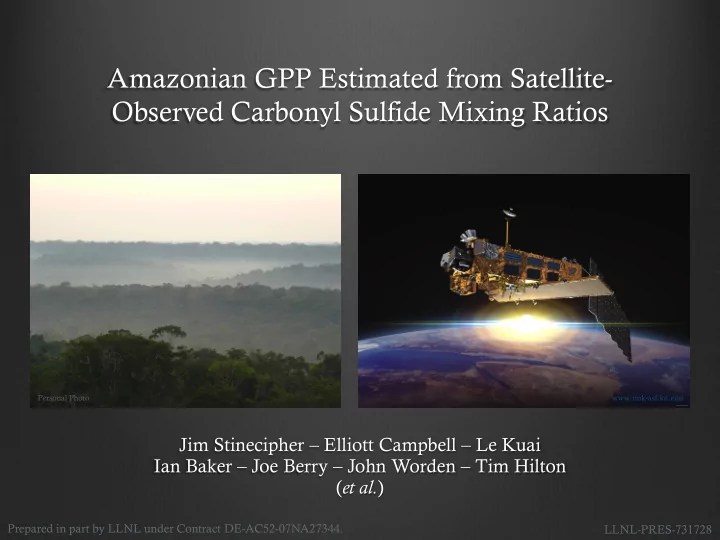
Amazonian GPP Estimated from Satellite- Observed Carbonyl Sulfide Mixing Ratios Personal Photo www.imk-asf.kit.edu Jim Stinecipher Elliott Campbell Le Kuai Ian Baker Joe Berry John Worden Tim Hilton ( et al. ) Prepared in


slide-1
SLIDE 1

Amazonian GPP Estimated from Satellite- Observed Carbonyl Sulfide Mixing Ratios

Jim Stinecipher – Elliott Campbell – Le Kuai Ian Baker – Joe Berry – John Worden – Tim Hilton (et al.)

Personal Photo www.imk-asf.kit.edu

Prepared in part by LLNL under Contract DE-AC52-07NA27344. LLNL-PRES-731728

slide-2
SLIDE 2

Background

GPP estimates are highly variable in the tropics. 2.5x difference between low and high members of TRENDY project in tropics Approach:

  • 1. Using TRENDY as a

guideline, scale COS plant fluxes in SiB up/down.

  • 2. Compare GEOS-Chem
  • utput to satellite COS
  • bservations (MIPAS).
slide-3
SLIDE 3

TRENDY Model Ensemble

slide-4
SLIDE 4

COS vs. CO2

GOSAT CO2 at 250hPa

±1% from global mean Competing signals from photosynthesis and respiration over land.

MIPAS COS at 250hPa

±10% from global mean No competing respiration signal over land!

slide-5
SLIDE 5

MIPAS

Michelson Interferometer for Passive Atmospheric Sounding onboard ENVISAT (now inactive) COS retrievals 2002-12. Approximately 250hPa See Glatthor et al., 2015 (GRL) for details. 10.1002/2015GL066293

slide-6
SLIDE 6

GEOS-Chem Model Output

(A) MIPAS Annual mean deviation from global mean (ppt COS) (B) GEOS-Low model output (C) GEOS-Med model output (D) GEOS-High model output  GEOS-Med and GEOS-High seem to be in the appropriate range.

slide-7
SLIDE 7

GEOS-Chem Model Output

(A) GEOS-Med model output (B) PCTM model output (using GEOS-Med fluxes) (C) GEOS-Med with increased anthropogenic, decreased ocean (D) GEOS-Low model output (A)-(C) relatively similar, even with large changes. Low is significantly lower.  Changes to plant fluxes have strong effect, relative to changes to

  • ther fluxes or choice of transport model
slide-8
SLIDE 8

Amazon Flux Uncertainty

Average annual COS flux in box 5N-15S, 75W-50W

slide-9
SLIDE 9

Amazon Depression, 250hPa

GEOS TES is a run optimized using TES retrievals over ocean. Average annual concentration difference in box 5N-15S, 75W-50W

slide-10
SLIDE 10

Implications for GPP

Eddy Flux-constrained GPP from Beer 2010. SIF-constrained GPP from Parazoo 2014. Average annual GPP in box 5N-15S, 75W-50W

slide-11
SLIDE 11

Put differently…

Crude optimization still yields a constraint close to other metrics!

slide-12
SLIDE 12

Conclusions

Remotely-sensed COS concentrations are a promising tracer for terrestrial gross primary production. Using MIPAS COS observations yields Amazonian GPP estimate close to other independent metrics, and near the median of the TRENDY model ensemble. Future work:

Investigating convective transport scenarios Magnitude and timing of seasonal cycles Collection and assimilation of airborne and flux-tower data 4D variational inverse modeling

Many thanks to Ian Baker (SiB data), Christian Beer (FLUXNET GPP data), Norbert Glatthor/Michael Höpfner/KIT (MIPAS data), Scot Miller (PCTM runs), Nick Parazoo (SIF GPP data), Stephen Sitch (TRENDY data), John Worden/JPL (TES data), Andrew Zumkehr (anthropogenic fluxes). Funded in part by UC Lab Fees Fellowship LGF-17-476795.
slide-13
SLIDE 13

Stomatal Conductance and GPP

slide-14
SLIDE 14

GEOS-Chem Setup

Flux (GgS COS) Berry 2013 This Study Notes Ocean COS 39 43.5 Kettle Ocean DMS 81 90 Kettle Ocean CS2 156 156 Kettle Anthropogenic 180.5 180.5 Kettle Biomass Burning 136 136 GFED, scaled to 136 GgS/yr Addl Ocean Source 600 269 to 619 Same approach and scaling factors as in Berry OH Radical

  • 101
  • 111

GEOS-Chem OH Canopy Uptake

  • 738
  • 793 to -948

SiB, adjusted Soil Uptake

  • 355
  • 166

SiB

slide-15
SLIDE 15
slide-16
SLIDE 16

Comparison of monthly concentration difference from global mean between all models compared to MIPAS observations. TES-optimized is best, but GEOS-Med and GEOS-High are close seconds.