Am I Missing Something? Dan Simons and Chris Chabris: Video studies - - PowerPoint PPT Presentation

am i missing something
SMART_READER_LITE
LIVE PREVIEW

Am I Missing Something? Dan Simons and Chris Chabris: Video studies - - PowerPoint PPT Presentation

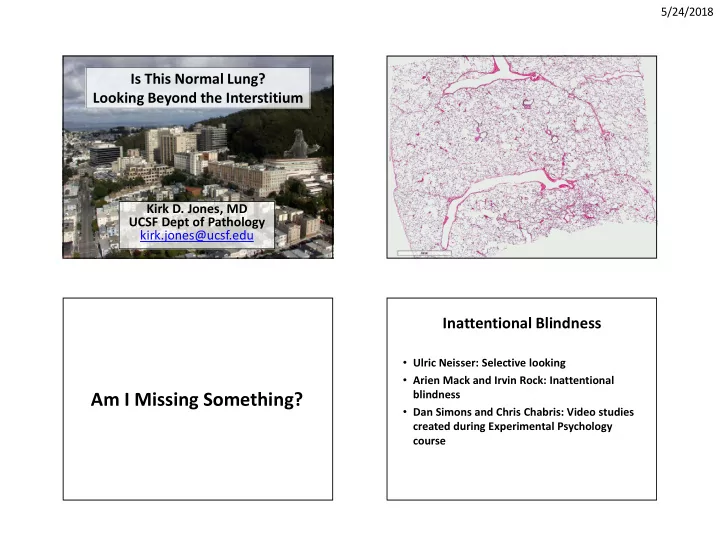
5/24/2018 Is This Normal Lung? Looking Beyond the Interstitium Kirk D. Jones, MD UCSF Dept of Pathology kirk.jones@ucsf.edu Inattentional Blindness Ulric Neisser: Selective looking Arien Mack and Irvin Rock: Inattentional blindness


slide-1
SLIDE 1

5/24/2018 1

Kirk D. Jones, MD UCSF Dept of Pathology kirk.jones@ucsf.edu

Is This Normal Lung? Looking Beyond the Interstitium

Am I Missing Something?

Inattentional Blindness

  • Ulric Neisser: Selective looking
  • Arien Mack and Irvin Rock: Inattentional

blindness

  • Dan Simons and Chris Chabris: Video studies

created during Experimental Psychology course

slide-2
SLIDE 2

5/24/2018 2

Inattentional Blindness

  • “when our attention is focused on one thing,

we fail to notice other, unexpected things around us—including those we might want to see.”

  • In pathology of the lung, there are often two

things that focus our attention:

– The tumor in neoplastic disease – The alveoli in non-neoplastic disease

ALVEOLI

bronchioles vessels pleura

The Neglected Compartments

  • Bronchioles

– Inflammatory bronchiolitis – Fibrotic bronchiolitis

  • Vessels

– Pulmonary arteriopathy – Pulmonary venopathy

  • Pleura

– Pleural inflammation or neoplasm

  • Absence of alveoli

– Cystic disease

slide-3
SLIDE 3

5/24/2018 3

Overview of Talk

  • Bronchioles

– Bronchiolitis – Diffuse panbronchiolitis – Constrictive bronchiolitis

  • Vessels

– Pulmonary arteriopathy – Pulmonary veno-occlusive disease

  • Lack of alveoli – cystic disease

– Lymphangioleiomyomatosis

Classification of Bronchiolitis

  • Cellular infiltrates (inflammatory)

– Intraluminal

  • Neutrophils: Acute bronchiolitis, bronchopneumonia
  • Macrophages: Respiratory bronchiolitis

– Mural

  • Lymphocytes: Chronic/cellular bronchiolitis
  • Lymphoid follicles: Follicular bronchiolitis

– Peribronchiolar/Interstitial

  • Macrophages: Diffuse panbronchiolitis
slide-4
SLIDE 4

5/24/2018 4

Adenovirus CC77-111 Respiratory bronchiolitis Respiratory bronchiolitis Follicular bronchiolitis

slide-5
SLIDE 5

5/24/2018 5

Follicular bronchiolitis

Illustrative Case

  • 46-year-old woman with

hypogammaglobulinemia treated with IVIG

  • Profound progressive dyspnea and sinusitis
  • Lung transplant performed
slide-6
SLIDE 6

5/24/2018 6

Diffuse Panbronchiolitis

Diffuse Panbronchiolitis

  • First described in the 1960’s in Japan
  • Named diffuse panbronchiolitis in 1969 due

to involvement of terminal bronchiole (sinusitis is often also present)

  • Progressive inflammatory bronchiolitis with

subsequent bronchiectasis

Diffuse Panbronchiolitis

  • Accumulation of foamy macrophages in the

peribronchiolar interstitium

  • The bronchioles usually show mixed acute

and chronic mural inflammation

  • Similar lesions observed in

hypogammaglobulinemia, inflammatory bowel disease, autoimmune disease

  • Often lethal without treatment, but

controllable with low-dose macrolide therapy

Classification of Bronchiolitis

  • Fibrotic/Fibroplastic

– Intraluminal polyps: Proliferative bronchiolitis

  • This is the old BOOP

– Intramural scarring: Constrictive bronchiolitis

  • aka BO, OB, cicatricial bronchiolitis

– Peribronchiolar/Interstitial

  • Peribronchiolar metaplasia
slide-7
SLIDE 7

5/24/2018 7

Organizing pneumonia – “Proliferative bronchiolitis”

BOOP

Granulation tissue polyp

Bronchiolitis Obliterans?

  • r Organizing Pneumonia

Organizing pneumonia – “Proliferative bronchiolitis”

slide-8
SLIDE 8

5/24/2018 8

Organizing Pneumonia

Organizing pneumonia Organizing pneumonia

slide-9
SLIDE 9

5/24/2018 9

Constrictive Bronchiolitis

Transplant rejection with CB

Illustrative Case

  • Legal case with limited history
  • Transplanted, worked with artificial flavoring

agents at some point

slide-10
SLIDE 10

5/24/2018 10

slide-11
SLIDE 11

5/24/2018 11

Diacetyl-related CB

Popcorn-worker lung

  • May 2000: a physician in Jasper, MO identified a

group of 8 former workers from a microwave popcorn plant.

  • 4 of the 8 worked in the “mixing room” (of the 425

total workers at the plant, only 13 worked in the mixing room).

  • Soybean oil, salt, and flavorings were mixed into a

large heated tank in a process that produces visible dust, aerosols, and vapors with a strong buttery odor

  • Analysis of the vapors identified diacetyl as the likely

culprit

  • Although originally referred to as “Popcorn-worker

lung” this is occasionally called “flavorings-related lung disease”

CB - Associated Histologic Findings

  • Foamy macrophage accumulation

– Often in the region immediately proximal to

  • bstruction
  • Cholesterol “stasis” granuloma formation

– Often in the alveolar ducts distal to obstruction

  • Proximal bronchiectasis and bronchiolectasis

Transplant rejection with CB

slide-12
SLIDE 12

5/24/2018 12

Diacetyl-related CB Transplant rejection with bronchiolectasis Transplant rejection with bronchiolectasis

CB - Increasing Diagnostic Yield

  • Clinical context helpful

– PFTs, CT with expiratory views

  • Obtain additional sections

– step or level sections (usually 30 micron gap)

  • Obtain elastic stains

– Verhoeff-van Gieson Stain (VVG) – Movat Pentachrome

slide-13
SLIDE 13

5/24/2018 13

EVG stain reveals CB

Histologic Mimic/Tissue Artifact

  • Ex vivo contraction of smooth muscle can result in narrowing
  • f bronchioles
  • This effect is less likely to occur when fixation is performed

through bronchi (as in lobectomy or pneumonectomy samples).

Thunnissen E, et al. Arch Pathol Lab Med. 2016 Mar; 140(3): 212-20. PMID: 26927715. Pneumonectomy perfused through mainstem bronchus

slide-14
SLIDE 14

5/24/2018 14

Surgical biopsy in patient with emphysema

Causes and Associations of CB

  • Chronic lung transplant rejection
  • Graft versus host disease
  • Post-infectious
  • Connective tissue disease
  • Fume or toxin exposure

– SO2 gas – Diacetyl (popcorn worker lung) – Sauropus androgynus tea

  • Drug reaction (penicillamine, gold)
  • Miscellaneous

– Inflammatory bowel disease – DIPNECH

  • Idiopathic

Chronic Rejection, Lung Transplant- CB Chronic Rejection, Lung Transplant- CB

slide-15
SLIDE 15

5/24/2018 15

Chronic Rejection, Lung Transplant- CB Chronic Rejection, Lung Transplant- CB Penicillamine toxicity - CB Penicillamine toxicity - CB

slide-16
SLIDE 16

5/24/2018 16

Constrictive Bronchiolitis

  • Subepithelial (often concentric) fibrosis
  • Patchy nature can make diagnosis difficult

– Knowledge of clinical and radiologic features – Use of level sections and elastic stains – Recognize “next-to” lesions

  • Ex vivo smooth muscle contraction can mimic
  • Various causes, but overall low incidence

Pulmonary Vascular Disease

  • Pulmonary arteries run alongside bronchioles

and are approximately the same caliber

  • Pulmonary veins lie in the interlobular septa,

but small venules are arranged within the lobules

  • Vascular disease can manifest as changes in

the vessel wall or changes within the vessel lumen

Normal Pulmonary Vessels

  • Pulmonary arteries have two distinct

elastic tissue layers while pulmonary veins have only one.

slide-17
SLIDE 17

5/24/2018 17

slide-18
SLIDE 18

5/24/2018 18

Pulmonary arteriopathy

  • Plexogenic arteriopathy

– Tufts of capillary-like vessels bulging from artery with damaged elastica – More common in primary pulmonary hypertension

  • Thrombotic arteriopathy

– Re-canalized thrombi (Masson lesion) with intact vascular elastica

  • Isolated medial and intimal thickening

– Beware of age-related changes

Illustrative Case

  • 18-year-old woman with history of systemic

lupus erythematosus, treated with plaquenil and steroid pulses, presenting with persistent progressive dyspnea

slide-19
SLIDE 19

5/24/2018 19

Pulmonary veno-occlusive disease (Occlusive Venopathy)

  • My least favorite diagnosis
  • Characterized by intimal obliteration of post-

capillary venules in many cases

  • Can see associated pathologic findings:

– Pulmonary capillary hemangiomatosis – Alveolar siderosis – Encrustation of vascular elastica

Diseases with Alveolar Loss

  • Cystic lung disease

– Pulmonary Langerhans cell histiocytosis

  • Upper zone dominant, often with nodules or irregular

shapes, observed in smokers

– Lymphangioleiomyomatosis

  • Diffuse involvement, observed in women, can see

angiomyolipoma in kidneys

– Lymphoid interstitial pneumonia (LIP)

  • Fewer cysts usually, associated with dense intersitial

infiltrates

– Birt-Hogg-Dube

  • More often in lower lung zones, punched-out look
slide-20
SLIDE 20

5/24/2018 20

Illustrative Case

  • 65-year-old woman with diffuse bilateral

pulmonary cystic disease

  • Transbronchial biopsy with “increased muscle”
  • Sent for consultation
slide-21
SLIDE 21

5/24/2018 21

Smooth-muscle actin Estrogen receptor HMB-45

Diagnosis of LAM

  • Patients with LAM show increases in

VEGF-D (but not VEGF-A or -C)

Seyama K, et al. Lymphat Res Biol. 2006;4(3):143-52. PMID: 17034294. Young LR, et al. N Engl J Med. 2008 Jan 10;358(2):199-200. PMID: 18184970.

slide-22
SLIDE 22

5/24/2018 22

Diagnosis of LAM

  • Cysts on CT? TSC? If both yes – LAM
  • Cysts on CT? Send serum VEGF-D. If (+) – LAM
  • TBBx
  • VATS

Inattentional Blindness

  • A key to inattentional blindness is that the event

is unexpected

  • Knowledge of possibilities and attention to

normal structures decreases the likelihood of an unexpected event

Drew T, et al. Psychol Sci. 2013 Sep;24(9):1848-53. PMID: 23863753.