ALS Survey Responses Analysis : All-ALSes AFRALO APRALO EURALO - - PDF document

als survey responses
SMART_READER_LITE
LIVE PREVIEW

ALS Survey Responses Analysis : All-ALSes AFRALO APRALO EURALO - - PDF document

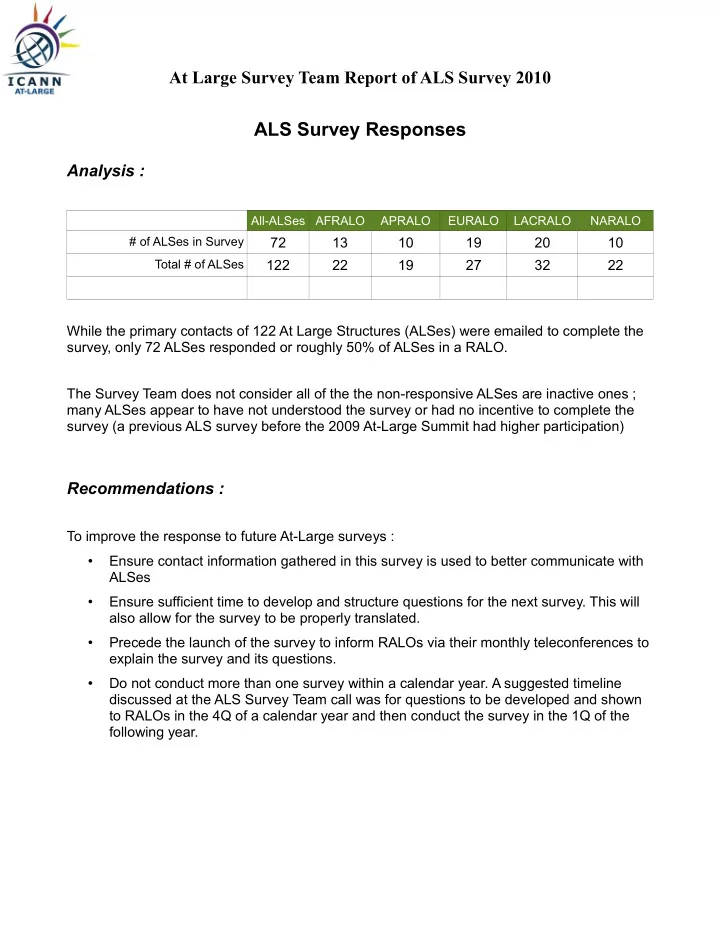
At Large Survey Team Report of ALS Survey 2010 ALS Survey Responses Analysis : All-ALSes AFRALO APRALO EURALO LACRALO NARALO # of ALSes in Survey 72 13 10 19 20 10 Total # of ALSes 122 22 19 27 32 22 While the primary contacts


slide-1
SLIDE 1

At Large Survey Team Report of ALS Survey 2010

ALS Survey Responses

Analysis :

All-ALSes AFRALO APRALO EURALO LACRALO NARALO # of ALSes in Survey

72 13 10 19 20 10

Total # of ALSes

122 22 19 27 32 22 While the primary contacts of 122 At Large Structures (ALSes) were emailed to complete the survey, only 72 ALSes responded or roughly 50% of ALSes in a RALO. The Survey Team does not consider all of the the non-responsive ALSes are inactive ones ; many ALSes appear to have not understood the survey or had no incentive to complete the survey (a previous ALS survey before the 2009 At-Large Summit had higher participation)

Recommendations :

To improve the response to future At-Large surveys :

  • Ensure contact information gathered in this survey is used to better communicate with

ALSes

  • Ensure sufficient time to develop and structure questions for the next survey. This will

also allow for the survey to be properly translated.

  • Precede the launch of the survey to inform RALOs via their monthly teleconferences to

explain the survey and its questions.

  • Do not conduct more than one survey within a calendar year. A suggested timeline

discussed at the ALS Survey Team call was for questions to be developed and shown to RALOs in the 4Q of a calendar year and then conduct the survey in the 1Q of the following year.

slide-2
SLIDE 2

At Large Survey Team Report of ALS Survey 2010

Q1 : Name and Contacts of ALS Representatives

All-ALSes AFRALO APRALO EURALO LACRALO NARALO # of ALSes in Survey

72 13 10 19 20 10

Total # of ALSes

122 22 19 27 32 22 Primary contact 98.61% 92.31% 100.00% 100.00% 100.00% 100.00% Secondary contact 66.67% 61.54% 60.00% 63.16% 85.00% 50.00% Tertiary contact 25.00% 61.54% 20.00% 0.00% 40.00% 0.00%

Analysis :

Regarding the issue of 1/3 of ALSes that responded who did not have a secondary contact and 75% of ALSes not having a tertiary contact, some RALOs (EURALO and NARALO) were

  • f the opinion that these are due to the ALS' size and capacity for persons within an ALS to be

able to dedicate the time and effort to follow and contribute to the ICANN At-Large and be able to represent the ALS in the ICANN At-Large. This seems to be supported by the responses to Q9b - “Contact information for another person in your ALS to be notified about ICANN public comments” and Q10 - “Contact info of Members of ALS who would be able to represent ICANN At-Large at local/regional functions”. Nearly all the ALSes who answered these questions specified the primary contact and secondary contact.

Recommendation :

  • Given the wide scope of ICANN At-Large activities, ALSes should be encouraged to

involve more persons within their ALS to participate in their RALO and in At-Large even if only to allow the primary ALS contact to share the workload of their ALS being in At- Large.

slide-3
SLIDE 3

At Large Survey Team Report of ALS Survey 2010

Q2 : ALSes with websites

Analysis :

All-ALSes AFRALO APRALO EURALO LACRALO NARALO # of ALSes in Survey

72 13 10 19 20 10

Total # of ALSes

122 22 19 27 32 22 % of ALSes with websites 79.17% 53.85% 60.00% 89.47% 90.00% 90.00% While the majority of ALSes have websites , 20% of ALSes who responded did not have a website. While a website is no guarantee that an ALS is able to participate and keep its members informed, it raises concerns that persons in a country with ALSes interested in policy issues from an At-Large perspective will not find that ALS if that ALS is not visible online.

Recommendation :

  • ALSes should be encouraged to have their own website. Those ALSes unable to have

websites due to capability/capacity issues can/should be encouraged to use a page on the RALO wiki.

  • RALOs should have on their wiki, details about the ALSes in their RALO so persons

searching for such groups can find them and discover ICANN At-Large and for ALSes in the region to learn from each other.

slide-4
SLIDE 4

At Large Survey Team Report of ALS Survey 2010

Q3 : Level of Representation of ALS

All-ALSes AFRALO APRALO EURALO LACRALO NARALO # of ALSes in Survey

72 13 10 19 20 10

Total # of ALSes

122 22 19 27 32 22 National 69.44% 76.92% 40.00% 89.47% 80.00% 30.00% Regional 13.89% 7.69% 10.00% 5.26% 15.00% 40.00% State 2.78% 0.00% 10.00% 0.00% 0.00% 10.00% Local 4.17% 7.69% 0.00% 5.26% 0.00% 10.00%

Analysis :

While the majority of ALSes identified themselves as national ALSes, errors were detected in APRALO where many ALSes did not answer the question. A review of some of the details provided by ALSes in the survey shows that some ALSes perhaps did not understand what was meant by the different levels of representation. Many RALOs have countries and regions where ALSes are not present, but a nearby country

  • r region has national or regional ALSes.

Recommendation :

  • Future surveys should attempt some form of validation so that unanswered questions

will be highlighted when the survey is submitted.

  • Definitions of the terms should be included so that ALSes responding can answer more

accurately

  • RALOs should investigate the possibility of ALSes in nearby countries or regions being

able to do outreach in countries and regions without any ALSes

slide-5
SLIDE 5

At Large Survey Team Report of ALS Survey 2010

Q4 : Number of individual and organizational members in ALS

Analysis :

The answers to this survey question was a free form answer which made it difficult to analyse any trends and also many ALSes (especially non English ones) appear to have misinterpreted this question.

Recommendation :

  • The next survey asking a similar question should break down the question in several

parts, asking how many individual members in your ALS and how many organisational members in your ALS.

slide-6
SLIDE 6

At Large Survey Team Report of ALS Survey 2010

Q5 : Communication Tools used by ALSes

All-ALSes AFRALO APRALO EURALO LACRALO NARALO

Mailing lists 77.78% 84.62% 50.00% 89.47% 75.00% 80.00% Skype 51.39% 69.23% 40.00% 36.84% 65.00% 40.00% Facebook 36.11% 38.46% 20.00% 26.32% 55.00% 30.00% RSS feeds 18.06% 7.69% 0.00% 21.05% 25.00% 30.00% Twitter 23.61% 30.77% 10.00% 15.79% 25.00% 40.00% Blogs 40.28% 30.77% 10.00% 52.63% 45.00% 50.00% Other 38.89% 53.85% 30.00% 42.11% 30.00% 40.00%

Analysis :

Email is the most popular communication tool, followed by use of Skype and blogs, Facebook and Twitter. The use of RSS feeds by ALSes was the lowest in usage. Given that RSS remains one of the key ways to track updates to the At-Large wiki, it is not clear whether this translates to a inability of ALSes to be aware of the many content changes on the At-Large wiki that are not emailed. Also unfortunate, although stating the use of a particular tool, many ALSes did not include such information about their Skype names or Facebook/Twitter identities for example. Given the survey form made this a free form answer, it is difficult to easily sort and extract a list of ALSes Skype IDs for a particular RALO.

Recommendation :

  • There should be information describing how ALSes can keep track of changes to the

At-Large wiki.

  • RALOs and At-Large should review the communication tools and seek ways to use

these tools effectively for engaging ALSes.

  • An important step is to collect and verify the ALSes' Skype Names, Facebook/Twitter

identities, etc for use by the RALOs and At-Large.

  • The next survey should break down the communication tool question into several parts

so that extraction of usernames/contacts for a particular tool can be more easily done

slide-7
SLIDE 7

At Large Survey Team Report of ALS Survey 2010

Q6 : Does your ALS hold regular meetings with its members?

All-ALSes AFRALO APRALO EURALO LACRALO NARALO

Yes 76.39% 84.62% 50.00% 78.95% 90.00% 60.00% No 15.28% 7.69% 20.00% 21.05% 5.00% 30.00%

Analysis :

A majority of ALSes do have regular meetings which in theory should provide opportunity for discussion/dissemination of information about ICANN and At-Large within the ALS.

Recommendation :

slide-8
SLIDE 8

At Large Survey Team Report of ALS Survey 2010

Q6a : How often does your ALS meet?

All-ALSes AFRALO APRALO EURALO LACRALO NARALO

Weekly 1.39% 0.00% 0.00% 0.00% 5.00% 0.00% Once or Twice a month 11.11% 15.38% 10.00% 0.00% 20.00% 10.00% Every 2-3 months 34.72% 46.15% 20.00% 26.32% 40.00% 40.00% Other 30.56% 23.08% 20.00% 57.89% 25.00% 10.00%

Analysis :

Most ALSes meet every 2-3 months with some ALSes meeting on a monthly basis. Those ALSes which meet once a year may find it difficult to have a discussion/dissemination

  • f ICANN and At-Large related policy issues at such a special meeting where the ALS

conducts its own activities. Similiarly, an ALS that meets every 2-3 months will have difficulty in getting feedback from its members about ICANN policy issues which typically have a 30 day time period for comments

Recommendation :

  • The RALOs and At-Large should promote to ALSes the availability of online material

about ICANN, At-Large policy issues that can be used by ALSes to inform its members and based on ALS feedback, look at what material is needed by ALSes.

  • RALOs and At-Large should encourage ALSes to allow its members to directly

subscribe to ICANN and At-Large/RALO updates distributed via online communication tools in order for possible interest and participation from the users. This can give rise to possible informal deliberations of ICANN and At-Large policy issues within the ALS and can lead to input on ICANN policy work.

slide-9
SLIDE 9

At Large Survey Team Report of ALS Survey 2010

Q6b : Type of meetings your ALS has with its members?

All-ALSes AFRALO APRALO EURALO LACRALO NARALO

Face to Face 73.61% 84.62% 50.00% 78.95% 90.00% 40.00% Teleconference 37.50% 30.77% 30.00% 15.79% 60.00% 50.00% Web Conferences 18.06% 38.46% 10.00% 5.26% 30.00% 0.00% Other 19.44% 38.46% 10.00% 21.05% 15.00% 10.00%

Analysis :

F2F meetings were the most popular type of meetings, followed by teleconferences.

Recommendation :

  • The next ALS survey should look at whether ICANN material (be it material from the

RALO, At-Large or ICANN) is in a form that allows ICANN At-Large related policies to be discussed/presented at ALS meetings and/or allow ALS members to learn on their

  • wn time about ICANN related policy issues.
slide-10
SLIDE 10

At Large Survey Team Report of ALS Survey 2010

Q7 : Working Languages of your ALS

All-ALSes AFRALO APRALO EURALO LACRALO NARALO

Arabic 5.56% 30.77% 0.00% 0.00% 0.00% 0.00% Bengali 0.00% 0.00% 0.00% 0.00% 0.00% 0.00% Chinese 2.78% 0.00% 20.00% 0.00% 0.00% 0.00% English 33.33% 30.77% 30.00% 36.84% 25.00% 50.00% French 26.39% 61.54% 0.00% 42.11% 5.00% 20.00% German 12.50% 0.00% 0.00% 47.37% 0.00% 0.00% Hindi/Urdu 1.39% 0.00% 10.00% 0.00% 0.00% 0.00% Portuguese 4.17% 0.00% 0.00% 0.00% 15.00% 0.00% Russian 0.00% 0.00% 0.00% 0.00% 0.00% 0.00% Spanish 20.83% 0.00% 0.00% 0.00% 65.00% 20.00% Swahili 0.00% 0.00% 0.00% 0.00% 0.00% 0.00% Other 11.11% 0.00% 10.00% 31.58% 0.00% 10.00%

Analysis :

English, French, Spanish are the three top working languages of ALSes, with typically 3 or more languages used by ALSes within a RALO.

Recommendation :

  • In order for Spanish and French ALSes to better participate in ICANN, we recommend

that more content from ICANN, especially those relating to policies out for comment, be available in Spanish and French.

slide-11
SLIDE 11

At Large Survey Team Report of ALS Survey 2010

Q8a : What issues are your ALS members interested in?

All-ALSes AFRALO APRALO EURALO LACRALO NARALO new gTLDs 56.94%

76.92% 50.00% 63.16% 60.00% 20.00%

IDNs 43.06%

53.85% 70.00% 31.58% 45.00% 20.00%

Security Stability & Resiliency 55.56%

53.85% 40.00% 47.37% 60.00% 80.00%

Whois 38.89%

23.08% 30.00% 52.63% 35.00% 50.00%

IPv4/IPv6 45.83%

69.23% 50.00% 42.11% 35.00% 40.00%

Internet related Engagement & Outreach 62.50%

53.85% 30.00% 73.68% 80.00% 50.00%

Any other matters 37.50%

30.77% 30.00% 57.89% 25.00% 40.00%

Analysis :

The key issues for ALSes vary from region to region, yet all issues in all regions have significant interest.

Recommendations :

  • ALS representatives with particular interests should be encouraged by RALOs / At-

Large to better participate in At-Large via the various Working Groups and associated email lists and wiki pages about that issue.

  • RALOs/At Large/ICANN should ensure that material (in accessible form) about these

issues are available to ALSes and its members.

slide-12
SLIDE 12

At Large Survey Team Report of ALS Survey 2010

Q9 : What type of Working Group activity do you prefer?

All-ALSes AFRALO APRALO EURALO LACRALO NARALO Standing WG focusing on larger Issue areas and meeting regularly

6.94% 15.38% 0.00% 0.00% 10.00% 10.00%

Ad Hoc Working Groups focusing on specific issue when they arise

15.28% 0.00% 20.00% 31.58% 10.00% 10.00%

Either depending on topic and required commitment 69.44%

76.92% 50.00% 68.42% 75.00% 70.00%

Analysis :

Many ALSes express a clear preference for either type of Working Group activity, depending

  • n the topic and required commitment.

Recommendation :

  • RALOs should incorporate the activities of the standing Working Groups in its inreach

to ALSes and to inform ALSes when ad-hoc working groups are created.

slide-13
SLIDE 13

At Large Survey Team Report of ALS Survey 2010

Q11 : Scale of 1 to 5, how well is At-Large integrated in overall ICANN policy structure?

All-ALSes AFRALO APRALO EURALO LACRALO NARALO 1 – At Large is an isolated & self serving constituency

8.33% 15.38% 0.00% 10.53% 5.00% 10.00%

2

11.11% 7.69% 10.00% 15.79% 5.00% 20.00%

3 41.67%

7.69% 50.00% 42.11% 60.00% 40.00%

4 23.61%

46.15% 0.00% 26.32% 20.00% 20.00%

5 – At Large is well integrated & vital part of ICANN

5.56% 15.38% 10.00% 0.00% 5.00% 0.00%

Analysis :

Nearly 42% of ALSes are “in between” ; they view At-Large as not being an isolated constituency but is not well integrated.

Recommendations :

  • A future ALS survey should ask ALSes for reasons and examples of why they view At-

Large integration in overall ICANN policy structure.

  • Material on how At-Large is integrated in overall ICANN policy structure should be

available online for use by RALOes and ALSes

slide-14
SLIDE 14

At Large Survey Team Report of ALS Survey 2010

Q12 : Scale of 1 to 5, how well is your ALS integrated in the

  • verall ALAC/RALO/ALS policy structure?

All-ALSes AFRALO APRALO EURALO LACRALO NARALO 1 – your ALS is rather isolated & apart from ICANN, At-Large & ALAC

4.17% 0.00% 10.00% 5.26% 5.00% 0.00%

2 18.06%

23.08% 20.00% 36.84% 5.00% 0.00%

3 31.94%

15.38% 30.00% 15.79% 50.00% 50.00%

4 22.22%

23.08% 0.00% 36.84% 20.00% 20.00%

5 – your ALS is well integrated & vital part of ICANN 13.89%

30.77% 10.00% 0.00% 15.00% 20.00%

Analysis :

While 36% of ALSes that responded feel their ALSes are integrated and a vital part of ICANN, 22% of ALSes feel isolated and apart from ICANN, At-Large and ALAC and a further 32% are “in between” - not completely isolated but not well integrated.

Recommendations :

  • To increase awareness of the many activities of ALAC and RALOs, the activities of At-

Large needs to be organised and documented for ALSes not directly involved in the activities to be able to find and review. This will increase the possibility for such ALSes to participate.

  • ICANN Global Partnerships typically participates in ICT and IG events in all the

regions, but many ALSes may not be aware that ICANN representatives are in their

  • country. RALOs and ICANN should better coordinate these activities so that an ALS

can attempt to meet informally with ICANN representatives when present in that country.

slide-15
SLIDE 15

At Large Survey Team Report of ALS Survey 2010

Q13 : What are the most important limitations to ALS participation?

All-ALSes AFRALO APRALO EURALO LACRALO NARALO There are no important limitations to ALS participation

6.94% 0.00% 0.00% 5.26% 20.00% 0.00%

Other time commitments

52.78% 53.85% 30.00% 73.68% 35.00% 70.00%

Connectivity problems such as low bandwidth

15.28% 53.85% 20.00% 0.00% 10.00% 0.00%

Policy documents are too technical and require too much time to read

51.39% 69.23% 20.00% 36.84% 70.00% 50.00%

Issues are not relevant to ALSes

22.22% 15.38% 50.00% 10.53% 25.00% 20.00%

There are not enough knowledgeable members in the ALSes

44.44% 38.46% 20.00% 31.58% 65.00% 60.00%

Other

33.33% 15.38% 30.00% 63.16% 20.00% 30.00%

Analysis :

Only a small number of ALSes felt there were no important limitations to participation. The three key limitations were :

  • Other time commitments by the ALS
  • Policy documents are too technical and require too much time to read
  • There are not enough knowledgeable members in the ALS

Recommendation :

  • ICANN, ALAC and At-Large should coordinate efforts to make available online more

accessible material explaining the background behind ICANN, ALAC, DNS and related policy work so ALSes can educate themselves at their own pace.

slide-16
SLIDE 16

At Large Survey Team Report of ALS Survey 2010

Q14a : Which recommendation(s) does your ALS consider the most important to increasing its own participation in ICANN?

All-ALSes AFRALO APRALO EURALO LACRALO NARALO Recommendation 1: ICANN bylaws to reflect ALAC's continuing purpose 11.11% 23.08% 0.00% 15.79% 5.00% 10.00% Recommendation 2: At-Large-selected ICANN Board member 12.50% 30.77% 0.00% 10.53% 10.00% 10.00% Recommendation 3: ALS-RALO-ALAC structure to remain 11.11% 23.08% 0.00% 10.53% 15.00% 0.00% Recommendation 4: ALS education and engagement 36.11% 61.54% 10.00% 42.11% 30.00% 30.00% Recommendation 5: Strategic and

  • perational plans

13.89% 23.08% 0.00% 15.79% 15.00% 10.00%

Recommendation 6: Accurate cost models

11.11% 23.08% 0.00% 15.79% 5.00% 10.00%

Recommendation 7: Choice of communication and collaborative tools

23.61% 30.77% 0.00% 21.05% 30.00% 30.00%

Recommendation 8: Public comment period

6.94% 23.08% 0.00% 0.00% 10.00% 0.00%

Recommendation 9: Translation and interpretation processes

23.61% 53.85% 0.00% 10.53% 40.00% 0.00%

Recommendation 10: ALAC/At-Large is home of individual Internet users

15.28% 15.38% 0.00% 21.05% 20.00% 10.00%

Recommendation 11: Board statement recognizing Rec. 10

6.94% 15.38% 0.00% 5.26% 0.00% 20.00%

Recommendation 12: Input from consumer representatives

26.39% 30.77% 0.00% 21.05% 40.00% 30.00%

Recommendation 13: Policy advice mechanisms to be strengthened

25.00% 23.08% 0.00% 26.32% 25.00% 50.00%

Other

31.94% 7.69% 40.00% 42.11% 40.00% 20.00%

Analysis :

ALSes overall considered Recommendations 4, 12, 13, 7, 9 as important

Recommendations :

slide-17
SLIDE 17

At Large Survey Team Report of ALS Survey 2010

Q14b : Which, if any, recommendation(s) would your ALS like to help the ALAC implement?

All-ALSes AFRALO APRALO EURALO LACRALO NARALO Recommendation 1: ICANN bylaws to reflect ALAC's continuing purpose

6.94% 7.69% 20.00% 5.26% 5.00% 0.00%

Recommendation 2: At-Large- selected ICANN Board member

2.78% 0.00% 10.00% 5.26% 0.00% 0.00%

Recommendation 3: ALS-RALO- ALAC structure to remain

5.56% 7.69% 10.00% 5.26% 5.00% 0.00%

Recommendation 4: ALS education and engagement

19.44% 46.15% 20.00% 15.79% 10.00% 10.00%

Recommendation 5: Strategic and

  • perational plans

5.56% 7.69% 10.00% 5.26% 5.00% 0.00%

Recommendation 6: Accurate cost models

4.17% 7.69% 10.00% 5.26% 0.00% 0.00%

Recommendation 7: Choice of communication and collaborative tools

6.94% 0.00% 20.00% 5.26% 5.00% 10.00%

Recommendation 8: Public comment period

4.17% 7.69% 10.00% 5.26% 0.00% 0.00%

Recommendation 9: Translation and interpretation processes

4.17% 0.00% 10.00% 10.53% 0.00% 0.00%

Recommendation 10: ALAC/At-Large is home of individual Internet users

5.56% 0.00% 10.00% 15.79% 0.00% 0.00%

Recommendation 11: Board statement recognizing Rec. 10

5.56% 0.00% 20.00% 10.53% 0.00% 0.00%

Recommendation 12: Input from consumer representatives

15.28% 15.38% 10.00% 10.53% 20.00% 20.00%

Recommendation 13: Policy advice mechanisms to be strengthened

5.56% 7.69% 10.00% 5.26% 0.00% 10.00%

Analysis :

Many ALSes left this blank.

Recommendations :