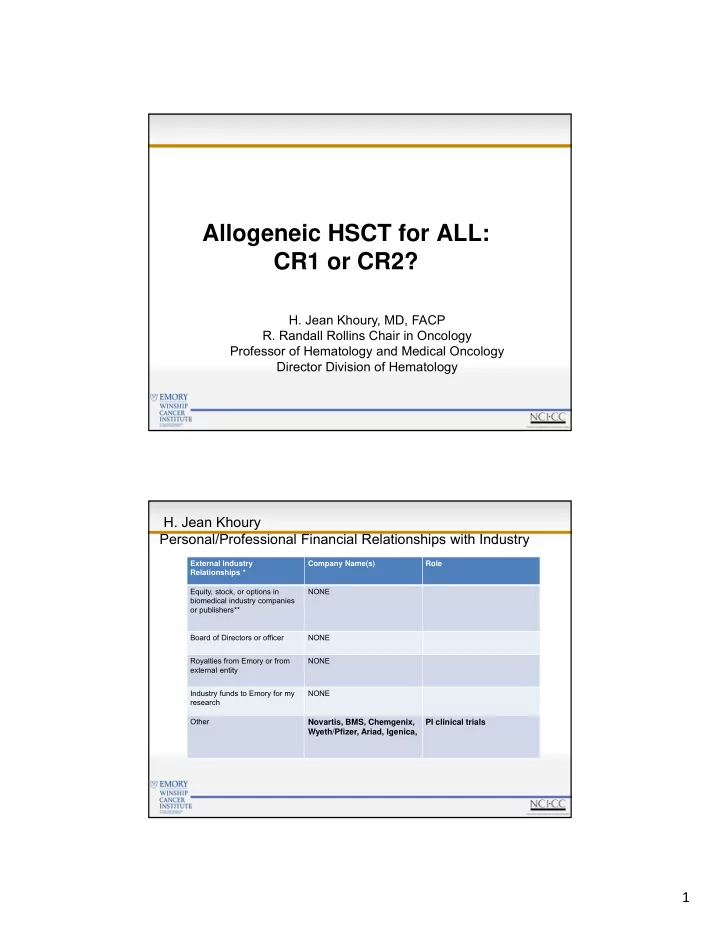
Allogeneic HSCT for ALL: CR1 or CR2? H. Jean Khoury, MD, FACP R. - - PDF document

allogeneic hsct for all cr1 or cr2
SMART_READER_LITE
LIVE PREVIEW

Allogeneic HSCT for ALL: CR1 or CR2? H. Jean Khoury, MD, FACP R. - - PDF document

Allogeneic HSCT for ALL: CR1 or CR2? H. Jean Khoury, MD, FACP R. Randall Rollins Chair in Oncology Professor of Hematology and Medical Oncology Director Division of Hematology H. Jean Khoury Personal/Professional Financial Relationships with


slide-1
SLIDE 1

1

Allogeneic HSCT for ALL: CR1 or CR2?

  • H. Jean Khoury, MD, FACP
  • R. Randall Rollins Chair in Oncology

Professor of Hematology and Medical Oncology Director Division of Hematology

External Industry Relationships * Company Name(s) Role Equity, stock, or options in biomedical industry companies

  • r publishers**

NONE Board of Directors or officer NONE Royalties from Emory or from external entity NONE Industry funds to Emory for my research NONE Other

Novartis, BMS, Chemgenix, Wyeth/Pfizer, Ariad, Igenica, PI clinical trials

  • H. Jean Khoury

Personal/Professional Financial Relationships with Industry

slide-2
SLIDE 2

2

High-Risk patients Low-Risk Young Adults Older Patient

ALL HCVAD + R Pediatric regimens Individualized Medicine

Intermediate-Risk With CR2 achievable

Overall survival: Childhood ALL on St. Jude’s Trials 1962-2007

Pui et al. NEJM 2006

slide-3
SLIDE 3

3

Pui, et al. NEJM 2004

Children

slide-4
SLIDE 4

4

Survival on hyper-CVAD regimen by age

Kantarjian et al. JCO 2000

Pieters R & Carroll WL. Ped Clin NA 2008;55:1‐20

slide-5
SLIDE 5

5

Nachman JB, et al. JCO 2009;27:5189

CCSG Study 1961: ALL in Young Adult Gp (age 16-21)

High-Risk patients Low-Risk Young Adults Older Patient

ALL HCVAD +/- R Pediatric regimens Individualized Medicine

Intermediate-Risk With CR2 achievable

slide-6
SLIDE 6

6

MRC ‐ UK

Study Group # patients aged > 50- 60 CR PFS OS SWOG L-10M 40 35% 8.3 months Median 1 month CALGB 8811 18 (> 60) 39% 12 months Median 1 month GMALL 94 (> 65) 48% NR < 10% ECOG 108 (> 50) NR NR 15% at 5 years MDACC 59 (> 60) 80% NR 17 % at 5 years

Outcome of

  • lder patients

with ALL

High-Risk patients Low-Risk Young Adults Older Patient

ALL HCVAD +/- R Pediatric regimens Individualized Medicine

Intermediate-Risk With CR2 achievable

slide-7
SLIDE 7

7

Results of the ALL-R87 trial of 61 adults (median age 28) with relapsed ALL

  • Only 9 patients were transplanted (5 autologous, 4 allogeneic).
  • Autografted patients: four relapsed after 1, 3, 4 and 25 months. One is currently in

continuous CR (CCR) at 46 months from BMT.

  • Allografted patients, 1 relapsed 5 months from BMT and 3 are alive in CR at 22, 43,

63 months from BMT.

34/61 (56%) achieved CR

Fiorina et al. Italian cooperative group BJH 1997

Portell & Avandi. Leuk/Lymp 2014;55:737

slide-8
SLIDE 8

8

An open label, multicenter, phase II study to evaluate efficacy and safety of the BiTE antibody blinatumomab in adult patients with relapsed/refractory B-precursor acute lymphoblastic leukemia(ALL)

  • 220 pts enrolled at last report from ASH :
  • 36 evaluable
  • 26 (72%) CR/Cri w/i 2 cycles—24 molecular resp
  • Med OS=9.0 mos; 13/26 went to allo SCT
  • Major toxicities: CNS (seizures;

encephalopathy), infection, thrombocytopenia, cytokine release syndrome

  • Phase I pediatric trial in rel/ref B-ALL reported at

ASH 2013 with 34 pts: ORR 41% (CR 35%)

Chimeric Antigen Receptors: CARs

Autologous T-cells modified to express a surface receptor that mediates binding of the target tumor antigen, e.g., CD19, which in turn activates a signal to the T-cell to induce target cell lysis.

  • a. Single chain variable fragment antibody

specific to tumor antigen

  • b. Fused to transmembrane domain and a

T-cell signaling moiety, e.g., CD3 zeta or FcRγ

slide-9
SLIDE 9

9

CARS in ALL

  • Chimeric T cells (CTL019)
  • 16 patients, age 5-22 with rel/ref ALL
  • CR = 81% (10 of 16 persist up to 16mos)
  • Continued expansion of CARs in vivo
  • Persistence of CARs in blood and BM for

>6 mos.

  • CARs found in CSF
  • Toxicity: Cytokine release syndrome

High-Risk patients Low-Risk Young Adults Older Patient

ALL HCVAD +/- R Pediatric regimens Individualized Medicine

Intermediate-Risk With CR2 achievable

slide-10
SLIDE 10

10

Durrant et al. MRC. Hem/Onc Clin of N. Am.. 2000

Outcomes Adult ALL

Elevated BC >30k (B-cell) >100k (T-cell) Cytogenetics & Molecular Genetics t(9;22), t(4;11), t(1;19) Complex Hypodiploidy NOTCH 1 activating mutation BAALC inc expression IKZF1 deletion/mutation Age >35 (a continuum) Time to CR >4 (?6) weeks Molecular failure (MRD)

Risk Factors in ALL

slide-11
SLIDE 11

11

MRD and prognosis in ALL

slide-12
SLIDE 12

12

Improving Outcomes

  • Targeted therapy against MRD:

– Monoclonal antibodies – TKI

Rituximab-HCVAD

slide-13
SLIDE 13

13

Blinatumomab for MRD A: RFS entire group (n= 20) = 61% (12 remain in CR) B: RFS 9 patients receiving HSCT = 65% (6 remain in CR) C: RFS 11 patients no subsequent Rx = 60% (6 remain in CR) f/u 33 mos

Topp MS, et al. Blood; 2012;120(26):5185‐5187)

slide-14
SLIDE 14

14

HyperCVAD-Imatinib in Ph+ ALL

Thomas et al, Blood 2004, 103:4396-4467

HyperCVAD-dasatinib in Ph+ ALL

slide-15
SLIDE 15

15

Treatment options for Relapsed Ph+ ALL

  • Blood. 2007;109:3207-3213

Myeloid BP-CML N=52 Lymphoid BP-CML N=10 MaHR 29% 40% Any CyRa 37% 50% MCyR 19% 40% CCyR 15% 30%

Ponatinib Dasatinib

Myeloid BP-CML N=52 MaHR 28% CHR 15% MCyR 37% CCyR 28%

Bosutinib

Goldstone AH, et al. Blood 2008;111:1827‐33

slide-16
SLIDE 16

16

Goldstone AH, et al. Blood 2008;111:1827‐33 Goldstone AH, et al. Blood 2008;111:1827‐33 0.02

slide-17
SLIDE 17

17

Post-Transplant Rituximab

BLOOD, 22 AUGUST 2013 x VOLUME 122, NUMBER 8

slide-18
SLIDE 18

18

Conclusions

  • Landscape for adult ALL is changing
  • Monoclonal antibodies and TKIs – upfront,

post-transplant, at relapse

  • Allogeneic HSCT is curative and the use

can be individualized –

  • Allogeneic HSCT can be postponed to

CR2 in adult ALL