
SLIDE 1
MEETING 3 FEBRUARY 23, 2016
AGRICULTURE WATER QUALITY PARTNERSHIP FORUM
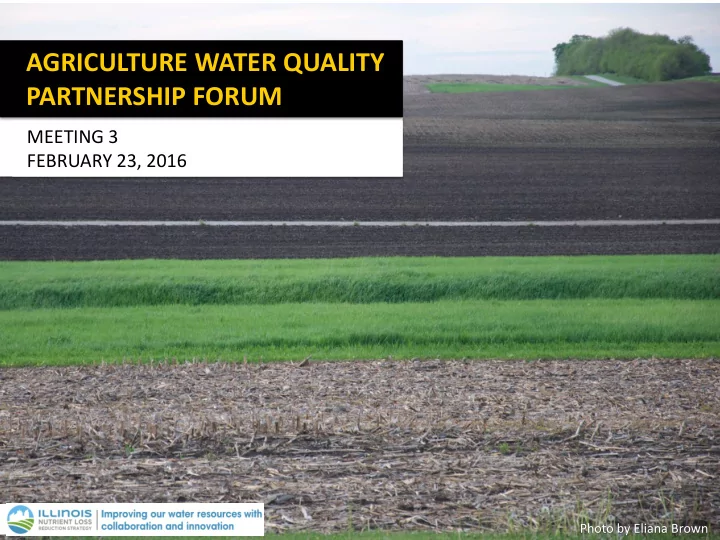
Photo by Eliana Brown
AGRICULTURE WATER QUALITY PARTNERSHIP FORUM MEETING 3 FEBRUARY 23, - - PowerPoint PPT Presentation
AGRICULTURE WATER QUALITY PARTNERSHIP FORUM MEETING 3 FEBRUARY 23, 2016 Photo by Eliana Brown Introductions Illinois EPA Illinois Farm Bureau Lisa Bonnett (Marcia Willhite) Lauren Lurkins IDA Illinois Pork Producers Association Warren
MEETING 3 FEBRUARY 23, 2016
Photo by Eliana Brown
Illinois EPA Lisa Bonnett (Marcia Willhite) IDA Warren Goetsch USDA-NRCS Ivan Dozier (Eric Gerth) IDNR James Herkert AISWCD Kelly Thompson The Nature Conservancy Maria Lemke IFCA Jean Payne American Farmland Trust Mike Baise Prairie Rivers Network Kim Knowles
Illinois Farm Bureau Lauren Lurkins Illinois Pork Producers Association Jennifer Tirey Illinois Soybean Association Amy Roady University of Illinois - Extension George Czapar Farm Service Agency Scherrie Giamanco (Kim Martin) Illinois Certified Crop Advisor Board of Directors Tom Kelley Illinois Stewardship Alliance Lindsey Record Illinois Soc of Prof. Farm Man. & Rural Appr. Randy Fransen Illinois Corn Growers Association Rodney Weinzierl
farmers address nutrient loss and select the most appropriate BMPs:
technical advisors.
continuing education requirements, state initiatives, and other technical services.
farmers address nutrient loss and select the most appropriate BMPs:
technical advisors.
continuing education requirements, state initiatives, and other technical services.
farmers address nutrient loss and select the most appropriate BMPs:
technical advisors.
continuing education requirements, state initiatives, and other technical services.
3nd Meeting, 12/3/15, Urbana, IL
Illinois EPA Gregg Good, Rick Cobb Illinois State Water Survey Laura Keefer Illinois Natural History Survey Andrew Casper Illinois Dept. of Natural Resources Ann Holtrop University of Illinois Mark David Sierra Club Cindy Skrukrud
MWRDGC Justin Vick Illinois Corn Growers Association Laura Gentry U.S. Army Corp of Engineers-Rock Island Marvin Hubbell U.S. Geological Survey Kelly Warner (temp assign) National Center for Supercomputing Apps Jong Lee Aqua America Kevin Culver (pending)
1. Coordinate the development and implementation of monitoring activities (e.g., collection, analysis, assessment) that provide the information necessary to: a. Generate estimations of 5-year running average loads of Nitrate-Nitrogen and Total Phosphorus leaving the state of Illinois compared to 1980-1996 baseline conditions; and b. Generate estimations of Nitrate-Nitrogen and Total Phosphorus loads leaving selected NLRS identified priority watersheds compared to 1997-2011 baseline conditions; and c. Identify Statewide and NLRS priority watershed trends in loading over time using NMC developed evaluation criteria. 2. Document local water quality outcomes in selected NLRS identified priority watersheds, or smaller watersheds nested within, where future nutrient reduction efforts are being implemented (e.g., increase in fish or aquatic invertebrate population counts or diversity, fewer documented water quality standards violations, fewer algal blooms or offensive conditions, decline in nutrient concentrations in groundwater). 3. Develop a prioritized list of nutrient monitoring activities and associated funding needed to accomplish the charges/goals in (1) and (2) above.
75% of area of the State
station (flow)
site/Historical Data
Kaskaskia at New Athens Little Wabash at Carmi Rock River at Joslin Green River at Geneseo
Plans and Associated Costs for ALL NLRS high priority watersheds that:
looked at the NLRS Fig. 4.2 Priority Watershed map to select watersheds that include existing and future BMPs. This will help the NMC determine where more monitoring is needed. The following watersheds were discussed:”
* also named by the NMC ** nearby a NMC-named watershed
improvements)
up, ….chemical, physical, and biological indicators)
funding/in-kind resources, next steps) Developed NLRS Priority Watershed Nutrient Monitoring Plans allow us to be ready to rock n’ roll when resources become available!
monitoring data collected by multiple organizations? (Jong Lee, Great Lakes to Gulf Virtual Observatory)
quality improvements?
were only selected based on where NMC members thought the most ongoing monitoring was happening in NLRS-identified priority watersheds.
the development of Watershed Nutrient Monitoring Plans needs to be a joint decision, not just the NMC’s.
monitoring! Therefore, NMC activity needs to be in those NLRS priority watersheds (or other identified critical watersheds) were the most money, and education,
Valerie Booth, IDOA
Source: Iowa State University, Extension and Outreach, Measures of Success Committee
Valerie Booth, IDOA
Valerie Booth, IDOA
Valerie Booth, IDOA
Valerie Booth, IDOA
75% of area of the State
station (flow)
site/Historical Data
Kaskaskia at New Athens Little Wabash at Carmi Rock River at Joslin Green River at Geneseo
farmers address nutrient loss and select the most appropriate BMPs:
technical advisors.
continuing education requirements, state initiatives, and other technical services.