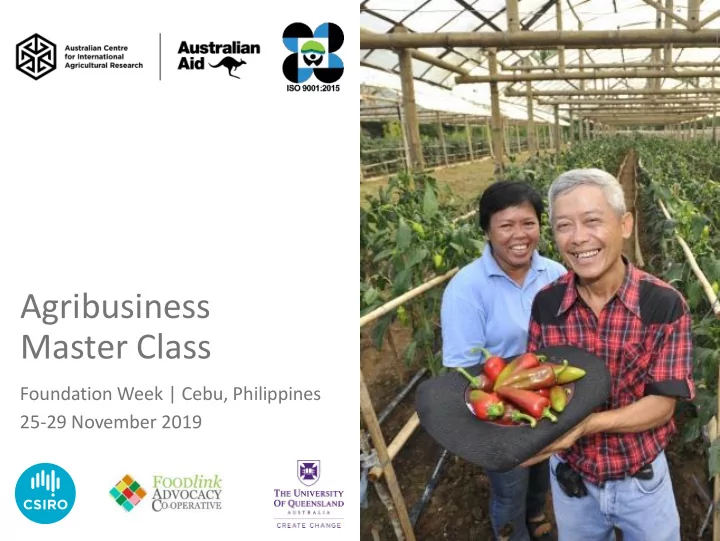
SLIDE 1 Agribusiness Master Class
Foundation Week | Cebu, Philippines 25-29 November 2019
SLIDE 2
Welcome remarks
SLIDE 3
Who’s who in the zoo?
Lilly Lim-Camacho
SLIDE 4
- Lilly Lim-Camacho
- Anton Simon Palo
- Tiago Wandschneider
- Oleg Nicetic
- Phil Currey
- Mai Alagcan
- Mara Faylon
About us
SLIDE 5 About you
- Your name
- Your organisation
- Something about yourself that
you’d like this group to remember
SLIDE 6
The road ahead: About the AMC
SLIDE 7 Food systems encompass the entire range of actors and their interlinked value-adding activities involved in the production, aggregation, processing, distribution, consumption and disposal of food products that originate from agriculture, forestry or fisheries, and parts of the broader economic, societal and natural environments in which they are embedded.
The food system
FAO, 2016. Sustainable Food Systems: Concept and framework. Food and Agriculture Organization of the United Nations (FAO), Rome.
SLIDE 8 The Food System Wheel: where do you sit?
FAO, 2016. Sustainable Food Systems: Concept and framework. Food and Agriculture Organization of the United Nations (FAO), Rome.
SLIDE 9 The role of R&D in the food system
- Applied research typically is to underpin positive
development – ie research that is designed to have an ‘impact’
- Achieving impact requires social change
- To bring about social change, human actors interact
through time within a social system
- To achieve impact, research projects need to align with
an implicit ‘theory’ about how desirable social change might occur—a ‘theory of change’
Theory of Change| Material by Christian Roth and Samantha Stone-Jovovich (CSIRO, 2019)
SLIDE 10
Your AMC Journey
SLIDE 11
- 1. Switch off to switch on
- 2. Peer-to-peer learning
- 3. Different strokes for different folks
- 4. Get your hands dirty
- 5. Move and breathe deeply
Some ground rules
SLIDE 12 Our approach to the week
Day 1
Value chain frameworks & concepts
AM Introductions PM Frameworks Dinner event
Day 2
Value chain analysis & its tools
AM Methods PM Rapid appraisals; case study
Day 3
Preparing for the field
AM Markets and field briefing PM Preparation and practice
Day 4
Walking the chain
AM Field visits Working evening
Day 4
Consolidating insights
AM Presentations PM Mini-projects
SLIDE 13
An introduction to value chains
Tiago Wandschneider
SLIDE 14
An Introduction to Value Chains
SLIDE 15
Learning Outcomes
By the end of this session, you should have a good understanding of: ▪ The concept (and some key features) of value chains ▪ The concept (and some key features) of supply chains ▪ The concept of inclusive value chain ▪ Value chain research frameworks ▪ Purposes/uses of value chain research
SLIDE 16 Structure of the Presentation
I. Supply chains versus value chains II. Inclusive chains
- III. Value chain research frameworks
- IV. Purposes and uses of value chain research
SLIDE 17
- I. Supply Chains versus Value Chains
SLIDE 18 Development practitioners often use the term value chain to refer to various types of production and marketing
- systems. In this Master Class the term value chain
is also applied indiscriminately. In the academic literature, however, value chains are a specific type of agrifood chain. They are fundamentally different from supply chains.
Introduction
SLIDE 19
What is your understanding of a value chain? How does it differ from a supply chain?
Discussion
SLIDE 20 What is a supply chain?
input supply farm productio n assembl y processin g wholesalin g retailin g
Full range of activities required to bring a product (or service) from conception through the different production phases to delivery to final consumers and disposal after use
SLIDE 21
What is a Value Chain?
Farmer cooperative s
Exporter
Importer
Vertical alliance or strategic vertical network involving a number of independent enterprises, focused on the development of competitive advantages and value creation
SLIDE 22 Supply chain Value chain Market structure
Atomistic Traditional markets Presence of lead firms Modern markets
Coordination
Opportunistic, spot market transactions Long-term, contract-based relationships
Primary focus
Cost/price Value/quality
Orientation
Commodity Differentiated product
Power relationship
Supply push Demand pull
Organizational structure
Independent Inter-dependent
Philosophy
Self-optimization Chain optimization
Information sharing
Limited Extensive
SLIDE 23
Please discuss the following statements: “Supply chains are shaped by demand and the needs of buyers and consumers” “In supply chains, value is created as the product moves from the farm to the end consumer” “Trust is a key element in many supply chains”
Discussion
SLIDE 24
- II. Inclusive Value Chains
SLIDE 25
What is an inclusive agricultural value chain?
Discussion
SLIDE 26
Value chains are inclusive when they offer opportunities for social and economic empowerment of disadvantaged groups (e.g. landless, marginal farmers, smallholder farmers, women, ethnic minorities, low castes) participating as producers, sellers, labourers and consumers.
Some possible definitions…
SLIDE 27
Inclusive value chains engage the poor as employees, suppliers, distributors or consumers, and expand their economic opportunities in a variety of ways.
Some possible definitions…
SLIDE 28
What factors should be considered when assessing the level of inclusiveness of a value chain?
Discussion
SLIDE 29
Please discuss the following statement: “Employment and consumption are often neglected as important dimensions of inclusive value chains”
Discussion
SLIDE 30 Rank the following four agricultural value chains in the Philippines in terms of inclusiveness and justify your assessment:
- Mango
- Banana
- Coconuts
- Vegetables
Discussion
SLIDE 31
- III. Value Chain Research Frameworks
Price Lead Firm Turnkey Supplier Lead Firm Relational Suppliers Lead Firm Integrated Firm
SLIDE 32 Some value chain research frameworks…
Lundy, M. et al (2014)
SLIDE 33 Rich (2004)
Some value chain research frameworks…
SLIDE 34 The Springfield Centre (2015)
Some value chain research frameworks…
SLIDE 35
Some value chain research frameworks…
SLIDE 36
- IV. Purposes and Uses of Value Chain Research
SLIDE 37
Discussion
Value chain studies can have different purposes and uses. What has been your experience? Please explain the purpose of previous value chain studies you have been involved in…
SLIDE 38 Purposes of value chain research
Research for development perspective (R4D) ▪ Identify chain development and upgrading interventions ▪ Assess the feasibility, sustainability, replicability and outreach of different chain innovations and models Development perspective ▪ Identify chain innovations with development impact potential ▪ Design appropriate chain development strategies and interventions ▪ Develop a baseline; assess intervention outcomes and impacts Private sector perspective
- Understand competition, market segmentation,
and consumer preferences
- Develop procurement models and marketing
strategies (4 Ps)
SLIDE 39 Some Reading material
Devaux, A., Torero, M., Donovan, J. and D. Horton (2016) Innovation for inclusive value-chain development: Successes and challenges, Synopsis, April 2016, International Food Policy Research Institute. http://ebrary.ifpri.org/utils/getfile/collection/p15738coll2/id/130282/filename /130493.pdf Hobbs, J. E., Cooney, A. and (2000) Value chains in the agri-food sector: What are they? How do they work? Are they for me?, Department of Agricultural Economics, University of Saskatchewan, September 2000. Lundy, M., Amrein, A., Hurtado, J.J., Becx, J.,Zamierowski, N., Rodriguez, F. and E.E. Mosquera (2014) Link methodology: a participatory guide to business models that link smallholder farmers to markets, Version 2.0. Cali, Colombia: International Center for Tropical Agriculture. https://www.cgspace.cgiar.org/handle/10568/49606
SLIDE 40
Frameworks for selecting value chains for analysis
Tiago Wandschneider
SLIDE 41
Selection of Value Chains for In-depth Analysis and Intervention
SLIDE 42
Learning objectives
By the end of this session, you should have a good understanding of the rationale and methodology for prioritising value chains for further analysis and possible intervention.
SLIDE 43 Discussion
- 1. Have you ever participated in a value chain
study or value chain intervention?
- 2. What were the value chains?
- 3. How and why were these chains selected?
SLIDE 44 Purpose of value chain selection processes
To target value chains with greatest potential to meet the objectives of the organisations
SLIDE 45
Four-step process
Step 1: Identify a list of potential products / value chains Step 2: Choose relevant value chain selection criteria Step 3: Assign weights to each criterion Step 4: Score value chains against selection criteria
SLIDE 46
are already produced in the country or region
not yet produced but have potential in terms
conditions, market
benefit to target groups
Step 1: Identify a list of potential products / value chains
Step 2: Choose relevant value chain selection criteria Step 3: Assign weights to each criterion Step 4: Score value chains against selection criteria
Step 1
SLIDE 47 Participation
- Key stakeholders and informants can be involved
in the development of the list of potential products
- r value chains (e.g. in a chain selection
workshop).
- Participants may come from the farming and
agribusiness sectors, academia, research centers, national and local government agencies, donor agencies, NGOS, or projects.
SLIDE 48
qualitative criteria against which different options can be evaluated and scored must be identified.
should provide a suitable framework for selecting the most promising chains for achieving
goals and priorities.
Step 1: Identify a list of potential products / value chains
Step 2: Choose relevant value chain selection criteria
Step 3: Assign weights to each criterion Step 4: Score value chains against selection criteria
Step 2
SLIDE 49
Common value chain evaluation dimensions
1. Chain relevance to target groups 2. Market size and growth 3. Competitiveness of target groups 4. Chain upgrading opportunities 5. Presence of lead firms 6. Environmental sustainability 7. Research interests 8. (…)
SLIDE 50
Number of criteria
Working with a relatively small number of criteria will reduce data requirements and ensure that key criteria have sufficient weight in the final choice of value chains.
SLIDE 51
Quantitative criteria
The indicators for different criteria should ideally be measurable or objectively assessable (e.g. number of people, contribution to household income, market size, five-year growth, etc). This will strengthen the rigor of scoring and analysis, reduce subjective assessments, and enable better comparison between value chains.
SLIDE 52
A framework for selection of inclusive value chains with some quantitative criteria
SLIDE 53 Discussion
- 1. Please identify in the previous example the
criteria that can be more easily quantified?
- 2. For each of these criteria, do you anticipate any
challenges accessing the data?
SLIDE 54
Qualitative criteria
Where qualitative indicators are used, scoring guidelines should be developed to ensure a level of consistency in the assessment of different value chains. Guiding questions can be used, either as selection criteria or under different criteria.
SLIDE 55 A qualitative framework for prioritisation of value chains for women’s empowerment
Relevance
- a. Do (or could) target women exist in significant numbers in the proposed sub-sectors?
- b. What are the trends around women’s engagement in or benefit from the selected sub-
sectors? Opportunity
- a. Do the proposed sub-sectors have potential to grow, become more efficient or reach
higher value markets and therefore offer economic opportunity?
- b. Will the targeted women be able to take advantage of the identified economic
- pportunities through upgrading their current roles or taking on new roles (as suppliers,
employees or service providers)?
- c. Are there other benefits to women such as access to a new product or service?
Feasibility
- a. Can the project effect sustainable change in the market system that will continue to
benefit women or ethnic minority groups?
- b. Are enabling environment factors such that they will either support, or at the very least
not inhibit, the project from moving forward?
- c. Are there any social norms that will make the targeting or integration of women too
difficult to justify the project investment at this point in time (low return on resources)? Source: Jones, L. (2016) Women’s Empowerment and Market Systems: Concepts, practical guidance and tools (WEAMS Framework). https://www.beamexchange.org.
SLIDE 56 A qualitative framework for selection of pro-poor value chains in Indonesia
1. Poverty alleviation and sustainability of the economic activity
- Is there potential to reach large numbers of poor households in production and post-
production?
- What is the potential to sustainably increase producer incomes?
- Does the chain/commodity fit with the focus of Government programs and priorities?
- How project-crowded is the sector? To what extent are sector needs addressed by
current donors?
- What is the agro-ecological feasibility of the commodity?
- Is the commodity environmentally sustainable?
- External risks
- 2. Chain structure
- Is there potential for production/post-harvest value addition?
- What is the potential for improving market access?
- What is the scalability and transferability potential?
- Is there sufficient infrastructure available?
Source: Australian Centre for International Agricultural Research (ACIAR) - Eastern Indonesia Agribusiness Development Opportunities (EI-ADO). https://eiado.aciar.gov.au/commodity-selection/commodity-prioritisation.
SLIDE 57
Discussion
In the two previous examples, do you see any scope for using quantitative data?
SLIDE 58
Participation
Involvement of key stakeholders in the choice of criteria (e.g. in a chain selection workshop) will help build a common understanding and consensus around chain selection results.
SLIDE 59 The influence of contextual factors
Ultimately, the choice of criteria will be determined by political and institutional factors, the specific purpose and focus of value chain assessments, and the thinking and views of those involved. These factors explain why value chain selection criteria may differ considerably across
- rganizations and projects.
SLIDE 60 Step 3
More important criteria should have greater influence in the ranking and selection of value chains Assign weights to the different criteria to reflect their relative importance
Step 1: Identify a list of potential products / value chains Step 2: Choose relevant value chain selection criteria
Step 3: Assign weights to each criterion
Step 4: Score value chains against selection criteria
SLIDE 61 Types of weighting
Simple numeric (e.g. 1, 2, 3 or 4) The relative importance
proportion to the numeric weighting Proportional (sum of weights = 100) The relative importance of criteria is reflected in the proportion assigned to it
SLIDE 62 Proportional weighting for gender-sensitive selection of value chains in Albania (FAO)
Weight Market demand and potential
- Importance of the sub-sector to regional development
- Evidence of high market potential or strong effective demand
- Positive growth prospects and opportunities for income and employment
- Assumed (potential) competitive advantage of a sub-sector in relation to the regional, national
and international market 20% Outreach
- Number or significance of SMEs in the sub-sector and their distribution along the value chain
- Estimated employment in the sub-sector (disaggregated by sex)
- Location of major clusters in the area
20% National priority ranking
- Government priority sector
- Potential demonstration effects, assumed spill-over effects, repeatability in other sub-sectors
10% Opportunities for intervention
- Existence of constraints/bottlenecks that could potentially be tackled in an efficient way
- Ease of entry and openness of key actors (private and public sectors) to cooperation
- Likelihood of stakeholder buy-in and active support to interventions
25% Relevance for women’s empowerment and cross-cutting issues
- Location of women’s cluster in the area
- Likely high impact on poverty or socially excluded groups
- Likelihood of opportunities for women’s economic empowerment
- Potential do add value to agricultural or other product
- Opportunities for networking
- Opportunities for diversification
25%
http://www.fao.org/3/I8909EN/i8909en.pdf
SLIDE 63 Proportional weighting for selection of pro-poor value chains in eastern Indonesia
https://eiado.aciar.gov.au/commodity-selection/commodity-prioritisation.
SLIDE 64 Step 4
- 1. Evaluate how well value chains
match selection criteria (1-5 is a common scoring scale)
- 2. Multiply scores by weights
- 3. Rank value chains according
to total scores (sum or average
Step 1: Identify a list of potential products / value chains Step 2: Choose relevant value chain selection criteria
Step 3: Assign weights to each criterion Step 4: Score value chains against selection criteria
SLIDE 65
Value chain scoring matrix
SLIDE 66 Scoring of value chains in Albania (FAO)
http://www.fao.org/3/I8909EN/i8909en.pdf
SLIDE 67
Scoring of pro-poor value chains in eastern Indonesia (ACIAR)
SLIDE 68
Initial identification of 32 commodities Reference Group selected 16 commodities Consultation of Provincial and Reference Group for commodity prioritization criteria Selection of 5 priority commodities for detailed chain studies
Scoring of pro-poor value chains in eastern Indonesia (ACIAR)
SLIDE 69
SLIDE 70
Scoring of pro-poor value chains in eastern Indonesia (ACIAR) Scoring of pro-poor value chains in eastern Indonesia (ACIAR)
SLIDE 71 Data collection options for evidence-based selection of value chains
- Review of secondary data and information
- Key informant interviews for additional (primary)
information and insights (depending on resources and time)
SLIDE 72
Approaches to stakeholder involvement during scoring
Option 1: Involve stakeholders after the data has been collected and analyzed, for validation of chain scores and ranking. Option 2: Base the whole exercise on the knowledge and views of a group of key informants and stakeholders, who come together to score and rank the value chains. Option 2 is less rigorous but quicker, cheaper and more conducive to stakeholder involvement than a more data-driven approach.
SLIDE 73
Group exercise
SLIDE 74 Some Reading material
M4P Toolbook Agri-ProFocus (2014) Gender in Value Chains – Practical toolkit to integrate a gender perspective in agricultural value chain development. https://agriprofocus.com/upload/ToolkitENGender_in_Value_ChainsJan2014com pressed1415203230.pdf Jones, L. (2016) Women’s Empowerment and Market Systems: Concepts, practical guidance and tools (WEAMS Framework). https://www.beamexchange.org. Schneemann, J. and T. Vredeveld (2015) Guidelines for value chain selection: Integrating economic, environmental, social and institutional criteria. Study commissioned by GIZ. https://www.giz.de/fachexpertise/downloads/giz2015-en-guidelines-value-chain- selection.pdf USAID MARKETLINKS, Value Chain Selection. https://www.marketlinks.org/good-practice-center/value-chain-wiki/value-chain- selection
SLIDE 75
Value chain mapping
Lilly Lim-Camacho
SLIDE 76
- Value chain maps provide a schematic snapshot of the key value
chain actors and the existing structure of raw material, product and information flows at a given point in time. (Haggblade et al., 2012)
- A common objective of VCA is to describe how a chain works –
mainly because it is something that is not well understood
- Mapping can assist in defining the scope of VCA
- Mapping a chain, often diagrammatically, is an accessible way to
communicate the structure of a chain.
Why is chain visualisation important?
SLIDE 77
- They can be too complex
- They can be too simple
- They can be considered as The Truth
- They can’t really convey how the chain works in reality
- It is often merely snapshot of a certain point in time
But, mapping a chain is a great way to start the conversation about chains. A map is a powerful boundary object.
Disadvantages of mapping
SLIDE 78 The concept of chains
Structure
78 |
Other input suppliers Finance Governance and regulatory structures Industry associations and services
SLIDE 79 The concept of chains
Flows
79 |
Value contribution Share of consumer value = Profit Information flow
SLIDE 80 The concept of chains
Relationships
80 |
Information flow Share of consumer value = Profit Value contribution
SLIDE 81
What can mapping output look like?
SLIDE 82 Capture & Packaging Company processor Retail (whole prawn & value added) Catch Receivers (drop off point) Cold Store & Processing Seafood Importer Melb. Wholesale & distrib. Importers & Retailers Consumers Otter board double trawl Otter board quad trawl? Overseas consumers Domestic consumers Indep. processor Offshore prawn processor Mother ship Karumba / Darwin Super markets Local retailers
3 5 %
Catch Receiver (at sea)
6 % 1 %
Cargo ship Cairns Wholesale & Distribution Spotter plane
5 % 5 % 1 5 %
Sydney Wholesale & distrib. Regional distribution centre
7 %
Farmery, A. et al (2012) Banana prawn supply chain environmental analysis, in Growth opportunities & critical elements in the supply chain for wild fisheries & aquaculture in a changing climate . FRDC-DCCEE 2011/233.
Example 1: Mapping actors in a chain
SLIDE 83 Example 2: Mapping enterprise locations for different commodities
TraNSIT Mapping | Material by Chris Chilcott and Andrew Higgins (CSIRO)
SLIDE 84 Origin Destinatio n
Example 3. Mapping transit routes
TraNSIT Mapping | Material by Chris Chilcott and Andrew Higgins (CSIRO)
SLIDE 85 Image from Haggbladeet al., 2012
Example 4. Mapping channels and gender roles
SLIDE 86 Breeding Harvest Cold Store & Processing Consumers Growing Marketing & Distribution Inputs
Increased sea surface temperature Reduced availability of feed meal Increased cost of production Decreased oxygenation Increased risk of disease Reduced growth rate Change in timing of harvest Animal deaths Increased pressure for environmenta l performance Consumer concerns Reduced product throughput Reduced reliability of supply Increased prices
Example 5: Mapping events as they take place across the chain
SLIDE 87 Example 5: Mapping risks and strategies against actors
Lim-Camacho. et al (2016) Adaptive value chain approaches. CSIRO www.adaptivevaluechains.org
SLIDE 88
Example 6. Process mapping
SLIDE 89 1. In a group, select a commodity that you would like to focus on 2. Map its chain, including:
- a. The activities along the chain
- b. The actors (businesses and other
- rganisations) that you know of who conduct
those activities
3. Output: A map, drawn on butchers paper, put up on the wall
Activity: Chain mapping
20
mins
SLIDE 90
- Haggblade, S., Theriault, V., Staatz, J.,
Dembele, N. and Diallo, B., 2012. A conceptual framework for promoting inclusive agricultural value
- chains. International Fund for Agricultural
Development (IFAD), mimeo (online document). https://pdfs.semanticscholar.org/89c8/1055 1b608805e843dc27b6cfdc4cb9d4dad2.pdf
- Lim-Camacho et al., 2019. Towards resilient
mining
- Lim-Camacho et al., 2017. Complex resource
References and reading material
SLIDE 91
End of Day 1