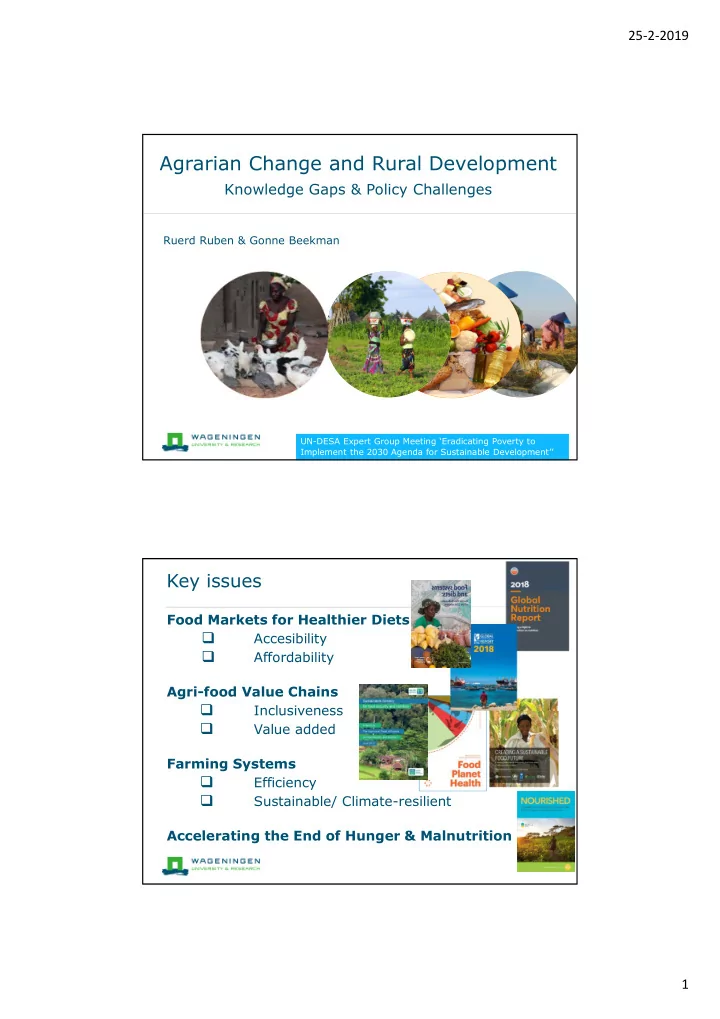
Agrarian Change and Rural Development Knowledge Gaps & Policy - - PDF document

agrarian change and rural development
SMART_READER_LITE
LIVE PREVIEW

Agrarian Change and Rural Development Knowledge Gaps & Policy - - PDF document

25-2-2019 Agrarian Change and Rural Development Knowledge Gaps & Policy Challenges Ruerd Ruben & Gonne Beekman UN-DESA Expert Group Meeting Eradicating Poverty to Implement the 2030 Agenda for Sustainable Development Key


slide-1
SLIDE 1

25-2-2019 1

Agrarian Change and Rural Development

Knowledge Gaps & Policy Challenges

Ruerd Ruben & Gonne Beekman

UN-DESA Expert Group Meeting ‘Eradicating Poverty to Implement the 2030 Agenda for Sustainable Development’’

Key issues

Food Markets for Healthier Diets

  • Accesibility
  • Affordability

Agri-food Value Chains

  • Inclusiveness
  • Value added

Farming Systems

  • Efficiency
  • Sustainable/ Climate-resilient

Accelerating the End of Hunger & Malnutrition

slide-2
SLIDE 2

25-2-2019 2

Agrarian Policies for Food Systems

Rural Development Policies & Programs Agrarian Production Systems Agri-food Value Chains Food & Nutrition Security

  • 1. Agrarian Change

a) Changes in Food demand &

Dietary Transition

b) Bifurcation of the Farm

Production Structure

c) Missing Middle for Rural

Support Services

4

Demography Urbanization Farm Size Employment Income

slide-3
SLIDE 3

25-2-2019 3

1a) Population Growth & Demand for Food

5

SSA population will increase from 800 Million (2000) to 2.5 Billion (2050) in next 40 years 20% world population, More than half of world’s population growth (2020-50) is expected to take place in Africa (+ 1.3 billion). African food market will grow with > 300% between 2010 and 2030 .

Urbanization & Employment

6

World: Urban population will grow to 75% in 2050 SSA: Rapid rate of Urbanization & some emerging mega-cities (Gulf of Guinea) Urban workforce share in SSA increases from 20% (2000) to 40% (in 2030) Most urban growth from natural increase (not migration) Most employment in family farms, SME businesses & informal household enterprises

slide-4
SLIDE 4

25-2-2019 4

7

Food Intake: Triple burden of malnutrition

Micronutrient deficiencies Overweight & obesity Undernutrition

Stunting & Wasting

8

Nigeria: Animal-sources food calories are up to 20 times more expensive than cereal-based calories

(Heady et al, 2016 Food prices & poverty reduction, IFPRI)

Ethiopia: Relative prices of leafy vegetables, legumes & nuts and animal-based foods compared to staple cereals are 30-60% higher

(Bachewe et al., 2017, The rising costs of nutritious foods in Ethiopia, IFPRI)

Food prices: healthy diets are expensive

slide-5
SLIDE 5

25-2-2019 5

Dietary change: shifts to energy-rich food

9

Food expenditures & shopping habits

SSA Household spend 45-80% of income for food SSA Markets provide 40-70 of food supplies Processed foods represent 20-40% of food intake

slide-6
SLIDE 6

25-2-2019 6

11

90% of farm in the world are smallholder owned &

  • perated, but they hold only

25% of world’s farmland Average farm size in SSA is 1.3

  • ha. and in SE Asia 1.06 ha.

(IFAD) Rapidly increasing role of medium-scale farms (Kenya) to 50% of farmland (Zambia)

1b) Farm production structure Agrarian structure: rural employment

12

44% of SSA households are engaged in off-farm and/or non-farm employment Women are 9% less likely to work non-farm: gender gap Off-fam income may represent up to 30-50% of rural household income Nonfarm income may represent 20-40% of rural household income (FAO)

Vd Broeck & Kilic, Worldbank, 2018

slide-7
SLIDE 7

25-2-2019 7

Contract Farming

13

Contract farming involves mainly medium-size farmers. Most contract farming takes place for high-value activities (F&V, broilers). Income & employment effects of contracts tend to be positive. Grades & standards encourage contract farming (for exports).

Giel Ton et al. (2018) Contract farming for improving smallholder incomes: What can we learn ?, World Development (104): 46-64.

14

1c) Missing Middle: Finance Gap

SSA Smallholder access to (formal) finance is less than 20% Scarce offer of appropriate loan products for small-scale farmers Growing number of bank accounts (also through mobile money) Largest number of loans from family, friends and informal institutions (ROSCA’s)

Bank Accounts Loan providers

slide-8
SLIDE 8

25-2-2019 8

Missing Middle: Lots of Very Small SMEs

15

  • P. Quartey et al. (2017) Financing the growth of SMEs in Africa.

Review of Development Finance 7 (1): 18-28,

SME firms dominate the SSA business landscape (90% firms < 10 workers) High (female) employment generation (20-30%); but low value added

Food Value Chain Funnel

  • Many smallholder producers
  • Some Local traders
  • Aggregation
  • Processing
  • Few Retailers
  • Large number of consumers

‘Missing Middle

Thin Midstream in Value Chains

High concentration & low competetition in the Middle of the Value Chain

slide-9
SLIDE 9

25-2-2019 9

Weak farmer organizations

17

Source: SCOPE Insight

Only 20-40% of farmers are affiliated to farmer organizations. Farmer organizations face severe financial & management constraints

  • 2. Inclusive Rural Development

18

Three Pathways Falling out Stepping up Stepping out Three strategies Innovation Intensification Integration

Source: Barrett & Dorward

slide-10
SLIDE 10

25-2-2019 10

2a) Food Systems Innovations: Agrologistics

19

International trade to/from Sub-Sahara Africa

  • Trade Costs are 4 – 7 times higher
  • Waiting times are 13-27 times longer

Food Systems Innovations: cash transfers

20

Highly effective demand-led interventions for poverty reduction through cash transfers

Source: Bastagli et al. (2016) SR

  • n Impact of cash Transfers
slide-11
SLIDE 11

25-2-2019 11

2b) Agricultural Intensification: Productivity

21

Land Productivity (1961-2013) Kg/ha Labour productivity (1991- 2017) VA/worker (vs GDP/capita) Overall stagnation in land & labour productivity delayed agricultural transformation

SSA SSA

TFP growth & Food gap (SSA)

22

Total Factor Productivity growth (1961-2011) by country/regio Food demand compared to TFP Output growth (2000-2030)

Only 14% of SSA Food demand can be met by current TFP growth Growing Food Gap

slide-12
SLIDE 12

25-2-2019 12

Sustainable Agricultural Intensification

23

Source: Pretty et al (2018) Global Assessment of Agricultural Systems Nature Sustainability (1): 441–446.

163 million farms (29%) are practising some forms of sustainable intensification on 453 Mha of agricultural land (9% of world total). Most initiatives are deploying one (25% of farms, 37% of hectares)

  • r two (66% of farms,

52% of hectares) SI strategies.

Area of Farmland

Number of Farms

Agricultural Intensification: Trade-offs & Risks

24

Source: Rasmussen et al. (2018). Socio-economic outcomes

  • f intensification. Nature Sustainability (1) 275–282

Trade-offs

Win/Win : 17% of cases Win/Lose : 23 % Lose/Win : 42 % Lose/Lose: 18 %

slide-13
SLIDE 13

25-2-2019 13

25

2c) Supply chain integration: waste & losses

Larger food loss & waste in perishable products (F&V, fish, dairy, tubers) Many losses already occur at farm/field level Most waste in developed economies; large losses in developing countries PHL reduction are complex (multi-stakeholder) interventions

Data source: FAO

Supply chains: standards & certification

26

  • C. Oya et al. (2018) The effectiveness of agricultural certification in

developing countries, World Development 112: 282-312

Certification gives positive price effects, but little (or negative) yield effects. Higher income from certified plots, but no higher full income (substitution effects) Scarce direct effects for wage labourers; some indirect effects (job security).

slide-14
SLIDE 14

25-2-2019 14

Supply Chain: Value added distribution

Farmers’ share in total VA is usually no more than 10-15 % Higher farmers’ shares in fresh produce (eggs, apples) that need little processing Large margins in stages of processing, packaging & retail (shelf space)

27

  • 3. Knowledge & Information Gaps

Improve availability of accurate data (i.e. urban

consumption, prices, value chain losses, etc.).

Training in higher quality data collection (for DHS

and LSMS).

Conduct experiments (RCTs) to generate insights in

responses to incentives.

Engage into robust impact studies to assess the effects

  • f large-scale public programs.

28

slide-15
SLIDE 15

25-2-2019 15

Outlook for Rural Development Strategies

  • 1. Focus on investment to improve labour productivity

in rural areas (within & outside agriculture).

  • 2. Ample margins for reducing losses and increasing value

added generation in agri-food supply chains.

  • 3. Reinforcing the food environment through improved

agrologistics and better price transmission.

  • 4. Incentives for internal market development towards

local production for healthier food choices.

Thanks for your attention

RRuerd Ruerd.Ruben@wur.nl