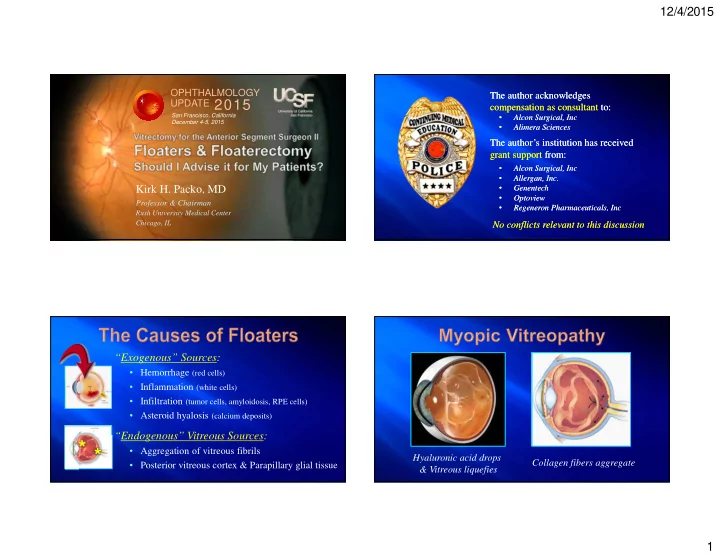
* * Aggregation of vitreous fibrils Hyaluronic acid drops - - PowerPoint PPT Presentation

aggregation of vitreous fibrils hyaluronic acid drops
SMART_READER_LITE
LIVE PREVIEW

* * Aggregation of vitreous fibrils Hyaluronic acid drops - - PowerPoint PPT Presentation

12/4/2015 OPHTHALMOLOGY The author acknowledges The author acknowledges 2015 UPDATE compensation as consultant to: compensation as consultant to: San Francisco, California Alcon Surgical, Inc Alcon Surgical, Inc December 4-5,


slide-1
SLIDE 1

12/4/2015 1

Kirk H. Packo, MD

Professor & Chairman

Rush University Medical Center Chicago, IL

2015

OPHTHALMOLOGY UPDATE

San Francisco, California December 4-5, 2015

The author acknowledges compensation as consultant to: The author acknowledges compensation as consultant to: The author’s institution has received grant support from: The author’s institution has received grant support from:

  • Alcon Surgical, Inc
  • Allergan, Inc.
  • Genentech
  • Optoview
  • Regeneron Pharmaceuticals, Inc
  • Alcon Surgical, Inc
  • Allergan, Inc.
  • Genentech
  • Optoview
  • Regeneron Pharmaceuticals, Inc
  • Alcon Surgical, Inc
  • Alimera Sciences
  • Alcon Surgical, Inc
  • Alimera Sciences

No conflicts relevant to this discussion No conflicts relevant to this discussion

“Exogenous” Sources:

  • Hemorrhage (red cells)
  • Inflammation (white cells)
  • Infiltration (tumor cells, amyloidosis, RPE cells)
  • Asteroid hyalosis (calcium deposits)

“Endogenous” Vitreous Sources:

  • Aggregation of vitreous fibrils
  • Posterior vitreous cortex & Parapillary glial tissue

* *

Hyaluronic acid drops & Vitreous liquefies Collagen fibers aggregate

slide-2
SLIDE 2

12/4/2015 2

Similar to Cotton Candy Sugar Fibers Clumping Weiss Ring & Posterior Vitreous Cortex Weiss Ring & Posterior Vitreous Cortex

Sebag, J

  • Degenerative opacities composed of hydroxyapatite

(calcium soaps & phospholipids)

  • Slight association with diabetes
  • Rarely noticeable to patient – only very rarely justifies

vitrectomy to improve symptoms

  • View in by doctor is much worse than patient’s view
  • Able to see fundus much better with fluorescein

angiography

slide-3
SLIDE 3

12/4/2015 3

Asteroid Ultrasound Asteroid OCT Imaging Optos Imaging Fluorescein Angiography

slide-4
SLIDE 4

12/4/2015 4

  • Blue light (430 nm) is absorbed by RBC’s

in capillaries.

  • Brain "edits out" the shadow lines of the

capillaries by dark adaptation of the photoreceptors lying beneath the capillaries.

  • WBCs do not absorb blue and create gaps in

the blood column

  • WBCs appear as bright dots
  • Focus behind lens with slit lamp
  • Have patient look up + look straight against a

red reflex

  • 78D Biomicroscopy with joystick pulled back
  • Kinetic ultrasonography
  • OCT imaging
  • Kinetic OCT imaging of infrared view

Biomicroscopy

slide-5
SLIDE 5

12/4/2015 5

Kinetic Ultrasonography

BMC Ophthalmol 2015:15:22-24

  • Case report of a large floater

(vitreous cyst)

  • OCT used to qualitate the

impact of the floater on the vision

Clinical Appearance Ultrasound

Patient Drawing

BMC Ophthalmol 2015:15:22-24 OCT Infrared Image 3D Reconstruction Standard OCT showing “ring” scotoma

  • peripheral shadowing

Kinetic OCT

Large Floaters Small Floaters

slide-6
SLIDE 6

12/4/2015 6

  • Floaters are always caused by a PVD
  • Floaters get less noticeable with time

due to gravitational settling

  • Floaters get less noticeable with time

due to neuro-psychological adaptation

  • People who complain of floaters have a

psychologic problem

Am J Ophthalmol 2011:152(1):60-65

  • 266 patients with floaters (age > 21) surveyed and utility value assessed
  • Utility Value:
  • Value 1.0 = “Perfect Health”
  • Value 0.0 = “Death”
  • Metric Used to Calculate Utility Value:
  • Time Trade Off (TTO): Willingness to trade off #years life out of every 10 years

to get rid of problem

  • Standard Gamble (SG): Willingness to risk death or blindness to rid problem

Am J Ophthalmol 2011:152(1):60-65

  • Utility Value of Floaters:
  • Is the same as vision loss from AMD
  • Is lower than diabetic retinopathy or glaucoma
  • Is the same as mild angina, mild stroke, colon cancer, and asymptomatic HIV
  • The same for acute floaters (< 1 month) or chronic floaters (> 1 year), thus do

not become less frustrating with time

  • Unilateral floaters had the same UV as bilateral floaters
  • Time Trade Off (TTO) of Floaters:
  • Willingness to trade off 1.1 years of life out of every 10 years
  • Standard Gamble (SG) of Floaters:
  • Willingness to accept an 11% risk of death and 7% risk of blindness
slide-7
SLIDE 7

12/4/2015 7

  • Absolute size of floaters
  • Floaters in the visual axis
  • Floaters clumped anteriorly near lens
  • Myopia – magnifies the retinal images
  • Multifocal Intraocular Lenses

ReSTOR

Diffractive

Technis

Refractive

  • Often very distraught
  • May be doctor shoppers
  • Shops the internet ~ participates in blogs
  • Professional surgical patient (LASIK, YAG)
  • Young patients more intollerant
  • Often very happy when floaters removed
slide-8
SLIDE 8

12/4/2015 8

  • 143 patients with floaters surveyed
  • 77 (54%) were first time patients

66 (46%) had seen multiple doctors

  • Women & non-myopes most likely doctor shoppers
  • Is doctor shopping related to the patient’s personality
  • r due to doctors not being sympathetic to patient’s

complaint?

  • Int. J. Environ. Res. Public Health 2015, 12, 7949-7958
slide-9
SLIDE 9

12/4/2015 9

1. Observation 2. Refer for psychologic counseling 3. Hyaluronidase (Vitrase™) enzyme 4. Holistic, herbal & other “treatments” 5. YAG laser vitreolysis 6. Vitrectomy

YAG Vitreolysis Vitrectomy

  • Should be tried first, especially with

acute onset of floaters/PVD

  • Consider occupational needs
  • Does it impact any activities?
  • Is the patient phakic?
  • Is there other retinal pathology?’
  • Often does not lessen with time
slide-10
SLIDE 10

12/4/2015 10

  • Patients can train themselves to see

minimal floaters – then become fixated

  • Can possibly train themselves to

disregard them?

  • Anxiolytic medications?
  • Patients usually are very resistant to this

suggestion

  • Vitrase™ - Ovine hyaluronidase
  • FDA approved as a tissue spreading agent
  • Off label use intraocularly
  • Theoretically will decrease hyaluronidase

thus liquefying vitreous allowing floaters to fall inferiorly

  • Study in Mexico showed 10% patients

were made worse

Herbal Eye Drops Ayurvedic Warm Eye Bath Treatments Exercises & Palming Massage Mystery Cure $17

The Silva Healing Method

slide-11
SLIDE 11

12/4/2015 11

  • Minimal evidence on efficacy & safety
  • Not covered by insurance

($2,500 - $5,000 per eye)

  • May require special Q-switched laser
  • Promoted by handful of
  • phthalmologists that do treatment

exclusively; promoted on internet

www.vitreousfloaters.com

  • www. thefloaterdoctor.com

www.EyeFloaters.com

  • Dr. Karickhoff’s book

$225.00

slide-12
SLIDE 12

12/4/2015 12

  • 31 patients (42 eyes) with floaters from PVD underwent

54 procedures with Nd:YAG laser

  • Outcome was “subjective improvement”
  • 38% were “moderately” improved; 61.5% had no improvement
  • 36% underwent subsequent vitrectomy
  • 1 patient developed a retinal detachment

Eye (London) 2002 Jan;16(1):21-6.

  • “FOV” – Floaters Only Vitrectomy
  • Controversial among retinal surgeons
  • More common with small gauge surgery
  • Phakic eyes will develop cataract
  • Balance against other risks of typical

vitrectomy (RD, tears, endophthalmitis, glaucoma)

  • The only true way to remove floaters
slide-13
SLIDE 13

12/4/2015 13

  • 0.44 mm diameter (cf. 20 ga = 0.95 mm)
  • The smallest gauge instrumentation
  • Sclerotomies easily seal without sutures
  • Full complement of instruments

(probe, light, laser, forceps)

  • Produced by multiple companies

Am J Ophthalmol 2011:151:995-998

  • Review of 116 consecutive floaterectomies in Amsterdam, Netherlands
  • Intraoperative Adverse Problems:
  • 16.4% iatrogenic retinal tears
  • 1 case of intraop choroidal hemorrhage (resolved)
  • Postoperative Adverse Problems:
  • 2.5% (n=3) retinal detachment
  • 50% of phakic eyes developed cataract in 1 year
  • 7.8% transient increased IOP
slide-14
SLIDE 14

12/4/2015 14

Graefes Arch Clin Exp Ophthalmol (2013) 251:1373–1382

  • Review of 110 consecutive floaterectomies in Nijmegen, Netherlands
  • 23 ga vitrectomy; assessed for satisfaction, complication, VFQ-25
  • 85% were satisfied or “cured” – 9.3% were dissatisfied
  • Complications:
  • 10.9%

Retinal detachment (4.5% in first 3 months)

  • 5.5%

Cystoid macular edema

  • 3.6%

Epiretinal membrane (macula pucker)

  • 0.9%

Each of: Glaucoma surgery – Macular hole - Scotoma

Graefes Arch Clin Exp Ophthalmol (2013) 251:1373–1382

Complications Outcomes of the Patients with Retinal Detachments

Postop retina tear

Graefes Arch Clin Exp Ophthalmol (2013) 251:1373–1382

Overall Patient Satisfaction after Vitrectomy

Graefes Arch Clin Exp Ophthalmol (2013) 251:1373–1382

Time Troubled by Floaters BEFORE Vitrectomy

slide-15
SLIDE 15

12/4/2015 15

Graefes Arch Clin Exp Ophthalmol (2013) 251:1373–1382

Time Troubled by Floaters AFTER Vitrectomy

Graefes Arch Clin Exp Ophthalmol (2013) 251:1373–1382

Difficulty Reading Small Print Before & After Vitrectomy

Graefes Arch Clin Exp Ophthalmol (2013) 251:1373–1382

Difficulty Driving at Night Before & After Vitrectomy

Graefes Arch Clin Exp Ophthalmol (2013) 251:1373–1382

Would You Recommend Vitrectomy to a Friend with Floaters ?

slide-16
SLIDE 16

12/4/2015 16

Retina 34:1055–1061, 2014

  • Review of 168 consecutive floaterectomies in Birmingham, Alabama
  • 25 ga vitrectomy; assessed for satisfaction, complication, VFQ-25
  • 96% were satisfied or “cured” – 4% were dissatisfied
  • Complications:
  • Intraop or Postop Retinal detachment
  • 1 pt

Transient cystoid macular edema

  • 2 pts.

Transient vitreous hemorrhage

  • 7.1%

Intraoperative retinal breaks - treated

Retina 34:1062–1068, 2014

  • Review of 66 consecutive 25 ga. floaterectomies in California
  • Causes: 80% from PVD; 32% from myopic vitreopathy
  • NO PVD was induced in the 20% not having a PVD preop
  • VFQ was 28% lower in preop floater patients than age matched controls

VFQ improved by 29% after vitrectomy

  • NO cases of retinal tears, RD or infection.
  • Only 24% developed cataract at 15 months (zero below age 53)

Henry CR, Schwartz SG, Flynn HW Clinical Ophthalmology 2014:8 1649–1653

  • 24 y/o female – 20ga floaterectomy
  • Inflammation on 1st postop day
  • Staphylococcus caprae endophthal.
  • Recovered 20/80 vision (from 20/20)
slide-17
SLIDE 17

12/4/2015 17

Simple Vitrectomies? Only happen Over the Rainbow

  • Examine! – Are significant floaters there?
  • Consider Surgery:
  • Has the patient tried a period of observation?
  • Are floaters anterior/clumped behind lens?
  • Is there a multifocal lens?
  • Does the patient have a convincing story/need?
  • Is the patient ready to accept risks?
  • Discourage Surgery:
  • Is the patient phakic?
  • Is there other pathology? (Lattice, High myopia)
  • Already had multiple procedures? (LASIK, YAG Vitreolysis)

Thank You !

OPHTHALMOLOGY

UPDATE

San Francisco, California December 4-5, 2015

slide-18
SLIDE 18

12/4/2015 18