Agents and Environments Example: Vacuum Cleaner Agent Oregon State - - PDF document

agents and environments
SMART_READER_LITE
LIVE PREVIEW

Agents and Environments Example: Vacuum Cleaner Agent Oregon State - - PDF document

Agents and Environments Example: Vacuum Cleaner Agent Oregon State University CS430 Intro to AI Oregon State University CS430 Intro to AI agent: robot vacuum cleaner environment: floors of your apartment sensors: dirt


slide-1
SLIDE 1

1

(c) 2003 Thomas G. Dietterich and Devika Subramanian 20

Oregon State University – CS430 Intro to AI

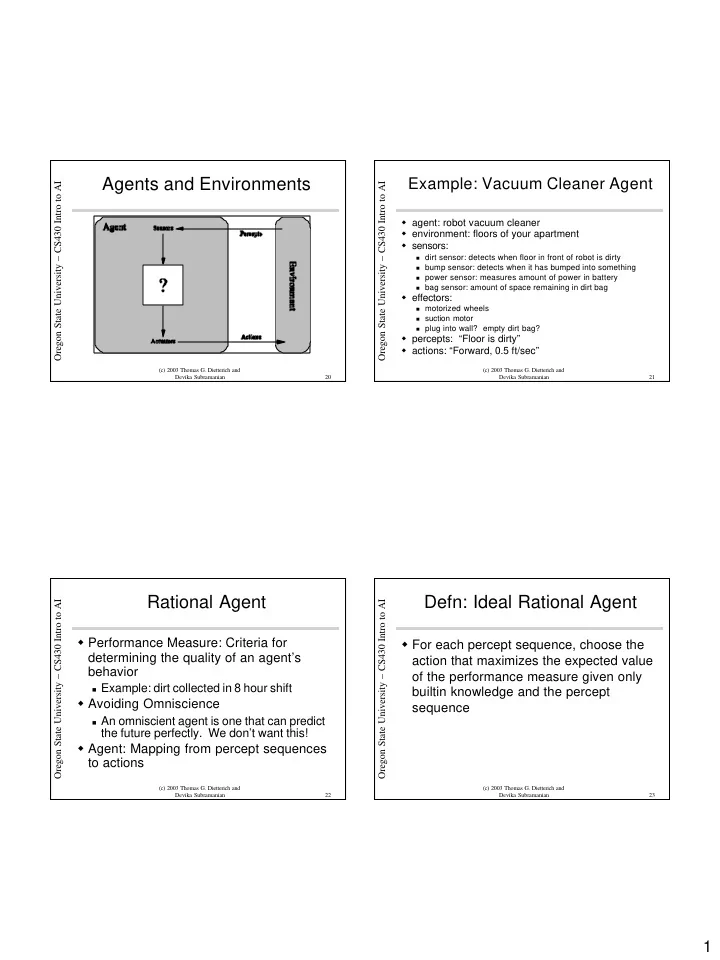
Agents and Environments

(c) 2003 Thomas G. Dietterich and Devika Subramanian 21

Oregon State University – CS430 Intro to AI

Example: Vacuum Cleaner Agent

agent: robot vacuum cleaner environment: floors of your apartment sensors:

dirt sensor: detects when floor in front of robot is dirty bump sensor: detects when it has bumped into something power sensor: measures amount of power in battery bag sensor: amount of space remaining in dirt bag

effectors:

motorized wheels suction motor plug into wall? empty dirt bag?

percepts: “Floor is dirty” actions: “Forward, 0.5 ft/sec”

(c) 2003 Thomas G. Dietterich and Devika Subramanian 22

Oregon State University – CS430 Intro to AI

Rational Agent

Performance Measure: Criteria for determining the quality of an agent’s behavior

Example: dirt collected in 8 hour shift

Avoiding Omniscience

An omniscient agent is one that can predict

the future perfectly. We don’t want this!

Agent: Mapping from percept sequences to actions

(c) 2003 Thomas G. Dietterich and Devika Subramanian 23

Oregon State University – CS430 Intro to AI

Defn: Ideal Rational Agent

For each percept sequence, choose the action that maximizes the expected value

  • f the performance measure given only

builtin knowledge and the percept sequence

slide-2
SLIDE 2

2

(c) 2003 Thomas G. Dietterich and Devika Subramanian 24

Oregon State University – CS430 Intro to AI

Policies

Policy: A mapping from percept sequences to actions Agent programming: designing and implementing good policies Policies can be designed and implemented in many ways:

Tables Rules Search algorithms Learning algorithms

(c) 2003 Thomas G. Dietterich and Devika Subramanian 25

Oregon State University – CS430 Intro to AI

Implementing Agents Using Tables

Problems:

Space: For chess this would require 35100 entries Design difficulty: The designer would have to anticipate how the agent should respond to every possible percept sequence

(c) 2003 Thomas G. Dietterich and Devika Subramanian 26

Oregon State University – CS430 Intro to AI

Avoiding Tables

Compact Representations of the Table. Many cells in the table will be identical.

Irrelevant Percepts: Example: If the car in front of

you slows down, you should apply the breaks. The color and model of the car, the music on the radio, the weather, and so on, are all irrelevant.

Markov Environments: Example: In chess, only the

current board position matters, so all previous percepts dictate the same move. Environments where this is always true are called Markov Environments

(c) 2003 Thomas G. Dietterich and Devika Subramanian 27

Oregon State University – CS430 Intro to AI

Example of Compact Representation: Implementing Agents using Rules

If car-in-front-is-braking then initiate-braking

slide-3
SLIDE 3

3

(c) 2003 Thomas G. Dietterich and Devika Subramanian 28

Oregon State University – CS430 Intro to AI

Avoiding Tables (2)

Summarizing the Percept Sequence

By analyzing the sequence, we can

compute a model of the current state of the

  • world. With this state, the agent can act as

if the world is a Markov environment

Percepts Model

Percept Summarizer Policy

(c) 2003 Thomas G. Dietterich and Devika Subramanian 29

Oregon State University – CS430 Intro to AI

Summarizing Percepts as Environment Model

(c) 2003 Thomas G. Dietterich and Devika Subramanian 30

Oregon State University – CS430 Intro to AI

Pseudo-Code

(c) 2003 Thomas G. Dietterich and Devika Subramanian 31

Oregon State University – CS430 Intro to AI

Goal-Based Agents

  • Generate possible sequences of actions
  • Predict resulting states
  • Assess goals in each resulting state
  • Choose an action that will achieve the goal
  • We can reprogram the agent simply by changing the goals
slide-4
SLIDE 4

4

(c) 2003 Thomas G. Dietterich and Devika Subramanian 32

Oregon State University – CS430 Intro to AI

Goal-Based Agents compute the desired action on demand

In many cases, the agent can compute the desired action rather than looking it

  • up. This trades extra CPU time to

reduce memory.

Example: Deep Blue (c) 2003 Thomas G. Dietterich and Devika Subramanian 33

Oregon State University – CS430 Intro to AI

Example of Computing Table Dynamically

(c) 2003 Thomas G. Dietterich and Devika Subramanian 34

Oregon State University – CS430 Intro to AI

Problems with Computing Table Dynamically

Search space may be exponentially large

Computing the best action may be computationally

intractable

World may change while we are searching

In a dynamic environment, we must act promptly

Knowledge of the world may be incomplete or wrong

We may not be able to accurately predict the future

(c) 2003 Thomas G. Dietterich and Devika Subramanian 35

Oregon State University – CS430 Intro to AI

Utility-Based Agents

In some applications, we need to make quantitative comparisons of states based on utilities. Important when there are tradeoffs.

slide-5
SLIDE 5

5

(c) 2003 Thomas G. Dietterich and Devika Subramanian 36

Oregon State University – CS430 Intro to AI

PEAS Descriptions

P: Performance Measure E: Environment A: Actuators S: Sensors

(c) 2003 Thomas G. Dietterich and Devika Subramanian 37

Oregon State University – CS430 Intro to AI

Examples of agent types

S A E P Agent Type

Keyboard entry Display exercises, suggestions, corrections Set of students, testing agency Maximize student’s score on test Interactive English tutor Camera, joint angle sensors Jointed arm and hand Conveyor belt with parts, bins Percentage of parts in correct bins Part-picking robot Color pixel array Display categorization

  • f scene

Downlink from satellite Correct image categorization Satellite image system Keyboard entry of symptoms, test results, patient’s answers Display questions, tests, diagnoses, treatments, referrals Patient, hospital, staff Healthy patient, minimize costs, lawsuits Medical Diagnosis (c) 2003 Thomas G. Dietterich and Devika Subramanian 38

Oregon State University – CS430 Intro to AI

Different Kinds of Environments

Fully-observable vs. Partially-observable

Fully-observable = Markov

Deterministic vs. Stochastic

Strategic: deterministic except for the actions of

  • ther agents

Episodic vs. Sequential Static vs. Dynamic Discrete vs. Continuous Single agent vs. Multiagent

(c) 2003 Thomas G. Dietterich and Devika Subramanian 39

Oregon State University – CS430 Intro to AI

Examples of Environments

Multi Discrete Dynamic Sequential Stochastic Partially English tutor Single Continuous Dynamic Sequential Stochastic Partially Refinery contr Single Continuous Dynamic Episodic Stochastic Partially Part-picking Single Continuous Semi Episodic Deterministic Fully Image analy Single Continuous Dynamic Sequential Stochastic Partially Medical Dx Multi Continuous Dynamic Sequential Stochastic Partially Taxi driving Multi Discrete Static Sequential Stochastic Fully Backgammon Multi Discrete Static Sequential Strategic Partially Poker Multi Discrete Semi Sequential Strategic Fully Chess w/clock Single Discrete Static Sequential Deterministic Fully Crossword puzzle Agents? Discrete Static Episodic Deterministic Observable Env

slide-6
SLIDE 6

6

(c) 2003 Thomas G. Dietterich and Devika Subramanian 40

Oregon State University – CS430 Intro to AI

Advantages of Simpler Environments

Observable: policy can be based on only most recent percept Deterministic: predicting effects of actions is easier Episodic: Do not need to look ahead beyond end of episode Static: Can afford lots of time to make decisions Discrete: Reasoning is simpler

(c) 2003 Thomas G. Dietterich and Devika Subramanian 41

Oregon State University – CS430 Intro to AI

Learning Agents