
ACAPS Briefing Note: Undocumented returnees in Afghanistan 1 Briefing Note – 27 August 2016
AFGHANISTAN
Undocumented returnees from Pakistan
Need for international assistance
Not required Low Moderate Significant Major
X
Very low Low Moderate Significant Major
Expected impact X
Crisis overview
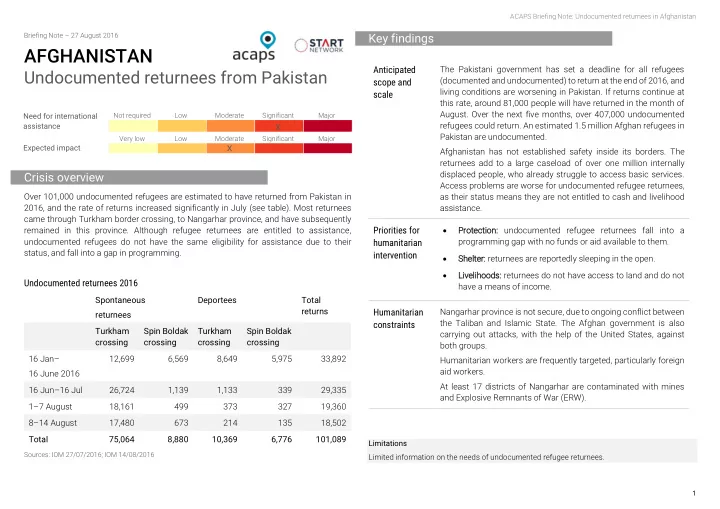
Over 101,000 undocumented refugees are estimated to have returned from Pakistan in 2016, and the rate of returns increased significantly in July (see table). Most returnees came through Turkham border crossing, to Nangarhar province, and have subsequently remained in this province. Although refugee returnees are entitled to assistance, undocumented refugees do not have the same eligibility for assistance due to their status, and fall into a gap in programming.
Undocumented returnees 2016
Spontaneous returnees Deportees Total returns Turkham crossing Spin Boldak crossing Turkham crossing Spin Boldak crossing 16 Jan– 16 June 2016 12,699 6,569 8,649 5,975 33,892 16 Jun–16 Jul 26,724 1,139 1,133 339 29,335 1–7 August 18,161 499 373 327 19,360 8–14 August 17,480 673 214 135 18,502 Total 75,064 8,880 10,369 6,776 101,089
Sources: IOM 27/07/2016; IOM 14/08/2016
Key findings
Anticipated scope and scale
The Pakistani government has set a deadline for all refugees (documented and undocumented) to return at the end of 2016, and living conditions are worsening in Pakistan. If returns continue at this rate, around 81,000 people will have returned in the month of
- August. Over the next five months, over 407,000 undocumented
refugees could return. An estimated 1.5 million Afghan refugees in Pakistan are undocumented. Afghanistan has not established safety inside its borders. The returnees add to a large caseload of over one million internally displaced people, who already struggle to access basic services. Access problems are worse for undocumented refugee returnees, as their status means they are not entitled to cash and livelihood assistance.
Priorities for humanitarian intervention
Pro rotection: undocumented refugee returnees fall into a programming gap with no funds or aid available to them. Sh Shelter: r: returnees are reportedly sleeping in the open. Livelihoods: s: returnees do not have access to land and do not have a means of income.
Humanitarian constraints
Nangarhar province is not secure, due to ongoing conflict between the Taliban and Islamic State. The Afghan government is also carrying out attacks, with the help of the United States, against both groups. Humanitarian workers are frequently targeted, particularly foreign aid workers. At least 17 districts of Nangarhar are contaminated with mines and Explosive Remnants of War (ERW).
Limitations Limited information on the needs of undocumented refugee returnees.