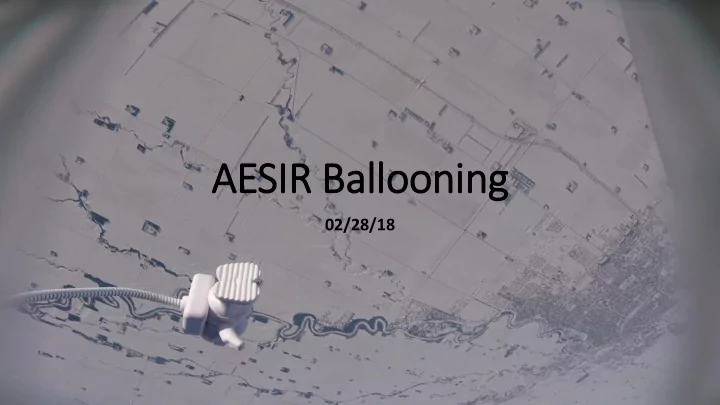
AESIR Ballooning 02/28/18 Updates USIP launches asap HASP- - - PowerPoint PPT Presentation

aesir ballooning
SMART_READER_LITE
LIVE PREVIEW

AESIR Ballooning 02/28/18 Updates USIP launches asap HASP- - - PowerPoint PPT Presentation

AESIR Ballooning 02/28/18 Updates USIP launches asap HASP- waiting for ozone sensor LMAH V habitat launch Pre- fl flight roles Flight prediction Weather File NOTAM Heavy supplies/state vehicles Payloads


slide-1
SLIDE 1

AESIR Ballooning

02/28/18
slide-2
SLIDE 2

Updates

  • USIP launches asap
  • HASP- waiting for ozone sensor
  • LMAH V habitat launch
slide-3
SLIDE 3

Pre- fl flight roles

  • Flight prediction
  • Weather
  • File NOTAM
  • Heavy supplies/state vehicles
  • Payloads
  • Weights
  • Tracking and cameras
  • Sensors
  • Payload integration
slide-4
SLIDE 4

Flight Predictions

  • Run flight predictions 1 week, 3 days, and 1 night before flight
  • Use multiple software (HabHub, Allen Jordan, Stanford, etc)
  • Screenshot and export data
  • After the flight, analyze actual path
  • Always consider weather
  • Save predictions and actual paths
slide-5
SLIDE 5

Weather

  • Monitor forecasts
  • Work with flight predictor
  • Keep track of METARs
slide-6
SLIDE 6

File NOTAM

  • Determine launch location
  • Call NOTAM office 3 days prior to the launch
  • Update NOTAM office if any plans change or if any issues come up

during the fill, launch, or flight

slide-7
SLIDE 7

Heavy Equipment

  • Request state vehicles at least one week before launch
  • Check that helium tanks are full
  • Check the pickup truck bed and oil and gas levels (fill at state vehicle

gasoline station if needed)

  • Driver ID cards?
slide-8
SLIDE 8

Payloads

  • Usually more than one person
  • Build payload boxes (first check if there are any pre- made)
  • Use Styrofoam boxes, vinyl tubing, hot glue, strapping tape
  • Consider the instruments being launched
  • Determine payload box order
  • Payload integration
slide-9
SLIDE 9

Weights

  • Weigh each payload with all equipment and batteries, etc, inside and

label each box with weight (to help determine payload order)

  • Calculate total weight and ensure it is UNDER 11 LBS
  • Determine appropriate balloon and parachute size (see charts)
  • Weigh payloads again after

integration

  • Calculate total final

weight including balloon and parachute weights (payloads <12 lbs

slide-10
SLIDE 10

Tracking and cameras

  • Make sure the Iridium and SPOTs are both working (test outside)
  • Charge Iridium batteries and put fresh AAA or AAAA batteries in the

SPOT

  • Check Go Pro auto record settings and SD cards
  • Charge cameras
  • During the launch, turn on the Iridium, SPOT, and cameras
  • Always wait until the LAST POSSIBLE SECOND for the cameras (GPS

can be turned on in advance)

  • Tape boxes shut
slide-11
SLIDE 11

Sensors

  • Determine which sensors should be flown
  • Determine configuration
  • Test each sensor by letting it run for a minimum of 2 hours, and

check data collected

  • Plug in fresh batteries the morning of

the launch

slide-12
SLIDE 12

Questions?