ADX Energy Ltd Zistersdorf & Gaiselberg Fields AUSTRIAN - - PowerPoint PPT Presentation

adx energy ltd
SMART_READER_LITE
LIVE PREVIEW

ADX Energy Ltd Zistersdorf & Gaiselberg Fields AUSTRIAN - - PowerPoint PPT Presentation

ADX Energy Ltd Zistersdorf & Gaiselberg Fields AUSTRIAN PRODUCTION & APPRAISAL ASSETS Asset Overview - July 2019 www.adxenergy.com.au A stable, predictable cash flow producing asset with infill potential, upside in deeper proven


slide-1
SLIDE 1

ADX Energy Ltd

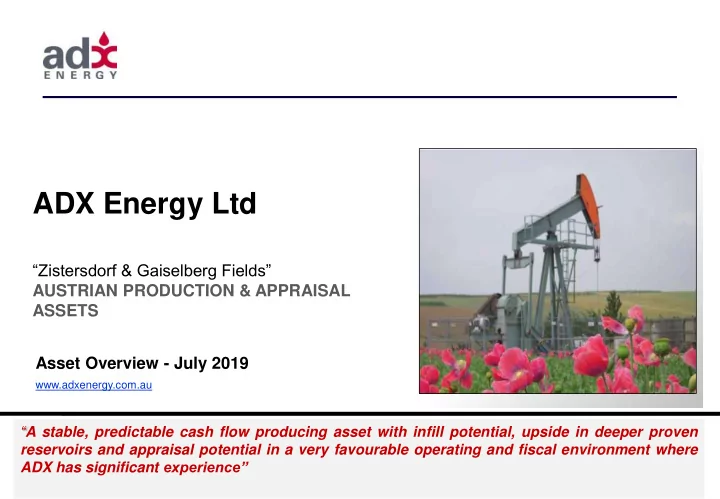
“Zistersdorf & Gaiselberg Fields” AUSTRIAN PRODUCTION & APPRAISAL ASSETS Asset Overview - July 2019

www.adxenergy.com.au

“A stable, predictable cash flow producing asset with infill potential, upside in deeper proven reservoirs and appraisal potential in a very favourable operating and fiscal environment where ADX has significant experience”

slide-2
SLIDE 2

Disclaimer Statement

2

This document has been prepared by ADX Energy Ltd for the purpose of providing information regarding the RAG production asset acquisition to interested analysts/investors and shareholders. Any statements, opinions, projections, forecasts or other material contained in this document do not constitute any commitments, representations or warranties by ADX Energy Ltd or its directors, agents and employees. Except as required by law, and only to the extent so required, directors, agents and employees of ADX Energy Ltd shall in no way be liable to any person or body for any loss, claim, demand, damages, costs or expenses of whatsoever nature arising in any way out of, or in connection with, the information contained in this document. This document includes certain statements, opinions, projections, forecasts and other material, which reflect various assumptions. The assumptions may or may not prove to be correct. ADX Energy Ltd recommends that potential investors consult their professional advisor/s as an investment in the company is considered to be speculative in nature. Persons compiling information about Hydrocarbons. Pursuant to the requirements of the ASX Listing Rule 5.31 the technical and reserves information contained in this release has been reviewed by Paul Fink as part of the due diligence process on behalf of ADX. Mr. Fink is Technical Director of ADX Energy Ltd and is a qualified geophysicist with 23 years of technical, commercial and management experience in exploration for, appraisal and development of oil and gas resources. Mr. Fink has reviewed the results, procedures and data contained in this presentation and considers the resource estimates to be fairly represented. Mr. Fink has consented to the inclusion of this information in the form and context in which it appears. Mr. Fink is a member of the EAGE (European Association of Geoscientists & Engineers) and FIDIC (Federation of Consulting Engineers). ADX has reviewed REP’s Reserves Estimates which are based on field performance and considers them to be conservative and reasonable. Production and Reserves quoted in this release are still under the ownership of REP/RAG. ADX will assume those Reserves, the production and assets upon transfer of licences and closing of the transaction, estimated to be 1 October 2019. At that point, ADX may undertake further assessment of reserves. PRMS Reserves Classifications used in this Report 1P Denotes low estimate of Reserves (i.e., Proved Reserves). Equal to P1. 2P Denotes the best estimate of Reserves. The sum of Proved plus Probable Reserves. 3P Denoted high estimate of Reserves. The sum of Proved plus Probable plus Possible Reserves. Developed Reserves are quantities expected to be recovered from existing wells and facilities. Developed Producing Reserves are expected to be recovered from completion intervals that are open and producing at the time of the estimate. Developed Non-Producing Reserves include shut-in and behind-pipe reserves with minor costs to access. Undeveloped Reserves are quantities expected to be recovered through future significant investments.

  • A. Proved Reserves are those quantities of Petroleum that, by analysis of geoscience and engineering data, can be estimated with reasonable certainty to be

commercially recoverable from known reservoirs and under defined technical and commercial conditions. If deterministic methods are used, the term “reasonable certainty” is intended to express a high degree of confidence that the quantities will be recovered. If probabilistic methods are used, there should be at least a 90% probability that the quantities actually recovered will equal or exceed the estimate.

slide-3
SLIDE 3

Disclaimer Statement (Continued)

3

  • B. Probable Reserves are those additional Reserves which analysis of geoscience and engineering data indicate are less likely to be recovered than Proved

Reserves but more certain to be recovered than Possible Reserves. It is equally likely that actual remaining quantities recovered will be greater than or less than the sum of the estimated Proved plus Probable Reserves (2P). In this context, when probabilistic methods are used, there should be at least a 50% probability that the actual quantities recovered will equal or exceed the 2P estimate.

  • C. Possible Reserves are those additional Reserves that analysis of geoscience and engineering data suggest are less likely to be recoverable than Probable
  • Reserves. The total quantities ultimately recovered from the project have a low probability to exceed the sum of Proved plus Probable plus Possible (3P)

Reserves, which is equivalent to the high-estimate scenario. When probabilistic methods are used, there should be at least a 10% probability that the actual quantities recovered will equal or exceed the 3P estimate. Possible Reserves that are located outside of the 2P area (not upside quantities to the 2P scenario) may exist only when the commercial and technical maturity criteria have been met (that incorporate the Possible development scope). Standalone Possible Reserves must reference a commercial 2P project. Contingent Resources: those quantities of petroleum estimated, as of a given date, to be potentially recoverable from known accumulations but, for which the applied project(s) are not yet considered mature enough for commercial development due to one or more contingencies. 1C, 2C, 3C Estimates: in a probabilistic resource size distribution these are the P90 (90% probability), P50, and P10, respectively, for individual opportunities. Totals are by arithmetic summation as recommended under PRMS guidelines. This results in a conservative low case total and optimistic high case total. Prospective Resources: those estimated quantities of petroleum that may potentially be recovered by the application of a future development project(s) related to undiscovered accumulations. These estimates have both an associated risk of discovery and a risk of development. Further explorations appraisal and evaluation is required to determine the existence of a significant quantity of potentially moveable hydrocarbons. “Low” means a conservative estimate of the quantity that will actually be recovered from the accumulation by the project; there is a 90% probability (P90) that the quantity actually recovered will equal or exceed the best estimate .“Best” means a best estimate of the quantity that will actually be recovered from the accumulation by the project; there is a 50% probability (P50) that the quantity actually recovered will equal or exceed the best estimate. “High” means an optimistic estimate of the quantity that will actually be recovered from the accumulation by the project; there is a 10% probability (P10) that the quantity actually recovered will equal or exceed the best estimate

Additional Information Required under Chapter 5 of the Listing Rules

LR 5.31.1 Material Economic Assumptions The Zistersdorf & Gaiselberg - RAG Fields are located near Zistersdorf in the Vienna basin. The fields consist of two Miocene age clastic high poro-perm reservoir accumulations.The fields are currently producing from conventional reservoirs into optimised and well maintained surface facilities. Production trends and operating cost trends are well established enabling the reliable prediction future production by decline curve analysis, the estimation of future revenue from

  • il and gas sales as well as the forecasting of future costs. Economic life of reserves takes into account oil and gas revenues based on prevailing commodity

pricing as well estimated operating costs, capital costs, royalties and taxes.

slide-4
SLIDE 4

Disclaimer Statement (Continued)

4

These assets conventional assets and Reserves have been calculated in accordance with the SPE PRMS system of reporting as updated in June 2018. Reserves associated with producing wells are Proved Developed as well Proved and Probable Developed have been estimated. Additional value exists in Proved and Probable Developed and Undeveloped Reserves which have been estimated. Proved and Probable Developed and Undeveloped Reserves require further capital investment for infill drilling and side tracks of existing wells to access reserves identified on electric line logs and confirmed through pressure

  • measurement. Further Proved, Probable and Possible Developed and Undeveloped Reserves potential has been identified and estimated in conjunction with the

necessary capital investment. All estimates have been made in accordance with the PRMS system of reporting as updated in June 2018. The reserves estimated are based on a 100% equity interest with only 1% royalty levied on gross production. After the closing date of the reported transaction ADX will become the owner and operator of the fields. Economics used for the calculation of reserves including economic life for the above producing properties are based on the prevailing Brent Oil Price of US$67.00 per barrel flat with a 7.9% quality differential. Operating costs are based on three year historical averages provided by the operator and include the cost of all personnel, maintenance costs, IT control costs and pipeline tariffs. These costs are estimated to be US$ 31 per barrel. Corporate tax is the only other impost in Austria which is levied at a rate of 25% however no license fees are paid for these production licenses.No forward looking valuations are included in this release other than reserves in the Proven and Probable Developed Category. LR 5.31.2 Overview of Operatorship of production Subject to closing of the described transaction. ADX will assume operatorship of the Zistersdorf and Gaiselberg fields following license transfer and closing of the transaction with the asset owner. LR 5.31.3 Types of Permits held by ADX in respect to the reported petroleum Subject to closing of the described transaction. *Subject to Mining Authority Approval. The licenses will be held ADX VIE GmbH a company incorporated in Austria which is a 100% subsidiary of ADX. LR 5.31.4 Basis for Determining Petroleum Reserves All reserves estimates are calculated probabilistically using the relevant PRMS Reserves Classifications. Production trends are predictions of future production determined by decline curve analysis. Oil and gas reserves are expressions of judgement based on experience and industry practice. ADX has had the benefit of the previous Operators extensive data base during due diligence. Estimates valid when originally calculated but may alter significantly when new information or techniques become available.

Mining Plot Name ADX interest* Area (km²) Zistersdorf Field, Vienna Basin, Austria 100% 2,503 Gaiselberg Field Vienna Basin, Austria 100% 2,523

slide-5
SLIDE 5

5

Contents

  • 1. Industry and Country Overview
  • 2. Asset Highlights
  • 3. RAG Fields – Photo Gallery
  • 4. RAG Fields – Fields, Reserves and Resources
  • 5. RAG Fields – Production History and Forecast
  • 6. RAG Fields – Low Risk Resource Upside
  • 7. RAG Exploration Assets – Portfolio Summary
  • 8. RAG FIELDS - Asset Strategy
  • 9. RAG Exploration Assets – Strategy and Potential

Asset Summary

Zistersdorf & Gaiselberg Fields - AN AUSTRIAN PRODUCTION AND APPRAISAL OPPORTUNITY

slide-6
SLIDE 6

Austria is a German speaking EU member country. Total population is around 8.8 million with a country area of 83,900

  • KM2. Large parts of the country are mountainous. Around 2 million

people live in the capital Vienna. The GDP per person with US$ 52,600 is slightly above Germany (source World Bank) and one of the highest in the world. Austria’s primary energy demand is met with oil (40%), gas (25%), hydro (25%) and the remainder from coal and alternative

  • energy. 80% of the gas comes from Russia.

The Austrian economy and industry is supported by politically well connected and powerful lobby groups (“IV” and “WKO”). Foreign investment is highly welcome, despite a lack of deep local capital

  • markets. Around 160 Austrian industrial companies are world –

market or technology leaders in their respective area of

  • perations (source: Wikipedia)

Austria Country Overview

Established Industry, Stable Regulatory Framework & Strong Market Fundamentals

  • Since 1932 Austria has produced approximately 900 MMBBLS of oil and 3 Tcf of

natural gas, currently producing approx. 14,000 BOPD and 120 MMSCFPD gas

  • A modern and environmentally friendly well maintained oil & gas infrastructure with a

dense pipeline network is available. Oil is exclusively transported via pipeline to refineries (Schwechat and Burghausen in Germany)

  • Attractive European gas prices: US $ 8.60 per Mcf (RAG actual wellhead prices)

Attractive Fiscal Terms

  • 15% Oil Royalty Rate and 20% Gas Royalty Rate at current product prices (06/2019)
  • The RAG oil field for sale has ZERO ROYALTY!

Excellent Future Exploration Potential Due to Past Duopoly

  • This is the first time a new player is admitted: OMV and RAG were for almost a

century the only companies exploring for hydrocarbons

  • OMV has only recently acquired a very large Vienna Basin 3D to target large deeper

exploration plays, first successes have been made public

  • After the exit of its main past shareholders Shell and Exxon the new shareholders of

RAG decided to stop exploration and focus on the gas storage and legacy gas production business only.

Austria Oil and Gas Industry Overview

Industry and Country Overview:

Zistersdorf & Gaiselberg Fields - AN AUSTRIAN PRODUCTION AND APPRAISAL OPPORTUNITY

Oil (green) & Gas(red) Fields in Austria Source: GBA

Germany Italy

Exploration Upper Austria Production Vienna Basin Production Vienna Basin
slide-7
SLIDE 7

7

Asset Highlights

Zistersdorf & Gaiselberg Fields - AN AUSTRIAN PRODUCTION AND APPRAISAL OPPORTUNITY

  • Long life production profile (10 years) on a proven reserves case valuation.
  • Multiple pay zones and behind pipe pay zones which have arrested production

decline & provide a robust most likely reserves case valuation.

  • Infill drilling opportunities add substantial reserves potential beyond 1P & 2 P cases

1) Proven production, behind

pipe and infill potential

  • Additional potential confirmed but yet to be exploited resource beneath RAG Fields
  • Large upside value that can be accessed from existing production license position.
  • OMV is pursuing the appraisal play in the basin.
  • Highly profitable appraisal opportunity given existence of production facilities.

2) Deeper discovered

resources accessible from production footprint

  • Well established, optimised and well maintained infrastructure position managed by

very capable and conservative operator.

  • Small but very capable production group to be transferred to ADX.
  • Good working relationship between ADX from previous joint operations in Romania.

3) Established Operations &

infrastructure position. Experienced people.

  • Production connected to existing OMV refinery pipeline network & local gas system.
  • Low Royalty & corporate tax are only imposts.
  • License position includes 2 Mining plots enabling further appraisal.
  • Stable and predictable regulatory system with long history for oil and gas E&P.

4) Excellent pipeline access

and fiscal terms, established license & regulatory position

  • High quality 27 to 33 API crude which achieves a 7.9% discount to Brent Crude.
  • Combination of minimal capex, low royalty, low opex, high value oil and strong gas

price yields highly profitable production.

  • Current break even oil price is US$ 27 per bbl

5) Attractive oil pricing,

low pipeline tariffs access and robust economics

  • Acquisition includes access to large 3D (3660 Km2 ) & 2D (21,300 Km) data set on

preferential basis, existing prospect portfolio & support of RAG to re-gazette acreage.

  • Access to RAG exploration personnel and drilling services (low cost drilling solution)
  • Technical, personnel and operational synergies with ADX Romanian operations
  • Collaboration with RAG in Austria for other production opportunities.

6) Exploration potential with

3D seismic data set. Additional Asset Priority

slide-8
SLIDE 8

8

RAG Fields – Photo Gallery

Zistersdorf & Gaiselberg Fields - AN AUSTRIAN PRODUCTION AND APPRAISAL OPPORTUNITY

Very well maintained and highly optimised sub surface and surface facilities.

slide-9
SLIDE 9

9

Field Summary The Zistersdorf & Gaiselberg - RAG Fields are located near Zistersdorf in the Vienna basin. The fields consist of two Miocene age clastic high poro-perm reservoir

  • accumulations. The fields contain 50 proven reservoirs

which are heavily compartmentalized. ADX believes there is justifiable upside however in the remaining reserves determinations RAG’s conservative estimates have been used. In addition to the proven producing reservoirs an additional almost undrilled Cretaceous (glauconitic sst.) reservoir section exists (Flysch Zone). It is proven to be oil and gas bearing and free flowing in a number of production wells, but is significantly lower poro-perm. It potentially contains significant additional resources which have not been exploited in RAG’s acreage but are proven by nearby OMV field production. RAG Field Reserves Summary Note: The above reserves are estimated probabilistically by RAG at 1 Jan 2019 using the PRMS System, ADX considers them to be conservative based on its own analysis.

RAG Producing Fields and Resources

RAG Fields – Fields, Reserves and Resource Summary

Zistersdorf & Gaiselberg Fields - AN AUSTRIAN PRODUCTION AND APPRAISAL OPPORTUNITY

Map of Gaiselberg field at Sarmation horizon and cross section

X section of Zistersdorf oil and gas field showing the Flysch (glauconitic sand stone)

E0Y2018 Reserves, MMBOE Field P1 P2 P&P P3 P&P&P GA 0,56 0,25 0,81 0,72 1,53

ZDF

0,03 0,14 0,17 0,18 0,35 Total 0,60 0,38 0,98 0,90

1,88

Reserves Summary EOY 2018 of the RAG Fields – Zistersdorf (ZDF) & Gaiselberg

slide-10
SLIDE 10

10

Field History The Zistersdorf & Gaiselberg RAG Fields where discovered in 1937 and 1938 respectively. Field history summarised as follows;

  • from 1938 to 1944 67 wells were drilled and production peaked at

4568 STBP/d in 1942

  • water break through occurred in first wells in 1940
  • from 1945 to 1989 26 additional wells were drilled and water cut

reached approx 80% and production declined to below 1000 STB/d.

  • water injection was introduced in 1972 with production at a 800 –

900 STB/d to 1982 and then approximately 4% decline thereafter

  • since 2016 RAG has been able to arrest decline with minor work
  • vers (perforating behind pipe potential)
  • Current production estimated to be 350 STB/d

Production to Date

  • OIL = 37.6 MMSTB, Gas = 16.6 Bcf, Water = 66.2 MMbbl

Historical Production and Field Properties

RAG Fields – Production History and Forecast

Zistersdorf & Gaiselberg Fields - AN AUSTRIAN PRODUCTION AND APPRAISAL OPPORTUNITY

Production Technology

Fluid and Reservoir Summary

Fluid Data

Oil Gravity (API) 27 33 Oil Viscosity (cP) 3 -20 0.45 -3.5 GOR (scf/bbl) 168 -340 350 -720

Reservoir Data

Depth Range (m) 690 1800 1200 -1960 Net Reservoir Thickness Range (m) 149 -305 60 Average Porosity (%) 24 17 Permeability Range (mD) 125 -870 58

Sarmation Badenian Well Design, Artificial lift and Well Maintenance. Most of the wells are drilled and cased with a 9 5/8” to 13 3/8” surface casing and a 6 5/8” or 7” production casing. The wells are completed with 2 3/8” or 3 ½” production tubing. Production form all but two of the wells pumped with Sucker Rod Pumps (SRP), with two wells fitted with Electric Submersible Pumps (ESP). Maximum gross rates from SRP wells is 650 BPD and 1330 BPD from ESP wells. Produced water is reinjected via 3 pumps that distribute to injection wells with injection pressures of approximately 360 Psi. Well work over’s average approximately 8 interventions per year mostly as a result of pump failures. .

Failure Statistics from 2010 to 2018

slide-11
SLIDE 11

11

The oilfield production facilities are located with in a compact production and facility area. The acquisition includes the 2 Mining plots as well as the existing production, processing and transportation infrastructure. In 2018 production averaged 373 BOEPD, current production is approximately 350 BOPED. The mining rights are royalty free. The operations are efficient and low cost due to an optimised maintenance and integrity strategy. (2018 unit operating cost US$ 31 /bbl)

The assets include 128,000 m2 (approx 34 acres) of land.

Production Facilities Summary

  • ADX is a licensed Exploration and Production Operator in

Romania

  • ADX intends to purchase the assets in a Austrian Subsidiary held

via UK special Purpose Vehicle. The Austrian Subsidiary’s Board will include senior Austrian Oil and Gas executives and ADX management.

  • The RAG Fields acquisition includes 5 full time field personnel, an
  • il field asset manger and 2 office based subsurface -
  • professionals. (all highly experienced with intimate field knowledge) .

Operating Framework and Capability

RAG Fields – Production Assets and Operations

Zistersdorf & Gaiselberg Fields - AN AUSTRIAN PRODUCTION AND APPRAISAL OPPORTUNITY

ADX Energy Ltd

UK SPV

(Terra Energy Limited

Austrian Asset Subsidiary

RAG Fields

100% 100% 100%

Corporate Structure

2 * ADX Executive Directors 2 * ADX Executive Directors & 2 * Austrian E&P Professionals 2 * RAG FTP office & 3 FTP field & 3 contractors

Management and Operational Personnel

Fields Gaiselberg & Zisterdorf (RAG Fields) Production Life 1P Forecast to 2028 Note 1 2P Forecast to 2033 Wells 48 Active (29 Production, 14 Injection, 5 Shut in) Facilities 1 Central Station, 3 separator test stations, 5 manifolds Oil Export Oil export pipeline directly connected to OMV refinery in Schwechat south of Vienna Gas Export Sold to local gas grid

RAG Fields Asset Summary

Note 1 Production Life is determined by the fields economic limit or where

  • perating cash flow at an oil price of US$ 60 per barrel is negative.
slide-12
SLIDE 12

12

1P and 2P Forecast Based on due diligence conducted by ADX the 1P and 2P production forecast generated by RAG is considered to be conservative. The 1P case is essentially a do nothing case however during the last 10 years decline has been arrested to a total decline

  • f 20% through routine work overs accessing behind pipe
  • reserves. Looking forward RAG has identified multiple

behind pipe perforation opportunities accessing additional pay which are likely to match or exceed the RAG 2P profile. As result ADX believes the RAG 2P forecast case is a realistic base case for valuation of the RAG Fields. Infill Potential RAG has also identified a number of credible infill drilling

  • pportunities with in the Gaiselburg Field that have the

potential to increase 2P reserves by approximately 50%. Recovery Factors Based on the historic and projected field performance the ultimate recovery factor for the main reservoirs in the Gaiselburg is 39% where as the main reservoirs in the Zistersdorf field is 33%. Production Life The remaining production life forecast for the 1P case and 2P case are 2028 and 2033 respectively.

Production Life is determined by the fields economic limit or where

  • perating cash flow at an oil price of US$ 65

per barrel is negative.

Field Performance and Remaining Reserves Forecast

RAG Fields – Production Forecast.

Zistersdorf & Gaiselberg Fields - AN AUSTRIAN PRODUCTION AND APPRAISAL OPPORTUNITY

RAG Fields 1P and 2P Production Forecast for oil and gas including both the Gaiselburg and Zistersdorf fields based on the RAG year end 2018 reserves assessment.

Note all forecasts are determined from probabilistic reserves estimations and decline curve analysis from well performance based on actual production history.

1P and 2P Production Forecast

slide-13
SLIDE 13

Technical Justification While the 2P Developed Reserves Case does not carry any reserves additions via side-tracks or new wells several low risk opportunities for resources addition have been identified and worked up by RAG to ready to drill projects by integration of logs, production, pressure and 3D data:

  • 1. Undrained up dip attic oil fault blocks with high initial oil rates
  • 2. Not yet fully developed Badenian reservoirs (slightly deeper and more variable reservoir

quality but low risk for finding low Sw oil)

  • 3. Northern and Eastern part of Gaiselberg field with new development potential

Operational Synergies

  • Additional capacity available in system
  • Additional reserves >>> value increase
  • Additional production >>> lower unit production cost
  • Extension of production life and deferment of abandonment

“Additional High Value Barrel Potential to Enhance Current Production Assets”

13

Infill Drilling Potential (Further Production Potential)

RAG Fields – Low Risk Resource Upside

Zistersdorf & Gaiselberg Fields - AN AUSTRIAN PRODUCTION AND APPRAISAL OPPORTUNITY

Undrained attic oil with no well  2 side track proposals Undrained crestal fault block with at least 0.3 mmbo reserves addition potential

slide-14
SLIDE 14

14

Flysch Zone - Appraisal Opportunity

RAG Fields – Resource Upside (Continued)

Zistersdorf & Gaiselberg Fields - AN AUSTRIAN PRODUCTION AND APPRAISAL OPPORTUNITY Exploration History The Flysch is a Paleogene fine grained deep water sandstone with proven oil. Due to lower permeability and porosity it was historically a secondary target and remains undeveloped. Basin Activity OMV has recently bet heavily on the Flysch exploration potential and acquired in 2018 a very large 3D survey to tap the deep potential. A first deep Flysch well has been drilled by OMV is a significant oil discovery. Resource Potential In Gaiselberg and Zistersdorf the Flysch is already a proven oil producer with 5 wells. It is available at shallow depths (900 meters

  • nwards) and provides the opportunity for relatively large additional

resource potential. Recovery with vertical wells through matrix reservoir is however low and estimated at best with 20%. Oil and gas rates with no water are in the order of 40 bbls/day and 2.5 mmscf/d from 3 meter thin glauconitic sandstones (GA-75). Horizontal wells in combination with (natural) fractures would significantly improve flow rates. Operational Synergies

  • Additional capacity available in system
  • Additional reserves >>> value increase
  • Additional production >>> lower unit production cost
  • Extension of production life and deferment of abandonment

“A Large Proven Resource Addition is Possible” The large in place resource potential

  • f the tight Flysch (green and red for
  • il/gas) was already recognized in

the seventies as the 1972 cross section above through the Zistersdorf (RAG) field shows. The map to the right shows for the GA-75 well the 1st Top Flysch glauconitic sandstone oil bearing

  • area. The historic estimate based on

matrix porosities only was a recovery

  • f 2.2 mmbo/ sqkm/reservoir At least

6 productive sandstone units exist in the thrust sheets of the Flysch zone.

slide-15
SLIDE 15

15

  • Existing value development opportunities in current

RAG Field asset base provides material organic growth potential

Value Development

RAG Fields (Multiple Layers of Value)

The RAG fields provide a footprint from which to develop multiple layers of value enabling ADX to develop a highly profitable and material business. The asset strategy is summarised as follows;

  • 1. Continue to produce the 1P Reserves in an efficient and cost effective manner utilising RAG core personnel.
  • 2. Continue accessing 2P Reserves (including developed behind pipe potential) at minimal cost to arrest production decline,

increase reserves and extend production

  • 3. Add to the Developed reserves base by undertaking infill drilling with in the RAG fields to access undrained compartments.
  • 4. Appraise the resource potential intersected in the deeper Flysch reservoirs beneath the current producing fields

“Maximise the value of RAG Fields and the available infrastructure, by increasing production rates, adding to reserves, reducing unit operating costs and deferring abandonment”.

Asset Strategy

RAG FIELDS Asset Strategy

Zistersdorf & Gaiselberg Fields - AN AUSTRIAN PRODUCTION AND APPRAISAL OPPORTUNITY

Efficiently Produce 1P profile Achieve 2P with ongoing behind pipe work overs Infill drilling

  • pportunities

Flysch Appraisal potential

slide-16
SLIDE 16

16

Exploration Data Set – Upper Austria

RAG Exploration Assets – An Additional Opportunity

Zistersdorf & Gaiselberg Fields - AN AUSTRIAN PRODUCTION AND APPRAISAL OPPORTUNITY

Exploration Portfolio – Upper Austria

RAG has invested around 90 Million Euro over the last decade to acquire state of the art 3D seismic. The large exploration acreage

  • f approx. 6,247 km2 is now covered with approx. 3650 km2 of

modern 3D seismic. This dataset which is available to ADX is key to unlock the remaining potential of a proven oil & gas province. This data also includes all well data and access to a large lead and prospect inventory. It is also a necessary requirement for the exploration license award through the Austrian government authorities. RAG did not relinquish the exploration acreage because of a lack

  • f prospectivity but because of a change in company strategy

which focussed on mature gas production and gas storage only. With the exit of Shell and Mobil as major shareholders exploration was no longer of interest.

Map showing 3D area (grey) and prospects as green or red circles

The exploration portfolio in Upper Austria is approx. 200 kilometres to the west of Zistersdorf – Gaiselberg fields and consists of 19 peer reviewed ready to drill prospects out of which eight have already approved rig site locations, partly with road construction commenced by RAG. In addition to that a large number of 3D covered leads (>30) exists. A number of prospects are drill ready. Since they are all close to infrastructure and producing fields with average dry hole cost in the

  • rder of 3 to 5 MMUSD the economic potential is excellent for low
  • risk. Several independent play types exist.

The portfolio is an excellent balance of low risk near field small sized exploration/ appraisal opportunities (mostly small gas prospects), low to .medium risk 3D covered structural and stratigraphic traps close to well control and a large portfolio of leads in the southern part close to

  • r inside the thrust sheet of the Austrian Calcareous Alps where large

sized anticlines with a large prospective resource potential have been mapped based on 2D seismic or outcrop data.

A B B A

Jurassic & Cretaceous & basement horst blocks Imbricate Thrust play Miocene oil & gas strat & struct. traps Thrust/compressive anticlines

slide-17
SLIDE 17

17

Zistersdorf & Gaiselberg Fields - AN AUSTRIAN PRODUCTION AND APPRAISAL OPPORTUNITY

END OF THIS PRESENTATION