
SLIDE 1
ADVOCACY & COALITION BUILDING
Pennsylvania Immigration and Citizenship Coalition
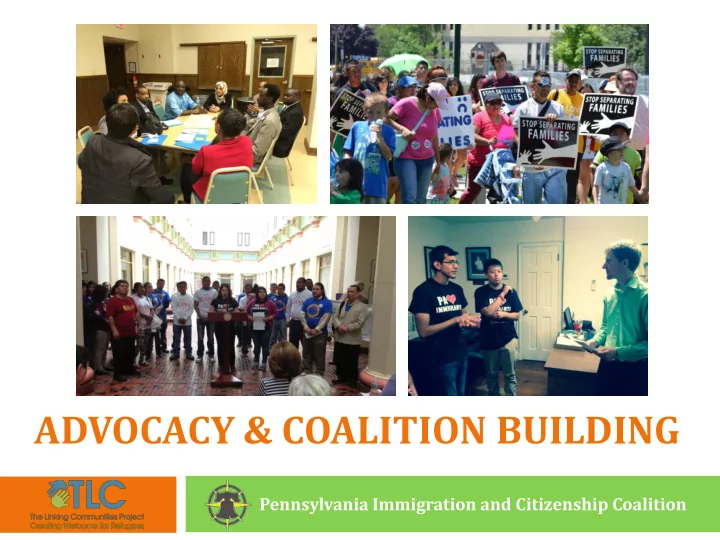
ADVOCACY & COALITION BUILDING Pennsylvania Immigration and - - PowerPoint PPT Presentation
ADVOCACY & COALITION BUILDING Pennsylvania Immigration and Citizenship Coalition Table of Contents Advocacy How-To Guides Visiting Legislators Writing an Op - Ed or Letter to the Editor Petitions and Sign-On Letters
Pennsylvania Immigration and Citizenship Coalition
Advocacy How-To Guides
Visiting Legislators Writing an “Op-Ed” or Letter to the Editor Petitions and Sign-On Letters
Coalition Building
Coalition Basics Coalition Models Examples
Community Organizing Public Education Community Mobilization Educating Legislators Nonpartisan voter mobilization Litigation Lobbying
Know the facts State your message clearly Build relationships Engage the public
Make an
Don’t go alone! Prepare!
Introductions and
Why You Are There Personalize It What You Want Thank You
Research the publication Choose a messenger
Grab attention State your position/Call to action Your evidence Closing
Collecting Signatures
Paper: Ask people to sign at events, go door-to-door, or ask people at a
busy intersection.
Online:
Collects all the signatures in one list to print or deliver all at once Automatically send an email to your target every time someone signs.
Types of Petitions and Sign-On Letters:
Targeted Petition: Addressed to a specific person asking for a specific action. Issue-Based Petition: Shows the level of support for a particular idea or policy proposal.
Deliver a physical copy of the petition and list of signatures. Publish your petition or sign-on letter with the list of
Hold a press conference.
Invite signers to a community meeting to discuss the issue
Ask signers to participate in lobbying efforts to advocate on
Ask signers to attend a meeting with the targeted official
Why build this coalition? What is the purpose of
Do members have a shared vision or shared principles? Which organizations or individuals should be included? What coalition structure would be best? How will the
What resources does the coalition need? How will they
How long should the coalition last?
Communicate openly with all coalition members Choose a realistic strategy and set reachable goals Be inclusive and participatory Acknowledge and use the diversity of the group Agree to disagree in the process Share risks and responsibility Improve trust and communication among
Exchange knowledge, ideas, and strategies
Spokes council: A loose association of organizations;
Collaborative: A collection of organizations formed to
Campaign: A close association of organizations that
Formal Coalition: A stand-alone organization with its
PA is Ready!
Collaborative model
Defined membership structure
Indefinite lifespan – mission oriented
Pennsylvania United for Immigration Reform (PUIR) Pennsylvania Immigration and Citizenship Coalition (PICC)
Campaign model
Loose membership structure
Limited lifespan
Formal coalition model
Formal membership structure
Indefinite lifespan – stand alone organization
For more information about this presentation: Pennsylvania Immigration & Citizenship Coalition 2100 Arch St., 4th Floor Philadelphia, PA 19103 215-832-0636 www.paimmigrant.org Made possible with the support of: