Adverse Selection Borrowers project x i with probability p i C - - PowerPoint PPT Presentation

adverse selection
SMART_READER_LITE
LIVE PREVIEW

Adverse Selection Borrowers project x i with probability p i C - - PowerPoint PPT Presentation

Prologue Stiglitz & Wiess De Meza & Webb Group Lending Ghatak Epilogue Prologue Stiglitz & Wiess De Meza & Webb Group Lending Ghatak Epilogue B ORROWER S P ROJECT & T YPE AND SO ON Adverse Selection


slide-1
SLIDE 1

Prologue Stiglitz & Wiess De Meza & Webb Group Lending Ghatak Epilogue

Adverse Selection

CREDIT & MICROFINANCE

  • Dr. Kumar Aniket

University of Cambridge Lecture 2

c Kumar Aniket 1/28 Prologue Stiglitz & Wiess De Meza & Webb Group Lending Ghatak Epilogue

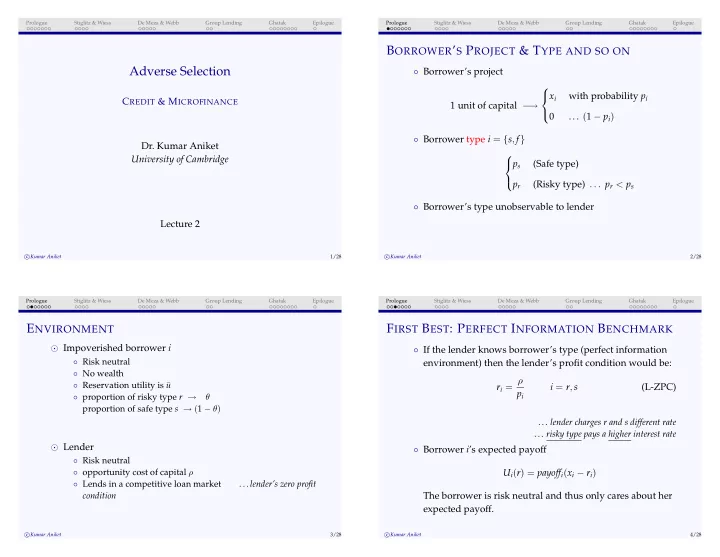
BORROWER’S PROJECT & TYPE AND SO ON

  • Borrower’s project

1 unit of capital − →    xi with probability pi . . . (1 − pi)

  • Borrower type i = {s, f}

   ps (Safe type) pr (Risky type) . . . pr < ps

  • Borrower’s type unobservable to lender

c Kumar Aniket 2/28 Prologue Stiglitz & Wiess De Meza & Webb Group Lending Ghatak Epilogue

ENVIRONMENT

⊙ Impoverished borrower i

  • Risk neutral
  • No wealth
  • Reservation utility is ¯

u

  • proportion of risky type r →

θ proportion of safe type s → (1 − θ)

⊙ Lender

  • Risk neutral
  • opportunity cost of capital ρ
  • Lends in a competitive loan market

. . . lender’s zero profit condition

c Kumar Aniket 3/28 Prologue Stiglitz & Wiess De Meza & Webb Group Lending Ghatak Epilogue

FIRST BEST: PERFECT INFORMATION BENCHMARK

  • If the lender knows borrower’s type (perfect information

environment) then the lender’s profit condition would be: ri = ρ pi i = r, s (L-ZPC)

. . . lender charges r and s different rate . . . risky type pays a higher interest rate

  • Borrower i’s expected payoff

Ui(r) = payoffi(xi − ri) The borrower is risk neutral and thus only cares about her expected payoff.

c Kumar Aniket 4/28

slide-2
SLIDE 2

Prologue Stiglitz & Wiess De Meza & Webb Group Lending Ghatak Epilogue

pi ri piri = ρ ps ¯ p pr rs ¯ r rr θ

1 − θ

c Kumar Aniket 5/28 Prologue Stiglitz & Wiess De Meza & Webb Group Lending Ghatak Epilogue

SOCIALLY VIABLE PROJECT

Socially Viable Project

A project is social viable if the expected output is greater than the social cost, in this case, the opportunity cost of capital and reservation wage in this case. pixi ρ + ¯ u

  • Under perfect information, all socially viable projects are

feasible.

– The lender would offer the borrowers contracts contingent

  • n their type and all borrowers’projects would be funded.

c Kumar Aniket 6/28 Prologue Stiglitz & Wiess De Meza & Webb Group Lending Ghatak Epilogue

SECOND BEST: HIDDEN INFORMATION PROBLEM

If the lender is ignorant of the borrower’s type, he has the following two options. either lend to both type - Pooling Equilibrium . . . both type pay the same pooling interest rate ¯ p = θpr + (1 − θ)ps (loan repayment probability) ¯ r = ρ ¯ p (interest rate)

  • r lend to only one type - Separating Equilibrium

. . . interest rate for the type left in the market . . . Which type do you think this will be? pr or ps (loan repayment probability) rr = ρ pr and rs = ρ prs (resp. interest rates)

c Kumar Aniket 7/28 Prologue Stiglitz & Wiess De Meza & Webb Group Lending Ghatak Epilogue

INTEREST RATE

With the zero profit condition, we only have to check for three interest rates: rs – separating equilibrium with only the safe types ¯ r – pooling equilibrium with both types rr – separating equilibrium with risky types . . . Timeline: Lender would choose the interest rate for the loan contract Borrowers would choose whether to self-select in the loan contract

c Kumar Aniket 8/28

slide-3
SLIDE 3

Prologue Stiglitz & Wiess De Meza & Webb Group Lending Ghatak Epilogue

IMPERFECT INFORMATION: ADVERSE SELECTION

  • Stiglitz & Wiess (1981)

psxs = prxr = ˆ x . . . the expected project outputs (mean) are identical . . . the risky project has a greater spread around mean

  • may lead to a problem of Under-investment

some safe type with socially viable projects, i.e., ˆ x = psxs ¯ u + ρ . . . driven out of the loan market

c Kumar Aniket 9/28 Prologue Stiglitz & Wiess De Meza & Webb Group Lending Ghatak Epilogue

PARTICIPATION CONSTRAINT: STIGLITZ & WIESS

Borrower’s Participation Constraint Ui(rj) = ˆ x − pir ¯ u i = r, s

ˆ x ¯ u Usafe Urisky r c Kumar Aniket 10/28 Prologue Stiglitz & Wiess De Meza & Webb Group Lending Ghatak Epilogue

PARTICIPATION CONSTRAINT: STIGLITZ & WIESS

Borrower’s Participation Constraint Ui(rj) = ˆ x − pir ¯ u i = r, s – Check participation constraint for both types at rs, ¯ r and rs. – Obtain lower threshold of ˆ x at which each type would self-select into the loan contract. Interest rate Safe type Risky type Us(r) = ˆ x − psr ¯ u Ur(r) = ˆ x − prr ¯ u rs = ρ

ps

ˆ x ρ + ¯ u ˆ x pr

ps ρ + ¯

u ¯ r = ρ

¯ p

ˆ x ps

¯ p ρ + ¯

u ˆ x pr

¯ p ρ + ¯

u rr = ρ

pr

ˆ x ps

pr ρ + ¯

u ˆ x ρ + ¯ u

Table: Self-selection condition at three interest rates in the Stiglitz Weiss

c Kumar Aniket 11/28 Prologue Stiglitz & Wiess De Meza & Webb Group Lending Ghatak Epilogue

UNDER-INVESTMENT: EXCLUSION OF THE SAFE TYPE

under-investment type s’s

Socially Viable Projects

Expected Output ρ + u

  • ps

¯ p

  • ρ + u

Figure: Safe type’s under-investment project range

Under-investment: Some safe agents with socially viable projects i.e., ¯ u + ρ < ˆ x < ¯ u + ps ¯ p ρ . . . unable to borrow.

c Kumar Aniket 12/28

slide-4
SLIDE 4

Prologue Stiglitz & Wiess De Meza & Webb Group Lending Ghatak Epilogue

IMPERFECT INFORMATION: ADVERSE SELECTION

  • De Meza & Webb (1987)

psx > prx . . . projects have different mean . . . risky project has a lower mean

  • may lead to a problem of Over-investment

risky type with projects which are not social viable (prx < ¯ u + ρ) may participate in the market at the pooling interest rate.

c Kumar Aniket 13/28 Prologue Stiglitz & Wiess De Meza & Webb Group Lending Ghatak Epilogue

PARTICIPATION CONSTRAINT: DE MEZA & WEBB

Borrower’s Participation Constraint Ui(r) = pi(xi − r) ¯ u i = r, s – Check participation constraint for both types at rs, ¯ r and rs. – Obtain lower threshold of ˆ x at which each type would self-select into the loan contract. Interest rate Safe type risky type Us(r) = psx − psr ¯ u Ur(r) = prx − prr ¯ u rs = ρ

ps

psx ρ + ¯ u prx pr

ps ρ + ¯

u ¯ r = ρ

¯ p

psx ps

¯ p ρ + ¯

u prx pr

¯ p ρ + ¯

u rr = ρ

pr

psx ps

pr ρ + ¯

u prx ρ + ¯ u

Table: Self-selection range at interest rates in the De Mezza Webb

c Kumar Aniket 14/28 Prologue Stiglitz & Wiess De Meza & Webb Group Lending Ghatak Epilogue

UNDER-INVESTMENT: DE MEZZA & WEBB

  • ver-investment

type r’s

Socially Viable Projects

Expected Output

  • pr

¯ p

  • ρ + u

ρ + u Figure: Risky type’s over-investment project range

Over-investment: Risky type agents with projects that are not socially viable (¯ u + ρ > prx > ¯ u + pr

¯ p ρ) are able to

borrow (because they are cross-subsidised by the safe type borrowers).

c Kumar Aniket 15/28 Prologue Stiglitz & Wiess De Meza & Webb Group Lending Ghatak Epilogue

  • ver-investment

type r’s under-investment type s’s

Socially Viable Projects

Expected Output

  • pr

¯ p

  • ρ + u

ρ + u ps

¯ r

  • ρ + u

Figure: Under and Over investment Ranges

  • Under-investment: Range of socially viable projects that are

not viable due to imperfect information ¯ u + ρ < ˆ x < ¯ u + ps ¯ p ρ

  • Over-investment: Range of socially non-Viable projects that

are viable only due to imperfect information ¯ u + pr ¯ p ρ < prx < ¯ u + ρ

c Kumar Aniket 16/28

slide-5
SLIDE 5

Prologue Stiglitz & Wiess De Meza & Webb Group Lending Ghatak Epilogue

INVESTMENT PROBLEM IN A ADVERSE SELECTION FRAMEWORK

⊙ Stiglitz & Webb Under-investment: Safe type unable to borrow for a range of socially viable projects because at high interest rates, only the risky types willing to borrow. ⊙ De Meza & Webb Over-investment: Risky type are able to borrow for a range of non socially viable projects because they are cross-subsidised by the safe type borrowers in a pooling equilibrium.

c Kumar Aniket 17/28 Prologue Stiglitz & Wiess De Meza & Webb Group Lending Ghatak Epilogue

GROUP LENDING WITH JOINT LIABILITY

Definition (Joint-Liability Group-Lending)

Lender lends to a group with the proviso that each borrower’s payoffs contingent on peer’s outcome.

  • Joint-Liability Group-Contract: (r, c)

Definition (Joint Liability Payment: c)

Payment due if the borrower succeeds but her peer fails

Definition (Positive Assortative Matching)

Groups homogenous in the types of borrowers

c Kumar Aniket 18/28 Prologue Stiglitz & Wiess De Meza & Webb Group Lending Ghatak Epilogue

POSITIVE ASSORTATIVE MATCHING

Proposition (Positive Assortative Matching)

Joint Liability contracts lead to positive assortative matching. Uij(r, c) = pipj(xi − r) + pi(1 − pj)(xi − r − c) = pi(xi − r) − pi(1 − pj)c Urs(r, c) − Urr(r, c) = pr(ps − pr)c (1) Uss(r, c) − Usr(r, c) = ps(ps − pr)c (2) (2) > (1)

c Kumar Aniket 19/28 Prologue Stiglitz & Wiess De Meza & Webb Group Lending Ghatak Epilogue

POSITIVE ASSORTATIVE MATCHING AND SOCIAL OPTIMUM

Paper (Ghatak, 1999, 2000)

Joint Liability Group Lending leads to positive assortative matching solves the problems of under and over-investment.

Assumption (Socially Optimal Matching)

Positive assortative matching maximises the aggregate expected payoffs of borrowers over all possible matches Uss(r, c) − Usr(r, c) > Urs(r, c) − Urr(r, c) ((2) > (1)) Uss(r, c)+Urr(r, c) > Urs(r, c)+Urs(r, c) (rearranging)

c Kumar Aniket 20/28

slide-6
SLIDE 6

Prologue Stiglitz & Wiess De Meza & Webb Group Lending Ghatak Epilogue

INDIFFERENCE CURVES

Indifference Curve of borrower type i Uij(r,c) = pi(xi − r) − pi(1 − pj)c = ¯ k dc dr

  • Uii=constant

= − 1 1 − pi s type’s indifference curve steeper

1 1 − ps

  • >

1 1 − pr

  • c

Kumar Aniket 21/28 Prologue Stiglitz & Wiess De Meza & Webb Group Lending Ghatak Epilogue

INDIFFERENCE CURVES OF THE TWO TYPES

Interest rate r Joint Liability c

b

− 1 1 − ps

Safe borrower’s steeper IC

− 1 1 − pr

Risky borrower’s flatter IC

c Kumar Aniket 22/28 Prologue Stiglitz & Wiess De Meza & Webb Group Lending Ghatak Epilogue

LENDER’S PROBLEM

  • Lender offers group contracts (rr, cr) and (rs, cs) which

maximise the borrower’s payoff subject to the following constraint”s: rrpr + cr(1 − pr)pr ρ ⇒ dc dr = − 1 1 − pr (L-ZPCr) rsps + cs(1 − ps)ps ρ ⇒ dc dr = − 1 1 − ps (L-ZPCs) Uii(ri, ci) ¯ u, i = r, s (PCi) xi ri + ci i = r, s (LLCi) Urr(rr, cr) Urr(rs, cs) (ICCrr) Uss(rs, cs) Uss(rr, cr) (ICCss)

c Kumar Aniket 23/28 Prologue Stiglitz & Wiess De Meza & Webb Group Lending Ghatak Epilogue

ABBREVIATIONS

L-ZPCi Lender’s Zero Profit Condition for type i PCi Participation Constraint for type i LLCi Limited Liability Constraint for type i ICCii Incentive Compatibility Constraint for group i, i

c Kumar Aniket 24/28

slide-7
SLIDE 7

Prologue Stiglitz & Wiess De Meza & Webb Group Lending Ghatak Epilogue

SEPARATING EQUILIBRIUM IN GROUP LENDING

⊙ (L-ZPCs) and (L-ZPCr) cross at (ˆ r,ˆ c)

Proposition (Separating Equilibrium)

For any joint liability contract (r, c)

  • i. if rs < ˆ

r, cs > ˆ c, then Uss(rs, cs) > Urr(rs, cs)

  • ii. if rr > ˆ

r, cr < ˆ c, then Urr(rr, cr) > Uss(rr, cr)

  • Safe groups prefer high joint liability payment low interest

rates

  • Risky groups prefer low joint liability payments high

interest rate

  • Different interest rates for different types – back to the

perfect information environment

c Kumar Aniket 25/28 Prologue Stiglitz & Wiess De Meza & Webb Group Lending Ghatak Epilogue

SEPARATING EQUILIBRIUM IN r-c SPACE

Interest rate r Joint Liability c

b b b

A B C D − 1 1 − ps

Safe borrower’s steeper IC

− 1 1 − pr

Risky borrower’s flatter IC

−1 LLC (ˆ r,ˆ c)

c Kumar Aniket 26/28 Prologue Stiglitz & Wiess De Meza & Webb Group Lending Ghatak Epilogue

CONTRACTS

Separating Contract

Safe: Segment BA Risky: Segment AC

Pooling Contract

(ˆ c,ˆ r) at A

Conditions: Projects sufficiently productive to satisfy the Limited Liability Condition (LLC) along respective contract segments.

Under-investment:

Bring back the safe borrowers with socially productive investment.

Over-investment:

Risky borrowers with socially productive investment drop out.

c Kumar Aniket 27/28 Prologue Stiglitz & Wiess De Meza & Webb Group Lending Ghatak Epilogue

CONCLUSIONS

In group lending – joint liability leads to positive assortative matching – the risky and safe group differ in the way they trade-off interest rates and joint liability payments – lender is able to discriminate between the risky and safe groups

  • problem of under and over investment is solved

c Kumar Aniket 28/28