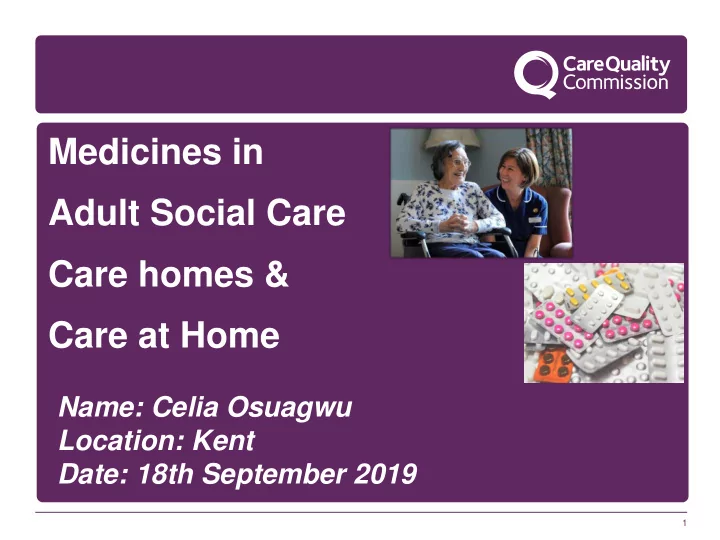
Adult Social Care Care homes & Care at Home Name: Celia - - PowerPoint PPT Presentation

adult social care
SMART_READER_LITE
LIVE PREVIEW

Adult Social Care Care homes & Care at Home Name: Celia - - PowerPoint PPT Presentation

Medicines in Adult Social Care Care homes & Care at Home Name: Celia Osuagwu Location: Kent Date: 18th September 2019 1 2 Our purpose We make sure health and social care services provide people with safe, effective, compassionate,


slide-1
SLIDE 1

1

Medicines in Adult Social Care Care homes & Care at Home

Name: Celia Osuagwu Location: Kent Date: 18th September 2019

slide-2
SLIDE 2

Our purpose

2

  • Register
  • Monitor and inspect
  • Use legal powers
  • Speak independently
  • Encourage improvement
  • Outstanding, Good, Requires

Improvement, Inadequate

  • We make sure health and social care services provide

people with safe, effective, compassionate, high-quality care and we encourage care services to improve

  • People have a right to expect safe, good care

from their health and social care services

slide-3
SLIDE 3

Common areas of risk

slide-4
SLIDE 4

Adult Social Care

Concerns Good practice

Medicines administration errors Using STOMP principles to reduce use of antipsychotic medicines in people with a learning disability and/or autism Record keeping When required medicines Storage and disposal Risk assessed self-administration to promote independence Covert administration Use of ‘red bags’ for safe transfer of care Staff training Governance and policy Self-administration Transfer of care

4

slide-5
SLIDE 5

5

  • 1. Adopt best practice guidance.
  • 2. Consider having a named pharmacist to

support staff.

  • 3. Training and competency assessment should

be an ongoing priority.

  • 4. Clarity around who has ongoing oversight of

medicines.

  • 5. The new nursing associates may help to ease

pressure on nursing staff in care homes.

  • 6. Adopting NHS England initiatives can help

drive improvement.

Recommendations for providers of adult social care

slide-6
SLIDE 6

Key lines of enquiry

To focus our inspection, we use a standard set of key lines of enquiry (KLOEs) that relate to the five key questions KLOEs support consistency of what we look at under each of the five key questions and focus on those areas that matter most KLOEs are supported by guidance on the key things to consider as part of the assessment; these are called prompts Each KLOE has a defined set of ratings characteristics – what does ‘good’ look like? S4: How does the provider ensure the proper and safe use of medicines?

6

slide-7
SLIDE 7

Medicines key lines of enquiry

S4.1: Is the provider’s role in relation to medicines clearly defined and described in relevant policies, procedures and training? Is current and relevant professional guidance about the management of medicines followed?

  • Policies should be service specific, reflect practice be in date,

read by and accessible to staff.

  • NICE guidance: SC1 for care homes / NG67 for people living

in their own homes.

  • Appropriate training, support and competency assessment is

essential to ensure the safety, quality and consistency of care.

7

slide-8
SLIDE 8

Medicines key lines of enquiry

S4.2: How does the service make sure that people receive their medicines (both prescribed and non-prescribed) as intended (including controlled drugs and as required medicines), and that this is recorded appropriately?

  • Medicines records – MARs, controlled drugs, topical
  • Treatment of minor ailments
  • Additional guidance for when required medicines and those

with variable doses

  • What adjustments are made for time sensitive medicines?
  • Compliance aids vs original packs

8

slide-9
SLIDE 9

Medicines key lines of enquiry

S4.3: How are medicines ordered, transported, stored, and disposed of safely and securely in ways that meet current and relevant regulations and guidance?

  • Responsibility for ordering and collecting medicines.
  • Secure or controlled access to medicines in care homes.
  • Suitable storage.
  • Safe disposal of unwanted medicines including controlled

drugs

9

slide-10
SLIDE 10

Medicines key lines of enquiry

S4.4: Are there clear procedures for giving medicines covertly, in line with the Mental Capacity Act 2005?

  • Assessment that person lacks capacity to make decisions

about medicines.

  • Best interest meeting to consider each individual medicine

– should be the last resort.

  • Discussion with pharmacy about how to administer safely

and ensure continued effectiveness.

10

slide-11
SLIDE 11

Medicines key lines of enquiry

S4.5: How does the service make sure that people’s behaviour is not controlled by excessive or inappropriate use of medicines?

  • Inappropriate use of sedation.
  • Good care planning to anticipate behavioural patterns

and environmental adjustments.

  • Records, care plans and staff guidance for when

required medicines.

11

slide-12
SLIDE 12

Medicines key lines of enquiry

S4.6: How do staff assess the level of support a person needs to take their medicines safely, particularly where there are difficulties in communicating, when medicines are being administered covertly, and when undertaking risk enablement assessments designed to promote self- administration?

  • Assumption that people can self-administer unless

preference or risk assessment says otherwise.

  • Medicines support – person centred, medicine specific.
  • How do staff decide if a person needs to be given their

medicines covertly? Is it always a last resort?

12

slide-13
SLIDE 13

Medicines key lines of enquiry

S4.7: How does the service engage with healthcare professionals in relation to reviews of medicines at appropriate intervals?

  • Supporting people to attend appointments and

reviews.

  • Contacting the GP to arrange a medicines review.
  • Knowing when to refer to healthcare professionals.

13

slide-14
SLIDE 14

Medicines key lines of enquiry

S4.8: How do staff make sure that accurate, up to date information about people’s medicines is available when people move between care settings? How do medicines remain available to people when they do so?

  • Medicines reconciliation.
  • New medicines.
  • Entry into new care services.
  • Discharge from hospital.

14

slide-15
SLIDE 15

Medicines Incidents

  • Home care providers must have robust processes

for medicines-related safeguarding incidents

  • Home care providers should have robust

processes for identifying, reporting, reviewing and learning from medicines-related problems.

  • These processes should support a person-

centred, 'fair blame' culture that actively encourages people and/or their family members or carers and home care workers to report their concerns.

15

slide-16
SLIDE 16

Audit

  • Care home providers should have a robust audit

process.

  • Audit should be completed in a timely manner.
  • Audit tools should be specific to the service and

reflect the policies in use.

  • Where issues are identified there should be an

action plan in place to address the issues and the action plan should be reviewed.

16

slide-17
SLIDE 17

What can you do?

  • Keep up to date with NICE guidelines and other sources
  • f best practice.
  • Talk to other providers – share best practice.
  • Use your medicines experts:
  • Medicines Optimisation Team
  • Community Pharmacy
  • GP practice

17

slide-18
SLIDE 18

Resources for providers and staff

Medicines FAQs available on CQC website Email Medicines.enquiries@cqc.org.uk

slide-19
SLIDE 19

CQC medicines team FAQs available on our website: http://www.cqc.org.uk/ascmedicinesfaq

ASC Medicines FAQs

  • Administering medicines covertly
  • Administering medicines in home care

agencies

  • Administering medicines safely via enteral

feeding tubes

  • Disposing of medicines in care homes and care

homes with nursing

  • Dysphagia and thickening powders
  • External medicines
  • Fluid administration charts
  • High risk medicines: anticoagulants
  • High risk medicines: insulin
  • High risk medicines: lithium
  • Managing oxygen in care homes
  • Managing time-sensitive medicines
  • Medicines for seizures
  • Medicines reconciliation and medication review
  • Medicines requiring fridge storage
  • Medicines support from home care agencies
  • Medicines: training and competency in adult

social care settings

  • Optimising medicines during end of life care
  • Ordering, transporting, storing and disposing
  • f medicines by home care agencies
  • Polypharmacy and deprescribing
  • Reporting medicine-related incidents in social

care

  • Self-administered medicines in care homes
  • Storing controlled drugs in care homes
  • Storing medicines in residential services
  • Treating minor ailments and promoting self-

care in adult social care

  • Using multi-compartment compliance aids

(MCAs) in care homes

  • When required (PRN) medicines
slide-20
SLIDE 20

www.cqc.org.uk Medicines.enquiries@cqc.org.uk Celia Osuagwu Pharmacist Specialist

20

Thank you

20