ADSL Surasak Sanguanpong nguan@ku.ac.th - - PDF document

adsl
SMART_READER_LITE
LIVE PREVIEW

ADSL Surasak Sanguanpong nguan@ku.ac.th - - PDF document

1/6 ADSL Surasak Sanguanpong nguan@ku.ac.th http://www.cpe.ku.ac.th/~nguan Last updated: 9 Feb 2001 Applied Network Research Group Department of Computer Engineering, Kasetsart University 2/6 What is ADSL?


slide-1
SLIDE 1

Applied Network Research Group Department of Computer Engineering, Kasetsart University 1/6

ADSL

Surasak Sanguanpong nguan@ku.ac.th http://www.cpe.ku.ac.th/~nguan

Last updated: 9 Feb 2001 Applied Network Research Group Department of Computer Engineering, Kasetsart University 2/6

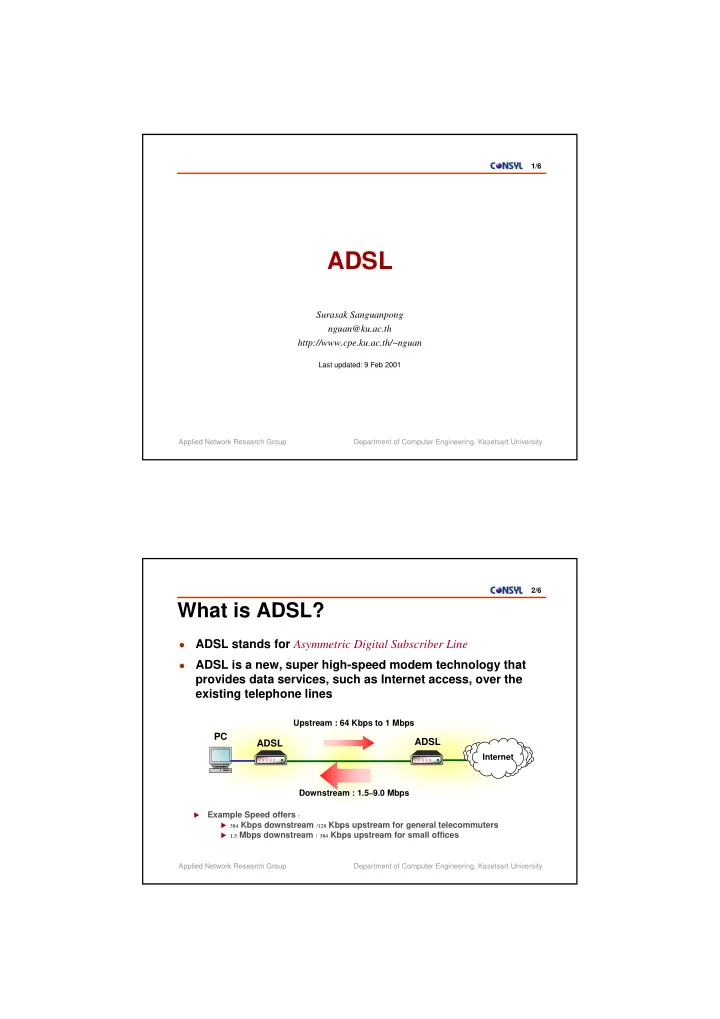
What is ADSL?

  • ADSL stands for Asymmetric Digital Subscriber Line
  • ADSL is a new, super high-speed modem technology that

provides data services, such as Internet access, over the existing telephone lines

PC ADSL ADSL

Internet Downstream : 1.5–9.0 Mbps Upstream : 64 Kbps to 1 Mbps

  • Example Speed offers :

384 Kbps downstream /128 Kbps upstream for general telecommuters 1.5 Mbps downstream / 384 Kbps upstream for small offices

slide-2
SLIDE 2

Applied Network Research Group Department of Computer Engineering, Kasetsart University 3/6

ADSL

High speed communications over twisted pair. Originally standardized in ANSI T1 in 1993.

ADSL Modem CO

  • Concurrent with plain
  • ld telephone service

(POTS)

  • Is always terminated at

the central office (CO).

Telephone and ADSL service can be used simultaneously

Applied Network Research Group Department of Computer Engineering, Kasetsart University 4/6

Modem and ADSL

PC Server modem modem

Line card filters determine bandwidth

PC Server ADSL

Local loop determines bandwidth

ADSL

4 KHz Voice Channel Data limited to 33.6 Kbps <1 MHz bandwidth data rate up to 52 Mbps depend on distance

slide-3
SLIDE 3

Applied Network Research Group Department of Computer Engineering, Kasetsart University 5/6

Typical ADSL System Configuration

??? ATU-R

POTS Splitter

PSTN

DLSAM Class 5 Switch Telco Central Office User

POTS Splitter

  • DSLAM — Digital Subscriber Line Access Multiplexer. A concentrating platform for DSL modems
  • ATU-C — ADSL transmission unit in CO. It refers to ADSL modems housed in DSLAMs.
  • ATU-R — ADSL transmission unit in remote (customer) locations. It refers to ADSL CPE.

ATU-C ATU-C ATU-C

ATM

Internet Telco Backbone

Applied Network Research Group Department of Computer Engineering, Kasetsart University 6/6

Typical ADSL Network

??? ATU-R

Radius Server

Internet

DLSAM PPP Connection

ATM

Router PC

slide-4
SLIDE 4

Applied Network Research Group Department of Computer Engineering, Kasetsart University 7/6

xDSL Family

DSL

HDSL HDSL SDSL SDSL ADSL ADSL VDSL VDSL RADSL RADSL

1.544/2.048 Mbps symmetric two twisted-pair wires to achieve full duplex 1.544/2.048 Mbps symmetric single line version

  • f HDSL, echo cancellation is employed

1.5–9.0 Mbps, asymmetric Single line over POTS Current View 13–52 Mbps, asymmetric (A very fast version of ADSL for short length) ADSL based technology with different data rate depending on the type communications

High bit rate Digital Subscriber Line Single Data line Digital Subscriber Line Asymmetric Digital Subscriber Line Very High Bit Rate Digital Subscriber Line Rate Adaptive Asymmetric Digital Subscriber Line

Applied Network Research Group Department of Computer Engineering, Kasetsart University 8/6

Speed shrinks with distance

10 20 30 40 50 3 6 9 12 15 18 VDSL ADSL Dominant impairment—Attenuation Attenuation increases with distance and frequency Secondary impairments—Cross Talk, Impulse noise, Bridged Taps Distance in kft of 24 (.5 mm) ga wire

  • ADSL has a range of downstream speeds

achievable depending on the distance and wire gauge.

slide-5
SLIDE 5

Applied Network Research Group Department of Computer Engineering, Kasetsart University 9/6

ADSL Spectrum

POTS

4 kHz 1.104 MHz

  • bandwidth is split into three information channels:

high-speed downstream channel, medium-speed duplex (upstream) channel conventional voice channel

Upstream Downstream Only 0-4 Khz is used for POTS Upstream utilizes lower frequencies to take advantage of reduced near end cross talk (NEXT) at CO Downstream uses as much of the remaining bandwidth as it can

Applied Network Research Group Department of Computer Engineering, Kasetsart University 10/6

Echo-Cancelled ADSL

ADSL can be used in either an echo-cancellation

(EC) or frequency division multiplexing (FDM)

POTS Upstream Downstream POTS Upstream Downstream Less useable downstream bandwidth but more simpler implementation More of downstream bandwidth is in the higher quality part of the spectrum

slide-6
SLIDE 6

Applied Network Research Group Department of Computer Engineering, Kasetsart University 11/6

Bands for ADSL

POTS

25.875 1.104

ADSL uses Discrete Multitone DMT signaling in up-

and downstream

  • Consists of up to 256 4.3125 KHz channels, each containing

a QAM modem (each QAM modem has a 4 KHz symbol rate)

133.68

1 2 3 4 5 6 7

4.135

31 32 256

Upstream (25 channels) Downstream (224 channels)

Applied Network Research Group Department of Computer Engineering, Kasetsart University 12/6

Compute ADSL Bit Rate

  • Bit rate = 224*60 Kbps=13.44 Mbps
  • Practical use : 500Kbps to 8 Mbps

Upstream : 25 channels

POTS Upstream Downstream

  • Bit rate = 25*60 Kbps=1.5 Mbps
  • Practical use : 64Kbps to 1 Mbps

Downstream : 224 channels For each 4 KHz channel, max rate is equal to 4

Khz*15=60 Kbps

slide-7
SLIDE 7

Applied Network Research Group Department of Computer Engineering, Kasetsart University 13/6

Bits per Channel Allocation

SNR can be continuously monitored and have the

bit loading table adjusted

Frequency response f f Input Output # of bits per Hertz f 1415 14 13 11 8 # of bits per Hertz

Bit rate = 4KHz*(14+15+14+13+11+8) =300 KHz

Applied Network Research Group Department of Computer Engineering, Kasetsart University 14/6

DMT Tra

QAM QAM QAM

DMT with N channels Bit 1 Bit 2 Bit N N bits Data QAM modulation with 0-15 bits per baud per Hertz

slide-8
SLIDE 8

Applied Network Research Group Department of Computer Engineering, Kasetsart University 15/6

Splitterless ADSL

Splitterless DSL, a subset of ADSL service. No splitter, hence low cost and easy to install G.992.2 standard, also known as G.Lite standard ATU-R

No Splitter

ATM PSTN

DLSAM Class 5 Switch

POTS Splitter

ATU-C ATU-C ATU-C

Applied Network Research Group Department of Computer Engineering, Kasetsart University 16/6

G.lite Spectrum

G.Lite technical aspects Utilizes only up to 577.875KHz (98 channels) Each bin limited to 8 bits per symbol Max data rate = 4KHz*8*98=3.136 Mbps Practical use : 1.5 Mbps/ 128 Kbps

POTS Upstream Downstream

133.6875 577.8750 1104.0 G.DMT G.DMT G.lite G.lite

slide-9
SLIDE 9

Applied Network Research Group Department of Computer Engineering, Kasetsart University 17/6

Problem of Splittlerless

Applied Network Research Group Department of Computer Engineering, Kasetsart University 18/6

Microfilter

slide-10
SLIDE 10

Applied Network Research Group Department of Computer Engineering, Kasetsart University 19/6

ITU Study Group 15 Standards Activities

ITU Study Group 15

G.dmt G.dmt G.lite G.lite G.hdsl G.hdsl G.hs G.hs G.oam G.oam A full-rate (6 to 8 Mbps) ADSL standard based on ANSI T1.413 Issue 2 A sub-rate (384 Kbps to 1.5 Mbps) ADSL standard which typically will require no splitter An HDSL standard based on ANSI and ETSI standards A handshaking standard, describe the start-up protocol and signaling for identification of xDSL capabilities and negotiation of the operating modes A standard which will identify the requirements for a control channel for operations and maintenance for xDSL modems G.test G.test A standard which will define a network model and procedures for testing xDSL modems