ADA Initiatives: City of Dunbar ADA Transition Plan Please Note: - - PowerPoint PPT Presentation
ADA Initiatives: City of Dunbar ADA Transition Plan Please Note: This presentation does not provide any formal guidance or legal advice Topics of Discussion History of the ADA, PROWAG and ADAAG Basic components of Transition
Please Note:
This presentation does not provide any formal guidance or legal advice
Topics of Discussion
- History of the ADA, PROWAG and ADAAG
- Basic components of Transition Plans/Self-Evaluations
- Overview of Dunbar’s ADA Transition Plan
ADA Background
Passed by Congress in 1990, the Americans with Disabilities Act (ADA) is the nation's first comprehensive civil rights law addressing the needs of people with disabilities, prohibiting discrimination in employment, public services, public accommodations, and telecommunications.
ADA Background
Components of the ADA:
- Title I- Employment
- Title II- State and Local Governments
- Title III- Public accommodations and private entities
- Title IV-Telecommunications
- Title V- Miscellaneous
ADA Background
Title II (State and Local Governments):
- U.S. Department of Justice (USDOJ) enforces and regulates
- Section 504 of the Rehabilitation Act of 1973 states that
programs and facilities funded with federal money must be accessible
- All programs and new/altered facilities must be accessible
Discussion
- Training sessions or seminars relating to ADA?
- Self-Evaluation/Transition Plan Timeline
- Self-Evaluations were due over 20 years ago (requirement for all public
agencies)
Did You Know?
- 18.8%: Of West Virginia’s population is disabled (the nation’s highest)
- National Average: 12%
Did You Know?
ADA improvements benefit everyone
- Non-compliance can lead to adverse consequences
- Resources on some significant court cases can be found online
Legal Examples
- Barden v. City of Sacramento
- Regarding access to the city’s sidewalks, settled in
2004
- City originally agreed to settle, then failed when
attempted an appeal
Barden v. Sacramento
- Failed to install curb ramps, or to maintain them
- Additionally for refusal to remove obstacles from
sidewalks such as benches, wires protruding from walkways, etc.
- Refused to develop transition plan as required by law
Barden v. Sacramento
- The settlement ordered the city to dedicate 20% of its
transportation funds for 30 years for ADA improvements
- Additionally, payments of legal fees & restitution of
approximately $1 million
Project Civic Access
- Program created and enforced by the U.S. Department of
Justice
- Originated in 1999, now has all 50 states, D.C. and PR
PROWAG Background
Public Right-of-Way Accessibility Guidelines= “PROWAG” (Used as guidance for the design and construction of buildings and
- ther facilities)
PROWAG Background
The PROWAG has not yet been adopted, it is still in Draft form It has been in draft form since the early 2000’s, several versions have since been published.
ADAAG
- ADA Accessibility Guidelines, (ADAAG)
- Published in 1991
- Details scoping and technical requirements to be applied during
the design, construction, and alteration of buildings and facilities covered by titles II and III of the ADA
PROWAG vs. ADAAG
* ADAAG does not provide guidance on modifications such as
sidewalks, curb ramps, etc.
The Process
Self-Evaluations
- Must be readily available and on file for inspection
- Identifies existing deficiencies and necessary modifications
- Continual Process- How so?
Self-Evaluations
What is not in compliance…?
Focus on providing maximum accessibility to the highest feasible
extent
Never interested in “minimums” Includes evaluating current policies and procedures
- Were to have been initiated and accomplished by July 26, 1995
- One of the first documents that would be requested in the event
- f a complaint
Self-Evaluations
Online Resources for Self-Evaluations
- ADA “Checklist for Existing Facilities”
http://www.adachecklist.org/checklist.html
- FHWA - “Federal-aid Essentials for Local Public Agencies, Self-
Evaluation Basics” https://www.fhwa.dot.gov/federalaidessentials/catmod.cfm?id=33
- www.adata.org – Great resource for ADA guidance
Transition Plans
- Purpose: To establish necessary actions to complete
modifications/alterations
- Also provides a schedule for completion
- Entails prioritization process for planned improvements
Transition Plans Designation of an ADA Coordinator Provide public notice Adopt a grievance procedure Conduct a self-evaluation Develop/adopt transition plan
Transition Plans
Prioritization Process:
- Modifications must be prioritized
- Criteria for this process can be found online
- Include modifications that align with planned alterations
such as utility work, paving, streetscape, etc.
- “Town of Calico Rock, ADA Transition Plan”
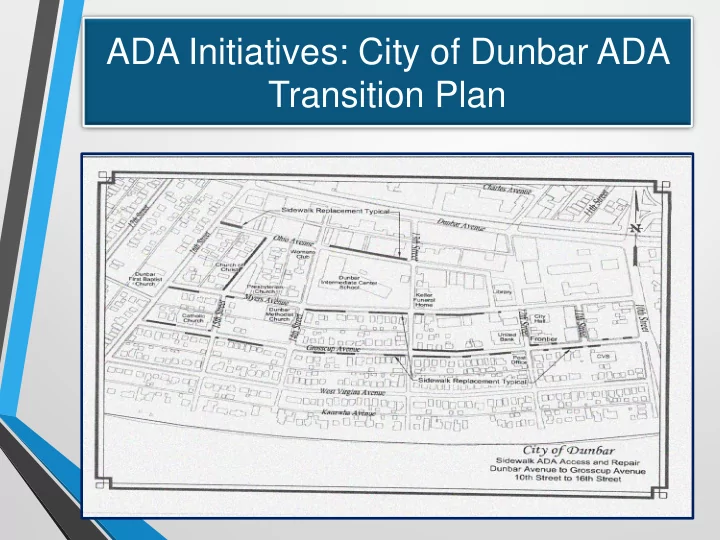
ADA Transition Plan for the City of Dunbar, West Virginia
City of Dunbar-Transition Plan
- Completed and scheduled alterations and modifications in conjunction with
- ngoing Streetscape projects
- Worked with city officials throughout the process
- Good influence on surrounding municipalities to take action
- The City of Dunbar recently completed and adopted their ADA Transition Plan
and Self-Evaluation
- Designated City’s Mayor as ADA Coordinator, common practice for smaller
municipalities
Sidewalk Replacement and ADA Curb Access
Totals
Example of a Type A Curb Improvement
Labeled as type “A”, “B” or “C”
Example of Curb Ramp Classification
Additional Resources
- U.S. DOJ’s “ADA Guide for Small Towns” (2000)
- www.ada.gov
- www.access-board.gov
- www.adainfo.org
- www.adata.org