Activity of Astrophysics in Hiroshima Group, led by T.Ohsugi - - PowerPoint PPT Presentation

activity of astrophysics in hiroshima
SMART_READER_LITE
LIVE PREVIEW

Activity of Astrophysics in Hiroshima Group, led by T.Ohsugi - - PowerPoint PPT Presentation

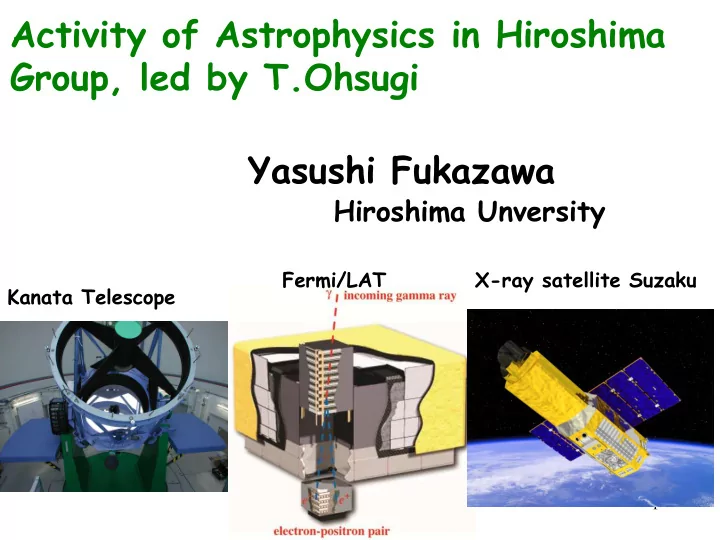
Activity of Astrophysics in Hiroshima Group, led by T.Ohsugi Yasushi Fukazawa Hiroshima Unversity Fermi/LAT X-ray satellite Suzaku Kanata Telescope 1 Observational Astrophysics Group in Hiroshima Univ. 2000- Gamma-ray and X-ray


slide-1
SLIDE 1

Activity of Astrophysics in Hiroshima Group, led by T.Ohsugi

Hiroshima Unversity

Yasushi Fukazawa

1

Kanata Telescope Fermi/LAT X-ray satellite Suzaku
slide-2
SLIDE 2

Observational Astrophysics Group in Hiroshima Univ. 2000- Gamma-ray and X-ray Observation Group T.Ohsugi, Y.Fukazawa(, T.Kamae) 2004- Hiroshima Astrophysical Science Center T.Ohsugi, K.Kawabata As of 2011

Gamma-ray,X-ray T.Ohsugi, Y.Fukazawa, T.Mizuno, H.Takahashi, M.Ohno Optical T.Ohsugi, M.Yoshida, K.Kawabata, M.Uemura, H.Akitaya Pos Doc 2 Graduate students D 8, M 12 Undergraduate students 7

slide-3
SLIDE 3

3

slide-4
SLIDE 4

4

T.Ohsugi Particle Physics, Detector Y.Fukazawa X-ray observation, Detector K.Kawabata Optical observation, Detector Persons with different backgrounds are collaborating. Ohsugi-san said, You should not confine to a specific wavelength

  • bservation. A final goal is to understand astrophysical

phenomena, so multi-wavelength observation is essential. We should utilize all the available observatory as much as possible.

slide-5
SLIDE 5

Kanata Telescope (2006-) Fermi/LAT (2008-) X-ray satellite Suzaku (2005-)

Multi-wavelength Observation in Hiroshima Group

High-energy astronomical phenomena

Unique in Japan

slide-6
SLIDE 6

Radio Optical X-ray GeV TeV

Crab Nebula Optical X-ray

Multi-wavelength Spectra

Multi- wavelength

  • bservation is

important !

slide-7
SLIDE 7

High-energy objects are variable.

7

Gamma-ray Sky with Fermi/LAT.

slide-8
SLIDE 8

GN

HEASARC

  • DELTA

7920H

  • White Sands

TDRSS SN S & Ku

LAT Instrument Science Operations Center GBM Instrument Operations Center GRB Coordinates Network

  • Telemetry 1 kbps
  • S

Alerts Data, Command Loads Schedules Schedules

Mission Operations Center (MOC) Science Support Center

  • m

sec

  • Fermi Spacecraft

Large Area Telescope & GBM GPS

MISSION ELEMENTS

8

slide-9
SLIDE 9

9

e

+

e–  Activity for Fermi/LAT Development and Fabrication of Silicon Strip Sensors Balloon Flight Experiment Beam Test @CERN Data Monitor (after launch) Data Analysis (after launch)

slide-10
SLIDE 10

in 9500 SSD×384 strips=3.7M strips Extremely low rate of dead strip 0.008% Very High Quality Stable Performance Development and Production of Silicon Strip Detectors By Hiroshima Univ. and HPK About 10,000 SSDs

~2.5 nA/cm2 ~65 V = 9 kWcm

Important contribution of Japan Leak Current Full-depletion voltage

Supported by KEK US-J Collabo Fund, MEXT…

slide-11
SLIDE 11

Certificate of Appreciation from NASA to T.Ohsugi (2005)

slide-12
SLIDE 12

12

  • Prof. T.Ohsugi retired from School of Science,

Hiroshima University (2008 March), just before launch. T.Ohsugi continues his activity as a head of Higashi- Hiroshima Observatory.

Final Lecture of T.Ohsugi

slide-13
SLIDE 13

13

GLAST/Fermi launch 2008 June Press Conference

slide-14
SLIDE 14

14

Fermi/LAT Collaboration Meeting in Hiroshima (2009 March)

slide-15
SLIDE 15

15

Higashi-Hiroshima Observatory and Kanata Telescope

2000 Hiroshima University proposed to receive the optical telescope in NAOJ and utilize it to observe GLAST(Fermi) gamma-ray objects.

  • T. Ohsugi
  • T. Muta

(President of Hiroshima U. in 2001-2006)

2002 Task force team of movement started the activity. Measurement of Observational Seeing Strong Support from Higashi-Hiroshima city 2004 Decision of movement

slide-16
SLIDE 16

Higashi-Hiroshima Observatory(東広島天文台)

  • Found in 2006
  • Only 20 min by car from campus (503m above sea level
  • Better weather condition and seeing relatively within Japan

Hiroshima Univ. Higashi Hiroshima Observatory

Osaka Kyoto Okayama OAO Hiroshima HHO

Red: Sunny >2000hr/yr

slide-17
SLIDE 17

Kanata Telescope

1.5m diameter Optical/Near Infrared

(the 4th largest in Japan、2nd among University)

  • Very fast speed of pointing

 Observe transient objects (gamma-ray bursts,

AGNs,…)

2011/8/5 17

slide-18
SLIDE 18

– Driving/control system replaced – Speed up of telescope pointing (1deg/s ⇒ 5deg/s in azimuth) 30 seconds in average to take to finish pointing to the next object – Automatic focus switching system – (New ceramic secondary mirror)  Capable of prompt observation of GRB, etc. Originally constructed as a simulator of Subaru telescope in 1994 at Mitaka campus, NAOJ Before moved to Hiroshima,

renewal Kanata Telescope

slide-19
SLIDE 19

2011/8/5 19

Subaru Telescope Kanata Telescope

slide-20
SLIDE 20

Telescope and Instruments

TRISPEC: 2006-2011 HONIR : 2011-

1 Optical band + 2 Near-IR bands (simultaneously) Imaging: FoV 7′×7′(T) 10′×10′(H) Spec: R~150, 150, 360(T) ~300(H) ImagPol/SpecPol (3-4 shots necessary)

High Speed-readout spectrograph

FoV: 2.3’×2.3′ Wavelength res.: R = λ/Δλ = 9-70(400-800nm)、 150(430-690nm) ~30 frames/sec

Cassegrain Nasmyth#2 HOWPol 2009-

Imaging: FoV 15′Φ ImagPol: One-shot type wide-f: 7′(GRB-AG) narrow-f: 1′×15′ Spec: R~400(400-1050nm)

Nasmyth#1

slide-21
SLIDE 21

X-ray Observatory: Suzaku (ASTRO-E1,E2) satellite The 5th Japanese X-ray Observatory

340mm 340mm BGO Diode GSO Photomultiplier + pre-Amplifier

TOP VIEW CROSS-SECTION

57 10 8 60 40 60 57

Well Unit Side Anti Unit Corner Anti Unit Passive Fine Collimator

60 25.5 25.5 4 40

320

340mm

380mm

2mmt Si-PIN Diode (HPK) GSO/BGO phoswich counter

HXD(Hard X-ray Detector) Launch 2005

slide-22
SLIDE 22

22

The 6th Japanese X-ray Observatory

ASTRO-H (2014-) HXI SGD

Talk by Ohno, Hayashi, Saito in this conference

DSSD APD (HPK) Si-Pad APD (HPK) CCD(HPK) ΔE=4eV

slide-23
SLIDE 23

Mis V1436 PKS 0215+015 QSO 0324+341 QSO 0454-234 OJ49 QSO 1239+044 3C 279 PKS 1502+106 PKS 1510-089 3C 454.3 1ES 0323+022 1ES 0647+250 1ES 0806+524 Mrk 421 ON 325 PG 1553+113 H 1722+119 Mrk 501 1ES 1959+650 PKS 2155-304 1ES 2344+514 PKS 0048-097 S2 0109+224 3C 66A PKS0422+004 S5 0716+714 PKS 0754+100 OJ 287 ON 231 PKS 1749+096 3C371 AO 0235+164 S5 1803+784 BL Lac PKS1222+216 PX J1542.8+612 S4 0954+65 3EG 1052+571 4C 14.23 FSRQ LBL IBL HBL Unknown

Active Galactic Nuclei with Jets Kanata monitored.

slide-24
SLIDE 24

FSRQ 3C 279

Abdo et al. 2010. Nature

MJD -5400 [day]

Gamma-ray Flux Gamma-ray Index X-ray Flux Optical Flux Polarization degree Polarization angle NIR flux Radio flux

Kanata found a rotation of polarization vector, associated with Gamma-ray flare. Suggested Bending Jet

slide-25
SLIDE 25

Discovery of Giant gamma-ray lobe

2M light year

Moon

Centaurus A Gamma-ray Image

Abdo+10, Science (One of Contact Authors: Y.Fukazawa)

slide-26
SLIDE 26

Abdo+10

Suzaku X-ray Spectra

Spectra became harder in 2009 than in 2005, suggesting an additional hard component.

2005 2009 Jet?

COMPTEL (1991-1995) Fermi (2008-2009)

Suzaku (2009)

Fukazawa+11

Fermi Error circles Radio Galaxy; Centaurus A

slide-27
SLIDE 27

27

min MQG (GeV/c2) 1016 1017 1018 1015 1.8x10¹⁵

Pulsar (Kaaret 99)

0.9x10¹⁶ 1.8x10¹⁷ 0.2x10¹⁸ 4x10¹⁶

GRB (Ellis 06) GRB (Boggs 04) AGN (Biller 98) AGN (Albert 08)

GRB080916C Planck mass 1019 1.5x10¹⁸ 1.2x10¹⁹ GRB090510 1.6x10¹⁹

Gamma-ray Burst

Constrain the Quantum Gravity Effect With Fermi/LAT, from the delay of high-energy gamma-ray time

Gamma-ray Energy

Abdo+09, Nature (One of contact authors: M.Ohno)

slide-28
SLIDE 28

Suzaku, HXD-WAM Swift HXD-WAM

340mm 340mm BGO Diode GSO Photomultiplier + pre-Amplifier

TOP VIEW CROSS-SECTION

57 10 8 60 40 60 57

Well Unit Side Anti Unit Corner Anti Unit Passive Fine Collimator

60 25.5 25.5 4 40 320

340mm

380mm

HXD-WAM

(Wide-band All-sky Monitor)

Gamma-ray bursts (150/year) Solar Flares Transient Sources

Ohno+06

slide-29
SLIDE 29

29

Uehara+11

Kanata observations of Gamma-ray burst afterglows Polarization

slide-30
SLIDE 30

30

Yamanaka et al. 2009

Light curve Spectra

Kanata observations of SuperNovae

slide-31
SLIDE 31

i~45 deg i~75 deg

H.Takahashiet al. PASJ 60, S69 (2008) Makishima et al. PASJ 60, in press

Best-fit nuFnu spectral models determined with Suzaku

Compton cloud Accretion disk

Suzaku observations of black-hole, newtron star binaries

slide-32
SLIDE 32

32

Multi-wavelength Observation in Hiroshima University was activated, led by T.Ohsugi, and is now nicely going on. We thanks T. Ohsugi, and we are going to continue and extend our activities.