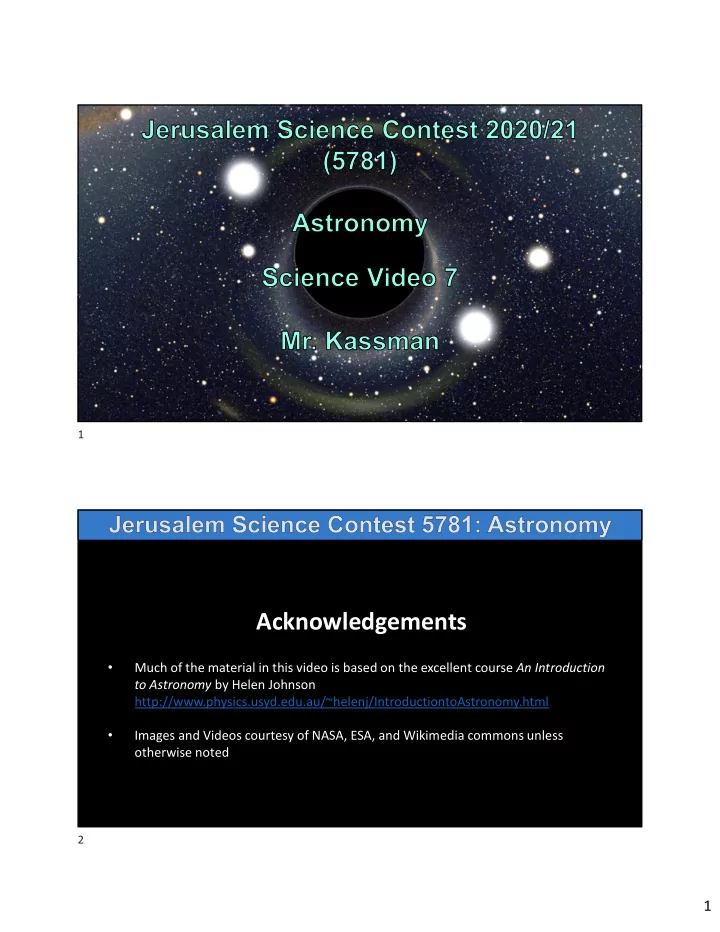
Acknowledgements Much of the material in this video is based on the - - PDF document

acknowledgements
SMART_READER_LITE
LIVE PREVIEW

Acknowledgements Much of the material in this video is based on the - - PDF document

1 Acknowledgements Much of the material in this video is based on the excellent course An Introduction to Astronomy by Helen Johnson http://www.physics.usyd.edu.au/~helenj/IntroductiontoAstronomy.html Images and Videos courtesy of NASA,


slide-1
SLIDE 1

1

Acknowledgements

  • Much of the material in this video is based on the excellent course An Introduction

to Astronomy by Helen Johnson http://www.physics.usyd.edu.au/~helenj/IntroductiontoAstronomy.html

  • Images and Videos courtesy of NASA, ESA, and Wikimedia commons unless
  • therwise noted

1 2

slide-2
SLIDE 2

2

“Death” of Stars

  • Initial mass of ~0.6 Msun to 8 Msun

White Dwarf Black Dwarf

  • Initial mass of ~8 Msun to 25 Msun

Neutron Stars (Pulsars)

  • Initial mass > ~25 Msun

Black Holes

image courtesy of Nick Strobel at www.astronomynotes.com

3 4

slide-3
SLIDE 3

3

Black Holes

Escape Velocity

5 6

slide-4
SLIDE 4

4

Escape Velocity

  • Greater distance (R) means

lower escape velocity

  • Larger mass (of large object)

means higher escape velocity

  • Black hole is matter so dense that the escape velocity is greater than the

speed of light

  • Not even light can escape!
  • This occurs for everything within a certain distance of the singularity –

the Schwartzchild Radius

7 8

slide-5
SLIDE 5

5

How do we detect black holes?

9 10

slide-6
SLIDE 6

6 Supermassive black holes at the centers of galaxies

11 12

slide-7
SLIDE 7

7

13 14

slide-8
SLIDE 8

8

Gravitational Lensing

15 16

slide-9
SLIDE 9

9

17 18

slide-10
SLIDE 10

10

Now the first real image of a black hole, from the Event Horizon Telescope (EHT)

19 20