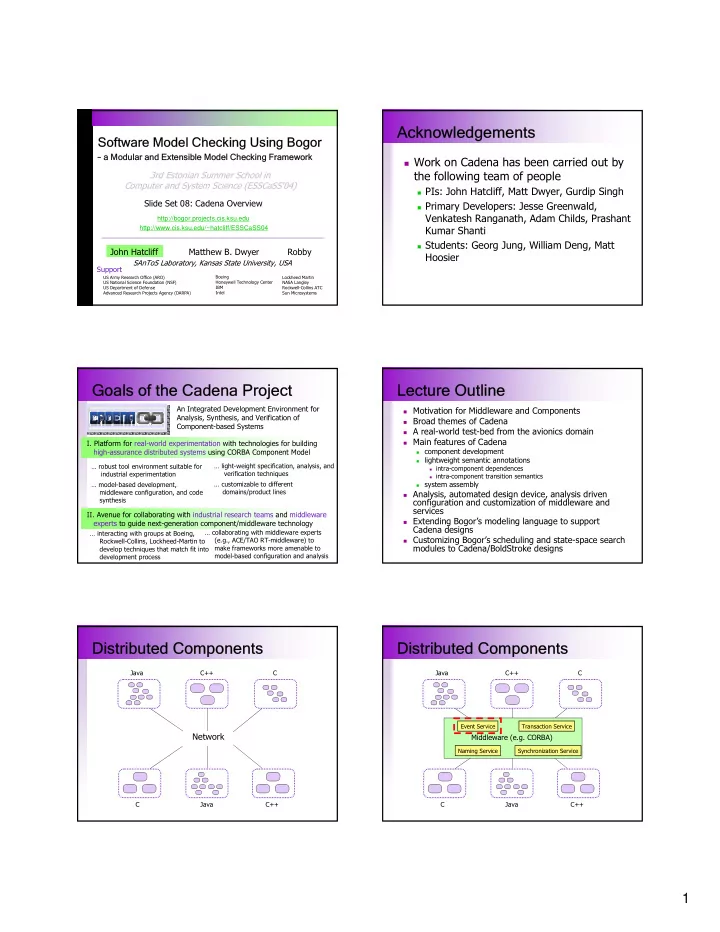
Acknowledgements Acknowl edgements Software M So ftware Mode - - PDF document

acknowledgements acknowl edgements
SMART_READER_LITE
LIVE PREVIEW

Acknowledgements Acknowl edgements Software M So ftware Mode - - PDF document

Acknowledgements Acknowl edgements Software M So ftware Mode odel Check Checking Us ng Using Bogor ng Bogor a Mod Modular an r and E Extensible Model Model Che Checking ng F Frame amework Work on Cadena has been carried out


slide-1
SLIDE 1

1

So Software M ftware Mode

  • del Check

Checking Us ng Using Bogor ng Bogor

– a Mod

Modular an r and E Extensible Model Model Che Checking ng F Frame amework

SAnToS Laboratory, Kansas State University, USA

http://bogor.projects.cis.ksu.edu

US Army Research Office (ARO) US National Science Foundation (NSF) US Department of Defense Advanced Research Projects Agency (DARPA) Boeing Honeywell Technology Center IBM Intel Lockheed Martin NASA Langley Rockwell-Collins ATC Sun Microsystems

Support

Slide Set 08: Cadena Overview Matthew B. Dwyer John Hatcliff Robby

http://www.cis.ksu.edu/~hatcliff/ESSCaSS04

3rd Estonian Summer School in Computer and System Science (ESSCaSS'04)

Acknowl Acknowledgements edgements

Work on Cadena has been carried out by

the following team of people

PIs: John Hatcliff, Matt Dwyer, Gurdip Singh Primary Developers: Jesse Greenwald,

Venkatesh Ranganath, Adam Childs, Prashant Kumar Shanti

Students: Georg Jung, William Deng, Matt

Hoosier

Goal Goals of the Cadena s of the Cadena Project Project

  • I. Platform for real-world experimentation with technologies for building

high-assurance distributed systems using CORBA Component Model

… light-weight specification, analysis, and verification techniques … model-based development, middleware configuration, and code synthesis

An Integrated Development Environment for Analysis, Synthesis, and Verification of Component-based Systems

… robust tool environment suitable for industrial experimentation … customizable to different domains/product lines

  • II. Avenue for collaborating with industrial research teams and middleware

experts to guide next-generation component/middleware technology

… interacting with groups at Boeing, Rockwell-Collins, Lockheed-Martin to develop techniques that match fit into development process … collaborating with middleware experts (e.g., ACE/TAO RT-middleware) to make frameworks more amenable to model-based configuration and analysis

Lecture Outline Lecture Outline

Motivation for Middleware and Components Broad themes of Cadena A real-world test-bed from the avionics domain Main features of Cadena

component development lightweight semantic annotations

intra-component dependences intra-component transition semantics

system assembly

Analysis, automated design device, analysis driven

configuration and customization of middleware and services

Extending Bogor’s modeling language to support

Cadena designs

Customizing Bogor’s scheduling and state-space search

modules to Cadena/BoldStroke designs

Distri Distributed Components buted Components

Network

Java C++ C C++ Java C

Distri Distributed Components buted Components

Middleware (e.g. CORBA)

Event Service Transaction Service Naming Service Synchronization Service

Java C++ C++ C Java C

slide-2
SLIDE 2

2

Obj Objects To Components cts To Components

  • Consider: group of objects

working together to provide a service to clients

  • Objects are meant to be used

“as a team”

  • unit of composition
  • No language mechanism to
  • identify components as a

single group

  • explicitly define interfaces
  • explicitly define dependences
  • n other ‘groups’
  • Harder for 3rd parties to reuse

and assemble

Client Client Client

Obj Objects To Components cts To Components

Components collects

related classes together to form a coarser-grain composable unit Client Client Client

Interfaces provided Interfaces provided Events published Events published

Components explicitly

define interfaces they provide to their clients

Components indicate the

  • ther interfaces/events

they depend on

Interfaces and event required Interfaces and event required

Considerable auto-coding

functionality provide

Checki Checking CCM Systems ng CCM Systems

Middleware (e.g. CORBA)

Event Service Transaction Service Naming Service Synchronization Service Java C++ C++ C Java C

Modern Software Systems Issues

These systems are huge! Extensive use of OO

patterns & software layering

What are appropriate

abstractions for formal reasoning?

How can we help developers

write them?

Useful properties? How must conventional

model-checking engines be extended?

Component-based Desi Component-based Design gn

Cadena development environment allows model-based development of Bold Stroke applications using the CORBA Component Model (CCM)

Component Development Component Development CCM Component

Input event port Output event port

Event Ports

Require an interface Provide an interface

Interface Ports

Component Development Component Development

Development of

component interfaces using CCM Interface Definition Language

Automatic generation of

component infrastructure code using CCM IDL compilers

Development of core

functional code (business logic) using Eclipse Java facilities

CCM Component Interface

Core functional code written by component developer Core functional code written by component developer Component infrastructure implementation Component infrastructure implementation Automatic code generation Automatic code generation

Leverage CORBA IDL Leverage CORBA IDL

Component Implementation Stubs & Skeletons

IDL Compiler

+

dependen dependencydef a cydef aul t ul t == no == none; ne; dependen dependenci es { ci es { i nDat aA i nDat aAvai l ab vai l abl e l e

  • >
  • >
  • ut Dat
  • ut Dat aAvai l

aAvai l abl e; abl e; } behavi or { behavi or { i f ( m

  • de

i f ( m

  • de==enab

==enabl ed) { l ed) { push ou push out Dat aA t Dat aAvai l ab vai l abl e; l e; el se el se … }

Dependency Annotations Transition System Semantics Dependency Analysis and Model-checking Engine

Model Builder

slide-3
SLIDE 3

3

Incremental Speci Incremental Specificati ation

port action dependencies

Increasing Effort & Strength of Verification

Specifications Component Structure

state-based dependencies

…only in mode Y Y

component transition semantics

…state machines give abstract behavior refinement refinement

Component Integration Component Integration

Multiple views for allocating component instances and connecting components together to form a system assembly

Component Integration Component Integration

Model Model-based Programming based Programming

Many system elements – configuration of communication services, setting of QoS properties, etc. – are programmed by selecting particular attribute values at the model level.

Programming at a higher level of abstraction… Programming at a higher level of abstraction…

communication service communication service

event

priority priority distribution location distribution location

Connection Attributes Component Attributes

Mode Model- l-leve level Ana l Analys ysis is

event

priority priority distribution location distribution location …analysis-driven synthesis

  • f attribute values based
  • n heuristics

…up to 1000 components! Analysis facilities provides multiple forms of a design-level slicing, chopping, etc. and model-checking of global temporal properties.

Various analyses guide system development… Various analyses guide system development…

Connection Attributes Component Attributes

communication service communication service

Packagi Packaging & Depl ng & Deployment

  • yment

Package Package

Network

CORBA Middleware

Event Service Transaction Service Naming Service Synchronization Service

Deploy Deploy

<CONFIGURATION_PASS> <HOME> <…> <COMPONENT> <ID> <…></ID> <EVENT_SUPPLIER> <…events this component supplies…> </EVENT_SUPPLIER> </COMPONENT> </HOME> </CONFIGURATION_PASS> <CONFIGURATION_PASS> <HOME> <…> <COMPONENT> <ID> <…></ID> <EVENT_SUPPLIER> <…events this component supplies…> </EVENT_SUPPLIER> </COMPONENT> </HOME> </CONFIGURATION_PASS>

XML-based Configuration and Deployment information

automatic generation

CCM Deployment Infrastructure CCM Deployment Infrastructure

Lecture Outline Lecture Outline

Motivation for Middleware and Components Broad themes of Cadena A real-world test-bed from the avionics domain Main features of Cadena

component development lightweight semantic annotations

intra-component dependences intra-component transition semantics

system assembly

Analysis, automated design device, analysis driven

configuration and customization of middleware and services

Extending Bogor’s modeling language to support

Cadena designs

Customizing Bogor’s scheduling and state-space search

modules to Cadena/BoldStroke designs

slide-4
SLIDE 4

4

Av Avionics Mission ionics Mission Cont

  • ntrol Systems

rol Systems Av Avionics Mission ionics Mission Cont

  • ntrol Systems

rol Systems

  • Mission-control software for Boeing

military aircraft

  • Boeing’s Bold Stroke Avionics

Middleware

  • …built on top of ACE/TAO RT CORBA
  • Provided with an Open Experimental Platform (OEP) from Boeing
  • a sanitized version of the real system
  • 100,000+ lines of C++ code (including RT CORBA middleware)
  • 50+ page document that outline development process and describe

challenge problems

  • Must provide…
  • tool-based solutions that can be applied by Boeing research team to

realistic systems

  • solutions that fit within current development process, code base, etc.
  • metrics for that allow Boeing research team to evaluate tool

performance and ease of use

Control-Push Data-Pull Control-Push Data-Pull

Component A computes some data that is to be read by one or more components Bi

Typical situation

A B1 Bk

Run-time Actions

A publishes a dataAvailable event Bi call the getData() method of A to fetch the data

dataAvailable dataAvailable getData()

Depending on current state, component may not fetch data Depending on current state, component may not fetch data

Contro Control-Push Data-Pu l-Push Data-Pull Structure ll Structure

  • 1. Logical GPS component

receives a periodic event indicating that it should read the physical GPS device.

  • 2. Logical GPS publishes

DATA_AVAILABLE event

  • 3. Airframe component

fetches GPS data by calling GPS GetData method

  • 4. Airframe updates its

position data and publishes DATA_AVAILABLE event

  • 5. NavDisplay component

fetches AirFrame data by calling AirFrame GetData method

  • 6. NavDisplay updates the

physical display

1 2 3 4 4 5 6

Input Output

Larger Confi Larger Configurati guration

…moving up to 1000+ components

System Requi System Requirements ements

Input Requirements

Very idealized(!), but should give you the flavor Very idealized(!), but should give you the flavor

The system shall request new inputs from the GPS subsystem at a 40 Hz rate. The system shall poll for a pilot steering mode input at a 1 Hz rate. The system shall receive data from the navigator controls at a 5 Hz rate.

Output Requirements The system shall disable the display of steering information when deselected by the pilot. When the navigation steering mode is selected, the system shall:

Update navigation steering information display outputs at 20Hz rate based on current airframe data

and the current list of navigation points that have been submitted by the navigator. The latency between the GPS data inputs and the display output shall be less than a single 20 Hz frame. The latency between navigation point input and the associated output shall be less than a single 5 Hz frame.

When the tactical steering mode is selected, the system shall:

Update tactical steering information display outputs whenever the airframe position data changes.

The system shall display new aircraft position data at a 20 Hz rate. The latency between associated

inputs and this output shall be less than a single 20 Hz frame.

System Desi System Design gn Aspects Aspects

Declare rates/ priorities for intermediate event handlers Declare rates/ priorities for intermediate event handlers

Implement mode semantics for changing subsystem behavior Implement mode semantics for changing subsystem behavior

Off

AirFrame

Intermediate components correlate incoming data and produce higher-level info Intermediate components correlate incoming data and produce higher-level info Inputs triggered @ different rates Inputs triggered @ different rates

Sensor1 Sensor1 Sensor1 Sensor1 Mode Switch

60Hz 20Hz 5Hz 1Hz

Map components to

  • nboard network nodes

Map components to

  • nboard network nodes

Outputs required @ different rates Outputs required @ different rates

Display Display

1Hz 20Hz 20Hz

Control

slide-5
SLIDE 5

5

Devel Development Process

  • pment Process

Component Development Component Development

Common Components Platform-specific Components

Component Integration Component Integration

Connect components, assign priorities, locking schemes, distribute

Analysis & Functional Testing Analysis & Functional Testing

Debuggers, call-graph analyzers, scheduling tools

Real Board Testing Real Board Testing

Test real-time aspects, frame-overruns, etc.

Lack of Model Lack of Model Analysis Analysis

  • 1. Forward & backward data

and event dependencies

  • 2. Dependency intersections
  • 4. All components from a

particular rate group

  • 5. Cycle checks

…15-20 others related to dependencies

Boeing OEP Challenge Problems

  • 3. Components with high

data coupling

Lack of Model Lack of Model Analysis Analysis

Boeing OEP Challenge Problems If component 1 is in mode A when component 2 produces event E, then component 3 will consume event F (Section 4.1.5.3.6) A temporal property well-suited for model-checking! A temporal property well-suited for model-checking!

Lecture Outline Lecture Outline

Motivation for Middleware and Components Broad themes of Cadena A real-world test-bed from the avionics domain Main features of Cadena

component development lightweight semantic annotations

intra-component dependences intra-component transition semantics

system assembly

Analysis, automated design device, analysis driven

configuration and customization of middleware and services

Extending Bogor’s modeling language to support

Cadena designs

Customizing Bogor’s scheduling and state-space search

modules to Cadena/BoldStroke designs

<CONFIGURATION_PASS> <HOME> <…> <COMPONENT> <ID> <…></ID> <EVENT_SUPPLIER> <…events this component supplies…> </EVENT_SUPPLIER> </COMPONENT> </HOME> </CONFIGURATION_PASS> <CONFIGURATION_PASS> <HOME> <…> <COMPONENT> <ID> <…></ID> <EVENT_SUPPLIER> <…events this component supplies…> </EVENT_SUPPLIER> </COMPONENT> </HOME> </CONFIGURATION_PASS>

No Uni No Unifyi ying Mechani ng Mechanism

C++ Component Code Bold Stroke XML Configurator Info

?

High-level Specification Language Design Artifacts Analysis and QoS Aspect Synthesis Integrated Development Environment

Cadena Cadena – CCM Devel CM Development

  • pment

Integrated Development Environment

CCM Interface Definition Language

RT Aspect Specs State Transitions System Configuration

Eclipse Plug-In

High-level Specification Language

Cadena

High-level specification of abstract component behavior Visualization and design-level reasoning Code generation functions (via OpenCCM) produces code amenable to conformance checking and certification

<CONFIGURATION_PASS> <HOME> <…> <COMPONENT> <ID> <…></ID> <EVENT_SUPPLIER> <…events this component supplies…> </EVENT_SUPPLIER> </COMPONENT> </HOME> </CONFIGURATION_PASS> <CONFIGURATION_PASS> <HOME> <…> <COMPONENT> <ID> <…></ID> <EVENT_SUPPLIER> <…events this component supplies…> </EVENT_SUPPLIER> </COMPONENT> </HOME> </CONFIGURATION_PASS>

Configuration and Deployment information

slide-6
SLIDE 6

6

Ex Exam ampl ple Sy e System em Ex Exam ampl ple Sy e System em

Basic components Basic components

Ex Exam ampl ple Sy e System em

Navigation Steering Subsystem Navigation Steering Subsystem

Ex Exam ampl ple Sy e System em

Tactical Steering Subsystem Tactical Steering Subsystem

Ex Exam ampl ple Sy e System em

Display Control Display Control

  • n/off
  • n/off

Out Outline line

  • 4. Component Connections
  • 4. Component Connections
  • 2. Dependence Information
  • 2. Dependence Information
  • 3. Modal Behavior
  • 3. Modal Behavior
  • 1. Component Interface
  • 1. Component Interface
slide-7
SLIDE 7

7

Component IDL Component IDL

CORBA 3 CCM IDL ModalSP Components

Component IDL Component IDL

CORBA 3 CCM IDL ModalSP Components

Component IDL Component IDL

  • utput data port

(facet)

  • utput data port

(facet)

CORBA 3 CCM IDL ModalSP Components

Component IDL Component IDL

input data port (receptacle) input data port (receptacle)

CORBA 3 CCM IDL ModalSP Components

Component IDL Component IDL

  • utput event port

(event source)

  • utput event port

(event source)

CORBA 3 CCM IDL ModalSP Components

Component IDL Component IDL

input event port (event sink) input event port (event sink)

CORBA 3 CCM IDL ModalSP Components

slide-8
SLIDE 8

8

Component IDL Component IDL

mode attribute mode attribute

CORBA 3 CCM IDL ModalSP Components

Leverage CORBA IDL Leverage CORBA IDL

Component Stub & Skeleton Code

IDL Compiler

+

dependen dependencydef a cydef aul t ul t == no == none; ne; dependen dependenci es { ci es { i nDat aA i nDat aAvai l ab vai l abl e l e

  • >
  • >
  • ut Dat
  • ut Dat aAvai l

aAvai l abl e; abl e; } behavi or { behavi or { i f ( m

  • de

i f ( m

  • de==enab

==enabl ed) { l ed) { push ou push out Dat aA t Dat aAvai l ab vai l abl e; l e; el se el se … }

Dependency Annotations Transition System Semantics Dependency Analysis and Model-checking Engine

Model Builder

Incremental Speci Incremental Specificati ation

port action dependencies

Increasing Effort & Strength of Verification

Specifications Component Structure

state-based dependencies

…only in mode Y Y

component transition semantics

…state machines give abstract behavior refinement refinement

Out Outline line

  • 2. Dependence Information
  • 2. Dependence Information
  • utDataAvailable

port action

  • utDataAvailable

port action triggers triggers call on set_data() call on set_data() dependencydef aul t == none; dependenci es { dat aW r i t eO ut . set _dat a( ) - > out Dat aAvai l abl e; } behavi or { . . . }

Li Light-weight Dependency Specs ght-weight Dependency Specs

triggers no other actions triggers no other actions

Li Light-weight Dependency Specs ght-weight Dependency Specs

dependencydef aul t == al l ; dependenci es { m

  • deChange( ) - >;

case m

  • deChange. m
  • deVar
  • f {

enabl ed: i nDat aAvai l abl e

  • > dat aI n. get _dat a( ) ,
  • ut Dat aAvai l abl e;

di sabl ed: i nDat aAvai l abl e - >; } } behavi or { . . . }

slide-9
SLIDE 9

9

in enabled mode, shows actions triggered by receipt of event

  • n

inDataAvailable port in enabled mode, shows actions triggered by receipt of event

  • n

inDataAvailable port

Li Light-weight Dependency Specs ght-weight Dependency Specs

dependencydef aul t == al l ; dependenci es { m

  • deChange( ) - >;

case m

  • deChange. m
  • deVar
  • f {

enabl ed: i nDat aAvai l abl e

  • > dat aI n. get _dat a( ) ,
  • ut Dat aAvai l abl e;

di sabl ed: i nDat aAvai l abl e - >; } } behavi or { . . . } in disabled mode, inDataAvailable triggers no other port actions in disabled mode, inDataAvailable triggers no other port actions

Li Light-weight Dependency Specs ght-weight Dependency Specs

dependencydef aul t == al l ; dependenci es { m

  • deChange( ) - >;

case m

  • deChange. m
  • deVar
  • f {

enabl ed: i nDat aAvai l abl e

  • > dat aI n. get _dat a( ) ,
  • ut Dat aAvai l abl e;

di sabl ed: i nDat aAvai l abl e - >; } } behavi or { . . . }

Out Outline line

  • 4. Modal Behavior
  • 4. Modal Behavior

Component Behavi Component Behavior

com p com pone

  • nent BM

M

  • nt BM

M

  • dal

dal { us uses es Re ReadD adDat a at a da dat aI n t aI n; co consu nsum es m es Da Dat aA t aAvai vai l ab l abl e l e i nDa nDat aA t aAvai l vai l abl abl e; e; pu publ i bl i she shes Da s Dat aA t aAvai vai l ab l abl e l e out D ut Dat a at aAvai Avai l ab l abl e; l e; pr pr ovi

  • vi des

des Re ReadD adDat a at a da dat aO u t aO ut ; t ; pr pr ovi

  • vi des

des Ch Chang angeM

  • eM
  • de

de m

  • de

m

  • deCha

Change nge; en enum um M

  • d

M

  • des (

es ( ena enabl e bl ed, d d, di sab i sabl ed l ed) ; ) ; M

  • M
  • des

des m ; m ; be behav havi or i or { { han handl e dl es da s dat aI t aI nRe nReady ady ( Da ( Dat aA t aAvai vai l abl l abl e e) { ) { case ase m

  • m
  • f

ena enabl ed bl ed { { dat dat aO u aO ut : : d t : : dat a at a <- <- dat dat aI n aI n. ge . get Da t Dat a( ) t a( ) ; pus push { h { } da dat aO t aO ut R ut Ready eady; } di s di sabl e abl ed { d { } } …

mode declaration using CORBA IDL mode declaration using CORBA IDL

Component Behavi Component Behavior

com p com pone

  • nent BM

M

  • nt BM

M

  • dal

dal { us uses es Re ReadD adDat a at a da dat aI n t aI n; co consu nsum es m es Da Dat aA t aAvai vai l ab l abl e l e i nDa nDat aA t aAvai l vai l abl abl e; e; pu publ i bl i she shes Da s Dat aA t aAvai vai l ab l abl e l e out D ut Dat a at aAvai Avai l ab l abl e; l e; pr pr ovi

  • vi des

des Re ReadD adDat a at a da dat aO u t aO ut ; t ; pr pr ovi

  • vi des

des Ch Chang angeM

  • eM
  • de

de m

  • de

m

  • deCha

Change nge; en enum um M

  • d

M

  • des (

es ( ena enabl e bl ed, d d, di sab i sabl ed l ed) ; ) ; M

  • M
  • des

des m ; m ; be behav havi or i or { { han handl e dl es da s dat aI t aI nRe nReady ady ( Da ( Dat aA t aAvai vai l abl l abl e e) { ) { case ase m

  • m
  • f

ena enabl ed bl ed { { dat dat aO u aO ut : : d t : : dat a at a <- <- dat dat aI n aI n. ge . get Da t Dat a( ) t a( ) ; pus push { h { } da dat aO t aO ut R ut Ready eady; } di s di sabl e abl ed { d { } } …

behavior for events on dat aI nReady port behavior for events on dat aI nReady port

Component Behavi Component Behavior

com p com pone

  • nent BM

M

  • nt BM

M

  • dal

dal { us uses es Re ReadD adDat a at a da dat aI n t aI n; co consu nsum es m es Da Dat aA t aAvai vai l ab l abl e l e i nDa nDat aA t aAvai l vai l abl abl e; e; pu publ i bl i she shes Da s Dat aA t aAvai vai l ab l abl e l e out D ut Dat a at aAvai Avai l ab l abl e; l e; pr pr ovi

  • vi des

des Re ReadD adDat a at a da dat aO u t aO ut ; t ; pr pr ovi

  • vi des

des Ch Chang angeM

  • eM
  • de

de m

  • de

m

  • deCha

Change nge; en enum um M

  • d

M

  • des (

es ( ena enabl e bl ed, d d, di sab i sabl ed l ed) ; ) ; M

  • M
  • des

des m ; m ; be behav havi or i or { { han handl e dl es da s dat aI t aI nRe nReady ady ( Da ( Dat aA t aAvai vai l abl l abl e e) { ) { case ase m

  • m
  • f

ena enabl ed bl ed { { dat dat aO u aO ut : : d t : : dat a at a <- <- dat dat aI n aI n. ge . get Da t Dat a( ) t a( ) ; pus push { h { } da dat aO t aO ut R ut Ready eady; } di s di sabl e abl ed { d { } } …

behavior mode cases behavior mode cases

slide-10
SLIDE 10

10

Component Behavi Component Behavior

com p com pone

  • nent BM

M

  • nt BM

M

  • dal

dal { us uses es Re ReadD adDat a at a da dat aI n t aI n; co consu nsum es m es Da Dat aA t aAvai vai l ab l abl e l e i nDa nDat aA t aAvai l vai l abl abl e; e; pu publ i bl i she shes Da s Dat aA t aAvai vai l ab l abl e l e out D ut Dat a at aAvai Avai l ab l abl e; l e; pr pr ovi

  • vi des

des Re ReadD adDat a at a da dat aO u t aO ut ; t ; pr pr ovi

  • vi des

des Ch Chang angeM

  • eM
  • de

de m

  • de

m

  • deCha

Change nge; en enum um M

  • d

M

  • des (

es ( ena enabl e bl ed, d d, di sab i sabl ed l ed) ; ) ; M

  • M
  • des

des m ; m ; be behav havi or i or { { han handl e dl es da s dat aI t aI nRe nReady ady ( Da ( Dat aA t aAvai vai l abl l abl e e) { ) { case ase m

  • m
  • f

ena enabl ed bl ed { { dat dat aO u aO ut : : d t : : dat a at a <- <- dat dat aI n aI n. ge . get Da t Dat a( ) t a( ) ; pus push { h { } da dat aO t aO ut R ut Ready eady; } di s di sabl e abl ed { d { } } …

data flow specification data flow specification

Component Behavi Component Behavior

com p com pone

  • nent BM

M

  • nt BM

M

  • dal

dal { us uses es Re ReadD adDat a at a da dat aI n t aI n; co consu nsum es m es Da Dat aA t aAvai vai l ab l abl e l e i nDa nDat aA t aAvai l vai l abl abl e; e; pu publ i bl i she shes Da s Dat aA t aAvai vai l ab l abl e l e out D ut Dat a at aAvai Avai l ab l abl e; l e; pr pr ovi

  • vi des

des Re ReadD adDat a at a da dat aO u t aO ut ; t ; pr pr ovi

  • vi des

des Ch Chang angeM

  • eM
  • de

de m

  • de

m

  • deCha

Change nge; en enum um M

  • d

M

  • des (

es ( ena enabl e bl ed, d d, di sab i sabl ed l ed) ; ) ; M

  • M
  • des

des m ; m ; be behav havi or i or { { han handl e dl es da s dat aI t aI nRe nReady ady ( Da ( Dat aA t aAvai vai l abl l abl e e) { ) { case ase m

  • m
  • f

ena enabl ed bl ed { { dat dat aO u aO ut : : d t : : dat a at a <- <- dat dat aI n aI n. ge . get Da t Dat a( ) t a( ) ; pus push { h { } da dat aO t aO ut R ut Ready eady; } di s di sabl e abl ed { d { } } …

publish event publish event

Out Outline line

  • 4. Component Connections
  • 4. Component Connections

Three Synchroni Three Synchronized Views ed Views

Scenario Description Scenario Description

Single I nternal Representation

Spreadsheet View Spreadsheet View Graphical View Graphical View Textual View Textual View

Textual Vi Textual View ew Textual Vi Textual View ew

…allocate AirFrame component instance …allocate AirFrame component instance

slide-11
SLIDE 11

11

Textual Vi Textual View ew

…connect event ports and facet/receptacles …connect event ports and facet/receptacles

Graphi Graphical View al View Graphi Graphical View al View

…design-level analyses mode- base views …design-level analyses mode- base views

Spreadsheet Vi Spreadsheet View ew

…ports for component type …ports for component type …port types …port types …port connections …port connections

…distribution sites …distribution sites …rate group …rate group

RT Attributes RT Attributes

Spreadsheet Vi Spreadsheet View ew

Results of automatic rate group synthesis are fed back into spreadsheet Results of automatic rate group synthesis are fed back into spreadsheet

Spreadsheet Vi Spreadsheet View ew

Pull-down menus give type-correct connection possibilities Pull-down menus give type-correct connection possibilities Value Added: Incremental, iterative scenario construction with multiple forms of visualization, analyses, and automated “design advice”. Value Added: Incremental, iterative scenario construction with multiple forms of visualization, analyses, and automated “design advice”.

slide-12
SLIDE 12

12

Lecture Outline Lecture Outline

Motivation for Middleware and Components Broad themes of Cadena A real-world test-bed from the avionics domain Main features of Cadena

component development lightweight semantic annotations

intra-component dependences intra-component transition semantics

system assembly

Analysis, automated design device, analysis driven

configuration and customization of middleware and services

Extending Bogor’s modeling language to support

Cadena designs

Customizing Bogor’s scheduling and state-space search

modules to Cadena/BoldStroke designs

Leveragi Leveraging Dependence Info ng Dependence Info

Form answers to visual queries about

paths/dependences through configured systems

Provides info to automatic/smart placement of

pieces of KSU Event Communication Framework middleware service

Basis of a number of forms of automated design

advice (rate seeding, component distribution, etc.)

state-based dependencies

Dependence declarations are leveraged in a variety of ways…

Y

CCM CCM Des Design Dependence Graphs gn Dependence Graphs

From system configuration information From user-specified intra-component dependences State predicates giving conditional dependences

Aspect Synthesi Aspect Synthesis

Dependency-driven rate assignment to event handlers 5Hz 5Hz 5Hz 5Hz 5Hz 5Hz 20Hz 20Hz 1Hz 1Hz 20Hz 20Hz 20Hz 20Hz 20Hz 20Hz 20Hz 20Hz 20Hz 20Hz

Aspect Synthesi Aspect Synthesis

Synthesis of distribution information 5Hz 5Hz 5Hz 5Hz 20Hz 20Hz 1Hz 1Hz 20Hz 20Hz 20Hz 20Hz 20Hz 20Hz 20Hz 20Hz 20Hz 20Hz

Look at coupling and traffic as indicated by rates

Loc L3 Loc L3 Loc L1 Loc L1 Loc L2 Loc L2

Aspect Synthesi Aspect Synthesis

Automatic detection of optimization opportunties 5Hz 5Hz 5Hz 5Hz 20Hz 20Hz 1Hz 1Hz 20Hz 20Hz 20Hz 20Hz 20Hz 20Hz 20Hz 20Hz 20Hz 20Hz

Asynchronous message delivery to synchronous method calls (must be co- located and run at same rate)

Loc L3 Loc L3 Loc L1 Loc L1 Loc L2 Loc L2

slide-13
SLIDE 13

13 Opti Optimi mizi zing Even ng Event Communi t Communicati cation

  • n

Common Situation

group of sensors group of sensors

Observe: if component is disabled, then event delivery of events from sensors is causing unnecessary

  • verhead

If (mode = enabled), then fetch data, combine data and propagate. If (mode = disabled), then ignore incoming events If (mode = enabled), then fetch data, combine data and propagate. If (mode = disabled), then ignore incoming events

mode logic mode logic

…but all events flow through event channel, so…

Opti Optimi mizi zing Even ng Event Communi t Communicati cation

  • n

Move mode logic into event channel

group of sensors group of sensors

Event Channel

If (customer.mode = enabled), then forward event to consumer If (customer.mode = disabled), then drop event If (customer.mode = enabled), then forward event to consumer If (customer.mode = disabled), then drop event

mode logic

…generate customized event channels from high-level specifications

Conf Configurable P igurable Product duct Line P Line Prof

  • files

iles

Cadena profiles enable flexible definition of attributes for CCM model entities and APIs for plug-in tools to access and manipulate attribute values

Boeing Profile JTRS Profile

Component type attributes …master/proxy Component type attributes …master/proxy Component instance attributes …distribution location Component instance attributes …distribution location Port attributes

…rate/priority

Port attributes

…rate/priority

Connection attributes …ERM …event-communication layer Connection attributes …ERM …event-communication layer

Profile-specific plug-ins

CCM Devel CCM Development Support

  • pment Support

Control: API for plugging CCM frameworks into Cadena for modeling, design, and analysis. Control: API for plugging CCM frameworks into Cadena for modeling, design, and analysis.

CIAO

(C++)

OpenCCM

(Java)

Zen RT ORB

XML Configuration

<CONFIGURATION_PASS> <HOME> <…> <COMPONENT> <ID> <…></ID> <EVENT_SUPPLIER> <…events this component supplies…> </EVENT_SUPPLIER> </COMPONENT> </HOME> </CONFIGURATION_PASS> <CONFIGURATION_PASS> <HOME> <…> <COMPONENT> <ID> <…></ID> <EVENT_SUPPLIER> <…events this component supplies…> </EVENT_SUPPLIER> </COMPONENT> </HOME> </CONFIGURATION_PASS> <CONFIGURATION_PASS> <HOME> <…> <COMPONENT> <ID> <…></ID> <EVENT_SUPPLIER> <…events this component supplies…> </EVENT_SUPPLIER> </COMPONENT> </HOME> </CONFIGURATION_PASS> <CONFIGURATION_PASS> <HOME> <…> <COMPONENT> <ID> <…></ID> <EVENT_SUPPLIER> <…events this component supplies…> </EVENT_SUPPLIER> </COMPONENT> </HOME> </CONFIGURATION_PASS> <CONFIGURATION_PASS> <HOME> <…> <COMPONENT> <ID> <…></ID> <EVENT_SUPPLIER> <…events this component supplies…> </EVENT_SUPPLIER> </COMPONENT> </HOME> </CONFIGURATION_PASS> <CONFIGURATION_PASS> <HOME> <…> <COMPONENT> <ID> <…></ID> <EVENT_SUPPLIER> <…events this component supplies…> </EVENT_SUPPLIER> </COMPONENT> </HOME> </CONFIGURATION_PASS>

Data: Configuration data for D & C, Event Communication, etc. Data: Configuration data for D & C, Event Communication, etc.

CIAO Support CIAO Support

properties::connection { / / = = = = = = = = = = = OEP CCM = = = = = = = = = = = = = = = = = = = …. / / = = = = = = = = = = = CI AO = = = = = = = = = = = = = = = = = = =

  • ptional("entry_point", STRI NG);

/ / Application-defined string that uniquely identifies the operation.

  • ptional("worst_case_execution_time", I NT);

/ / Execution times

  • ptional("typical_execution_time", I NT);
  • ptional("cached_execution_time", I NT);

/ / To account for server data caching.

  • ptional("period", I NT);

/ / For rate-base operations, this expresses the rate. 0 means "completely / / passive", i.e., this operation only executes when called.

Cadena profile Cadena profile …this info can be entered/synthesized at the modeling level

CIAO Support CIAO Support

CIDL Editor -- Skeleton generated automatically from CCM IDL CIDL Editor -- Skeleton generated automatically from CCM IDL Auto-generate CIAO build files Auto-generate CIAO build files

slide-14
SLIDE 14

14

Lecture Outline Lecture Outline

Motivation for Middleware and Components Broad themes of Cadena A real-world test-bed from the avionics domain Main features of Cadena

component development lightweight semantic annotations

intra-component dependences intra-component transition semantics

system assembly

Analysis, automated design device, analysis driven

configuration and customization of middleware and services

Extending Bogor’s modeling language to support

Cadena designs

Customizing Bogor’s scheduling and state-space search

modules to Cadena/BoldStroke designs

Boei Boeing Threadi ng Threading Model ng Model

Event channel

Boei Boeing Threadi ng Threading Model ng Model

Event channel Abstractly… Abstractly…

produce produce consume consume

Boei Boeing Threadi ng Threading Model ng Model

Event channel

produce produce

In reality… In reality…

Proxy Consumer

consumer references consumer references proxy proxy

timer/ thread pool Proxy Supplier

filtering network filtering network

… … … …

threading threading proxy proxy queuing queuing dispatch dispatch multiplexing multiplexing consume consume

b

Challenges of Event Com Challenges of Event Communicat unication ion

Component C is

receiving from two components A and B

A and B send at

different rates

C needs both inputs

to become active

Consider the following situation:

a C A B ab b

Challenges of Event Com Challenges of Event Communicat unication ion

We can:

Reduce network

traffic

Simplify computation

inside the component

Clarify the design Define the

components in a more general way

Consider the following situation:

a ab C A B a + b If we add correlations to the infrastructure If we add correlations to the infrastructure

A Correlation Framework for the CORBA Component Model, Georg Jung, John Hatcliff, Venkatesh Prasad Ranganath. Proceedings of FASE 2004.

slide-15
SLIDE 15

15

Middl Middleware/Service Semantics ware/Service Semantics

Weak CCM and Event Services Specs (OMG)

Informal : English and examples Intentionally under-specified to allow implementor

freedom

Looked at implemented semantics of existing

ORBs and Event Services

ACE/TAO, FACET, OpenCCM, …

Developed a family of semantic models that

captured their behavior

Implemented these models as Bogor extensions

model modules are reused each time we reason about

a system

Domain in-Sp

  • Specific M

Modelin ling

Bogor -- Extensible Modeling Language

Core Modeling Language

Threads, Objects, Methods, Exceptions, etc.

New Bogor primitives corresponding to Event Channel API

+

publish() subscribe() push() connect() disconnect()

Eve Event nt p publ i sh( ) ( ) { Bogor API cal l s… }

Java implementation of new primitives inside model- checker

Eve Event nt c connect ( ) ( ) { Bogor API cal l s… }

… Bogor Cust

  • gor Custom
  • mized To Cadena

ized To Cadena

Bogor -- Extensible Modeling Language

Core Modeling Language

Threads, Objects, Methods, Exceptions, etc.

+

Extensions

Sets Queues Tables RT CORBA Event Service API Abstraction

Domain-specific Abstractions

+

Event Service Scheduling

Lazy Time Search Partial State Representation

Bogor -- Customizable Checking Engine Modules

Scheduling Strategy State-space Exploration State Representation Core Checker Modules Customized Checker Modules …existing modules…

Bogor Mode Bogor Modeling ling Extensi Extensions

  • ns

Bogor extensions for representing event-channel queue data structures

Thread Pool

60Hz 20Hz 5Hz 1Hz

… … …

correlation & filtering

Bogor Mode Bogor Modeling ling Extensi Extensions

  • ns

Bogor extensions for representing CCM component API

Thread Pool

60Hz 20Hz 5Hz 1Hz

… … …

correlation & filtering

Lecture Outline Lecture Outline

Motivation for Middleware and Components Broad themes of Cadena A real-world test-bed from the avionics domain Main features of Cadena

component development lightweight semantic annotations

intra-component dependences intra-component transition semantics

system assembly

Analysis, automated design device, analysis driven

configuration and customization of middleware and services

Extending Bogor’s modeling language to support

Cadena designs

Customizing Bogor’s scheduling and state-space search

modules to Cadena/BoldStroke designs

slide-16
SLIDE 16

16

Verified Counter Example

Lexer Parser Type Checking Semantic Analyses IExpEvaluator ITransformer ISearcher IActionTaker IBacktrackIF IStateMgr IValueFactory ISchedulingStg IStateFactory

.bir .config

Domai Domain-Speci

  • Specific Al

ic Algori gorithms hms

Bogor -- Customizable Checking Engine Modules

Partial State Manager Priority Scheduler Relative Time Searcher

Bogor default modules are unplugged and replaced with state representation, scheduling and search strategies customized to the Bold Stroke domain

Assessments of Previ Assessments of Previous Work

  • us Work

740 K states 3 min 21.5 MB

Boeing MediumSP

2 rate groups 50 components 820 events per hp

9.1 K states 8.59 sec 1.61 MB 1.4 M states 58 sec 130 MB

Boeing ModalSP

3 rate groups 8 components 125 events per hp

Bogor (FMCO’02) dSPI N (I CSE’02) Cadena

X

want to check larger model

does not seem to scale well regardless aggressive

reductions

Key Observat Key Observation

use the structure of periodic systems to systematically

drop states

Leverage patterns of periodic computation

Leveragi Leveraging Periodi ng Periodic Structure Structure

  • break the search into several regions
  • divide the problem into smaller problems

1 Hz Periodic Tasks 5 Hz 10 Hz Hyper-period “Macro-state” S1 Basic I dea Hyper-period S2 Hyper-period S3

Leveragi Leveraging Periodi ng Periodic Structure Structure

  • Same at each macro-state:
  • dispatch queues empty, threads idle, correlators are at initial state
  • Different: component/system mode values are different

1 Hz Periodic Tasks 5 Hz 10 Hz Hyper-period “Macro-state” S1 Macro-state Structure Hyper-period S2 Hyper-period S3

Quasi Quasi-Cyclic Structure Cyclic Structure

Trace Structure S3 Macro-states S4 S2 S1 These successive macro-states maybe different (acyclic)… …but a portion of each

  • f the states is

repeating…

equal equal equal

…and so we say that the state-space is quasi- cyclic.

slide-17
SLIDE 17

17

Quasi Quasi-Cyclic Structure Cyclic Structure

Many applications

with control-loops have this property

GUIs, web-

servers,…

Use a predicate Φ

to characterize the repeating portion

Trace Structure Macro-states S3 S4 S2 S1

equal equal equal

Generalizing

Φ-conforming Φ-conforming Φ-conforming Φ-conforming

Φ-states Φ-states

Φ-Bounded Search

  • Bounded Search

Trace Structure Global State Store

Φ0

Region State Store

Φ0

Place initial Φ-state in global store, and begin state exploration. Place initial Φ-state in global store, and begin state exploration.

Φ-Bounded Search

  • Bounded Search

Trace Structure Global State Store

Φ0

Region State Store

Φ0 Φ1 Φ0

Place states in region state store until Φ-state is encountered. Place states in region state store until Φ-state is encountered.

Φ-Bounded Search

  • Bounded Search

Trace Structure Global State Store

Φ0

Region State Store

Φ0 Φ1 Φ0

Place Φ-state into global store Place Φ-state into global store

, Φ1

Φ-Bounded Search

  • Bounded Search

Trace Structure Global State Store

Φ0

Region State Store

Φ0 Φ1

Flush region state store Flush region state store

, Φ1

Φ-Bounded Search

  • Bounded Search

Trace Structure Global State Store

Φ0

Region State Store

Φ0 Φ1

, Φ1

Φ3 Φ2

Place states in region state store until Φ-state is encountered. Place states in region state store until Φ-state is encountered.

slide-18
SLIDE 18

18

Φ-Bounded Search

  • Bounded Search

Trace Structure Global State Store

Φ0

Region State Store

Φ0 Φ1

, Φ1

Φ3 Φ2

Non-determinism in region generated two Φ-states. Put these into global state store. Non-determinism in region generated two Φ-states. Put these into global state store.

, Φ2 , Φ3

Φ-Bounded Search

  • Bounded Search

Trace Structure Global State Store

Φ0

Region State Store

Φ0 Φ1

, Φ1

Φ3 Φ2

, Φ2 , Φ3

Flush region state store Flush region state store

Φ-Bounded Search

  • Bounded Search

Trace Structure Global State Store

Φ0

Region State Store

Φ0 Φ1

, Φ1

Φ3 Φ2

, Φ2 , Φ3

Explore these regions until Φ states encountered Explore these regions until Φ states encountered

Φ5 Φ4

Φ-Bounded Search

  • Bounded Search

Trace Structure Global State Store

Φ0

Region State Store

Φ0 Φ1

, Φ1

Φ3 Φ2

, Φ2 , Φ3

Φ5 Φ4 Φ4 , Φ5

( l 3, ( l 3, 0, 5 0, 5) ( l 1, ( l 1, 0, 0 0, 0) ( l 3, ( l 3, 0, 0 0, 0) ( l 2, ( l 2, 0, 0 0, 0) ( l 3, ( l 3, 0, 2 0, 2) ( l 5, ( l 5, 2, 2 2, 2) ( l 4, ( l 4, 2, 0 2, 0) ( l 2, ( l 2, 2, 2 2, 2) ( l 3, ( l 3, 0, 3 0, 3) ( l 5, ( l 5, 3, 3 3, 3) ( l 4, ( l 4, 3, 0 3, 0) ( l 2, ( l 2, 3, 3 3, 3) ( l 3, ( l 3, 0, 4 0, 4) ( l 2, ( l 2, 2, 4 2, 4) ( l 5, ( l 5, 2, 4 2, 4) ( l 4, ( l 4, 2, 2 2, 2) ( l 2, ( l 2, 3, 5 3, 5) ( l 5, ( l 5, 3, 5 3, 5) ( l 4, ( l 4, 3, 2 3, 2) ( l 4, ( l 4, 2, 3 2, 3) ( l 5, ( l 5, 2, 5 2, 5) ( l 2, ( l 2, 2, 5 2, 5) ( l 4, ( l 4, 3, 3 3, 3) ( l 5, ( l 5, 3, 6 3, 6) ( end ( end, 3, , 3, 6) 6) ( l 5, ( l 5, 2, 6 2, 6) ( l 4, ( l 4, 2, 4 2, 4) ( end ( end, 2, , 2, 6) 6) ( l 5, ( l 5, 3, 7 3, 7) ( l 4, ( l 4, 3, 4 3, 4) ( end ( end, 3, , 3, 7) 7) ( l 5, ( l 5, 2, 7 2, 7) ( l 4, ( l 4, 2, 5 2, 5) ( end ( end, 2, , 2, 7) 7) ( l 5, ( l 5, 3, 8 3, 8) ( l 4, ( l 4, 3, 5 3, 5) ( end ( end, 3, , 3, 8) 8) l 1: l 1: y = y = 0; 0; got got o l 2; 2; l 2: l 2: x = x = 0; 0; got got o l 3; 3; l 3: l 3: t r u t r ue - e - > x x = 2 = 2; g got o

  • t o l 4;

l 4; t r u t r ue - e - > x x = 3 = 3; g got o

  • t o l 4;

l 4; l 4: l 4: y = y = y y + x; + x; go got o t o l 5; l 5; l 5: l 5: y > y > 5 5 - > s

  • > ski p

ki p; g ; got o

  • t o end

end; y < y <= 5 5 - >

  • > ski

ski p; p; got got o l 2; end: end:

A Quasi-cyclic System: Exa A Quasi-cyclic System: Example

( l 3, ( l 3, 0, 5 0, 5) ( l 1, ( l 1, 0, 0 0, 0) ( l 3, ( l 3, 0, 0 0, 0) ( l 2, ( l 2, 0, 0 0, 0) ( l 3, ( l 3, 0, 2 0, 2) ( l 5, ( l 5, 2, 2 2, 2) ( l 4, ( l 4, 2, 0 2, 0) ( l 2, ( l 2, 2, 2 2, 2) ( l 3, ( l 3, 0, 3 0, 3) ( l 5, ( l 5, 3, 3 3, 3) ( l 4, ( l 4, 3, 0 3, 0) ( l 2, ( l 2, 3, 3 3, 3) ( l 3, ( l 3, 0, 4 0, 4) ( l 2, ( l 2, 2, 4 2, 4) ( l 5, ( l 5, 2, 4 2, 4) ( l 4, ( l 4, 2, 2 2, 2) ( l 2, ( l 2, 3, 5 3, 5) ( l 5, ( l 5, 3, 5 3, 5) ( l 4, ( l 4, 3, 2 3, 2) ( l 4, ( l 4, 2, 3 2, 3) ( l 5, ( l 5, 2, 5 2, 5) ( l 2, ( l 2, 2, 5 2, 5) ( l 4, ( l 4, 3, 3 3, 3) ( l 5, ( l 5, 3, 6 3, 6) ( end ( end, 3, , 3, 6) 6) ( l 5, ( l 5, 2, 6 2, 6) ( l 4, ( l 4, 2, 4 2, 4) ( end ( end, 2, , 2, 6) 6) ( l 5, ( l 5, 3, 7 3, 7) ( l 4, ( l 4, 3, 4 3, 4) ( end ( end, 3, , 3, 7) 7) ( l 5, ( l 5, 2, 7 2, 7) ( l 4, ( l 4, 2, 5 2, 5) ( end ( end, 2, , 2, 7) 7) ( l 5, ( l 5, 3, 8 3, 8) ( l 4, ( l 4, 3, 5 3, 5) ( end ( end, 3, , 3, 8) 8) l 1: l 1: y = y = 0; 0; got got o l 2; 2; l 2: l 2: x = x = 0; 0; got got o l 3; 3; l 3: l 3: t r u t r ue - e - > x x = 2 = 2; g got o

  • t o l 4;

l 4; t r u t r ue - e - > x x = 3 = 3; g got o

  • t o l 4;

l 4; l 4: l 4: y = y = y y + x; + x; go got o t o l 5; l 5; l 5: l 5: y > y > 5 5 - > s

  • > ski p

ki p; g ; got o

  • t o end

end; y < y <= 5 5 - >

  • > ski

ski p; p; got got o l 2; end: end:

A Quasi-cyclic System: Exa A Quasi-cyclic System: Example

slide-19
SLIDE 19

19

Quasi Quasi-cyclic Search: Example cyclic Search: Example

( l 1, ( l 1, 0, 0 0, 0)

Φ: pc = l3 ∧ x = 0 Global States = {} Queues = {}

l 1: l 1: y = y = 0; 0; got got o l 2; 2; l 2: l 2: x = x = 0; 0; got got o l 3; 3; l 3: l 3: t r u t r ue - e - > x x = 2 = 2; g got o

  • t o l 4;

l 4; t r u t r ue - e - > x x = 3 = 3; g got o

  • t o l 4;

l 4; l 4: l 4: y = y = y y + x; + x; go got o t o l 5; l 5; l 5: l 5: y > y > 5 5 - > s

  • > ski p

ki p; g ; got o

  • t o end

end; y < y <= 5 5 - >

  • > ski

ski p; p; got got o l 2; end: end:

Quasi Quasi-cyclic Search: Example cyclic Search: Example

( l 1, ( l 1, 0, 0 0, 0) ( l 3, ( l 3, 0, 0 0, 0) ( l 2, ( l 2, 0, 0 0, 0) l 1: l 1: y = y = 0; 0; got got o l 2; 2; l 2: l 2: x = x = 0; 0; got got o l 3; 3; l 3: l 3: t r u t r ue - e - > x x = 2 = 2; g got o

  • t o l 4;

l 4; t r u t r ue - e - > x x = 3 = 3; g got o

  • t o l 4;

l 4; l 4: l 4: y = y = y y + x; + x; go got o t o l 5; l 5; l 5: l 5: y > y > 5 5 - > s

  • > ski p

ki p; g ; got o

  • t o end

end; y < y <= 5 5 - >

  • > ski

ski p; p; got got o l 2; end: end:

Φ: pc = l3 ∧ x = 0 Global States = {} Queues = {0}

Quasi Quasi-cyclic Search: Example cyclic Search: Example

( l 1, ( l 1, 0, 0 0, 0) ( l 3, ( l 3, 0, 0 0, 0) ( l 2, ( l 2, 0, 0 0, 0) ( l 3, ( l 3, 0, 2 0, 2) ( l 5, ( l 5, 2, 2 2, 2) ( l 4, ( l 4, 2, 0 2, 0) ( l 2, ( l 2, 2, 2 2, 2) ( l 3, ( l 3, 0, 3 0, 3) ( l 5, ( l 5, 3, 3 3, 3) ( l 4, ( l 4, 3, 0 3, 0) ( l 2, ( l 2, 3, 3 3, 3) l 1: l 1: y = y = 0; 0; got got o l 2; 2; l 2: l 2: x = x = 0; 0; got got o l 3; 3; l 3: l 3: t r u t r ue - e - > x x = 2 = 2; g got o

  • t o l 4;

l 4; t r u t r ue - e - > x x = 3 = 3; g got o

  • t o l 4;

l 4; l 4: l 4: y = y = y y + x; + x; go got o t o l 5; l 5; l 5: l 5: y > y > 5 5 - > s

  • > ski p

ki p; g ; got o

  • t o end

end; y < y <= 5 5 - >

  • > ski

ski p; p; got got o l 2; end: end:

Φ: pc = l3 ∧ x = 0 Global States = {0} Queues = {} Queues = {2} Queues = {2,3}

Quasi Quasi-cyclic Search: Example cyclic Search: Example

( l 1, ( l 1, 0, 0 0, 0) ( l 3, ( l 3, 0, 0 0, 0) ( l 2, ( l 2, 0, 0 0, 0) ( l 3, ( l 3, 0, 2 0, 2) ( l 5, ( l 5, 2, 2 2, 2) ( l 4, ( l 4, 2, 0 2, 0) ( l 2, ( l 2, 2, 2 2, 2) ( l 3, ( l 3, 0, 3 0, 3) ( l 5, ( l 5, 3, 3 3, 3) ( l 4, ( l 4, 3, 0 3, 0) ( l 2, ( l 2, 3, 3 3, 3) ( l 3, ( l 3, 0, 4 0, 4) ( l 2, ( l 2, 2, 4 2, 4) ( l 5, ( l 5, 2, 4 2, 4) ( l 4, ( l 4, 2, 2 2, 2) ( l 3, ( l 3, 0, 5 0, 5) ( l 2, ( l 2, 3, 5 3, 5) ( l 5, ( l 5, 3, 5 3, 5) ( l 4, ( l 4, 3, 2 3, 2) l 1: l 1: y = y = 0; 0; got got o l 2; 2; l 2: l 2: x = x = 0; 0; got got o l 3; 3; l 3: l 3: t r u t r ue - e - > x x = 2 = 2; g got o

  • t o l 4;

l 4; t r u t r ue - e - > x x = 3 = 3; g got o

  • t o l 4;

l 4; l 4: l 4: y = y = y y + x; + x; go got o t o l 5; l 5; l 5: l 5: y > y > 5 5 - > s

  • > ski p

ki p; g ; got o

  • t o end

end; y < y <= 5 5 - >

  • > ski

ski p; p; got got o l 2; end: end:

Φ: pc = l3 ∧ x = 0 Global States = {0,2} Queues = {3} Queues = {3,4} Queues = {3,4,5}

Quasi Quasi-cyclic Search: Example cyclic Search: Example

( l 1, ( l 1, 0, 0 0, 0) ( l 3, ( l 3, 0, 0 0, 0) ( l 2, ( l 2, 0, 0 0, 0) ( l 3, ( l 3, 0, 2 0, 2) ( l 5, ( l 5, 2, 2 2, 2) ( l 4, ( l 4, 2, 0 2, 0) ( l 2, ( l 2, 2, 2 2, 2) ( l 3, ( l 3, 0, 3 0, 3) ( l 5, ( l 5, 3, 3 3, 3) ( l 4, ( l 4, 3, 0 3, 0) ( l 2, ( l 2, 3, 3 3, 3) ( l 3, ( l 3, 0, 4 0, 4) ( l 2, ( l 2, 2, 4 2, 4) ( l 5, ( l 5, 2, 4 2, 4) ( l 4, ( l 4, 2, 2 2, 2) ( l 2, ( l 2, 3, 5 3, 5) ( l 5, ( l 5, 3, 5 3, 5) ( l 4, ( l 4, 3, 2 3, 2) ( l 3, ( l 3, 0, 5 0, 5) ( l 4, ( l 4, 3, 3 3, 3) ( l 5, ( l 5, 3, 6 3, 6) ( end ( end, 3, , 3, 6) 6) ( l 4, ( l 4, 2, 3 2, 3) ( l 5, ( l 5, 2, 5 2, 5) ( l 2, ( l 2, 2, 5 2, 5) l 1: l 1: y = y = 0; 0; got got o l 2; 2; l 2: l 2: x = x = 0; 0; got got o l 3; 3; l 3: l 3: t r u t r ue - e - > x x = 2 = 2; g got o

  • t o l 4;

l 4; t r u t r ue - e - > x x = 3 = 3; g got o

  • t o l 4;

l 4; l 4: l 4: y = y = y y + x; + x; go got o t o l 5; l 5; l 5: l 5: y > y > 5 5 - > s

  • > ski p

ki p; g ; got o

  • t o end

end; y < y <= 5 5 - >

  • > ski

ski p; p; got got o l 2; end: end:

Φ: pc = l3 ∧ x = 0 Global States = {0,2,3} Queues = {4,5}

Quasi Quasi-cyclic Search: Example cyclic Search: Example

( l 4, ( l 4, 3, 3 3, 3) ( l 5, ( l 5, 3, 6 3, 6) ( end ( end, 3, , 3, 6) 6) ( l 3, ( l 3, 0, 5 0, 5) ( l 1, ( l 1, 0, 0 0, 0) ( l 3, ( l 3, 0, 0 0, 0) ( l 2, ( l 2, 0, 0 0, 0) ( l 3, ( l 3, 0, 2 0, 2) ( l 5, ( l 5, 2, 2 2, 2) ( l 4, ( l 4, 2, 0 2, 0) ( l 2, ( l 2, 2, 2 2, 2) ( l 3, ( l 3, 0, 3 0, 3) ( l 5, ( l 5, 3, 3 3, 3) ( l 4, ( l 4, 3, 0 3, 0) ( l 2, ( l 2, 3, 3 3, 3) ( l 3, ( l 3, 0, 4 0, 4) ( l 2, ( l 2, 2, 4 2, 4) ( l 5, ( l 5, 2, 4 2, 4) ( l 4, ( l 4, 2, 2 2, 2) ( l 2, ( l 2, 3, 5 3, 5) ( l 5, ( l 5, 3, 5 3, 5) ( l 4, ( l 4, 3, 2 3, 2) ( l 4, ( l 4, 2, 3 2, 3) ( l 5, ( l 5, 2, 5 2, 5) ( l 2, ( l 2, 2, 5 2, 5) ( l 5, ( l 5, 2, 6 2, 6) ( l 4, ( l 4, 2, 4 2, 4) ( end ( end, 2, , 2, 6) 6) ( l 5, ( l 5, 3, 7 3, 7) ( l 4, ( l 4, 3, 4 3, 4) ( end ( end, 3, , 3, 7) 7) l 1: l 1: y = y = 0; 0; got got o l 2; 2; l 2: l 2: x = x = 0; 0; got got o l 3; 3; l 3: l 3: t r u t r ue - e - > x x = 2 = 2; g got o

  • t o l 4;

l 4; t r u t r ue - e - > x x = 3 = 3; g got o

  • t o l 4;

l 4; l 4: l 4: y = y = y y + x; + x; go got o t o l 5; l 5; l 5: l 5: y > y > 5 5 - > s

  • > ski p

ki p; g ; got o

  • t o end

end; y < y <= 5 5 - >

  • > ski

ski p; p; got got o l 2; end: end:

Φ: pc = l3 ∧ x = 0 Global States = {0,2,3,4} Queues = {5}

slide-20
SLIDE 20

20

Quasi Quasi-cyclic Search: Example cyclic Search: Example

( l 4, ( l 4, 3, 3 3, 3) ( l 5, ( l 5, 3, 6 3, 6) ( end ( end, 3, , 3, 6) 6) ( l 5, ( l 5, 2, 6 2, 6) ( l 4, ( l 4, 2, 4 2, 4) ( end ( end, 2, , 2, 6) 6) ( l 3, ( l 3, 0, 5 0, 5) ( l 1, ( l 1, 0, 0 0, 0) ( l 3, ( l 3, 0, 0 0, 0) ( l 2, ( l 2, 0, 0 0, 0) ( l 3, ( l 3, 0, 2 0, 2) ( l 5, ( l 5, 2, 2 2, 2) ( l 4, ( l 4, 2, 0 2, 0) ( l 2, ( l 2, 2, 2 2, 2) ( l 3, ( l 3, 0, 3 0, 3) ( l 5, ( l 5, 3, 3 3, 3) ( l 4, ( l 4, 3, 0 3, 0) ( l 2, ( l 2, 3, 3 3, 3) ( l 3, ( l 3, 0, 4 0, 4) ( l 2, ( l 2, 2, 4 2, 4) ( l 5, ( l 5, 2, 4 2, 4) ( l 4, ( l 4, 2, 2 2, 2) ( l 2, ( l 2, 3, 5 3, 5) ( l 5, ( l 5, 3, 5 3, 5) ( l 4, ( l 4, 3, 2 3, 2) ( l 4, ( l 4, 2, 3 2, 3) ( l 5, ( l 5, 2, 5 2, 5) ( l 2, ( l 2, 2, 5 2, 5) ( l 5, ( l 5, 3, 7 3, 7) ( l 4, ( l 4, 3, 4 3, 4) ( end ( end, 3, , 3, 7) 7) ( l 5, ( l 5, 2, 7 2, 7) ( l 4, ( l 4, 2, 5 2, 5) ( end ( end, 2, , 2, 7) 7) ( l 5, ( l 5, 3, 8 3, 8) ( l 4, ( l 4, 3, 5 3, 5) ( end ( end, 3, , 3, 8) 8) l 1: l 1: y = y = 0; 0; got got o l 2; 2; l 2: l 2: x = x = 0; 0; got got o l 3; 3; l 3: l 3: t r u t r ue - e - > x x = 2 = 2; g got o

  • t o l 4;

l 4; t r u t r ue - e - > x x = 3 = 3; g got o

  • t o l 4;

l 4; l 4: l 4: y = y = y y + x; + x; go got o t o l 5; l 5; l 5: l 5: y > y > 5 5 - > s

  • > ski p

ki p; g ; got o

  • t o end

end; y < y <= 5 5 - >

  • > ski

ski p; p; got got o l 2; end: end:

Φ: pc = l3 ∧ x = 0 Global States = {0,2,3,4,5} Queues = {}

Quasi Quasi-cyclic Search: Example cyclic Search: Example

( l 4, ( l 4, 3, 3 3, 3) ( l 5, ( l 5, 3, 6 3, 6) ( end ( end, 3, , 3, 6) 6) ( l 5, ( l 5, 2, 6 2, 6) ( l 4, ( l 4, 2, 4 2, 4) ( end ( end, 2, , 2, 6) 6) ( l 3, ( l 3, 0, 5 0, 5) ( l 1, ( l 1, 0, 0 0, 0) ( l 3, ( l 3, 0, 0 0, 0) ( l 2, ( l 2, 0, 0 0, 0) ( l 3, ( l 3, 0, 2 0, 2) ( l 5, ( l 5, 2, 2 2, 2) ( l 4, ( l 4, 2, 0 2, 0) ( l 2, ( l 2, 2, 2 2, 2) ( l 3, ( l 3, 0, 3 0, 3) ( l 5, ( l 5, 3, 3 3, 3) ( l 4, ( l 4, 3, 0 3, 0) ( l 2, ( l 2, 3, 3 3, 3) ( l 3, ( l 3, 0, 4 0, 4) ( l 2, ( l 2, 2, 4 2, 4) ( l 5, ( l 5, 2, 4 2, 4) ( l 4, ( l 4, 2, 2 2, 2) ( l 2, ( l 2, 3, 5 3, 5) ( l 5, ( l 5, 3, 5 3, 5) ( l 4, ( l 4, 3, 2 3, 2) ( l 4, ( l 4, 2, 3 2, 3) ( l 5, ( l 5, 2, 5 2, 5) ( l 2, ( l 2, 2, 5 2, 5) ( l 5, ( l 5, 3, 7 3, 7) ( l 4, ( l 4, 3, 4 3, 4) ( end ( end, 3, , 3, 7) 7) ( l 5, ( l 5, 2, 7 2, 7) ( l 4, ( l 4, 2, 5 2, 5) ( end ( end, 2, , 2, 7) 7) ( l 5, ( l 5, 3, 8 3, 8) ( l 4, ( l 4, 3, 5 3, 5) ( end ( end, 3, , 3, 8) 8) l 1: l 1: y = y = 0; 0; got got o l 2; 2; l 2: l 2: x = x = 0; 0; got got o l 3; 3; l 3: l 3: t r u t r ue - e - > x x = 2 = 2; g got o

  • t o l 4;

l 4; t r u t r ue - e - > x x = 3 = 3; g got o

  • t o l 4;

l 4; l 4: l 4: y = y = y y + x; + x; go got o t o l 5; l 5; l 5: l 5: y > y > 5 5 - > s

  • > ski p

ki p; g ; got o

  • t o end

end; y < y <= 5 5 - >

  • > ski

ski p; p; got got o l 2; end: end:

Φ: pc = l3 ∧ x = 0 Global States = {0,2,3,4,5} Queues = {}

( l 3, ( l 3, 0, 4 0, 4)( l 3, ( l 3, 0, 5 0, 5) ( l 3, ( l 3, 0, 5 0, 5) ( l 3, ( l 3, 0, 2 0, 2) ( l 3, ( l 3, 0, 3 0, 3) ( l 3, ( l 3, 0, 0 0, 0)

Quasi Quasi-cyclic Search: Example cyclic Search: Example

( l 4, ( l 4, 3, 3 3, 3) ( l 5, ( l 5, 3, 6 3, 6) ( end ( end, 3, , 3, 6) 6) ( l 5, ( l 5, 2, 6 2, 6) ( l 4, ( l 4, 2, 4 2, 4) ( end ( end, 2, , 2, 6) 6) ( l 3, ( l 3, 0, 5 0, 5) ( l 1, ( l 1, 0, 0 0, 0) ( l 3, ( l 3, 0, 0 0, 0) ( l 2, ( l 2, 0, 0 0, 0) ( l 3, ( l 3, 0, 2 0, 2) ( l 5, ( l 5, 2, 2 2, 2) ( l 4, ( l 4, 2, 0 2, 0) ( l 2, ( l 2, 2, 2 2, 2) ( l 3, ( l 3, 0, 3 0, 3) ( l 5, ( l 5, 3, 3 3, 3) ( l 4, ( l 4, 3, 0 3, 0) ( l 2, ( l 2, 3, 3 3, 3) ( l 3, ( l 3, 0, 4 0, 4) ( l 2, ( l 2, 2, 4 2, 4) ( l 5, ( l 5, 2, 4 2, 4) ( l 4, ( l 4, 2, 2 2, 2) ( l 2, ( l 2, 3, 5 3, 5) ( l 5, ( l 5, 3, 5 3, 5) ( l 4, ( l 4, 3, 2 3, 2) ( l 4, ( l 4, 2, 3 2, 3) ( l 5, ( l 5, 2, 5 2, 5) ( l 2, ( l 2, 2, 5 2, 5) ( l 5, ( l 5, 3, 7 3, 7) ( l 4, ( l 4, 3, 4 3, 4) ( end ( end, 3, , 3, 7) 7) ( l 5, ( l 5, 2, 7 2, 7) ( l 4, ( l 4, 2, 5 2, 5) ( end ( end, 2, , 2, 7) 7) ( l 5, ( l 5, 3, 8 3, 8) ( l 4, ( l 4, 3, 5 3, 5) ( end ( end, 3, , 3, 8) 8) ( l 1, ( l 1, 0, 0 0, 0) ( l 3, ( l 3, 0, 0 0, 0) ( l 3, ( l 3, 0, 2 0, 2) ( l 3, ( l 3, 0, 3 0, 3) ( l 3, ( l 3, 0, 5 0, 5) ( l 3, ( l 3, 0, 4 0, 4)

3 9 8 8 7 7

Quasi Quasi-cyclic Search: Example cyclic Search: Example

3 9 8 8 7 7

Search each region

independently

max of 9 versus 37 states in

classical DFS

note that the sum here is >37

same states may appear in

multiple regions

Regions can be searched in

parallel

Works well when

reasonable fraction of state

variables are cyclic

low-degree of overlapping

between regions

Verified Counter Example

Lexer Parser Type Checking Semantic Analyses IExpEvaluator ITransformer ISearcher IActionTaker IBacktrackIF IStateMgr IValueFactory ISchedulingStg IStateFactory

.bir .config

Domai Domain-Speci

  • Specific Al

ic Algori gorithms hms

Bogor -- Customizable Checking Engine Modules

Partial State Manager Priority Scheduler Lazy Time Searcher

Bogor default modules are unplugged and replaced with state representation, scheduling and search strategies customized to the Bold Stroke domain

Quasi-Cyclic Searcher

Scaling Boei Scaling Boeing Modal ng ModalSP

1000000 2000000 3000000 4000000 5000000 6000000 1 2 3 4 5 6 Classic v<=3 Cyclic v<=3

memory requirement

both searches have exponential time growth

quasi-cyclic search takes more time (overlapping regions)

parallel quasi-cyclic takes 25% less time than classical DFS

actively pursuing distributed solution

slide-21
SLIDE 21

21

Concl Conclusions sions

Model-driven component-based development provides a

variety of benefits

One goal of system architecture design is to lift as much

aspect logic up to modeling level as possible

System integrator (who assembles components together to

form a system) plays a crucial “programming role” by selecting/configuring attributes and services

Bogor can be customized to check Cadena system

designs

customized scheduling and search strategies new BIR extensions model the APIs of component infrastructure

and RT-CORBA event channel

For More Informati For More Information…

  • n…

http://cadena.projects.cis.ksu.edu

SAnToS Laboratory, Kansas State University

http://www.cis.ksu.edu/santos

Cadena Project …see us, for demo, examples, plug-in development, etc.