Ac Accepted d abstracts for Poster Presentatio ion Corresponding - - PowerPoint PPT Presentation

ac accepted d abstracts for poster presentatio ion
SMART_READER_LITE
LIVE PREVIEW

Ac Accepted d abstracts for Poster Presentatio ion Corresponding - - PowerPoint PPT Presentation

Ac Accepted d abstracts for Poster Presentatio ion Corresponding author email Organization Abstract Title Abstract Number Alessandra Melo de Aguiar alessandra.aguiar@fiocruz.br Instituto Carlos Chagas - THE USE OF HUMAN ADIPOSE-DERIVED


slide-1
SLIDE 1

Ac Accepted d abstracts for Poster Presentatio ion

Corresponding author email Organization Abstract Title Abstract Number

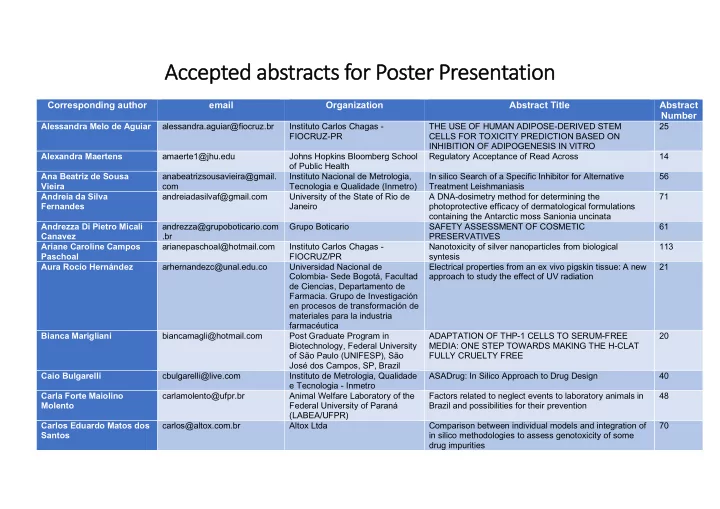
Alessandra Melo de Aguiar alessandra.aguiar@fiocruz.br Instituto Carlos Chagas - FIOCRUZ-PR THE USE OF HUMAN ADIPOSE-DERIVED STEM CELLS FOR TOXICITY PREDICTION BASED ON INHIBITION OF ADIPOGENESIS IN VITRO 25 Alexandra Maertens amaerte1@jhu.edu Johns Hopkins Bloomberg School

  • f Public Health

Regulatory Acceptance of Read Across 14 Ana Beatriz de Sousa Vieira anabeatrizsousavieira@gmail. com Instituto Nacional de Metrologia, Tecnologia e Qualidade (Inmetro) In silico Search of a Specific Inhibitor for Alternative Treatment Leishmaniasis 56 Andreia da Silva Fernandes andreiadasilvaf@gmail.com University of the State of Rio de Janeiro A DNA-dosimetry method for determining the photoprotective efficacy of dermatological formulations containing the Antarctic moss Sanionia uncinata 71 Andrezza Di Pietro Micali Canavez andrezza@grupoboticario.com .br Grupo Boticario SAFETY ASSESSMENT OF COSMETIC PRESERVATIVES 61 Ariane Caroline Campos Paschoal arianepaschoal@hotmail.com Instituto Carlos Chagas - FIOCRUZ/PR Nanotoxicity of silver nanoparticles from biological syntesis 113 Aura Rocío Hernández arhernandezc@unal.edu.co Universidad Nacional de Colombia- Sede Bogotá, Facultad de Ciencias, Departamento de

  • Farmacia. Grupo de Investigación

en procesos de transformación de materiales para la industria farmacéutica Electrical properties from an ex vivo pigskin tissue: A new approach to study the effect of UV radiation 21 Bianca Marigliani biancamagli@hotmail.com Post Graduate Program in Biotechnology, Federal University

  • f São Paulo (UNIFESP), São

José dos Campos, SP, Brazil ADAPTATION OF THP-1 CELLS TO SERUM-FREE MEDIA: ONE STEP TOWARDS MAKING THE H-CLAT FULLY CRUELTY FREE 20 Caio Bulgarelli cbulgarelli@live.com Instituto de Metrologia, Qualidade e Tecnologia - Inmetro ASADrug: In Silico Approach to Drug Design 40 Carla Forte Maiolino Molento carlamolento@ufpr.br Animal Welfare Laboratory of the Federal University of Paraná (LABEA/UFPR) Factors related to neglect events to laboratory animals in Brazil and possibilities for their prevention 48 Carlos Eduardo Matos dos Santos carlos@altox.com.br Altox Ltda Comparison between individual models and integration of in silico methodologies to assess genotoxicity of some drug impurities 70

slide-2
SLIDE 2

Carolina Motter Catarino catarc@rpi.edu Rensselaer Polytechnic Institute Skin corrosion test: a comparison between reconstructed human epidermis and full thickness skin models 90 Daniela Zimbardi danielazimbardi@natura.net Natura Inovação e Tec. Prod. Ltda Gene expression screening to identify activation profiles of sensitizing pathways in skin after exposition to cosmetic ingredients 96 Desirée Cigaran Schuck desirees@grupoboticário.com. br Grupo Boticário Neopapila for hair care ingredients evaluation: efficacy model. 81 DIEGO HENRIQUE SILVESTRE DIEGO HENRIQUE SILVESTRE UFRJ IN SILICO SEARCH FOR POSSIBLE SKELETAL MUSCLE RECEPTOR TO QUERCETIN 76 Eliana Blini Marengo eliana.marengo@butantan.gov .br Butantan Institute Reduction of animals in safety Quality Control test of hyperimmune sera 133 Eliana Blini Marengo eliana.marengo@butantan.gov .br Butantan Institute Tetanus and diphtheria combined vaccine in vitro potency analysis – replacement of animal testing by ToBI test 134 Eliane Blanco Nunes ebnunes@gmail.com Federal University of Goiás Mutagenicity, Cytotoxicity and Carcinogenicity Evaluation

  • f Synthetic ChloroChalcone Derivative (CLF) using

Drosophila melanogaster 66 Elyse Parchmont ecparchm@texaschildrens.org Texas Children's Hospital - Baylor College of Medicine The Three R’s of Research: Utilization of Modern Alternative Research Methods 87 Elyse Parchmont ecparchm@texaschildrens.org Baylor College of Medicine - Texas Childrens Hospital The 3Rs of Research - Utilization of Modern Research Methods 104 Emily Marques dos Reis emily_reis@intelab.ufsc.br UFSC/BioCellTis BNC-BASED PLATFORM FOR TUMOR GROWTH MODELS 105 Emily R. Trunnell, Ph.D. emilyt@peta.org People for the Ethical Treatment

  • f Animals

Modernizing Biomedical Research and Regulatory Policies to Advance Human Health 116 Eugene Demchuk edemchuk@cdc.gov Agency for Toxic Substances and Disease Registry Prioritization of Chemicals for Chronic Toxicity Testing using a Global QSAR LOAEL Model 11 Fernanda Naomi Tanji Fernanda Naomi Tanji Federal University of Paraná Urinary tract displays for physiological function and disease comprehension 34 Fernando Limoeiro Lara de Oliveira fll.oliveira.c2@gmail.com INMETRO AGNINetwork: Deep Neural Networks as alternative methods for Drug Design Screenings. Study case of HIV-1 Protease substrate recognition. 60 Gabriela de Fatima da Silva Soares gabissoares1@gmail.com Federal University of São Paulo Standardization of "in vitro" production of monoclonal antibody. 72 Gabriela Göethel goethel_63@hotmail.com UFRGS CHRONIC TOXICITY OF BENZO(B)FLUORANTHENE IN Caenorhabditis elegans 97 Geonildo Rodrigo Disner disner.rodrigo@gmail.com Universidade Federal do Paraná NANOMATERIALS GENOTOXIC MODE OF ACTION THROUGH THE IN VITRO COMET ASSAY 15 Graziela de Paula Ferreira Dantas grazidepaula@yahoo.com.br Federal University of Minas Gerais Cytotoxicity and Genotoxicity of multiple-walled carbon nanotubes functionalized with polyethylene glycol 130 Handressa P. Fêu-Laviola handressafeu@gmail.com INMETRO Development of a Computer Tool to Assist in Adherence to Good Laboratory Practices for the Management of Test Systems Using Animal Cells 54

slide-3
SLIDE 3

Helena Baggio Soares mvhelenabaggio@gmail.com Federal University of Paraná (UFPR) Photographic images and oral cavity molds for use in non- human primate veterinary dentistry 63 Helena Baggio Soares mvhelenabaggio@gmail.com Federal University of Paraná (UFPR) Skulls and dental molds of rodents in exotic animal dentistry education 64 Holly Rodrigues

  • lisim@hotmail.com

Avantis Faculty, Balneário Camboriú, Santa Catarina, Brazil Methods substitutive to the use of animals practiced in the Veterinary Medicine course of the regional university of Blumenau - FURB: perception and evaluation of the graduates 24 Humberto de Mello Brandão humaberto.brandao@embrapa .br Embrapa Gado de Leite Development of a new opacitometer prototype to improve the scope of the BCOP assay 128 Humberto de Mello Brandão humberto.brandao@embrapa. br Embrapa Gado de Leite Perspective of the inclusion of ketamine/xylazine in the HET-CAM test protocol. 129 Isisdoris Rodrigues de Souza isisrsdoris@gmail.com Federal University of Paraná - UFPR An in vitro hepatospheroid model for detecting genotoxicants 8 Izadora de Souza izadoradesouza@yahoo.com.b r School of Pharmaceutical Sciences of Ribeirão Preto, University of São Paulo PHOTOTOXICITY POTENTIAL AND PHOTOSTABILITY OF AÇAÍ SEEDS EXTRACTS AS A SUNSCREEN INGREDIENT 120 Janaína Spoladore janspoladore@gmail.com Universidade Federal Fluminense Standardized pyrogen testing of health products with LAL (limulus amebocyte lysate) as a substitute to rabbit pyrogen testing: A systematic review 94 Janaína Spoladore janspoladore@gmail.com Universidade Federal Fluminense Interference of hydroxyapatite in the pyrogen test for biomaterials through the monocyte activation test 95 Janaína Spoladore janspoladore@gmail.com Universidade Federal Fluminense Interference of hydroxyapatite in the pyrogen test for biomaterials through the monocyte activation test 119 Jéssica Dornelas da Silva jdornelas@cbpf.br Brazilian Center of Physics Research In vitro assessment of the biological effects of zinc- containing nanostructured biomaterials for therapeutic applications. 127 Joana Lobato Barbosa jolbarbosa@gmail.com Universidade Federal de Minas Gerais Production of an artificial skin substitute using tissue engineering principles to be used for toxicological tests in vitro 67 Josemar Vinicius Maiworm Abreu Silva josemar.maiworm@outlook.co m National Institute of Metrology, Quality and Metrology - Inmetro The use of OECD TG 432 to evaluate de phototoxicity of non-nanometric and nanometric particles of zinc oxide 122 Josemar Vinicius Maiworm Abreu Silva josemar.maiworm@outlook.co m National Institute of Metrology, Quality and Technology - Inmetro The use of OECD TG 432 to evaluate de phototoxicity of non-nanometric and nanometric particles of zinc oxide 123 Juliana Carvalhães Lago julianalago@natura.net Natura Inovação e Tecnologia de Produtos Ltda The influence of UVA protection on skin during sun exposure 98 Juliana Lott de Carvalho julianalott@gmail.com Universidade Católica de Brasília Induction of cellular senescence in vitro: a step towards animal-free research of human aging 74 Juliana Lott de Carvalho juliana@oneskintech.com OneSkin Technologies Characterization of human aged 2d and 3d skin models, and application for the identification of novel senotherapeutics: a comparison with retinoic acid 75

slide-4
SLIDE 4

KARYNN VIEIRA CAPILE karynn.capile@gmail.com Federal Fluminense University Outcomes of a workshop on alternative models for veterinary training in Brazil 32 Larissa Camila Ribeiro de Souza issafarma@hotmail.com UFMG Evaluation of the safety of immunogenic calixarenes for the treatment of cocaine dependence in in vitro and in vivo models 12 Larissa Cleres Moreira larissacleresm@gmail.com Federal University of Goiás Development and characterization of ethosomes containing octadecenedioic acid (ODA) applied for whitening cosmetic products 62 Leandra Santos Baptista leandra.baptista@gmail.com National Institute of Metrology, Quality and Technology Using human adipose stem cells spheroids as novel approach for assessment of silver chloride nanoparticles chronic exposure 101 Leandra Santos Baptista leandra.baptista@gmail.com INMETRO Human Adipose Stem/Stromal Cell Spheroids as a Model

  • f Osteogenesis

102 Lidiane de Jesus Silva lidi.silva@gmail.com Universidade Federal do Panará - UFPR Design and validation of a simulator for feline cephalic vein cannulation 30 LIU Zheng-tao liuzt@craes.org.cn Chinese Research Academy of Environmental Sciences Study of Ecotoxicological Effect and Soil Environmental Criteria of heavy metal Lead in China 83 Lorena de Oliveira Neves llorenneves@hotmail.com Universidade Católica de Petrópolis Using Polyvinylpyrrolidone (PVP) as an alternative to animal inputs in the Western blotting protocol 131 Lorena Rigo Gaspar lorena@fcfrp.usp.br University of Sao Paulo - School

  • f Pharmaceutical Sciences of

Ribeirao Preto Assessment of skin sensitizing potential of UV-filters by a novel in vitro method based on DPRA 93 LUCIANA PINTO SARTORI lpsartori@hotmail.com Centro Universitário São Camilo/SP Evaluation of the replacement of animal cadavers by 3D software in anatomical education 27 LUCIANA PINTO SARTORI lpsartori@hotmail.com Centro Universitário São Camilo/SP Reuse of testudines shells as didactic-scientific material 36 LUCIANA PINTO SARTORI lpsartori@hotmail.com Centro Universitário São Camilo/SP Use of exotic turtle (Trachemys scripta elegans) as bioindicator of trace elements from the urban area of São Paulo 38 Luciene Bottentuit López Balottin lbbalottin@inmetro.gov.br National Institute of Metrology, Quality and Technology - Inmetro The use of OECD TG 432 to evaluate de phototoxicity of non-nanometric and nanometric particles of zinc oxide 124 Luths Raquel de Oliveira Geaquinto luthsgeaquinto@gmail.com INMETRO, Rio de Janeiro, Brasil The use of metrology in the alternative method of skin absorption (OECD TG N° 428) 92 Maria Augusta Amaral Campos guttaa18@yahoo.com.br Laboratório de Toxicologia Experimental, Departamento de Análises Clínicas e Toxicológicas, Faculdade de Farmácia Universidade Federal de Minas Gerais, Belo Horizonte, Minas Gerais, Brasil In vitro evaluation of biomarkers of nephrotoxicity through gene expression using gentamicin 9

slide-5
SLIDE 5

Maria Fernanda RIbeiro DIas marfedias@gmail.com INMETRO Machine Learning assisted Virtual Screening: the quest for enzyme inhibitors search and Protein information association. 52 Maria Júlia Tasso mjuliatasso@hotmail.com University of Sao Paulo HepG2 cells cultured in a three-dimensional (3D) environment prove to be more resistant to the autophagic process induced by BDE-153. 126 Maria Laura Gutierrez laurabiologa@gmail.com CONICET - UBA Comparison between three score systems using HET- CAM method and in vivo eye irritation evaluation for cosmetics products in Argentina 43 Marianna Cavalheiro Marianna Cavalheiro Instituto Nacional de Metrologia, Qualidade e Tecnologia (Inmetro); Universidade Federal do Rio de Janeiro (UFRJ) Development of an alternative method candidate: Human alveolar tissue model for toxicological analysis of TiO2 nanoparticles. 99 Mario Lettieri Teixeira mario.teixeira@ifc.edu.br Instituto Federal Catarinense, Campus Concordia Use of an ex vivo model to determine the dermal toxicity

  • f imidazole salts

110 Mario Lettieri Teixeira mario.teixeira@ifc.edu.br Instituto Federal Catarinense, Campus Concordia Investigation of the cytotoxicity of leaf and stem extract of the plant Baccharis coridifolia 111 Mario Lettieri Teixeira mario.teixeira@ifc.edu.br Instituto Federal Catarinense, Campus Concordia Use of an ex vivo model to determine the dermal toxicity

  • f imidazole salts

112 Mário Lettieri Teixeira mario.teixeira@ifc.edu.br Instituto Federal Catarinense, Campus Concordia Use of in vivo model to determine antibacterial activity 114 Marize Campos Valadares marizeufg@gmail.com Federal University of Goiás Corneal epithelium biomimetic model for eye toxicity testing to support innovation in Brazil 135 Matheus Barbosa Gomes Cruz mbgcruz@gmail.com Federal University of Paraná A dog spinal cord simulator for study of spinal lesions 28 Matheus Barbosa Gomes Cruz mbgcruz@gmail.com Federal University of Paraná Synthetic model for feline orchiectomy training 29 Michele Munk Pereira mimunkbio@gmail.com Não Titanium dioxide nanoparticles increase the proliferation cells and micronucleus frequency in Chinese hamster

  • vary cells

118 Mohammad A. Akbarsha rc@nct.ac.in MGDC, Bharathidasan University, Tiruchirapalli, India / National College (Autonomous), Tiruchirappalli, India A success story of University-Industry collaboration towards popularization of 3D models for cosmetics testing in India 58 Mohanan PV mohanpv10@gmail.com Toxicology Division, Biomedical Technology Wing Sree Chitra Tirunal Institute for Medical Sciences and Technology, Thiruvananthapuram 695 012, Kerala, India Mesenchymal stem cells as an alternative test system for assessing the molecular toxicity 19 Nathalia de Carvalho Indolfo nathalia.indolfo@lnbio.cnpem. br LNBio Disseminating OECD TG 491 and OECD TG 492 tests in Brazil 41

slide-6
SLIDE 6

Nathalia de Carvalho Indolfo nathalia.indolfo@lnbio.cnpem. br LNBio, CNPEM Evaluation of the Cytotoxicity Effects on the in vitro Corneal Model by the Tetrazolium Reduction (MTT) or by Multiparametric High Content Analyses Assays - A Comparative OECD TG 491-STE Based Study. 42 Nathalia de Carvalho Indolfo nathalia.indolfo@lnbio.cnpem. br LNBio/CNPEM Long-term survival of spontaneously beating cardiomyocyte spheroids a 2-Organ-Chip (2-OC) platform 44 Nathalia de Carvalho Indolfo nathalia.indolfo@lnbio.cnpem. br LNBio/CNPEM Acetaminophen absorption and metabolism in an intestine/liver microphysiological system 45 Patrick Hayden phayden@mattek.com MatTek Corp Use of In Vitro Human Intestinal Microtissues as Relevant Models for Drug Permeation and Metabolism in the Gut 39 Patrick Hayden phayden@mattek.com MatTek Corp Performance of the OECD Accepted In Vitro Skin Irritation Test (SIT) using the EpiDerm Reconstructed Human Epidermal (RHE) Model 68 Paulo Emilio Correa Leite leitepec@gmail.com UFRJ/INMETRO Suitability of 3D human brain spheroid models to distinguish toxic effects of gold and poly-lactic acid nanoparticles to assess biocompatibility for brain drug delivery 91 Priscila Laviola Sanches plaviolasanches@gmail.com Pós-Graduação em Biomedicina Translacional, BIOTRANS (Unigranrio, Inmetro e UEZO) Cytotoxicity studyof titanium dioxide nanoparticles used in sunscreenswith primary human skin cells 18 Raissa Santos de Lima raissalima2709@gmail.com Inmetro IN SILICO EVALUATION OF TARGET ENZYMES FOR POTENTIAL ANTI-TUBERCULOSIS DRUGS 46 Renata Akemi Morais Matsui leandra.baptista@gmail.com INMETRO NON-HYPERTROPHIC CARTILAGE BY SCAFFOLD- FREE TISSUE ENGINEERING VALIDATED BY COMPARATIVE SECRETOME ANALYSIS 103 Renato Ivan de Ávila renatoivan.avila@gmail.com Federal University of Goiás The use of GARDskinTM for skin sensitization evaluation

  • f cosmetic ingredients and “real-life” mixtures

17 Ricardo Cardozo de Barros rcbarros@faeterj- petropolis.edu.br Faculdade de Educação Tecnológica do Estado do rio de Janeiro - Faeterj / Instituto Nacional de Metrologia, Qualidade e Tecnologia - Inmetro Testing the ASAProt Platform: Searching for New Targets from Neglected Tropical Diseases 65 Ricardo Sergio Almeida almeidar@uel.br State University of Londrina Detection of pyrogens by Galleria mellonella amebocyte lysate 125 Ricardo Valle Ladewig Zappala ricardolad@biof.ufrj.br Federal University of Rio de Janeiro Comprehension on the hidden genome of Deinococcus radiodurans through functional prediction of its proteins 31 Robert Pogue repogue@gmail.com Universidade Católica de Brasília Genome editing in pluripotent cells for genetic disease modeling 77 Rodolpho C. Braga rodolpho@altox.com.br Altox Ltda. Pred-Ecotox: a computational tool for the prediction of aquatic acute toxicity of chemicals 85

slide-7
SLIDE 7

Rodrigo De Vecchi rvecchi@rd.loreal.com L´Oréal Research & Innovation SkinEthic RHE Skin Corrosion Test: An OECD adopted method to identify skin corrosive UN GHS subcategories 106 Rodrigo De Vecchi nathalie.alepee@rd.loreal.com L´Oréal Research & Innovation SkinEthic™ HCE EIT: An in vitro assay complies with regulatory use for serious eye damage/eye irritation testing 107 Rodrigo De Vecchi rvecchi@rd.loreal.com L´Oréal Research & Innovation In vitro skin irritation assay of medical devices with SkinEthicTM RHE model 108 Rodrigo De Vecchi rvecchi@rd.loreal.com L´Oréal Brazil Research & Innovation Implementation of an OECD accepted Reconstructed Human Epidermis (RHE) model in Brazil 109 Róli Rodrigues Simões rolisim@hotmail.com Avantis Faculty Methods substitutive to the use of animals practiced in the Veterinary Medicine course of the regional university of Blumenau - FURB: perception and evaluation of the graduates 10 Sara Gemini Piperni sara.gemini@hotmail.com CBPF 3D bone cell model in nanotoxicological evaluation of TiO2 nano-bio interface. 121 Simone Fanan simone_fanan@hotmail.com Federal University of Santa Catarina - UFSC IN VITRO SKIN IRRITATION ASSAY OF JABUTICABA PEEL EXTRACT (Plinia peruviana (Poir) Govaerts), A BRAZILIAN NATIVE FRUIT 33 Talita Dacroce Tonin talita_dacroce@hotmail.com Universidade do Vale do Itajaí EVALUATION OF THE PHOTOMETHYOPROTETIC AND PHOTOPROTETHER ACTIVITY AGAINST UVA AND UVB IRRADIATION OF THE EXTRACT AND PHYTOCOSMETICO OBTAINED FROM THE FRUITS OF MYRCIARIA CAULIFLORA (MART.) 132 THALES DE ASTROGILDO E TREZ thalestrez@gmail.com Universidade Federal de Alfenas - UNIFAL-MG Animal Ethics Committees in Brazil: a survey on the 3Rs concept 51 Victor Hugo de Souza lima vh_souzalima@hotmail.com Federal Fluminense University/ Brazilian center for physics research In vitro assessment of the effects of surface modifications

  • n osteoconductivity parameters of hydroxyapatite-based

bone substitute biomaterials 117