Abstract Success in first-semester general chemistry, a known 'high- - - PDF document

abstract
SMART_READER_LITE
LIVE PREVIEW

Abstract Success in first-semester general chemistry, a known 'high- - - PDF document

10/27/18 Te Texas NS NSA Project Abstract Success in first-semester general chemistry, a known 'high- risk' course, is being studied as a continuing research Numeracy Skills Needed for endeavor by the NSA Texas team to evaluate college-ready


slide-1
SLIDE 1

10/27/18 1

Deborah Walker, PhD & Diana Mason, PhD, ACSF The National Numeracy Network 11:30-12:00, Wells Hall A118 October 13, 2018

Te Texas NS NSA Project

Numeracy Skills Needed for QR Success in General Chemistry

Abstract

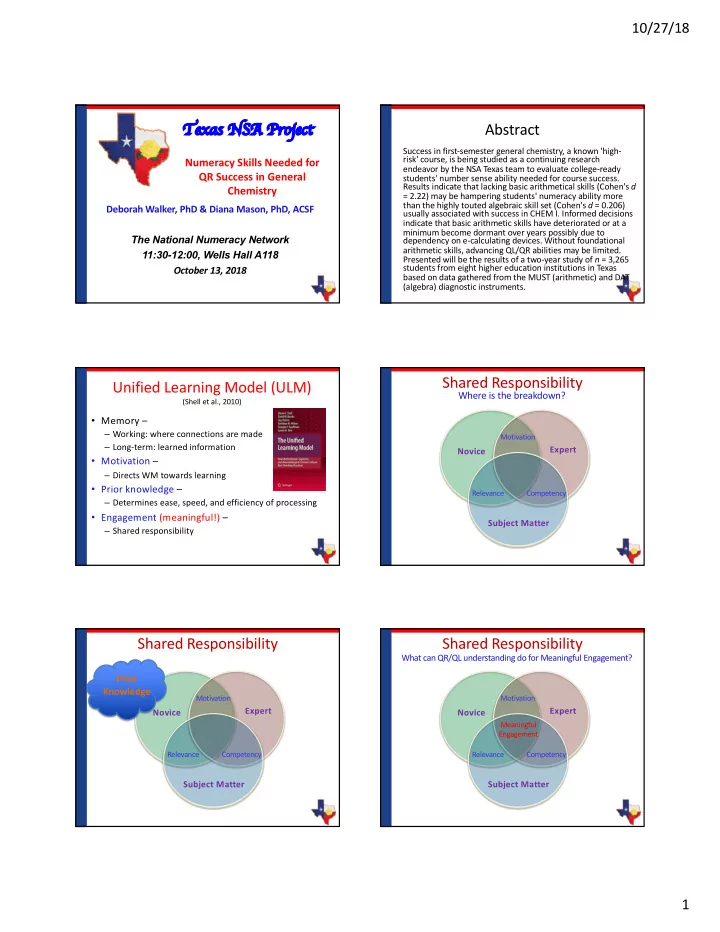
Success in first-semester general chemistry, a known 'high- risk' course, is being studied as a continuing research endeavor by the NSA Texas team to evaluate college-ready students' number sense ability needed for course success. Results indicate that lacking basic arithmetical skills (Cohen's d = 2.22) may be hampering students' numeracy ability more than the highly touted algebraic skill set (Cohen's d = 0.206) usually associated with success in CHEM I. Informed decisions indicate that basic arithmetic skills have deteriorated or at a minimum become dormant over years possibly due to dependency on e-calculating devices. Without foundational arithmetic skills, advancing QL/QR abilities may be limited. Presented will be the results of a two-year study of n = 3,265 students from eight higher education institutions in Texas based on data gathered from the MUST (arithmetic) and DAT (algebra) diagnostic instruments.

Unified Learning Model (ULM)

(Shell et al., 2010)
  • Memory –

– Working: where connections are made – Long-term: learned information

  • Motivation –

– Directs WM towards learning

  • Prior knowledge –

– Determines ease, speed, and efficiency of processing

  • Engagement (meaningful!) –

– Shared responsibility Novice Expert Subject Matter

Motivation Competency Relevance

Shared Responsibility

Where is the breakdown?

Novice Expert Subject Matter

Motivation Competency Relevance

Shared Responsibility

Prior Knowledge

Novice Expert Subject Matter

Motivation Meaningful Engagement Competency Relevance

Shared Responsibility

What can QR/QL understanding do for Meaningful Engagement?

slide-2
SLIDE 2

10/27/18 2

The Gap

30-years of SAT: Texas v. USA

(Max score = 1600)

2017 U.S. SAT: 533 Evidence-Based Reading and Writing + 527 Math = 1060 Total (up 58 points) 2017 SAT: Texas = 1020 composite (Up 76 points) Robin Hood Reform Robin Hood

Proficiency

“A real phenomenon we’re now seeing is that we have more and more students with a

diploma, but we also know — look at test

scores over the last few years — we’re not graduating more students who are proficient.”

https://www.the74million.org/new-report-in-46-states-high-school-graduation- requirements-arent-enough-to-qualify-for-nearby-public-universities

NSA Team (2017-2019)

(All with IRB Approval)

  • Diana Mason, UNT (retired)
  • Collaborating researchers

– Sue Broadway, UNT Adjunct – Anton Dubrovskiy, UHCL Assistant Professor – Ben Jang, TAMU-C, Regents Professor – Blain Mamiya, TSU Lecturer – Cynthia Powell, ACU Associate Professor – Bob Shelton, TAMU-SA Assistant Professor – Adrian Villalta-Cerdas, Sam Houston State Assistant Professor – Deborah Rush Walker, UT Austin Lecturer – Rebecca Weber, UNT Lecturer – Vickie Williamson, TAMU Instructional Professor

NSA Team Members’ Institutions

Fall 2017-Fall 2018 Undergrad Enrollment (Pop Rank) Hispanic Emerging > 15% Hispanic Serving > 25% *Minority- Serving > 50% TAMU (R1) 50,707 (#1) UT (R1: pre-ID’d at-risk grp) 40,492 (#2) TSU (R2) 34,180 (#5) UNT (R1) 31,405 (#6) 23.4% 36.0% TAMU-C (R2) 12,490 19.7% 40.9% Sam Houston (R3) 8,031 21.9% 40.1% UHCL 5,798 TAMU-SA 5,417 ACU (private) 4,427 Added for Fall 2018: no data to date! Goal: Get all 37 Texas Public Universities on board! *MSI = 50%+ URMs

Protocol

  • Research plan

– Year 1 (Pilot): Effect(s) of calculator (n = 2,117)

  • MUST

– Year 2: Effect(s) of automaticity (n = 3,266)

  • MUST
  • DAT

– Year 3: Effect(s) of automaticity (n = 643 +)

  • MUST
  • QR
  • Non-cognitive: Higher Education Expectations
  • Drop instrument with smaller effect size
  • Add new instruments each iteration
slide-3
SLIDE 3

10/27/18 3

AY 1: Pilot Study

MUST (no calculator) & Course grade

r = .451 (WITHOUT) and r = .402 (WITH)

0 . 0 0 1 0 .0 0 2 0 .0 0 3 0 .0 0 4 0 .0 0 5 0 .0 0 6 0 .0 0 7 0 .0 0 8 0 .0 0 9 0 .0 0 1 0 0 .0 1 2 3 4 5 6 7 8 9 1 0 1 1 1 2 1 3 1 4 1 5 1 6 MUST Score (all) v. Course Grade Co urse Slope: m = 1.58

Mean (WITHOUT) 7.36/16 = 46.0% Mean (WITH) = 12.19/16 = 76.2%

Are Students Dependent on Calculators?

Chemistry Course Grade MUST Score Positive slope without calculators; negative slope with!

AY 2: Prior Knowledge Focus High School Chemistry

HS Chem n = 1,064 Course Avg (SD) MUST (SD) DAT (SD) PreCal + AP/IB 240 84.6 (11.3) 12.2 (4.6) 16.7 (3.2) 166/240 = 69.2% Pre-AP 536 79.8 (12.9) 10.4 (4.8) 15.7 (3.4) 357/536 = 66.6% Regular 276 76.3 (13.8) 8.9 (4.9) 14.7 (3.6) 138/276 = 50.0% None 12 71.2 (13.8) 6.2 (3.5) 13.1 (5.2) 6/12 = 50.0%

Mathematics

Grade Cal I or II n (avg %) PreCal n (avg %) Col Alg n (avg %) Prob/Stat n (avg %) None/Dev n (avg %) No Report n (avg %) A 103 (93.5%) 138 (94.1%) 48 (92.5%) 8 (92.7%) 10 (91.9%) 1 (89.3%) B 99 (84.6%) 117 (83.7%) 79 (83.5%) 14 (84.6%) 17 (83.7%) 1 (81.6%) C 51 (73.9%) 90 (73.7%) 81 (73.2%) 17 (73.7%) 17 (74.5%) 1 (73.6%) D 12 (64.5%) 35 (63.3%) 43 (64.3%) 7 (64.3%) 9 (63.3%) 3 (65.7%) F 11 (53.5%) 15 (50.5%) 28 (49.9%) 9 (42.0%) 9 (44.1%) Total 276 (83.8%) 395 (82.0%) 279 (75.8%) 55 (72.8%) 62 (73.8%) 6 (65.7%) Majority of students (276 + 395/1,073 = 62.5%) currently are enrolled in pre-cal or higher (groups A and B) and have a B average.
slide-4
SLIDE 4

10/27/18 4

Fall 2017 MUST vs. Course Average

y = 1.5036x + 62.198 R² = 0.9321 .0 1 0 .0 2 0 .0 3 0 .0 4 0 .0 5 0 .0 6 0 .0 7 0 .0 8 0 .0 9 0 .0 1 0 0 .0 1 2 3 4 5 6 7 8 9 1 1 1 1 2 1 3 1 4 1 5 1 6 1 7 1 8 1 9 2 Course Average MUST Score Fall 2017: MUST Scores v. Course Avg

Most-missed Example Problems

(< 30% correct)

  • Division with exponential notation:
  • Logs: Determine the base-10 log of: 1000 = _____ and 0.001 = _____
  • Power of 10 square root:
  • *Division by 0: If A = B, evaluate
105 ×1023 10−1 ×10⁻⁶ 9.0 ×10⁻¹⁸ 2.0 ×10⁻⁵ 64 ×10−12 A A − B *New question for fall 2017

None of 20 questions > 70% correct!

MUST (by institution) DAT: Algebra Skills

Slope: m = 1.39

DAT (by institution) Letter Grades

Identify the potential D/F students at the beginning of semester (or before) and provide them with the HIPs needed to improve their math-sense!
slide-5
SLIDE 5

10/27/18 5

Prior Knowledge

1 2 3 4 5 6 7 8 9 AP /IB P re -A P Re gul a r No ne Average High School Course High School Chemistry Background (Fall 2017) Co u rs e A vg M US T DA T P re C a l +

Correlations & Effect Sizes

Course average (SD) = 76.75 (15.56)

n = 3.266 Max = 20 points Correlation to Avg R2

MUST 7.75 = 38.75% 0.398 0.158 DAT 14.71 = 73.55% 0.324 0.105 Effect Size DAT : Course Avg = .206 [small]

indicating 50% chance of predicting average from DAT (algebra skills)

Effect Size MUST : Course Avg = 2.22 [huge] indicating that there is a 80% chance (or greater) of predicting course average from MUST (arithmetic skills)

Correlation (r): MUST:DAT = 0.700

Predictability of MUST Ranges (Fall 2017)

MUST Range n Average (SD) (SE) n with Average < 69.5% (% in MUST range)

Above average (> 12)

392 87.05 (8.85) (0.45) 12 (3.06%)

Average (8-12)

347 80.42 (10.90) (0.59) 45 (12.97%)

Below average (< 8)

334 70.85 (13.71) (0.75) 123 (36.82%) Total 1073 79.86 (13.02) (0.40) 180 (16.78%)

Preparation
  • Graduated from
TX High School
  • Took Pre-AP
Chemistry College
  • First-time in course
(Avg = 76%)
  • STEM major
  • Co-enrolled in Pre-
Calc or higher
  • Plans to take Chem II
Nonacademic
  • Parents and
grandparents have some college
  • Does not work

Average Student Profile

AY 3: QR Introduction Quantitative Reasoning (Fall 2018)

arithmetic word intense images N = 643; correlation between MUST and QR = 0.658 (a little lower than with the DAT, r = 0.700); mean on MUST = 6.69; mean on QR = 12.09
slide-6
SLIDE 6

10/27/18 6

Most Missed QR Arithmetic Most Missed QR Word Problems Near Most Missed QR with Image Most Missed QR with Image MUST vs QR: Institution

n MUST QR Small, HSI 71 2.23 9.75 Middle, Pub 76 5.26 10.20 Large, HSI 79 5.61 10.97 Small, HSI 84 6.36 11.68 Large, Pub 115 6.96 12.27 Large, Pub 112 8.08 13.13 Small, Private 106 10.00 14.87 Total 643 6.69 12.09 *MUST and QR scores are in alignment.

MUST vs QR: Gender

n MUST* QR* Female 308 4.96 (3.78) 10.68 (3.10) Male 221 7.56 (4.92) 12.73 (3.40) Total 531 6.05 11.54 MUST and QR scores are in alignment. *Males statistically outperformed females on MUST and QR.
slide-7
SLIDE 7

10/27/18 7

MUST vs QR: Ethnicity

n MUST* QR* Non-Hispanic 328 (62.4%) 6.81 (4.57) 12.07 (3.40) Hispanic 198 (38.6%) 4.67 (3.82) 10.66 (3.12) Total 526 6.01 11.54 MUST and QR scores are in alignment. Non-Hispanics statistically outperformed Hispanics on MUST and QR.

MUST vs QR: Race

n (%) MUST QR Asian/PI 49 (9.4%) 7.82 (4.75) 12.06 (3.45) Mixed 9 (1.7%) 6.33 (4.47) *11.22 (3.31) White 313 (60.3%) 6.05 (4.41) *11.86 (3.24) Black 78 (15.0%) 5.99 (4.28) 11.00 (3.43) Native Am/Alaskan 10 (1.9%) 5.70 (4.17) 10.90 (4.41) Other 60 (11.6%) 4.58 (3.95) 10.42 (3.40) Total 519 6.03 11.55 *MUST and QR scores are almost in alignment.

HIGH IMPACT PRACTICES (HIP)

Your Preference?

  • No Calculator:
– “I prefer the chemistry exams without a calculator... With a calculator, you could take a long time because you can use the answer and try to work backwards. Without a calculator, you either know it
  • r you don’t.
  • Calculator:
– “I prefer exams with a calculator because I know the process however sometimes I get nervous or anxious during exams which hinders my mathematical capabilities and the calculator makes sure that doesn’t get the better of me and that my grade remains intact.” n=70 79% 11% 10% PREFERENCE FOR CHEMISTRY EXAMS? Calculator NoCalculator Both/Either

Recommend to Future Students?

  • No Calculator:

– “Honestly, I think not using a calculator has better prepared me for CH302.”

  • Calculator:

– “The reason I failed my first two exams in CH301 was because I struggled greatly with estimating. I don’t feel like that’s fair because I knew the chemistry and this is a chemistry course.”

n=69 96% 4% FUTURE CH301 CLASSES? No-Calculator Exams Calculator Exams

Next Steps

  • Determine the degree to which QR skills relate

to success in general chemistry

  • Implement HIPs

– Re-awaken numeracy skills – Support QR skill development

  • Spread the word

– Numeracy skills are declining in college students

slide-8
SLIDE 8

10/27/18 8

Summary

  • Numeracy skills are “low-hanging fruit”

– MUST identifies at-risk students taking chemistry – Number sense is linked to chemistry course success

  • Quantitative Reasoning warrants further study

– Numeracy skills may be limited by reasoning skills – Chemistry success may improve as both QR and numeracy skills improve

Acknowledgments

Many thanks to the Networking for Science Advancement (NSA) Team for contributing to this statewide project! Also, thanks are extended to Eric Gaze for getting the NSA Team started on QL/QR research line and sharing his problems from QLRA with us, and to Peter Brown for allowing us to select problems from his “Number Sense” research collection of problems that can be solved without e-devices!

Questions?

Diagnostic Instruments

  • Math-Up Skills Test (MUST): arithmetic skills

– Hartman, JA. R.; Nelson, E. A. Automaticity in Computation and Student Success in Introductory Physical Science

  • Courses. Cornell University Library. arXiv:1608.05006v2

[physics.ed-ph]

  • Quiz: http://bit.ly/1HyamPc (Named: MUST)

– Authors

  • Hartman (U.S. Naval Academy)
  • Nelson, Chemistry instructor (multi-institutions)

– Highly reliable (KR-20 = 0.863)

  • Diagnostic Algebra Test (DAT)

– Cooper, C. I., Pearson, P . T. (2012). A Genetically Optimized Predictive System for Success in General Chemistry Using a Diagnostic Algebra Test. Journal of Science Education and Technology, 21 (1), 197-205.

slide-9
SLIDE 9

Deborah Walker, PhD & Diana Mason, PhD, ACSF The National Numeracy Network 11:30-12:00, Wells Hall A118 October 13, 2018

Texas N NSA P Pro roject ct

Numeracy Skills Needed for QR Success in General Chemistry

slide-10
SLIDE 10

Abstract

Success in first-semester general chemistry, a known 'high- risk' course, is being studied as a continuing research endeavor by the NSA Texas team to evaluate college-ready students' number sense ability needed for course success. Results indicate that lacking basic arithmetical skills (Cohen's d = 2.22) may be hampering students' numeracy ability more than the highly touted algebraic skill set (Cohen's d = 0.206) usually associated with success in CHEM I. Informed decisions indicate that basic arithmetic skills have deteriorated or at a minimum become dormant over years possibly due to dependency on e-calculating devices. Without foundational arithmetic skills, advancing QL/QR abilities may be limited. Presented will be the results of a two-year study of n = 3,265 students from eight higher education institutions in Texas based on data gathered from the MUST (arithmetic) and DAT (algebra) diagnostic instruments.

slide-11
SLIDE 11

Unified Learning Model (ULM)

(Shell et al., 2010)

  • Memory –

– Working: where connections are made – Long-term: learned information

  • Motivation –

– Directs WM towards learning

  • Prior knowledge –

– Determines ease, speed, and efficiency of processing

  • Engagement (meaningful!) –

– Shared responsibility

slide-12
SLIDE 12

Novice Expert Subject Matter

Motivation Competency Relevance

Shared Responsibility

Where is the breakdown?

slide-13
SLIDE 13

Novice Expert Subject Matter

Motivation Competency Relevance

Shared Responsibility

Prior Knowledge

slide-14
SLIDE 14

Novice Expert Subject Matter

Motivation Meaningful Engagement Competency Relevance

Shared Responsibility

What can QR/QL understanding do for Meaningful Engagement?

slide-15
SLIDE 15

The Gap

slide-16
SLIDE 16

30-years of SAT: Texas v. USA

(Max score = 1600)

2017 U.S. SAT: 533 Evidence-Based Reading and Writing + 527 Math = 1060 Total (up 58 points) 2017 SAT: Texas = 1020 composite (Up 76 points)

Robin Hood Reform Robin Hood

slide-17
SLIDE 17

Proficiency

“A real phenomenon we’re now seeing is that we have more and more students with a

diploma, but we also know — look at test

scores over the last few years — we’re not graduating more students who are proficient.”

https://www.the74million.org/new-report-in-46-states-high-school-graduation- requirements-arent-enough-to-qualify-for-nearby-public-universities

slide-18
SLIDE 18

NSA Team (2017-2019)

(All with IRB Approval)

  • Diana Mason, UNT (retired)
  • Collaborating researchers

– Sue Broadway, UNT Adjunct – Anton Dubrovskiy, UHCL Assistant Professor – Ben Jang, TAMU-C, Regents Professor – Blain Mamiya, TSU Lecturer – Cynthia Powell, ACU Associate Professor – Bob Shelton, TAMU-SA Assistant Professor – Adrian Villalta-Cerdas, Sam Houston State Assistant Professor – Deborah Rush Walker, UT Austin Lecturer – Rebecca Weber, UNT Lecturer – Vickie Williamson, TAMU Instructional Professor

slide-19
SLIDE 19

NSA Team Members’ Institutions

Fall 2017-Fall 2018 Undergrad Enrollment (Pop Rank) Hispanic Emerging > 15% Hispanic Serving > 25% *Minority- Serving > 50% TAMU (R1) 50,707 (#1) UT (R1: pre-ID’d at-risk grp) 40,492 (#2) TSU (R2) 34,180 (#5) UNT (R1) 31,405 (#6) 23.4% 36.0% TAMU-C (R2) 12,490 19.7% 40.9% Sam Houston (R3) 8,031 21.9% 40.1% UHCL 5,798 TAMU-SA 5,417 ACU (private) 4,427

Added for Fall 2018: no data to date!

Goal: Get all 37 Texas Public Universities on board! *MSI = 50%+ URMs

slide-20
SLIDE 20

Protocol

  • Research plan

– Year 1 (Pilot): Effect(s) of calculator (n = 2,117)

  • MUST

– Year 2: Effect(s) of automaticity (n = 3,266)

  • MUST
  • DAT

– Year 3: Effect(s) of automaticity (n = 643 +)

  • MUST
  • QR
  • Non-cognitive: Higher Education Expectations
  • Drop instrument with smaller effect size
  • Add new instruments each iteration
slide-21
SLIDE 21

AY 1: Pilot Study

slide-22
SLIDE 22

MUST (no calculator) & Course grade

r = .451 (WITHOUT) and r = .402 (WITH)

0.00 10.00 20.00 30.00 40.00 50.00 60.00 70.00 80.00 90.00 100.00 1 2 3 4 5 6 7 8 9 10 11 12 13 14 15 16

MUST Score (all) v. Course Grade

Course

Slope: m = 1.58

Mean (WITHOUT) 7.36/16 = 46.0% Mean (WITH) = 12.19/16 = 76.2%

slide-23
SLIDE 23

Are Students Dependent on Calculators?

Chemistry Course Grade MUST Score Positive slope without calculators; negative slope with!

slide-24
SLIDE 24

AY 2: Prior Knowledge Focus

slide-25
SLIDE 25

High School Chemistry

HS Chem n = 1,064 Course Avg (SD) MUST (SD) DAT (SD) PreCal +

AP/IB 240 84.6 (11.3) 12.2 (4.6) 16.7 (3.2) 166/240 = 69.2% Pre-AP 536 79.8 (12.9) 10.4 (4.8) 15.7 (3.4) 357/536 = 66.6% Regular 276 76.3 (13.8) 8.9 (4.9) 14.7 (3.6) 138/276 = 50.0% None 12 71.2 (13.8) 6.2 (3.5) 13.1 (5.2) 6/12 = 50.0%

slide-26
SLIDE 26

Mathematics

Grade Cal I or II n (avg %) PreCal n (avg %) Col Alg n (avg %) Prob/Stat n (avg %) None/Dev n (avg %) No Report n (avg %) A 103 (93.5%) 138 (94.1%) 48 (92.5%) 8 (92.7%) 10 (91.9%) 1 (89.3%) B 99 (84.6%) 117 (83.7%) 79 (83.5%) 14 (84.6%) 17 (83.7%) 1 (81.6%) C 51 (73.9%) 90 (73.7%) 81 (73.2%) 17 (73.7%) 17 (74.5%) 1 (73.6%) D 12 (64.5%) 35 (63.3%) 43 (64.3%) 7 (64.3%) 9 (63.3%) 3 (65.7%) F 11 (53.5%) 15 (50.5%) 28 (49.9%) 9 (42.0%) 9 (44.1%) Total 276 (83.8%) 395 (82.0%) 279 (75.8%) 55 (72.8%) 62 (73.8%) 6 (65.7%) Majority of students (276 + 395/1,073 = 62.5%) currently are enrolled in pre-cal or higher (groups A and B) and have a B average.

slide-27
SLIDE 27

Fall 2017 MUST vs. Course Average

y = 1.5036x + 62.198 R² = 0.9321

0.0 10.0 20.0 30.0 40.0 50.0 60.0 70.0 80.0 90.0 100.0 1 2 3 4 5 6 7 8 9 10 11 12 13 14 15 16 17 18 19 20

Course Average MUST Score

Fall 2017: MUST Scores v. Course Avg

slide-28
SLIDE 28

Most-missed Example Problems

(< 30% correct)

  • Division with exponential notation:
  • Logs: Determine the base-10 log of: 1000 = _____ and 0.001 = _____
  • Power of 10 square root:
  • *Division by 0: If A = B, evaluate

105 ×1023 10−1 ×10⁻⁶ 9.0 ×10⁻¹⁸ 2.0 ×10⁻⁵

64 ×10−12

A A − B

*New question for fall 2017

None of 20 questions > 70% correct!

slide-29
SLIDE 29

MUST (by institution)

slide-30
SLIDE 30

DAT: Algebra Skills

Slope: m = 1.39

slide-31
SLIDE 31

DAT (by institution)

slide-32
SLIDE 32

Letter Grades

Identify the potential D/F students at the beginning of semester (or before) and provide them with the HIPs needed to improve their math-sense!

slide-33
SLIDE 33

Prior Knowledge

10 20 30 40 50 60 70 80 90 AP/IB Pre-AP Regular None

Average High School Course

High School Chemistry Background (Fall 2017)

Course Avg MUST DAT PreCal +

slide-34
SLIDE 34

Correlations & Effect Sizes

Course average (SD) = 76.75 (15.56)

n = 3.266 Max = 20 points Correlation to Avg R2

MUST 7.75 = 38.75% 0.398 0.158 DAT 14.71 = 73.55% 0.324 0.105 Effect Size DAT : Course Avg = .206 [small]

indicating 50% chance of predicting average from DAT (algebra skills)

Effect Size MUST : Course Avg = 2.22 [huge] indicating that there is a 80% chance (or greater) of predicting course average from MUST (arithmetic skills)

Correlation (r): MUST:DAT = 0.700

slide-35
SLIDE 35

Predictability of MUST Ranges (Fall 2017)

MUST Range n Average (SD) (SE) n with Average < 69.5% (% in MUST range)

Above average (> 12)

392 87.05 (8.85) (0.45) 12 (3.06%)

Average (8-12)

347 80.42 (10.90) (0.59) 45 (12.97%)

Below average (< 8)

334 70.85 (13.71) (0.75) 123 (36.82%) Total 1073 79.86 (13.02) (0.40) 180 (16.78%)

slide-36
SLIDE 36

Preparation

  • Graduated from

TX High School

  • Took Pre-AP

Chemistry College

  • First-time in course

(Avg = 76%)

  • STEM major
  • Co-enrolled in Pre-

Calc or higher

  • Plans to take Chem II

Nonacademic

  • Parents and

grandparents have some college

  • Does not work

Average Student Profile

slide-37
SLIDE 37

AY 3: QR Introduction

slide-38
SLIDE 38

Quantitative Reasoning (Fall 2018)

arithmetic word intense images

N = 643; correlation between MUST and QR = 0.658 (a little lower than with the DAT, r = 0.700); mean on MUST = 6.69; mean on QR = 12.09

slide-39
SLIDE 39

Most Missed QR Arithmetic

slide-40
SLIDE 40

Most Missed QR Word Problems

slide-41
SLIDE 41

Near Most Missed QR with Image

slide-42
SLIDE 42

Most Missed QR with Image

slide-43
SLIDE 43

MUST vs QR: Institution

n MUST QR Small, HSI 71 2.23 9.75 Middle, Pub 76 5.26 10.20 Large, HSI 79 5.61 10.97 Small, HSI 84 6.36 11.68 Large, Pub 115 6.96 12.27 Large, Pub 112 8.08 13.13 Small, Private 106 10.00 14.87 Total 643 6.69 12.09 *MUST and QR scores are in alignment.

slide-44
SLIDE 44

MUST vs QR: Gender

n MUST* QR* Female 308 4.96 (3.78) 10.68 (3.10) Male 221 7.56 (4.92) 12.73 (3.40) Total 531 6.05 11.54 MUST and QR scores are in alignment. *Males statistically outperformed females on MUST and QR.

slide-45
SLIDE 45

MUST vs QR: Ethnicity

n MUST* QR* Non-Hispanic 328 (62.4%) 6.81 (4.57) 12.07 (3.40) Hispanic 198 (38.6%) 4.67 (3.82) 10.66 (3.12) Total 526 6.01 11.54 MUST and QR scores are in alignment. Non-Hispanics statistically outperformed Hispanics on MUST and QR.

slide-46
SLIDE 46

MUST vs QR: Race

n (%) MUST QR Asian/PI 49 (9.4%) 7.82 (4.75) 12.06 (3.45) Mixed 9 (1.7%) 6.33 (4.47) *11.22 (3.31) White 313 (60.3%) 6.05 (4.41) *11.86 (3.24) Black 78 (15.0%) 5.99 (4.28) 11.00 (3.43) Native Am/Alaskan 10 (1.9%) 5.70 (4.17) 10.90 (4.41) Other 60 (11.6%) 4.58 (3.95) 10.42 (3.40) Total 519 6.03 11.55 *MUST and QR scores are almost in alignment.

slide-47
SLIDE 47

HIGH IMPACT PRACTICES (HIP)

slide-48
SLIDE 48

Your Preference?

  • No Calculator:

– “I prefer the chemistry exams without a calculator... With a calculator, you could take a long time because you can use the answer and try to work backwards. Without a calculator, you either know it

  • r you don’t.
  • Calculator:

– “I prefer exams with a calculator because I know the process however sometimes I get nervous or anxious during exams which hinders my mathematical capabilities and the calculator makes sure that doesn’t get the better of me and that my grade remains intact.”

n=70

79% 11% 10% PREFERENCE FOR CHEMISTRY EXAMS? Calculator NoCalculator Both/Either

slide-49
SLIDE 49

Recommend to Future Students?

  • No Calculator:

– “Honestly, I think not using a calculator has better prepared me for CH302.”

  • Calculator:

– “The reason I failed my first two exams in CH301 was because I struggled greatly with estimating. I don’t feel like that’s fair because I knew the chemistry and this is a chemistry course.”

n=69

96% 4% FUTURE CH301 CLASSES? No-Calculator Exams Calculator Exams

slide-50
SLIDE 50

Next Steps

  • Determine the degree to which QR skills relate

to success in general chemistry

  • Implement HIPs

– Re-awaken numeracy skills – Support QR skill development

  • Spread the word

– Numeracy skills are declining in college students

slide-51
SLIDE 51

Summary

  • Numeracy skills are “low-hanging fruit”

– MUST identifies at-risk students taking chemistry – Number sense is linked to chemistry course success

  • Quantitative Reasoning warrants further study

– Numeracy skills may be limited by reasoning skills – Chemistry success may improve as both QR and numeracy skills improve

slide-52
SLIDE 52

Acknowledgments

Many thanks to the Networking for Science Advancement (NSA) Team for contributing to this statewide project! Also, thanks are extended to Eric Gaze for getting the NSA Team started on QL/QR research line and sharing his problems from QLRA with us, and to Peter Brown for allowing us to select problems from his “Number Sense” research collection of problems that can be solved without e-devices!

slide-53
SLIDE 53

Questions?

slide-54
SLIDE 54

Diagnostic Instruments

  • Math-Up Skills Test (MUST): arithmetic skills

– Hartman, JA. R.; Nelson, E. A. Automaticity in Computation and Student Success in Introductory Physical Science

  • Courses. Cornell University Library. arXiv:1608.05006v2

[physics.ed-ph]

  • Quiz: http://bit.ly/1HyamPc (Named: MUST)

– Authors

  • Hartman (U.S. Naval Academy)
  • Nelson, Chemistry instructor (multi-institutions)

– Highly reliable (KR-20 = 0.863)

  • Diagnostic Algebra Test (DAT)

– Cooper, C. I., Pearson, P. T. (2012). A Genetically Optimized Predictive System for Success in General Chemistry Using a Diagnostic Algebra Test. Journal of Science Education and Technology, 21 (1), 197-205.