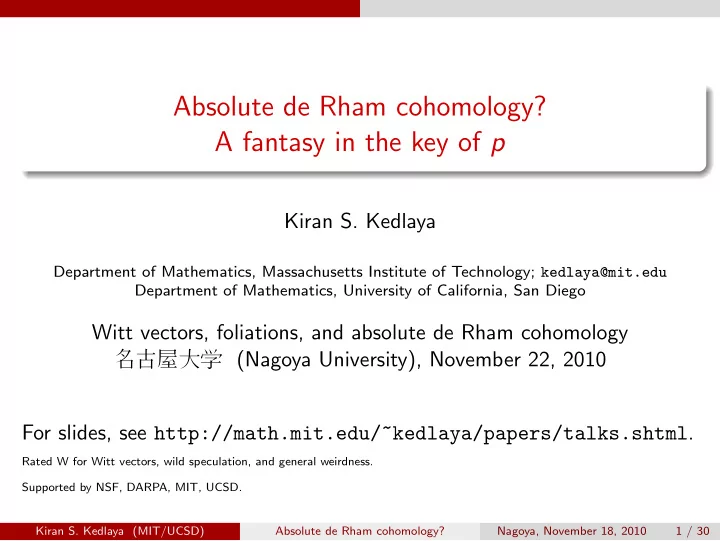
Absolute de Rham cohomology? A fantasy in the key of p Kiran S. - - PowerPoint PPT Presentation

absolute de rham cohomology a fantasy in the key of p
SMART_READER_LITE
LIVE PREVIEW

Absolute de Rham cohomology? A fantasy in the key of p Kiran S. - - PowerPoint PPT Presentation

Absolute de Rham cohomology? A fantasy in the key of p Kiran S. Kedlaya Department of Mathematics, Massachusetts Institute of Technology; kedlaya@mit.edu Department of Mathematics, University of California, San Diego Witt vectors, foliations, and


slide-1
SLIDE 1

Absolute de Rham cohomology? A fantasy in the key of p

Kiran S. Kedlaya

Department of Mathematics, Massachusetts Institute of Technology; kedlaya@mit.edu Department of Mathematics, University of California, San Diego

Witt vectors, foliations, and absolute de Rham cohomology 名古屋大学 (Nagoya University), November 22, 2010 For slides, see http://math.mit.edu/~kedlaya/papers/talks.shtml.

Rated W for Witt vectors, wild speculation, and general weirdness. Supported by NSF, DARPA, MIT, UCSD. Kiran S. Kedlaya (MIT/UCSD) Absolute de Rham cohomology? Nagoya, November 18, 2010 1 / 30

slide-2
SLIDE 2

Contents

1

Weil cohomologies and L-functions

2

The missing link: absolute cohomology

3

The de Rham-Witt complex

4

Nonarchimedean analytic geometry

5

p-adic Hodge theory

6

What next?

Kiran S. Kedlaya (MIT/UCSD) Absolute de Rham cohomology? Nagoya, November 18, 2010 2 / 30

slide-3
SLIDE 3

Weil cohomologies and L-functions

Contents

1

Weil cohomologies and L-functions

2

The missing link: absolute cohomology

3

The de Rham-Witt complex

4

Nonarchimedean analytic geometry

5

p-adic Hodge theory

6

What next?

Kiran S. Kedlaya (MIT/UCSD) Absolute de Rham cohomology? Nagoya, November 18, 2010 3 / 30

slide-4
SLIDE 4

Weil cohomologies and L-functions

Zeta functions and L-functions

For X a scheme of finite type over Z, the zeta function of X is defined in the halfplane Re(s) > dim(X) as the absolutely convergent Dirichlet series ζ(X, s) =

  • x∈X closed

(1 − #(κx)−s)−1. Many famous questions surround this function. Does it admit meromorphic continuation over C? Where do the poles and zeroes occur? What is the arithmetic meaning of the values ζ(X, s) when s ∈ Z? One can factor ζ(X, s) into L-functions corresponding to motives comprising X, and the same questions apply. E.g., for X the ring of integers in a number field, ζ(X, s) factors as the Riemann zeta function times Artin L-functions.

Kiran S. Kedlaya (MIT/UCSD) Absolute de Rham cohomology? Nagoya, November 18, 2010 4 / 30

slide-5
SLIDE 5

Weil cohomologies and L-functions

Weil cohomologies and spectral interpretations

For X of finite type over Fq, a Weil cohomology theory, mapping X to certain vector spaces Hi(X) over a field of characteristic zero, provides a spectral interpretation of ζ(X, s) via the formula ζ(X, s) =

  • i

det(1 − q−sFrobq, Hi(X))(−1)i+1. Existence of a Weil cohomology theory immediately implies analytic continuation for L-functions of pure motives comprising X. The Riemann hypothesis and the interpretation of special values lie deeper. A familiar example is ´ etale cohomology with values in Qℓ for any given ℓ = p. A possibly less familiar example is rigid cohomology, taking values in a suitable p-adic field; this is a form of de Rham cohomology in positive

  • characteristic. More on this in the next two slides.

Kiran S. Kedlaya (MIT/UCSD) Absolute de Rham cohomology? Nagoya, November 18, 2010 5 / 30

slide-6
SLIDE 6

Weil cohomologies and L-functions

p-adic Weil cohomology: origins

Dwork’s original proof of the rationality of zeta functions of varieties over finite fields used a p-adic analytic trace formula, without a cohomological

  • interpretation. Some links were found to differential forms (Katz).

Monsky and Washnitzer introduced formal cohomology for smooth affine varieties over positive characteristic fields. The idea: take a weakly complete lift in characteristic 0 and compute algebraic de Rham

  • cohomology. The lift is functorial up to homotopy (thanks to the

completion) and has well-behaved cohomology (thanks to weakness). Based on Grothendieck’s site-theoretic description of algebraic de Rham cohomology, Berthelot developed crystalline cohomology for smooth proper schemes over positive characteristic fields. This is again based on local lifting, in the form of infinitesimal thickenings with divided powers.

Kiran S. Kedlaya (MIT/UCSD) Absolute de Rham cohomology? Nagoya, November 18, 2010 6 / 30

slide-7
SLIDE 7

Weil cohomologies and L-functions

Rigid cohomology

Berthelot’s rigid cohomology takes values in K = W (Fq)[p−1]. Given X,

  • ne can locally embed X into some Y which lifts nicely (e.g., projective

space), cut out the tube in the generic fibre of the lift of Y , then compute de Rham cohomology on a strict neighborhood. This description can be made functorial using le Stum’s overconvergent site, and extends to algebraic stacks (Brown). It is true but nontrivial that this gives finite-dimensional vector spaces over

  • K. In fact, one has a good theory of coefficient objects resembling

algebraic D-modules (Berthelot, Caro, Chiarellotto, Crew, Kedlaya, Shiho, Tsuzuki, etc.)

Kiran S. Kedlaya (MIT/UCSD) Absolute de Rham cohomology? Nagoya, November 18, 2010 7 / 30

slide-8
SLIDE 8

The missing link: absolute cohomology

Contents

1

Weil cohomologies and L-functions

2

The missing link: absolute cohomology

3

The de Rham-Witt complex

4

Nonarchimedean analytic geometry

5

p-adic Hodge theory

6

What next?

Kiran S. Kedlaya (MIT/UCSD) Absolute de Rham cohomology? Nagoya, November 18, 2010 8 / 30

slide-9
SLIDE 9

The missing link: absolute cohomology

A modest proposal

Can one describe an absolute cohomology theory for schemes of finite type

  • ver Z, proving a spectral interpretation of ζ(X, s)? The correct form of

this question is suggested by: trace formulas for ζ and the like (Weil); analogies with phenomena appearing for foliated spaces (Deninger). The latter may (should?) be viewed as noncommutative spaces (Connes). Bonus question: does a related construction produce p-adic L-functions? These are only known in a few cases, where they are obtained by interpolation of archimedean special values. Double bonus question: can one explain special values this way? Triple bonus question: what about the Riemann hypothesis?

Kiran S. Kedlaya (MIT/UCSD) Absolute de Rham cohomology? Nagoya, November 18, 2010 9 / 30

slide-10
SLIDE 10

The missing link: absolute cohomology

Absolute ´ etale cohomology?

Lichtenbaum has proposed a variant of ´ etale cohomology, called Weil-´ etale cohomology, which would allow for the interpretation of special values. For the relationship with Deninger’s formalism, see Morin’s lecture. However, there are reasons to think that ´ etale cohomology is not the most natural way to look for a spectral interpretation of L-functions. Example (Weil): class field theory describes a reciprocity map GL1(AQ)/Q× = ′

v

v

  • /Q× → Gal(Qab/Q),

but this map fails to interpret the archimedean part of the id` ele class group.

Kiran S. Kedlaya (MIT/UCSD) Absolute de Rham cohomology? Nagoya, November 18, 2010 10 / 30

slide-11
SLIDE 11

The missing link: absolute cohomology

Absolute de Rham cohomology?

I’m instead looking for an analogue of rigid cohomology (absolute de Rham cohomology) that might provide a spectral interpretation of L-functions. In such a construction, archimedean and nonarchimedean places should enter on comparable footing; for instance, Hodge theory and p-adic Hodge theory would play corresponding roles in determining Euler factors. Various clues from arithmetic geometry point towards extracting absolute de Rham cohomology from an appropriate version of the de Rham-Witt complex, and suggest how one might get started doing that.

Kiran S. Kedlaya (MIT/UCSD) Absolute de Rham cohomology? Nagoya, November 18, 2010 11 / 30

slide-12
SLIDE 12

The de Rham-Witt complex

Contents

1

Weil cohomologies and L-functions

2

The missing link: absolute cohomology

3

The de Rham-Witt complex

4

Nonarchimedean analytic geometry

5

p-adic Hodge theory

6

What next?

Kiran S. Kedlaya (MIT/UCSD) Absolute de Rham cohomology? Nagoya, November 18, 2010 12 / 30

slide-13
SLIDE 13

The de Rham-Witt complex

p-typical Witt vectors

Fix a prime number p. The p-typical Witt vectors are an endofunctor Wp

  • n rings, such that Wp(R) has underlying set R{0,1,... }, and the ghost map

(r0, r1, r2, . . . ) → (r0, rp

0 + pr1, rp2 0 + prp 1 + p2r2, . . . )

is a natural transformation of rings for the product ring structure on the

  • target. For R a perfect Fp-algebra, Wp(R) is the unique strict p-ring with

Wp(R)/pWp(R) ∼ = R. If R is of characteristic p and carries a submultiplicative norm, one obtains

  • verconvergent subrings of Wp(R) by imposing growth conditions of the

form |ri|p−i ≤ abi (thanks to homogeneity of Witt vector arithmetic). This is true in a limited form for more general R.

Kiran S. Kedlaya (MIT/UCSD) Absolute de Rham cohomology? Nagoya, November 18, 2010 13 / 30

slide-14
SLIDE 14

The de Rham-Witt complex

The big Witt vectors

The big Witt vectors are an endofunctor W on rings, such that W(R) has underlying set RN (for N the positive integers), and the ghost map (rn)n∈N → (wn)n∈N, wn =

  • d|n

drn/d

d

is a natural transformation of rings for the product ring structure on the

  • target. The ring W(R) projects onto Wp(R) for each prime p, and carries

special operators Fn, Vn for n ∈ N (Frobenius and Verschiebung). There is also a multiplicative map R → W(R) taking r to [r] = (r, 0, 0, . . . ) (the Teichm¨ uller map). The rings W(R) are examples of λ-rings. In Borger’s philosophy, λ-ring structures stand in for descent data from Spec(Z) to Spec(F1), for F1 the mysterious field of one element. This extends the idea that λp-ring structures provide descent data from Spec(Zp) to Spec(Fp).

Kiran S. Kedlaya (MIT/UCSD) Absolute de Rham cohomology? Nagoya, November 18, 2010 14 / 30

slide-15
SLIDE 15

The de Rham-Witt complex

The big de Rham-Witt complex (after Hesselholt)

The module of K¨ ahler differentials ΩW(R) is naturally a λ-module over W(R), so the Frobenius maps Fn act naturally. (This is not the action given by viewing Fn as a ring endomorphism!) Form the quotient of the tensor algebra of ΩW(R) over W(R) by the relations da ⊗ da − d log[−1] ⊗ F2(da) (a ∈ R); this is the exterior algebra if 2−1 ∈ R. There is a natural further quotient WΩ·

R on which the maps Vn extend

and satisfy FndVn(ω) = dω + (n − 1)(d log[−1]) · ω (ω ∈ WΩ·

R).

This is the big absolute de Rham-Witt complex.

Kiran S. Kedlaya (MIT/UCSD) Absolute de Rham cohomology? Nagoya, November 18, 2010 15 / 30

slide-16
SLIDE 16

The de Rham-Witt complex

Variants of de Rham-Witt

From Hesselholt’s construction, one can recover other de Rham-Witt complexes appearing in the literature. These complexes appear in a variety

  • f ways and for a variety of reasons.

Inspired by Bloch’s p-typical curves in K-theory plus ideas of Lubkin, Deligne-Illusie introduced p-typical de Rham-Witt to compute crystalline cohomology of smooth proper schemes over a field of characteristic p. It also inspired their proof of degeneration of the Hodge-de Rham spectral sequence in characteristic 0. The p-typical construction was modified by Davis-Langer-Zink by introducing overconvergent Witt vectors, in order to compute rigid cohomology of smooth schemes over a field of characteristic p. This might work for stacks too (Brown-Davis). The p-typical construction behaves well for Z(p)-algebras. This can be used, for instance, to define Frobenius and monodromy operators on p-adic ´ etale cohomology for schemes over Qp (Hyodo-Kato).

Kiran S. Kedlaya (MIT/UCSD) Absolute de Rham cohomology? Nagoya, November 18, 2010 16 / 30

slide-17
SLIDE 17

The de Rham-Witt complex

Variants of de Rham-Witt (continued)

A relative de Rham-Witt complex was introduced by Langer and Zink to study relative crystalline cohomology. Absolute de Rham-Witt was introduced by Hesselholt and Madsen in

  • rder to compute topological Hochschild cohomology, with

applications to algebraic K-theory via the cyclotomic trace map. Their definition was a bit off at the prime 2; this was fixed by Costeanu. One can also interpret de Rham-Witt naturally in terms of homotopical algebra. See Barwick’s talk. There might even be links to string theory! See Stienstra’s talk. This (incomplete) list suggests the centrality of the de Rham-Witt construction.

Kiran S. Kedlaya (MIT/UCSD) Absolute de Rham cohomology? Nagoya, November 18, 2010 17 / 30

slide-18
SLIDE 18

The de Rham-Witt complex

Absolute de Rham-Witt and absolute cohomology

The differential graded algebra WΩ·

R only contains Z in its center, not

W(Z) (in contrast with the Langer-Zink construction). It thus seems to be trying to compute crystalline cohomology over F1. A further consistency with Connes’s program is that WΩ·

Z is a quotient of

Ω·

W(Z) by an explicit differential graded ideal generated in degree 1. In

  • ther words, de Rham-Witt defines a foliation on W(Z) compatible with

Frobenius and Verschiebung; in Borger’s philosophy, this corresponds to a foliation on Spec(Z) relative to F1. To understand L-functions, one must integrate complex analysis into the

  • construction. To understand how to do this, it will help to see how

nonarchimedean analytic geometry already plays a role.

Kiran S. Kedlaya (MIT/UCSD) Absolute de Rham cohomology? Nagoya, November 18, 2010 18 / 30

slide-19
SLIDE 19

Nonarchimedean analytic geometry

Contents

1

Weil cohomologies and L-functions

2

The missing link: absolute cohomology

3

The de Rham-Witt complex

4

Nonarchimedean analytic geometry

5

p-adic Hodge theory

6

What next?

Kiran S. Kedlaya (MIT/UCSD) Absolute de Rham cohomology? Nagoya, November 18, 2010 19 / 30

slide-20
SLIDE 20

Nonarchimedean analytic geometry

Several approaches to nonarchimedean analytic geometry

Analytic geometry can be thought of as the analogue of algebraic geometry in which the basic spaces correspond not to bare rings, but to Banach rings (rings complete for submultiplicative norms). Tate turns these rings into maximal spectra (spaces of maximal ideals). Raynaud’s formal geometry is related. Berkovich turns them into Gel’fand spectra (spaces of multiplicative real-valued seminorms). Huber turns them into adic spectra (spaces of multiplicative seminorms valued in totally ordered groups). The approach of Fujiwara-Kato is related. Since I’m interested in links with archimedean analytic geometry, I tend to favor Berkovich’s approach. But I would welcome counterarguments!

Kiran S. Kedlaya (MIT/UCSD) Absolute de Rham cohomology? Nagoya, November 18, 2010 20 / 30

slide-21
SLIDE 21

Nonarchimedean analytic geometry

Gel’fand spectra

Let A be a commutative Banach ring. Berkovich associates to A the compact topological space M(A) of multiplicative seminorms on A bounded by the given norm. (The resulting spaces are related to the polyhedral spaces used in tropical geometry.) This construction is usually made over a nonarchimedean analytic field like Qp, in which case one can restrict to affinoid algebras and recover a theory

  • f analytic spaces. See Temkin’s lecture.

However, at some price, one can work absolutely. In fact, there is no need to restrict to nonarchimedean seminorms!

Kiran S. Kedlaya (MIT/UCSD) Absolute de Rham cohomology? Nagoya, November 18, 2010 21 / 30

slide-22
SLIDE 22

Nonarchimedean analytic geometry

Nonarchimedean geometry of Witt vectors

Here is an example of an absolute construction in the theory of Berkovich

  • spaces. Let R be a perfect Fp-algebra carrying a power-multiplicative

norm α, and let oR be the subring of elements of norm at most 1. Then the formula (r0, r1, . . . ) → sup

i

{p−iα(ri)p−i} defines a power-multiplicative norm λ(α) on Wp(oR). The map λ : M(oR) → M(Wp(oR)) sections the projection µ : M(Wp(oR)) → M(oR) defined by µ(β)(r) = β([r]). In fact, there is a natural homotopical retraction of M(Wp(oR)) onto image(λ). This construction has consequences in p-adic Hodge theory.

Kiran S. Kedlaya (MIT/UCSD) Absolute de Rham cohomology? Nagoya, November 18, 2010 22 / 30

slide-23
SLIDE 23

p-adic Hodge theory

Contents

1

Weil cohomologies and L-functions

2

The missing link: absolute cohomology

3

The de Rham-Witt complex

4

Nonarchimedean analytic geometry

5

p-adic Hodge theory

6

What next?

Kiran S. Kedlaya (MIT/UCSD) Absolute de Rham cohomology? Nagoya, November 18, 2010 23 / 30

slide-24
SLIDE 24

p-adic Hodge theory

Comparison isomorphisms

Traditional Hodge theory revolves around the relationship between Betti and de Rham cohomology on a complex algebraic variety. The subject of p-adic Hodge theory concerns a similar relationship between p-adic ´ etale cohomology and de Rham cohomology for varieties over p-adic fields. For instance, let X be a smooth proper scheme over Zp. For a certain topological Qp-algebra Bcrys, one obtains a distinguished isomorphism Hi

et(XQp, Qp) ⊗Qp Bcrys ∼

= Hi

dR(XQp, Qp) ⊗Qp Bcrys

from work of Fontaine, Faltings, Tsuji, Nizio l, etc. Another way to say this is that de Rham cohomology can be recovered from ´ etale cohomology, and vice versa, using certain p-adic analytic constructions.

Kiran S. Kedlaya (MIT/UCSD) Absolute de Rham cohomology? Nagoya, November 18, 2010 24 / 30

slide-25
SLIDE 25

p-adic Hodge theory

Galois representations and vector bundles

A key component of p-adic Hodge theory is the analytic description of continuous representations of p-adic Galois groups on finite dimensional Qp-vector spaces. This has commonly been done using (ϕ, Γ)-modules (Fontaine, Colmez, Berger, etc.). It appears from work of Fargues-Fontaine (building on Kedlaya, Berger, Kisin, etc.) that one can instead use Γ-equivariant vector bundles on a certain one-dimensional scheme (the curve in p-adic Hodge theory). One uses only those which are semistable of degree 0, i.e., of degree 0 with no subbundles of positive slope. This evokes the Narasimhan-Seshadri correspondence between stable degree 0 vector bundles on a compact Riemann surface and irreducible unitary representations of π1.

Kiran S. Kedlaya (MIT/UCSD) Absolute de Rham cohomology? Nagoya, November 18, 2010 25 / 30

slide-26
SLIDE 26

p-adic Hodge theory

Geometry of the curve in p-adic Hodge theory

The study of M(Wp(R)) from the previous section implies that the Fargues-Fontaine curve, when analytified in a natural way, has the homotopy type of a circle. Better yet, one of the generators of the fundamental group corresponds to the Frobenius map on Bcrys! Wild question: is this curve the fibre at p of a scheme over Spec(Z) whose quotient by a one-dimensional group action is Connes’s arithmetic curve? And can one try to construct the whole arithmetic curve using a big Witt vector analogue of the construction of Fontaine’s period rings? A first step would be to rewrite the p-adic period rings in such a way that all references to p pass through the p-adic absolute value. It should be possible to do this by working directly with the Witt vectors of Qp and its extensions (Davis-Kedlaya).

Kiran S. Kedlaya (MIT/UCSD) Absolute de Rham cohomology? Nagoya, November 18, 2010 26 / 30

slide-27
SLIDE 27

p-adic Hodge theory

Relative p-adic Hodge theory

One should maybe think of p-adic ´ etale and de Rham together as a single cohomology theory. It would be helpful to make this theory work well in the relative setting. Work of Faltings (notably the almost purity theorem) provides some partial answers (Andreatta, Brinon, Iovit ¸a, etc.). An alternate approach (Kedlaya-Liu) goes through the following construction. Let k be a perfect field of characteristic p, and equip k((π)) with the π-adic norm with |π| = p−p/(p−1). Let R be any reduced affinoid algebra

  • ver k((π)) (or a completed direct limit of same), with the spectral norm.

For z = p−1

i=0 [1 + π]i/p, there is a natural homeomorphism

M(R) ∼ = M(Wp(oR)[[π]−1]/(z)). This can be used to show that the two rings have equivalent categories of finite ´ etale algebras, ´ etale Zp-local systems, and ´ etale Qp-local systems.

Kiran S. Kedlaya (MIT/UCSD) Absolute de Rham cohomology? Nagoya, November 18, 2010 27 / 30

slide-28
SLIDE 28

p-adic Hodge theory

Links to de Rham-Witt?

It would help greatly to understand how constructions in p-adic Hodge theory can be described in terms of de Rham-Witt. For example, for X a smooth proper Zp-scheme, absolute de Rham-Witt provides something like a Gauss-Manin connection on the relative de Rham-Witt cohomology. Can

  • ne use this connection to get back to p-adic ´

etale cohomology, by taking horizontal sections? Far wilder idea: can one do something like this globally to get to Weil-´ etale cohomology? Could this even provide a construction of the latter? Intermediate question: can one use the language of Fontaine’s rings with p replaced by the infinite place to articulate ordinary Hodge theory?

Kiran S. Kedlaya (MIT/UCSD) Absolute de Rham cohomology? Nagoya, November 18, 2010 28 / 30

slide-29
SLIDE 29

What next?

Contents

1

Weil cohomologies and L-functions

2

The missing link: absolute cohomology

3

The de Rham-Witt complex

4

Nonarchimedean analytic geometry

5

p-adic Hodge theory

6

What next?

Kiran S. Kedlaya (MIT/UCSD) Absolute de Rham cohomology? Nagoya, November 18, 2010 29 / 30

slide-30
SLIDE 30

What next?

What next?

That’s where you come in. Help me figure out where to go with this! Thanks for listening. Enjoy the conference!

Kiran S. Kedlaya (MIT/UCSD) Absolute de Rham cohomology? Nagoya, November 18, 2010 30 / 30