
SLIDE 1
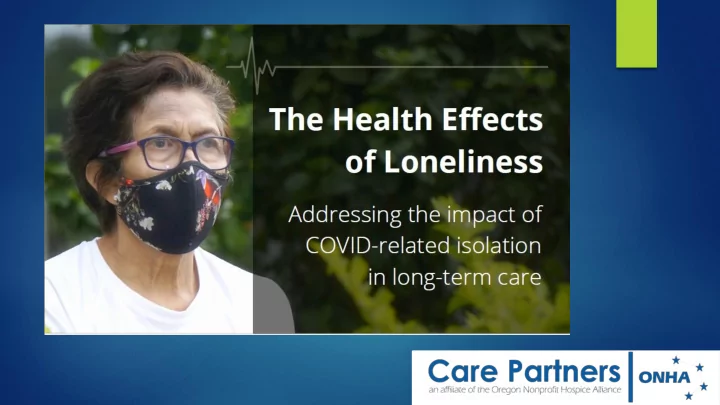
About Care Partners Exceptional hospice care since 1982, palliative - - PowerPoint PPT Presentation
About Care Partners Exceptional hospice care since 1982, palliative care since 2008 Our goals To support your staff and your operating procedures To enable the best care for your residents To increase family satisfaction
Exceptional hospice care since 1982, palliative care since 2008 Our goals
To support your staff and your operating procedures To enable the best care for your residents To increase family satisfaction
Unique Focused Care hospice programs by diagnosis:
https://youtu.be/FO2dUy-SMRg
CMS Guidance ODHS Additional Guidance
visitors/resident at a time
(or max 5, whichever is lower), may have visitors at one time
ODHS Provider Alert
Source: FDA: “Coronavirus Testing Basics”
A Rapid Antigen Test recently given FDA
Emergency Use Authorization
It is an anterior nasal swab test that will
provide results in 15 minutes
Administered by healthcare professionals in
point-of care settings
Abbott will sell this test for $5 each Studies have demonstrated the test to have
97.1% Sensitivity (probability of correctly
identifying positive cases)
98.5% Specificity (probability of correctly
identifying negative cases)
In late August, per federal gov’t orders, 150
million tests were shipped to “nursing homes, assisted living facilities, home health, and hospice agencies”
Best-Case Timeline (Estimated)
INITIAL EFFICACY & SAFETY NOV 2020 EUA** APPLICATION DEC 2020 3 VISITS/2 MOS ADMINISTRATION Q2 2021 EUA APPROVAL/ 1ST SHIPMENTS Q1 2021
Two vaccines (from Pfizer & Moderna) produced by mRNA technology are currently close to releasing interim efficacy and safety data*
These vaccines require two doses 1 month apart
Two other vaccines (from J&J & AstraZeneca) produced with adenoviral vectors have each had a serious adverse event but are continuing in development
HHS & OHCA announced pre-registration for vaccine distribution to LTCs 10/19
Distribution to be managed by Walgreens and CVS
WHO also estimates Q2 2021
* 50% greater effect than placebo + 2 months of safety follow up since last dose **EUA = Emergency Use Authorization from FDA
Overall COVID-19 death rate appears to be declining (papers from NYU and UK
being published this week), however
Data have been limited and conflicting Death rates in people over age 75 remain higher than in younger age groups
What is known:
Outcome of ventilation is generally poor Steroids and anti-coagulants may be beneficial Convalescent plasma data is mixed (Lilly antibody derived from recovered COVID-19
infected patients was discontinued due to lack of effect)
Veklury (remdesivir) received full FDA approval on 10/23
Based on time to recovery in hospitalized patients age 12 and older, but has not
demonstrated a clear survival benefit
NIH is conducting follow-on studies (ACTIV-5) evaluating two approved monoclonal
antibodies used in autoimmune disease + remdesivir to see if mortality is improved
*Modified version created in 2004 from original 20 questions
Least lonely -- Most Lonely
Assess (new) resident history Include opportunities to for contribution Develop groups that foster relationships What forms of group participation are meaningful?
Source: The Need for a Social Revolution in Residential Care, K. Theurer et al. Journal of Aging Studies (2015) 201-210
A resident who was living with
A resident who is grieving after
A resident who is experiencing
A resident who used to engage
ODHS announced that CMP funds can be
used to buy communications devices ($3K max/community)
Pads may also be available to borrow from
different organizations (Care Partners has an iPad “lending library”)
Many residents will become comfortable
managing the interface on their own after 2
Those with cognitive impairment may need a
staff member to start the meeting and monitor the connection
Go through an old photo album and share memories Listen to a concert or a few favorite pieces of music together Have them remotely advise you with making a family recipe or with a household project Schedule a regular date with several family members
for afternoon tea or coffee
Do a good night FaceTime each evening Create art together – send special materials like
pressed flowers or magazine photos in advance