AB3DMOT: A Baseline for 3D Multi-Object Tracking and New Evaluation - - PowerPoint PPT Presentation

β–Ά
ab3dmot a baseline for 3d multi object tracking and new
SMART_READER_LITE
LIVE PREVIEW

AB3DMOT: A Baseline for 3D Multi-Object Tracking and New Evaluation - - PowerPoint PPT Presentation

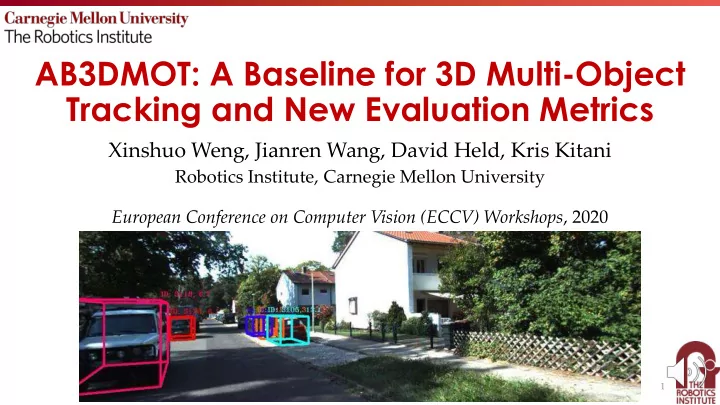
AB3DMOT: A Baseline for 3D Multi-Object Tracking and New Evaluation Metrics Xinshuo Weng, Jianren Wang, David Held, Kris Kitani Robotics Institute, Carnegie Mellon University European Conference on Computer Vision (ECCV) Workshops , 2020 1


slide-1
SLIDE 1

AB3DMOT: A Baseline for 3D Multi-Object Tracking and New Evaluation Metrics

Xinshuo Weng, Jianren Wang, David Held, Kris Kitani

Robotics Institute, Carnegie Mellon University European Conference on Computer Vision (ECCV) Workshops, 2020

1

slide-2
SLIDE 2

Standard 3D MOT Pipeline

2

3D Object Detection Data Association

Evaluation Sensor Data

slide-3
SLIDE 3

Standard 3D MOT Pipeline

3

3D Object Detection Data Association

Evaluation Sensor Data

LiDAR point clouds RGB frames

slide-4
SLIDE 4

Standard 3D MOT Pipeline

4

3D Object Detection Data Association

Evaluation Sensor Data

Detection results

slide-5
SLIDE 5

Standard 3D MOT Pipeline

5

3D Object Detection Data Association

Evaluation Sensor Data

3D MOT results

slide-6
SLIDE 6

Standard 3D MOT Pipeline

6

Also important!

3D Object Detection Data Association

Evaluation Sensor Data

Evaluation:

  • 1. MOTA: MOT accuracy
  • 2. MOTP: MOT precision
  • 3. IDS: # of identity switches
  • 4. FRAG: # of trajectory

fragments

  • 5. ……
slide-7
SLIDE 7

Standard 3D MOT Pipeline

7

3D Object Detection Data Association

Evaluation Sensor Data

Limitation: ignore practical factors such as speed and system complexity Limitation: appropriate 3D MOT evaluation is not available

slide-8
SLIDE 8

8

Our Contributions

  • 1. A 3D MOT evaluation tool along with three

integral metrics

  • 2. A strong and simple 3D MOT system with

the fastest speed (207.4 FPS)

slide-9
SLIDE 9

What are the Issues of 3D MOT Evaluation?

  • Matching criteria: IoU (intersection of union)
  • For the pioneering 3D MOT dataset KITTI, evaluation is performed in the 2D space
  • IoU is computed on the 2D image plane (not 3D)
  • The common practice for evaluating 3D MOT methods is:
  • Project 3D trajectories onto the image plane
  • Run the 2D evaluation code provided by KITTI

9

IoU in 2D space

Image credit to Xu et al: 3D-GIoU

IoU in 3D space

Bp: the predicted box Bg: the ground truth box Bc: the smallest enclosing box I2D, I3D: the intersection

slide-10
SLIDE 10

Our Solution: Upgrade the Matching Criteria to 3D

10

  • Replace the matching criteria (2D IoU) in the KITTI evaluation code with 3D IoU
  • https://github.com/xinshuoweng/AB3DMOT (800+ stars)
  • Work with nuTonomy collaborators and use our 3D MOT evaluation metrics in the

nuScenes evaluation with the matching criteria of center distance

  • https://www.nuscenes.org/

Our released new evaluation code nuScenes 3D MOT evaluation with our metrics

slide-11
SLIDE 11

What are the Issues of Evaluation?

  • Are we done with the evaluation? Can we further

improve the current metrics?

  • E.g., MOTA (multi-object tracking accuracy)
  • π‘π‘ƒπ‘ˆπ΅ = 1 βˆ’ 𝐺𝑄 +𝐺𝑂+𝐽𝐸𝑇

π‘œπ‘£π‘›π‘•π‘’

  • Performance is measured at a single recall point
  • Cannot understand the full spectrum of accuracy of a MOT

system

11

MOTA over Recall curve

slide-12
SLIDE 12

Our Solution: Integral Metrics

  • MOTA is measured at a single point on the curve
  • What can we do to improve the evaluation metrics?
  • Compute the integral metrics through the area under the

curve, e.g., average MOTA (AMOTA)

  • Analogous to the average precision (AP) in object detection
  • Can measure the full spectrum of MOT accuracy

12

MOTA over Recall curve

Area under the curve

slide-13
SLIDE 13

13

Our Contributions

  • 1. A 3D MOT evaluation tool along with three

integral metrics

  • 2. A strong and simple 3D MOT system with

the fastest speed (207.4 FPS)

slide-14
SLIDE 14

14

AB3DMOT: A Baseline for 3D Multi-Object Tracking

  • Motivation
  • Reduce system complexity of 3D MOT methods
  • Increase the computational efficiency (i.e., run

time speed)

  • Simple design: 3D Kalman filter + Hungarian

algorithm

  • 3D Kalman filter
  • Extension of standard 2D Kalman filter
  • Add object’s 3D property into the state space
  • High speed:
  • 207.4 FPS on the KITTI dataset for Cars
  • 470.1 FPS on the KITTI dataset for Pedestrians
  • 1241.6 FPS on the KITTI dataset for Cyclists
  • Strong 3D MOT performance competitive to

more complicated systems

KITTI MOT leaderboard by end of 2019

slide-15
SLIDE 15

15

AB3DMOT: A Baseline for 3D Multi-Object Tracking

  • System pipeline (5 modules)
  • 3D object detection

3D Kalman filter: state prediction

  • Hungarian algorithm

3D Kalman filter: state update

  • Birth and death memory

Dunmatch Test Tt-1 3D Object Detection

3D Kalman Filter

Dt

Data Association (Hungarian algorithm)

State prediction

Tunmatch Dmatch/Tmatch

Birth and Death Memory

State update

Tt

Tnew/Tlost

Associated Trajectories

LiDAR Point Cloud

slide-16
SLIDE 16

16

Quantitative Results

slide-17
SLIDE 17

17

3D MOT Evaluation on KITTI for Cars

  • Our 3D MOT system runs at the fastest speed without the need of a GPU
  • Our simple system outperforms two more complicated 3D MOT systems
slide-18
SLIDE 18

18

Qualitative Results

slide-19
SLIDE 19

Qualitative Results for Cars

6

slide-20
SLIDE 20

Qualitative Results for Pedestrians / Cyclists

6

slide-21
SLIDE 21

AB3DMOT: A Baseline for 3D Multi-Object Tracking and New Evaluation Metrics

Xinshuo Weng, Jianren Wang, David Held, Kris Kitani

Robotics Institute, Carnegie Mellon University European Conference on Computer Vision (ECCV) Workshops, 2020

21