AB 86: Adult Education Los Angeles Regional Adult Education - - PDF document

ab 86 adult education
SMART_READER_LITE
LIVE PREVIEW

AB 86: Adult Education Los Angeles Regional Adult Education - - PDF document

AB 86: Adult Education Los Angeles Regional Adult Education Consortium All Districts Faculty General Meeting October 3, 2014 http://ab86.cccco.edu


slide-1
SLIDE 1
  • AB 86: Adult Education

Los Angeles Regional Adult Education Consortium All Districts’ Faculty General Meeting

October 3, 2014 http://ab86.cccco.edu

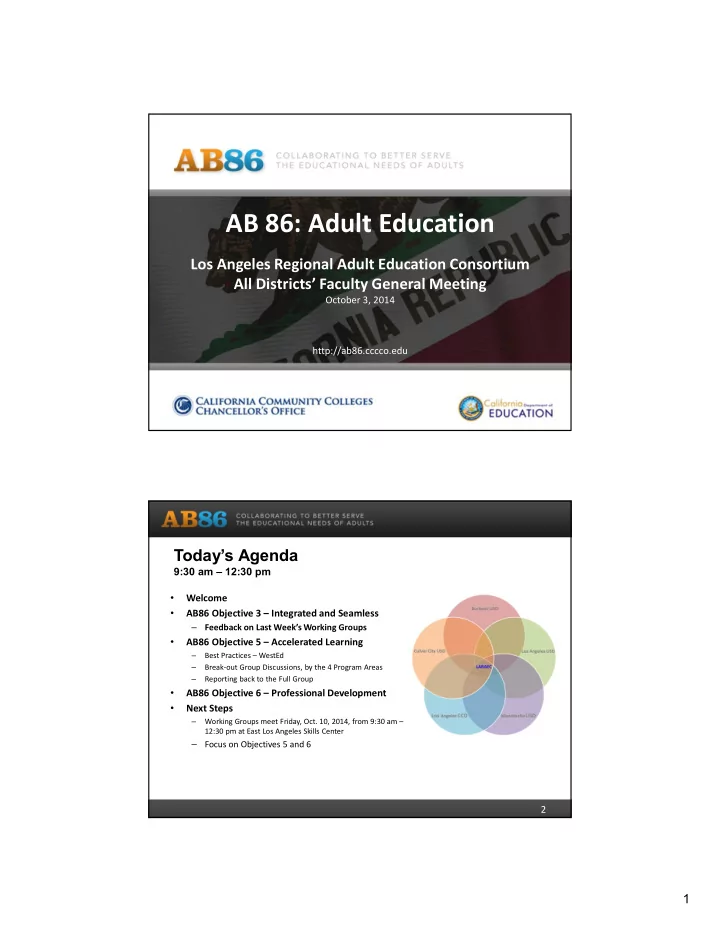
  • Welcome
  • AB86 Objective 3 – Integrated and Seamless
  • Feedback on Last Week’s Working Groups
  • AB86 Objective 5 – Accelerated Learning
  • Best Practices – WestEd
  • Break-out Group Discussions, by the 4 Program Areas
  • Reporting back to the Full Group
  • AB86 Objective 6 – Professional Development
  • Next Steps
  • Working Groups meet Friday, Oct. 10, 2014, from 9:30 am –

12:30 pm at East Los Angeles Skills Center

  • Focus on Objectives 5 and 6

2

slide-2
SLIDE 2
  • The LARAEC will sustain, expand and improve adult education to our region.
  • Creates seamless programs and pathways to workforce and higher education

that are regionally relevant, efficient, and comprehensive

  • Leverages community resources through a structured and collaborative inter-

agency approach

  • Provides programs that are student centered, data driven, focused on best

practices and that reduce existing gaps in programs and services

  • Prepares students with 21st century skills that meet their employment,

academic and civic goals ensuring that they contribute to the economic vitality

  • f the Los Angeles region
  • Establishes vehicles for collaborative professional development that improve

student outcomes 3

5 Program Areas

1. Elementary and Secondary Basic Skills 2. Classes for Immigrants 3. Programs for Adults with Disabilities 4. Short Term CTE Programs 5. Programs for Apprentices

7 Objectives

1. Evaluation of existing AE programs 2. Evaluation of AE needs 3. Plans to integrate programs 4. Plans to address the gaps 5. Plans to accelerate students’ progress 6. Plans to collaborate on provision of professional development 7. Plans to leverage existing regional structures

  • 4
slide-3
SLIDE 3
  • !"#$"%"&%%

'(%"

  • Curriculum Alignment
  • Assessment
  • Bridges and Pathways
  • Counseling
  • Partner/Business Collaboration
  • Technology, including Data-sharing, and Tracking

5

!"#) '"%"

Academic/Career Pathways to Employment Alignment of: Curriculum Alignment Assessments and Placement Student Progress Indicators Major Outcomes Transition Strategies Bridges and Pathways Counseling and Student Services Partner/Business Collaboration Technology

!"#

  • $
  • %

$$ $ &

  • ' !"
  • 6
slide-4
SLIDE 4

(

!"#)*(%"%

Plans to employ approaches proven to accelerate a student’s progress toward his or her academic or career goals, such as contextualized basic skills and career technical education, and other joint programming strategies between adult education and career technical education. 7

!"#)*&("(%+%#"(%"""%%",%+% +%%%%(-+"."(/ 0((%%"+("- "+%!"%%"%" ",(""%%"+("1 AB86 RFP: Research has emerged in recent years identifying practices that reduce the time it takes for adult learners to progress through basic skills and career education pathways. Common strategies include compressing courses into shorter, more intensive terms (accelerated), individualized instruction based on a student’s competencies (competency-based), and putting basic skills content into the context of a student’s goals and career path (contextualized). Many examples of these “best practices” are already in place within and among California adult education and community college

  • programs. These “best practices” are not new to faculty; in fact, they have been developed by faculty. AB86 expects that the work

done by regional consortia will include plans to make use of these strategies within their basic skills and career programs and in joint programming strategies. In many places in the country, Integrated Basic Skills Training (IBEST) models, which contextualize the development of basic skills with the acquisition of workforce competency, have produced impressive data showing how learning can be accelerated while joining skills development with career readiness certifications. The AB86 website will continue to build links and resources tied to best practices and research done through adult education and community colleges. Qualitative Narrative: Identify plans to implement and/or improve specific evidence-based strategies across the region, within and between systems where they currently don’t exist, to accelerate student’s progress. Plans should address:

  • How the consortium will identify and gather measurable improvement metrics
  • How existing best practices and strategies such as those described earlier will be implemented for each of the program

areas.

8
slide-5
SLIDE 5

)

!"#)*(%"% Best Practices – WestEd

9

!"#)*&("(%+%#"(%"""%%",%+% +%%%%(-+"."(/ 0((%%"+("- "+%!"%%"%" ",(""%%"+("1 Focus Today Also Required for the Planning Grant Description of Approach Tasks/ Activities Needed to Implement the Approach Resources Needed Estimated Cost Responsible Parties Assessment Methods Time Line

10

slide-6
SLIDE 6

*

!"#)*&("(%+%#"(%"""%%",% +%+%%%%(-+"."(/ 0((%%"+( "-"+%!"%%"%" ",(""%% "+("1

Focus Today Description of Approach Potential Tasks/ Activities Needed to Implement the Approach

(%"%2%0+"

11

+ ,'-$)

  • +

.

  • +

. $ (+ /

  • )+
  • '((3%4

!"#*(%"% !"#)*&("(%+%#"(%"""%% ",%+%+%%%%(-+"."(/ 0(( %%"+("-"+%!"%%"%" ",(" "%%"+("1

slide-7
SLIDE 7

5%06"3% !"#*

Program Areas Specialty Room Core Leadership Team Member KH Consulting Group/WestEd Facilitator Elementary and secondary basic skills; high school diploma or high school equivalency certificate Basic Skills English 106 Gayla Kraetsch Hartsough Basic Skills Math 117 Jeffrey Hartsough Citizenship and ESL for immigrants and non-English speakers ESL VESL 102 WestEd ESL General 215 Heather Sims Education programs for adults with disabilities AWD General 210 WestEd Basic skills workforce preparation, short-term CTE, and apprenticeships CTE General 120 Charlotte Maure

13 Report out

  • 1. Elementary and secondary basic skills; high school

diploma or high school equivalency certificate

  • 1. English
  • 2. Math
  • 2. Citizenship and ESL for immigrants
  • 1. ESL
  • 2. VESL
  • 3. Education programs for adults with disabilities
  • 4. Basic skills workforce preparation, short-term CTE, and

apprenticeships (

!"#)*&("(%+%#"(%"""%% ",%+%+%%%%(-+"."(/ 0(( %%"+("-"+%!"%%"%" ",(" "%%"+("1

slide-8
SLIDE 8

1

!"#)7&%8(4#("

Plans to collaborate in the provision of ongoing professional development

  • pportunities for faculty and other staff to help them achieve greater program

integration and improve student outcomes. 15

!"#)7&("(( %""+%#8%8(#(" %""8%8(""+%"88"+("++#%"%%% "%"%#"""1

AB86 RFP: A critical element to ensuring the effective implementation of the consortium’s plans to improve adult education programs are faculty and staff equipped with the skills, knowledge, and support needed to deliver high-quality instruction and use classroom support strategies that foster learner persistence and goal achievement. Significant and effective professional development will be required to build capacity within the existing systems to deliver this new vision for adult learning throughout the state. Faculty and staff from all local consortium members and partners will need to implement collaborative professional development strategies to foster alignment and to support ongoing assessment and improvement of student outcomes. Qualitative Narrative: Collaborative professional development plans should identify topic areas the consortium considers a priority, such as:

  • Practices in basic and secondary skills that build the “college readiness” skills.
  • Team building, critical thinking, problem solving, study skills, soft skills, and career assessment.
  • Technology use and integration to enhance and expand technology in Instruction.
  • New models and instructional strategies for contextualized and/or accelerated teaching and learning.
  • Skills building intercultural competence among faculty, staff, and administrators.

Examples of collaborative activities might include developing professional learning communities comprising faculty in the same content area, representing all consortium participants. Plans might also describe joint team participation in professional development activities offered through regional/statewide associations and how these teams might share what they learn with

  • ther faculty. Consortia may also want to consider having field experts come to a regional facility to provide in-house training to

greater numbers of staff, faculty and administrators. Consortia in areas where transportation may pose a problem may want to develop plans to use technology to overcome that challenge.

16

slide-9
SLIDE 9

2

Modified Open Space

What is Open Space?

  • Based in the belief that organizations

and communities run on passion and responsibility

  • Parallel discussions around a central

theme

  • Participants create and manage their
  • wn Agenda
  • Self-organize around what you really

care about to get things done

Where has it been used?

  • Develop strategic plans and bring

perceived adversaries together Kick-start end to Apartheidism in South Africa Bring Palestinians and Israelis together to talk about peace

  • Design new approaches to cancer

research

  • Increase efficiency and revenue
  • Design land use
  • Create new products
  • Discuss ethnicity and culture

17 The Law of Two Feet means you take responsibility for what you care about.

  • You can move to whatever place you can best contribute or learn.

Whoever comes is the right people.

  • Whoever is attracted to the same conversation are the people who can

contribute most to that conversation – because they care.

  • You can enter any discussion as you feel inspired.

Whatever happens is the only thing that could have.

  • We are all limited by our own pasts and expectations.
  • We’ll all do our best to focus on NOW, and not get bogged down in what could’ve
  • r should’ve happened.

When it's over, it's over.

  • The creative spirit has its own time. Creativity has its own rhythm.
  • When you believe you have gotten your ideas captured, you can leave.

We will capture and share the ideas with you and the Working Groups next week.

Modified Open Space: Ground Rules

slide-10
SLIDE 10

3

Objective #6: Plans to collaborate in the provision of ongoing professional development opportunities for faculty and other staff to help them achieve greater program integration and improve student outcomes.

On the left side of the room, brainstorm: Current Effective Professional Development Strategies

  • Identify current, effective

professional development strategies carried out by consortium members that could be adapted for consortium-wide use. On the right side of the room, brainstorm: Collaborative Professional Development Plan

  • Address topics the consortium considers

priorities for collaborative professional development.

  • Include, at a minimum, ideas to:

Help achieve integration among consortium members Improve student outcomes 19

  • Montebello USD
  • Culver City USD and Burbank USD
  • LAUSD
  • LACCD
  • New integration or collaborative models
  • Faculty and staff development priorities
  • Optimal student learning outcomes
  • Instructional delivery models
  • Curriculum development
  • Best practices that can be adapted
  • Use of technology

20

Objective #6: Professional Development (PD)

Current Effective Professional Development Strategies Collaborative Professional Development Plan Topic PD Strategy Program Area(s) Addressed Estimated Costs to Implement Consortium- Wide Topic Collaborative PD Strategy Program Area(s) Addressed Estimated Costs to Implement Consortium- Wide

slide-11
SLIDE 11
  • 597:.";"4"

Date Time Where Purpose Friday, Oct. 10, 2014 9:30 am – 12:30 pm East Los Angeles Skills Center Working Group Meetings on Objectives 5 and 6 Friday, Oct. 17, 2014 9:30 am – 12:30 pm East Los Angeles Skills Center General Meeting Report out from Working Groups Objective 5 on Accelerated Learning Objective 6 on Professional Development Discuss next steps November 2014 or December 2014 TBD TBD General Meeting – Follow up

21