AAM Ecosystem Working Groups (AEWG): Urban Air Mobility (UAM) - - PowerPoint PPT Presentation

aam ecosystem
SMART_READER_LITE
LIVE PREVIEW

AAM Ecosystem Working Groups (AEWG): Urban Air Mobility (UAM) - - PowerPoint PPT Presentation

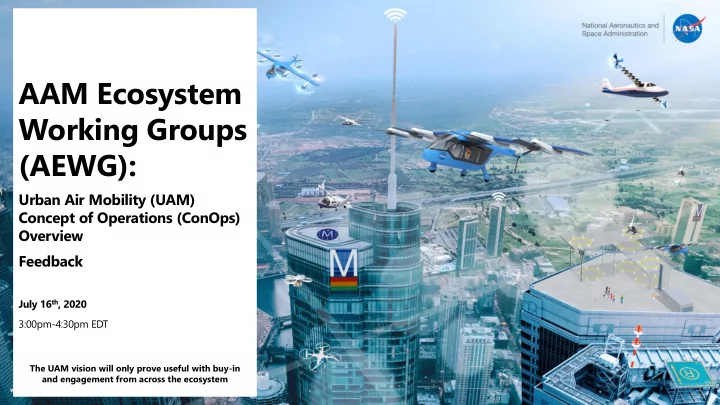
AAM Ecosystem Working Groups (AEWG): Urban Air Mobility (UAM) Concept of Operations (ConOps) Overview Feedback July 16 th , 2020 3:00pm-4:30pm EDT The UAM vision will only prove useful with buy-in and engagement from across the ecosystem


slide-1
SLIDE 1

AAM Ecosystem Working Groups (AEWG):

Urban Air Mobility (UAM) Concept of Operations (ConOps) Overview Feedback

July 16th, 2020 3:00pm-4:30pm EDT

The UAM vision will only prove useful with buy-in and engagement from across the ecosystem

slide-2
SLIDE 2

Agenda

July 16th, 2020

3:00pm-4:30pm

Topic Content Presenters Timing Duration

Welcome UAM ConOps Overview Recap Introductions Brief review to spur conversation Misty Davies Michael Patterson Jim Murphy 3:00-3:10 0:10 Session Engagement Ground Rules How we will handle feedback from 100 over the next 60 or so minutes. Misty Davies 3:10-3:15 0:05 Feedback from the Audience Open mic Questions from chat Questions from original ConOps overview session N/A 3:15-4:30 1:15

slide-3
SLIDE 3

Speakers

  • Dr. Misty Davies, National Aeronautical and Space Administration (NASA)

System Wide Safety Deputy Project Manager, NASA Ames Research Center AAM Ecosystems Crosscutting Working Group Lead

  • Dr. Michael Patterson, National Aeronautical and Space Administration (NASA)

Aerospace Technologist, NASA Langley Research Center Jim Murphy, National Aeronautical and Space Administration (NASA) Integration Manager, NASA Ames Research Center Nancy Mendonca, National Aeronautical and Space Administration (NASA) Deputy Team Lead, UAM Coordination and Assessment Team (UCAT), NASA COR

slide-4
SLIDE 4

Urban Air Mobility Community Concept of Operations

“Vision ConOps”

  • High-level – Providing a vision of key

concepts in the future

  • Broad covering all pillars

Scope

  • Passenger-carrying operations
  • Vision at the Intermediate state (UML-4)
  • Placing air mobility within reach of the

general public (i.e., realistic / cost effective transportation choice for general public) Vision ConOps (Structure Based on NASA OpsCon)

UAM Vision Revolutionize mobility around metropolitan areas by enabling a safe, efficient, convenient, affordable, and accessible air transportation system Airspace System Design & Implementation Airspace & Fleet Operations Management Vehicle Development & Production Individual Vehicle Management & Operations Community Integration

4

slide-5
SLIDE 5

Pre-Flight Take-off Climb & Cruise Descend Land/De-Plane Operator

  • Request performance

authorization

  • File operations plan
  • Confirm vehicle ready for

departure

  • Approves taxi/takeoff

authorization and execute take-off

  • Conformance monitoring
  • Vehicle monitoring
  • Maintain open data exchange with

U4-PSU and vehicle

  • Conformance monitoring
  • Vehicle monitoring
  • Maintain open data exchange with

U4-PSU and vehicle

  • Conformance monitoring
  • Ready for turnaround

U4-PSU

  • Initiate take-off planning
  • Transmit taxi/takeoff authorization

and departure sequencing command

  • Conformance monitoring
  • Communicate updated operations

plan

  • Maintain open data exchange
  • Conformance monitoring
  • Communicate and sequencing of

route changes, issues landing clearance

  • Confirm all clear for vehicle

landing

FAA

  • Automated Operations Plan

approval (through data exchange) No active participation but maintain authority over airspace

Vertiport Operator

  • Screen passengers & cargo
  • Perform vehicle boarding
  • Confirm all clear for departure
  • Confirm all clear for vehicle

departure

  • N/A
  • Confirm vertiport clear for vehicle

landing

  • Allocate landing pad
  • Confirm landing area is clear
  • Deplane vehicle

Vehicle

  • Perform systems check
  • Confirm ready for departure
  • Execute take-off procedure and

sequencing

  • Execute climb & cruise procedures
  • Maintain vehicle-to-vehicle

performance-based separation

  • Monitor systems & push vehicle

health and status to operator

  • Execute descent procedure and

sequencing

  • Maintain vehicle-to-vehicle

performance-based separation

  • Scan and confirm all clear for

landing

  • Execute landing

UAM Nominal Gate-to-Gate Operations Overview

UAM operations are highly collaborative & rely on constant information exchange between stakeholders

5

slide-6
SLIDE 6

Discussion Ground Rules

We will be utilizing the microphone and chat features on the MS Teams platform.

  • Leave your cameras/webcams off to preserve WiFi bandwidth
  • Enter comments/questions in the chat function on the right side of the screen
  • Use your mute/unmute button
  • Type “REQUEST TO SPEAK: [Insert First & Last Name]” in the chat box to notify the

emcee that you would like to verbally comment/ask a question

  • Say your name and affiliation before you begin speaking
  • Speak loudly and clearly
  • You will be given up to 90 seconds (1.5 minutes) to verbally comment/ask a

question

  • Be professional in all verbal and written comments/questions
slide-7
SLIDE 7

7

Backup

slide-8
SLIDE 8

UML Unlock Timeline

8 ~2028 ~2026 ~2023 Image Source: NASA AAM Ecosystem Working Group Kickoff

slide-9
SLIDE 9

Design, manufacture, and system readiness of UAM vehicles Operations and maintenance

  • f a single UAM vehicle,

independent of the sharing of airspace or other system resources Societal integration and acceptance of UAM operations Operations and management

  • f multiple vehicles within a

UAM system that enable safe and efficient sharing of airspace and other system resources Design, development, and implementation of infrastructure to enable safe and efficient multi-vehicle UAM operations

UAM Vision and Framework

9

Airspace System Design & Implementation Airspace & Fleet Operations Management Vehicle Development & Production Individual Vehicle Management & Operations Community Integration

Vehicle Barriers Airspace Barriers Community Integration Barriers

Urban Air Mobility (UAM) Vision: Revolutionize mobility around metropolitan areas by enabling a safe, efficient, convenient, affordable, and accessible air transportation system for passengers and cargo

slide-10
SLIDE 10

UAM Framework and Barriers

10

Vertiports Autonomy Noise Regulations/Certification Affordability Security

  • 1. Vehicle Design & Integration
  • 2. Airworthiness Standards &

Certification

  • 3. Vehicle Noise
  • 4. Weather-Tolerant Vehicles
  • 5. Cabin Acceptability
  • 6. Manufacturing & Supply Chain
  • 1. Safe Urban Flight Management
  • 2. Increasingly Automated Vehicle

Operations

  • 3. Certification & Ops Approval
  • 4. Ground Ops & Maintenance
  • 1. Public Acceptance
  • 2. Supporting Infrastructure
  • 3. Operational Integration
  • 4. Local Regulatory

Environment & Liability

  • 1. Safe Airspace Ops
  • 2. Efficient Airspace Ops
  • 3. Scalable Airspace Ops
  • 4. Resilient Airspace Ops
  • 5. Fleet Management
  • 6. Urban Weather Prediction
  • 1. Airspace System Design &

Implementation

  • 2. Operational Rules, Roles, &

Procedures

  • 3. CNSI & Control Facility

Infrastructure

  • 4. Vertiport Design

Safety

Airspace System Design & Implementation Airspace & Fleet Operations Management Vehicle Development & Production Individual Vehicle Management & Operations Community Integration

Vehicle Barriers Airspace Barriers Community Integration Barriers

slide-11
SLIDE 11

Vehicles Airspace Community

11

UML-1

Late-Stage Certification Testing and Operational Demonstrations in Limited Environments

Aircraft certification testing and operational evaluations with conforming prototypes; procedural and technology innovation supporting future airspace

  • perations (e.g. UTM-inspired); community/market demonstrations and data collection

UML-2

Low Density and Complexity Commercial Operations with Assistive Automation

Type certified aircraft; initial Part 135 operation approvals; limited markets with favorable weather and regulation; small UAM network serving urban periphery; UTM Construct and UAM routes supporting self-managed operations through controlled airspace

UML-3

Low Density, Medium Complexity Operations with Comprehensive Safety Assurance Automation

Operations include urban core; operational validation of advanced airspace operations and management including UTM inspired ATM, CNSI, C^2, and automation for scalable, weather-tolerant operations; few high-capacity vertiports; noise compatible with urban soundscape; model-local regulations

UML-4

Medium Density and Complexity Operations with Collaborative and Responsible Automated Systems

100s of simultaneous operations; expanded networks including closely-spaced high throughput vertiports; many UTM inspired ATM services available, simplified vehicle operations for credit; low-visibility operations

UML-5

High Density and Complexity Operations with Highly-Integrated Automated Networks

1,000s of simultaneous operations; large-scale, highly-distributed networks; high-density UTM inspired ATM; autonomous aircraft and remote, M:N fleet management; high-weather tolerance including icing; high-volume manufacturing

UML-6

Ubiquitous UAM Operations with System-Wide Automated Optimization

10,000s of simultaneous operations (capacity limited by physical infrastructure); ad hoc landing sites; noise compatible with suburban/rural operations; private ownership & operation models enabled; societal expectation

INITIAL STATE MATURE STATE INTERMEDIATE STATE

UAM Framework and Barriers

UAM Maturity Levels (UML)
slide-12
SLIDE 12

Key Elements of Airspace at UML-4

  • U4 UAM Operations Environment (U4-UOE) – Dynamic

airspace volumes with high UAM activity

  • U4 Provider of Services to UAM (U4-PSU) – Federated 3rd

party suppliers of services including air traffic management

12

UAM Maturity Level (UML)-Level 4 : Medium Density and Complexity Operations with Collaborative and Responsible Automated Systems

Other Characteristics

  • Advanced automation (vehicles and air traffic

management) largely human over the loop

  • High performance vehicles (e.g., EVTOL)) capable of

detect and avoid and performance based separation

  • All vehicles operating in U4-UOE are appropriately

equipped and actively participate in U4-UOE

  • U4-UAM is characterized by medium density
  • perations between closely-spaced, high throughput

vertiport

  • Higher throughout combined with lower operating costs

reduce per passenger price & place air travel within reach

  • f the general public as a practical mode of

transportation)

slide-13
SLIDE 13

13

slide-14
SLIDE 14

14