
SLIDE 1
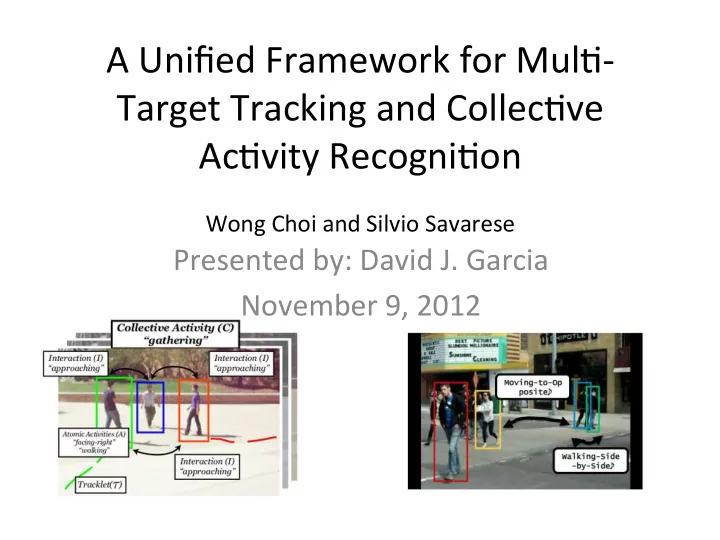
A Unified Framework for Mul4- Target Tracking and Collec4ve - - PowerPoint PPT Presentation
A Unified Framework for Mul4- Target Tracking and Collec4ve Ac4vity Recogni4on Wong Choi and Silvio Savarese Presented by: David J. Garcia November 9,
[1] ¡W. ¡Choi, ¡S. ¡Savarese. ¡A ¡Unified ¡Framework ¡for ¡Mul4-‑Target ¡Tracking ¡and ¡Collec4ve ¡Ac4vity ¡Recogni4on ¡
[2] ¡hWp://www-‑personal.umich.edu/~wgchoi/eccv12/wongun_eccv12.html ¡
Maybe ¡one ¡group ¡is ¡converging, ¡and ¡maybe ¡the ¡other ¡is ¡simply ¡wai4ng? ¡ ¡ It’s ¡difficult ¡to ¡tell ¡without ¡more ¡informa4on. ¡ ¡Video ¡might ¡be ¡able ¡to ¡add ¡ addi4onal ¡informa4on. ¡
[1] ¡W. ¡Choi, ¡S. ¡Savarese. ¡A ¡Unified ¡Framework ¡for ¡Mul4-‑Target ¡Tracking ¡and ¡Collec4ve ¡Ac4vity ¡Recogni4on ¡
[2] ¡hWp://www-‑personal.umich.edu/~wgchoi/eccv12/wongun_eccv12.html ¡
[1] ¡W. ¡Choi, ¡S. ¡Savarese. ¡A ¡Unified ¡Framework ¡for ¡Mul4-‑Target ¡Tracking ¡and ¡Collec4ve ¡Ac4vity ¡Recogni4on ¡
[2] ¡hWp://www-‑personal.umich.edu/~wgchoi/eccv12/wongun_eccv12.html ¡
¡ ¡Collec4ve-‑Ac4vity: ¡C ¡(Oc ¡is ¡called ¡the ¡crowd ¡context ¡descriptor) ¡
¡Pairwise-‑Ac4vity: ¡I ¡(i ¡and ¡j ¡are ¡the ¡individual ¡subjects ¡in ¡the ¡interac4on) ¡ ¡Individual-‑Ac4vity: ¡A ¡(Oi ¡are ¡the ¡“appearance ¡features” ¡of ¡subject ¡i) ¡
¡ ¡These ¡include ¡features ¡like ¡HoG ¡[3] ¡and ¡BoV ¡[4] ¡ ¡
[1] ¡W. ¡Choi, ¡S. ¡Savarese. ¡A ¡Unified ¡Framework ¡for ¡Mul4-‑Target ¡Tracking ¡and ¡Collec4ve ¡Ac4vity ¡Recogni4on ¡
[2] ¡hWp://www-‑personal.umich.edu/~wgchoi/eccv12/wongun_eccv12.html ¡
[3] ¡Dalal, ¡N., ¡Triggs, ¡B.: ¡Histograms ¡of ¡oriented ¡gradients ¡for ¡human ¡detec4on. ¡CVPR. ¡2005 ¡
[4] ¡Dollar, ¡P., ¡Rabaud, ¡V., ¡CoWrell, ¡G., ¡Belongie, ¡S. ¡Behavior ¡recogni4on ¡via ¡sparse ¡spa4o-‑temporal ¡features. ¡VS-‑PETS. ¡2005 ¡
is ¡a ¡binning-‑style ¡descriptor. ¡
person ¡is ¡noted ¡and ¡placed ¡into ¡a ¡bin ¡ rela4ve ¡to ¡the ¡anchor. ¡
4me ¡dimension.. ¡
¡
¡
[1] ¡W. ¡Choi, ¡S. ¡Savarese. ¡A ¡Unified ¡Framework ¡for ¡Mul4-‑Target ¡Tracking ¡and ¡Collec4ve ¡Ac4vity ¡Recogni4on ¡
[2] ¡hWp://www-‑personal.umich.edu/~wgchoi/eccv12/wongun_eccv12.html ¡
[3] ¡W. ¡Choi, ¡S. ¡K. ¡Savarese. ¡What ¡are ¡they ¡doing?: ¡Collec4ve ¡ac4vity ¡classifica4on ¡using ¡spa4o-‑temporal ¡ rela4onship ¡among ¡people. ¡VSWS ¡2009 ¡
[4] ¡W. ¡Choi, ¡S. ¡K. ¡Savarese. ¡Learning ¡context ¡for ¡collec4ve ¡ac4vity ¡recogni4on. ¡CVPR ¡2011 ¡
Although ¡it’s ¡assumed ¡that ¡only ¡one ¡collec4ve ¡ac4vity ¡is ¡present ¡in ¡any ¡
The ¡tracklet ¡associa4on ¡problem ¡can ¡be ¡understood ¡as ¡a ¡matching ¡
The ¡best ¡associa4on ¡is ¡the ¡one ¡of ¡LEAST ¡resistance… ¡
[1] ¡W. ¡Choi, ¡S. ¡Savarese. ¡A ¡Unified ¡Framework ¡for ¡Mul4-‑Target ¡Tracking ¡and ¡Collec4ve ¡Ac4vity ¡Recogni4on ¡
This ¡track ¡associa4on ¡is ¡not ¡good ¡if ¡this ¡is ¡a ¡crossing ¡ac4vity. ¡
[1]W. ¡Choi, ¡S. ¡Savarese. ¡Slides: ¡hWp://www.umich.edu/~wgchoi/eccv12/choi_eccv12_final_web.pptx ¡
[2] ¡W. ¡Choi, ¡S. ¡Savarese. ¡A ¡Unified ¡Framework ¡for ¡Mul4-‑Target ¡Tracking ¡and ¡Collec4ve ¡Ac4vity ¡Recogni4on ¡
𝛺(𝐷, ¡𝐽, ¡𝐵, ¡𝑃, ¡𝑔) ¡= 𝛺(𝐵, ¡𝑃)+𝛺(𝐽, ¡𝐵, ¡𝑔) ¡+ ¡𝛺(𝐷, ¡𝐽)+𝛺(𝐷, ¡𝑃) ¡+ 𝛺(𝐷)+𝛺(𝐽)+𝛺(𝐵)− ¡𝑑↑𝑈 𝑔, ¡𝑔∈𝑻 ¡
Tracking ¡
Crossing ¡
This ¡is ¡a ¡much ¡beWer ¡associa4on. ¡
[1]W. ¡Choi, ¡S. ¡Savarese. ¡Slides: ¡hWp://www.umich.edu/~wgchoi/eccv12/choi_eccv12_final_web.pptx ¡
[2] ¡W. ¡Choi, ¡S. ¡Savarese. ¡A ¡Unified ¡Framework ¡for ¡Mul4-‑Target ¡Tracking ¡and ¡Collec4ve ¡Ac4vity ¡Recogni4on ¡
𝛺(𝐷, ¡𝐽, ¡𝐵, ¡𝑃, ¡𝑔) ¡= 𝛺(𝐵, ¡𝑃)+𝛺(𝐽, ¡𝐵, ¡𝑔) ¡+ ¡𝛺(𝐷, ¡𝐽)+𝛺(𝐷, ¡𝑃) ¡+ 𝛺(𝐷)+𝛺(𝐽)+𝛺(𝐵)− ¡𝑑↑𝑈 𝑔, ¡𝑔∈𝑻 ¡
Tracking ¡
Crossing ¡
The ¡two ¡problems ¡combined ¡as ¡a ¡maximiza4on ¡of ¡the ¡following: ¡
Sec4on ¡3 ¡dealt ¡with ¡the ¡classifica4on ¡bit. ¡
Sec4on ¡4 ¡defined ¡the ¡tracking ¡problem. ¡ ¡
Note ¡that ¡‘f’ ¡is ¡incorporated ¡in ¡both ¡terms. ¡
[1] ¡W. ¡Choi, ¡S. ¡Savarese. ¡A ¡Unified ¡Framework ¡for ¡Mul4-‑Target ¡Tracking ¡and ¡Collec4ve ¡Ac4vity ¡Recogni4on ¡
The ¡compact ¡equa4on ¡on ¡the ¡previous ¡slide ¡is ¡broken ¡up ¡into ¡two ¡problems ¡and ¡ solved ¡itera4vely. ¡ ¡ ¡
¡
[1] ¡W. ¡Choi, ¡S. ¡Savarese. ¡A ¡Unified ¡Framework ¡for ¡Mul4-‑Target ¡Tracking ¡and ¡Collec4ve ¡Ac4vity ¡Recogni4on ¡
[2] ¡Choi, ¡W., ¡Savarese, ¡S.: ¡Supplementary ¡material. ¡In: ¡ECCV. ¡(2012) ¡
Hold ¡f ¡constant, ¡and ¡solve ¡via ¡Belief ¡
With ¡‘I’ ¡and ¡‘A’, ¡find ¡f ¡with ¡Branch-‑and-‑ Bound ¡algorithm[2]. ¡
Video-‑words ¡are ¡obtained ¡by ¡applying ¡PCA ¡(principal ¡component ¡analysis) ¡ with ¡200 ¡dimensions ¡and ¡using ¡K-‑means ¡with ¡100 ¡code ¡words ¡on ¡the ¡ cuboids ¡described ¡in ¡[2]. ¡
Collec4ve ¡ac4vity ¡features ¡are ¡computed ¡using ¡STL ¡on ¡tracklets[3]. ¡
Presumably, ¡tracklets ¡are ¡obtained ¡with ¡[4]. ¡
STL ¡set ¡for ¡8 ¡meters ¡and ¡60 ¡frames ¡for ¡reinforcement. ¡
Experiments ¡are ¡done ¡over ¡two ¡datasets. ¡
¡
[1] ¡W. ¡Choi, ¡S. ¡Savarese. ¡A ¡Unified ¡Framework ¡for ¡Mul4-‑Target ¡Tracking ¡and ¡Collec4ve ¡Ac4vity ¡Recogni4on ¡
[2] ¡Dollar, ¡P., ¡Rabaud, ¡V., ¡CoWrell, ¡G., ¡Belongie, ¡S. ¡Behavior ¡recogni4on ¡via ¡sparse ¡spa4o-‑temporal ¡features. ¡VS-‑
[3] ¡W. ¡Choi, ¡S. ¡K. ¡Savarese. ¡What ¡are ¡they ¡doing?: ¡Collec4ve ¡ac4vity ¡classifica4on ¡using ¡spa4o-‑temporal ¡ rela4onship ¡among ¡people. ¡VSWS ¡2009 ¡
[4] ¡Choi, ¡W., ¡Savarese, ¡S.: ¡Mul4ple ¡target ¡tracking ¡in ¡world ¡coordinate ¡with ¡single, ¡minimally ¡calibrated ¡camera. ¡In: ¡
First ¡dataset ¡is ¡composed ¡of ¡44 ¡video ¡clips ¡with ¡annota4ons ¡for ¡5 ¡collec4ve ¡ ac4vi4es ¡(crossing, ¡wai4ng, ¡queuing, ¡walking, ¡and ¡talking) ¡and ¡8 ¡poses ¡(right, ¡right-‑ front,…, ¡right ¡back). ¡ ¡8 ¡types ¡of ¡interac4ons ¡are ¡annotated: ¡
AP ¡(approaching) ¡
LV ¡(leaving) ¡
PB ¡(passing-‑by) ¡
FE ¡(facing-‑each-‑other) ¡
WS ¡(walking-‑side-‑by-‑side) ¡
SR ¡(standing-‑in-‑a-‑row) ¡
SS ¡(standing-‑side-‑by-‑side) ¡
NA ¡(no ¡interac4ons) ¡
[1] ¡W. ¡Choi, ¡S. ¡Savarese. ¡A ¡Unified ¡Framework ¡for ¡Mul4-‑Target ¡Tracking ¡and ¡Collec4ve ¡Ac4vity ¡Recogni4on ¡
[2] ¡]W. ¡Choi, ¡S. ¡Savarese. ¡Slides: ¡hWp://www.umich.edu/~wgchoi/eccv12/choi_eccv12_final_web.pptx ¡
Crossing ¡ Wai4ng ¡ Queuing ¡ Walking ¡ Talking ¡
Second ¡dataset ¡is ¡composed ¡of ¡32 ¡video ¡clips ¡with ¡annota4ons ¡for ¡6 ¡collec4ve ¡ac4vi4es ¡ (gathering, ¡talking, ¡dismissal, ¡walking, ¡together, ¡chasing, ¡queueing) ¡and ¡8 ¡poses ¡(right, ¡right-‑ front,…, ¡right ¡back). ¡ ¡9 ¡types ¡of ¡interac4ons ¡are ¡annotated: ¡
AP ¡(approaching) ¡
WO ¡(walking-‑in-‑opposite-‑direc4on) ¡
WR ¡(walking-‑one-‑ater-‑the-‑other) ¡
RS ¡(running-‑side-‑by-‑side) ¡
RR ¡(running-‑one-‑ater-‑the-‑other) ¡
FE ¡(facing-‑each-‑other) ¡
WS ¡(walking-‑side-‑by-‑side) ¡
SR ¡(standing-‑in-‑a-‑row) ¡
NA ¡(no ¡interac4ons) ¡
¡
[1] ¡W. ¡Choi, ¡S. ¡Savarese. ¡A ¡Unified ¡Framework ¡for ¡Mul4-‑Target ¡Tracking ¡and ¡Collec4ve ¡Ac4vity ¡Recogni4on ¡
[2] ¡]W. ¡Choi, ¡S. ¡Savarese. ¡Slides: ¡hWp://www.umich.edu/~wgchoi/eccv12/choi_eccv12_final_web.pptx ¡
Gathering ¡ Talking ¡ Dismissal ¡ Walking-‑ together ¡ Chasing ¡ Queuing ¡
Accuracy ¡measure ¡show ¡significant ¡improvement ¡for ¡the ¡method ¡
The ¡numbers ¡on ¡top ¡are ¡mean-‑accuracy ¡per ¡class, ¡and ¡overall ¡accuracy. ¡
The ¡basic ¡SVM ¡isn’t ¡terrible ¡and ¡much ¡simpler ¡to ¡do. ¡
[1] ¡W. ¡Choi, ¡S. ¡Savarese. ¡A ¡Unified ¡Framework ¡for ¡Mul4-‑Target ¡Tracking ¡and ¡Collec4ve ¡Ac4vity ¡Recogni4on ¡
Dataset ¡two ¡also ¡shows ¡improvement ¡over ¡the ¡baseline ¡
The ¡numbers ¡on ¡top ¡are ¡mean-‑accuracy ¡per ¡class, ¡and ¡overall ¡accuracy. ¡
What ¡do ¡the ¡“Gathering” ¡and ¡“Dissmissal” ¡ac4vi4es ¡have ¡in ¡common? ¡
[1] ¡W. ¡Choi, ¡S. ¡Savarese. ¡A ¡Unified ¡Framework ¡for ¡Mul4-‑Target ¡Tracking ¡and ¡Collec4ve ¡Ac4vity ¡Recogni4on ¡
Gathering ¡ Dismissal ¡
Is ¡the ¡graphical ¡model ¡correct? ¡ ¡The ¡authors ¡test ¡different ¡versions: ¡
The ¡authors ¡cut ¡some ¡of ¡these ¡links ¡and ¡ see ¡what ¡happens ¡to ¡classifica4on ¡accuracy. ¡
The ¡Collec4ve ¡observa4ons ¡are ¡clearly ¡the ¡most ¡
Baseline: ¡SVM ¡over ¡Collec4ve ¡ac4vity ¡observa4ons ¡(i.e. ¡STL[2]). ¡
¡
[1] ¡W. ¡Choi, ¡S. ¡Savarese. ¡A ¡Unified ¡Framework ¡for ¡Mul4-‑Target ¡Tracking ¡and ¡Collec4ve ¡Ac4vity ¡Recogni4on ¡
[2] ¡W. ¡Choi, ¡S. ¡K. ¡Savarese. ¡What ¡are ¡they ¡doing?: ¡Collec4ve ¡ac4vity ¡classifica4on ¡using ¡spa4o-‑temporal ¡rela4onship ¡among ¡people. ¡VSWS ¡ 2009 ¡
What ¡is ¡the ¡sensi4vity ¡of ¡ ¡ ¡ ¡ ¡ ¡ ¡ ¡ ¡ ¡ ¡ ¡ ¡ ¡ ¡ ¡and ¡ ¡ ¡ ¡ ¡ ¡ ¡ ¡ ¡ ¡ ¡ ¡ ¡ ¡ ¡ ¡ ¡ ¡ ¡ ¡ ¡ ¡ ¡ ¡ ¡ ¡to ¡the ¡temporal ¡support ¡ window? ¡ ¡The ¡authors ¡isolate ¡each ¡window ¡and ¡test ¡different ¡sizes. ¡
Authors ¡claim ¡that ¡classifica4on ¡becomes ¡more ¡robust. ¡ ¡Perhaps ¡for ¡collec4ve ¡ ac4vity ¡more ¡so ¡than ¡for ¡pairwise-‑inference? ¡ ¡How ¡conclusive ¡are ¡these ¡results? ¡ ¡ ¡
These ¡values ¡directly ¡affect ¡the ¡“cuboid” ¡based ¡features[2]. ¡ ¡Perhaps ¡some ¡ windows ¡are ¡beWer ¡for ¡par4cular ¡ac4vi4es. ¡
[1] ¡W. ¡Choi, ¡S. ¡Savarese. ¡A ¡Unified ¡Framework ¡for ¡Mul4-‑Target ¡Tracking ¡and ¡Collec4ve ¡Ac4vity ¡Recogni4on ¡
[2] ¡Dollar, ¡P., ¡Rabaud, ¡V., ¡CoWrell, ¡G., ¡Belongie, ¡S.: ¡Behavior ¡recogni4on ¡via ¡sparse ¡spa4o-‑temporal ¡features. ¡In: ¡VS-‑PETS. ¡(2005) ¡
[1] ¡Dollar, ¡P., ¡Rabaud, ¡V., ¡CoWrell, ¡G., ¡Belongie, ¡S.: ¡Behavior ¡recogni4on ¡via ¡sparse ¡spa4o-‑temporal ¡features. ¡In: ¡VS-‑PETS. ¡(2005) ¡
¡ ¡ ¡ ¡ ¡ ¡ ¡
Person-‑Object ¡“composites” ¡are ¡combined ¡“into ¡local ¡patches ¡or ¡‘phraselets.’” ¡
Phraselets ¡are ¡then ¡used ¡for ¡learning ¡ater ¡a ¡clustering ¡step. ¡
There ¡are ¡separate ¡“mixtures ¡for ¡visible ¡and ¡occluded ¡parts.” ¡
[1] ¡C. ¡Desai. ¡D. ¡Ramanan. ¡Detec4ng ¡Ac4ons, ¡Poses, ¡and ¡Objects ¡with ¡Rela4onal ¡Phraselets ¡
Movies ¡used ¡to ¡train ¡SVM ¡to ¡detect ¡ac4ons. ¡
Scripts ¡are ¡used ¡to ¡aid ¡in ¡ac4on ¡annota4on. ¡
Spa4al-‑Temporal ¡features ¡are ¡extracted ¡for ¡the ¡ sequences/subsequences. ¡
SVM ¡is ¡trained ¡on ¡clustered ¡BoF ¡data-‑points. ¡
KTH ¡dataset ¡evalua4on[2]. ¡
[1] ¡I. ¡Laptev, ¡M. ¡Marszalek, ¡C. ¡Schmid, ¡B. ¡Rozenfeld. ¡Learning ¡realis4c ¡human ¡ac4ons ¡from ¡movies ¡
[2] ¡C. ¡Schuldt, ¡I. ¡Laptev, ¡and ¡B. ¡Caputo. ¡Recognizing ¡human ¡ac4ons: ¡A ¡local ¡SVM ¡approach. ¡In ¡ICPR, ¡2004. ¡