A small case history Fergus Finlay Barnardos The basic facts - - PowerPoint PPT Presentation

a small case history
SMART_READER_LITE
LIVE PREVIEW

A small case history Fergus Finlay Barnardos The basic facts - - PowerPoint PPT Presentation

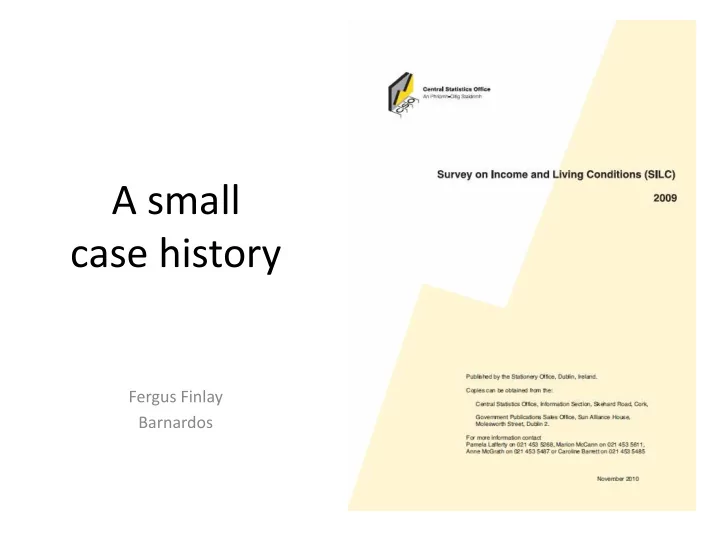
A small case history Fergus Finlay Barnardos The basic facts Children (aged 0-17) remained the most exposed age group with a consistent poverty rate of 8.7% in 2009, up from the 6.3% recorded in 2008. (Thats an increase of almost a half


slide-1
SLIDE 1

A small case history

Fergus Finlay Barnardos
slide-2
SLIDE 2

The basic facts

  • Children (aged 0-17) remained the most exposed age group

with a consistent poverty rate of 8.7% in 2009, up from the 6.3% recorded in 2008. (That’s an increase of almost a half in one year.) This compares with a consistent poverty rate

  • f 1.3% among persons aged 65-74 and just 0.9% among

persons aged 75 or over in 2009.

  • Almost 17% of people living in lone parent households

were in consistent poverty in 2009. (That’s children too.) From a household composition perspective lone parent households remained the household type with the highest consistent poverty rate. There was no significant change in their rate between 2008 and 2009.

slide-3
SLIDE 3

Eleven Deprivation Indicators

  • Without heating at some stage in the last year due to lack of money
  • Unable to afford a morning, afternoon or evening out in the last

fortnight

  • Unable to afford two pairs of strong shoes
  • Unable to afford a roast once a week
  • Unable to afford a meal with meat, chicken or fish every second day

(that means not enough protein in the diet)

  • Unable to afford new (not second-hand) clothes
  • Unable to afford a warm waterproof coat
  • Unable to afford to keep the home adequately warm
  • Unable to afford to replace any worn out furniture
  • Unable to afford to have family or friends for a drink or meal once a

month

  • Unable to afford to buy presents for family or friends at least once a

year

slide-4
SLIDE 4

Hard to make a story out of statistics

  • Children (aged 0-17) were the most likely

age group of those at risk of poverty to experience deprivation, with 46.7% experiencing two or more items of deprivation (that’s half of them), a rise of 11.9 percentage points on the rate reported in 2008 (34.8%).

  • Children's rates (46.7%) compared with a

rate of 11.7% for people aged 65 and over who were at risk of poverty in 2009.

  • The most notable change in the year for

people at risk of poverty was the increase in the number experiencing two or more items of deprivation, rising from 29.3% in 2008 to 38.8% in 2009.

  • 62.9% of individuals in lone parent

families reported having experienced at least one form of deprivation in 2009.

  • Individuals in lone parent households

reported the highest rates of deprivation experiencing two or more items of deprivation at 44.1%.

  • Children (aged 0-17) reported higher

levels of deprivation (36.8%) than any

  • ther age group. Over 23% of children

reported to have experienced two or more items of enforced deprivation in 2009 which is an increase from 18.1% in 2008.

  • Almost 31% of people with a third level

degree or above had an equivalised disposable income of more than €740.49 in 2009.

  • More than 63% of people with a primary

education or below had an equivalised disposable income of less than €335.49 per week.

slide-5
SLIDE 5

Government reaction

  • Taoiseach – nothing
  • Finance – nothing
  • Health and Children – nothing
  • Minister for Children – nothing
  • Social Protection –

“Ó Cuív shock at scaremonger tactics by Social Justice Ireland”

slide-6
SLIDE 6

The coverage

  • Irish Times

– Almost a quarter of households in arrears on bills – Household incomes down over 6%

  • The Star - More People live in poverty
  • The Sun - 10% had to borrow
  • The Irish Independent - Nothing
  • The Irish Examiner - O Cuiv accuses welfare groups of 'scare tactics'
slide-7
SLIDE 7

The consequences

  • Tomorrow’s Budget

– Child Benefit – Lone Parents – Mininum wage – Dependency rates

  • Next year’s EU-SILC figures?
  • If the economics of childhood aren’t covered, aren’t

children more likely to be the “victims of recovery”?